Bits & Pieces (Monday Evening Bowl of Flibbertygibbits)

Another on-set report from the Hobbit. Can’t wait for this film, yet I will be waiting–for another year. But maybe there will be teaser trailer soon?

Martin Freeman as the young Bilbo Baggins, standing with director Peter Jackson who, after having lost a tremendous amount of weight, is packing the pounds back on. Man, have I been there. 

I’m not sure if any of the theaters in my town will be able to do the 48-frames per second the film is being shot in. 48 frames makes a difference, though—especially with 3D.

•••

Democrats and Republicans can come together and get along and work together in tandem toward a common goal. If that goal is lining their own personal pockets .

Why did Nancy “Republicans don’t believe in public safety” Pelosi block credit card reform? Might have something to do with all that Visa stock she was sitting on. How did Pelosi get in on this sweet deal? We’re not sure, but Big Government is suspicious.

Why is this all coming up now? Peter Schweizer wrote a book. He should be our era’s Upton Sinclair, and his book should be like a non-fiction The Jungle, prompting real and significant long term reforms. However, given that Upton Sinclair was dealing with meat-packers who did not write the laws that governed them, and Peter Schweizer is writing about the folks who write laws with their own convenience often in mind, I’m not holding my breath.

That’s it for tonight, for me. Peace, homeys! — KW

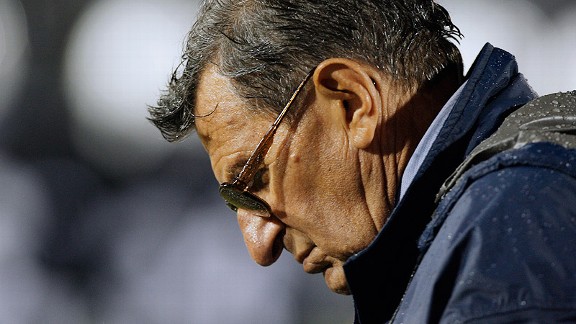
John Opines on Paterno

The following was written by John. Since he refuses to become an administrator, I must post it for him. But sometimes there are comments that ought to be above-the-fold posts.

…
AP Photo/Carolyn Kaster, via espn.go.com


In an odd reversal universe, I will now become a Penn State fan again.

As an alumni from the late 70’s, I used to sit 4 rows behind Joe Paterno at Mass in Eisenhower Auditorium on Sunday. Back then he was just a terrific football coach, and good man all around. Something happened in the last 10-12 years or so, that had made me root against my alma mater though. It had ceased to be Penn State University, and had become Paterno State University.

It seemed at the time to be happening just on the football field, though now we know that much more was occurring elsewhere. When Sandusky “retired” in 1999 he was presumed to have lost some sort of internal power struggle. Tom Bradley took over the defense and essentially saved Joe’s reputation as Bradley produced quality defenses year after year producing the team’s winning records. Meanwhile on the offensive side of the ball where Joe ruled, ossification, nepotism and gerontology ruled the day. The coaching got less and less competent as prep stars came and went without ever achieving their potential. Joe’s son was given responsibilities clearly beyond his capability but was as untouchable as the ancient Galen Hall and Dick Anderson rounding out the oldest coaching staff in the NCAA, perhaps the oldest ever. Personal animosity seemed to rule the day as when QB Rob Bolden requested a transfer but was denied a release by Paterno.

I need not go into the by now well known details of how this were happening off the field as well as on. A lesser known tale perhaps though is that Graham Spanier the President and Tim Curley the AD tried to retire Paterno in 2004 but were rebuffed. So out of proportion had things become at the university that a then 78 year old head coach could simply refuse to leave and be upheld.

Never a material or acquisitive person Paterno loved the spotlight and cultic status bestowed on him more than anything else in the world. He perhaps knew better than anyone else that he could never have that adulation in pro football and decided not to go when the offers came.

To say he was drunk with power, is not exactly accurate. It was the “love” he craved, not the power per se, not even the victories. For you see any coach as good as Joe must have known that his insularity was sacrificing victories. He didn’t gather his sycophantic band of offensive stooge coaches around him because he thought they were good. He did it because they were no threat to him on any level. No one could ever say that the Penn State program had a lot of bright young minds that were REALLY responsible for the victories. To that extent also, the players were anonymous and purposefully so. Tim Tebow could never have happened at Penn State. Penn State is one of the last major programs where the players don’t even have their names on their jerseys or are be made routinely available for interviews.

While the particular cause of the ending is both shocking and horrifying, the fact that it could ONLY have ended this way, was inevitable. Paterno and Penn State University were locked in a death grip struggle that could only have ended when something pried one out of the cold dead hand of the other.

More On Penn State

I have been largely baffled and appalled by the reaction to the unspeakable child molestation incidents that have been connected to Penn State, its coaches and administrators. I’m a big sports fan and my first child is due to appear on Saturday so I guess that helps explain my interest in the story. I have traded comments with many bloggers over at ESPN in the last week or so attempting to disabuse people of their inclination to defend Paterno. I have also read lots of columns addressing the issue, but the majority of them lack any semblence of perspective. This weekend I occasionally switched over to the Penn State v. Nebraska game only to hear announcers, coaches and players lament the empty seat on the Penn State bus usually occupied by Joe Paterno or to praise the focus of the players despite all the distractions (I get angry even typing that). I eventually just had to stop watching the game. I was also slightly disappointed in how Obama addressed the issue when asked about it during another sporting event, the Carrier Classic. While he made the point to focus on the children, he should have more forcefully condemned the attitudes that got Penn State to the point it is now. Finally I think I have found a column that strikes the appropriate tone.

The author may cast his net a bit too wide on occassion, but even when he does, he raises issues about corporations, religion in general and the Catholic Church in particular. I particularly enjoyed his ending:

Nevertheless, Kenny said:

“Thankfully … this is not Rome. Nor is it industrial school or Magdalene Ireland, where the swish of a soutane smothered conscience and humanity and the swing of a thurible ruled the Irish-Catholic world. This is the Republic of Ireland, 2011. A Republic of laws … of rights and responsibilities … of proper civic order … where the delinquency and arrogance of a particular kind of ‘morality’ will no longer be tolerated or ignored … as taoiseach, I am making it absolutely clear that, when it comes to the protection of the children of this state, the standards of conduct which the Church deems appropriate to itself cannot, and will not, be applied to the workings of democracy and civil society in this Republic.”

He did not drop to his knees. He did not ask for a moment of silence. He did not seek “closure” but, rather, he demanded the hard and bitter truth of it, and he demanded it from men steeped in deceit from their purple carpet slippers to their red beanies. Enda Kenny did not look to bind up wounds before they could be cleansed. And that is the only way to talk about what happens after the raping of children.

11/22/63

In my review of Stephen King’s Under the Dome,  I wrote:

It might be interesting if King–a very good writer when he challenges himself—tried to write a Michael Crichton style novel, like State of Fear, which—to be fair—showed about the same nuance and subtlety in it’s characterizations of environmentalists that King does in Under the Dome regarding conservative Christians.

In 11/22/63, he hasn’t precisely done that, but he’s come a lot closer than he has in a while. King’s Crazy Christians™are nowhere to be seen, and the typical Evil Right Winger© that also makes frequent appearances in King’s work, is barely heard from. A segregationist billboard in 1962 Texas is attributed to The Tea Party Society (when, in fact, it would have more likely been the John Birch Society; I can’t find any indication that anybody referred to themselves as Tea Party anything in the early 60s) in a throw away, but that’s it. The central bad guy is Lee Harvey Oswald and a few of those who egged him on, and they’re rabid left-wingers and Marxists.

It may seem that I’m praising King with faint damns, but this was a really good book. I still think his best book is probably The Stand, but when he challenges himself he tends to produce some of his best work, and I think 11/22/63 falls squarely in that category (Eyes of the Dragon, King’s only real foray into a traditional fantasy, is another example for King challenging himself and creating a great little book).

The book deals with what might happen if someone found a tunnel in time in the back pantry of a greasy spoon, one that always leads out to exact same moment in 1958. History can be changed, but every time you go back, time is reset, and any changes you made the last time are wiped out. This leads to Jake Epping, a recently divorced high school teacher, attempting to interfere with history for personal reasons, and then attempting to prevent the assassination of JFK in order the save the world. While doing so, he gets a job, falls in love, and ends up making a mess of things in very interesting ways.

I found the ending very, very satisfying, especially after the anemic conclusion to Under the Dome. I was not surprised to read that King’s son, novelist Joe Hill, actually came up with the ending, one that largely replaced whatever King’s original ending was.

If you’ve read a lot of Stephen King, you’ve met all these characters before. Some of them literally–there are, as is typical in most of King’s books, cameos from previous novels, notably It, and a Plymouth Fury (probably not Christine, but maybe) makes more than one appearance. However, Jake Epping is reliably King’s ass-kicing alter-ego, Sadie Clayton has appeared numerous times as the True Love™who both too aware of what makes the hero special, and too easily convinced that the protagonist is magic, has experienced the impossible, has telepathic powers, or is from the future. Most of the other characters are now very familiar, although with different names, but I imagine any writer who produces as much as King does would fall back repetition. In an interesting turn, he acknowledges this in a way, by intentionally echoing character names, vocal tics, and events. The narrator refers to this repetition as harmonization, suggesting that his existence out of time causes frequent echos around him, and in the lives of those he touches.

Stephen King did more historical research on this novel than on any previous novel, and it shows. The one truly new character, for King, is the setting. From his own creations, such as Derry, to Lisbon, Maine to Dallas, Texas, he works hard to craft a sense of time and space. He’s clearly got a strong sense of what his imaginary town of Derry was like in the late 50s (more clear, I think, when he covered the same basic stretch of time, in the same imaginary down, in It). His depiction of the real Dallas and Fort Worth to his fictional Jodie, Texas enjoy a tremendous depth and clarity. It helps makes what could have been another typical King novel into an exception King novel—one that I plan to read again in a year or so, or at least listen to on audiobook. Two thumbs up from me. I highly recommend.

Finally, King mentions that, like Under the Dome, he originally had the idea for this book years ago (in this case, 1971; in the case of Under the Dome, it was the late 70s and early 80s). I find this an interesting approach. Stephen King retired from writing in 2002 (part of this may have been ongoing pain from his accident, which he may have found better ways to manage, since then), but has been almost as prolific since his retirement as he was before. Lately, he’s been mining the ideas of his youth to see what he can come up with, and he’s come up with some interesting things. As much as I disliked Under the Dome (and, to be fair, many loved it, I just thought it was a mess), the idea of going back to old ideas and tackling them anew seems to work, by and large, for Mr. King. It certainly works here.

For an opposing viewpoint, check out Rachel Cooke’s negative review in The Guardian. I think she misses the point, but then, of course I would think that.

This is a Problem (IMO)

I’ve been corresponding with someone from the Plumline for the past couple of weeks, since I finally left, and I haven’t read the comments over there since. But the quote below which I was provided (via email) causes me great concern. It’s no wonder we have so much trouble finding common or even compromised ground in our political debate. Since when did fellow Americans become our sworn enemies along with those of us who are trying to bring the sides, if not together, to at least discuss the issues in an intelligent and persuasive manner. There is a huge divide between what I believe and some of my friends on the right believe, especially when taken to the logical conclusion, but the path below leads to very nasty consequences. I hope we’ll continue to do a little better than this at ATiM. I don’t think we’re being naive to hope for a better result from our dialogue.


“We’ll have to agree to disagree on some things but I hope we can stay friends and I’d like to close with a post that shrink put up on the PL this morning.

This pretty much encapsulates my feelings.”

Well I can see we don’t like each other, the left and the right. But that’s not news. I’ve considered the right the enemy all my life, it makes no difference to me if they are Americans or Iranians. So I find people who appoint themselves the role of bringing us together, changing the tone of politics etc., arrogant and naive to the point of being dangerous themselves. I don’t believe in the narrative, dominant or otherwise.

I think there is truth and falsehood, right and wrong, better people and worse people, just as I believe there are advanced and primitive social structures and even cultures. And so the better people must battle the worse and work to minimize the damage done by the necessary evils we can never wholly eradicate, the evil that people do, everything from income disparity, to ignorance.

Morning Report

Vital Statistics:

Last Change Percent
S&P Futures 1256.9 -4.7 -0.37%
Eurostoxx Index 2304.6 -20.250 -0.87%
Oil (WTI) 98.39 -0.600 -0.61%
US Dollar Index (DXY) 77.383 0.438 0.57%
10 Year Govt Bond Yield 2.08% 0.02%

Markets are a touch weaker this morning as Italian and Spanish government bond yields back up. The markets are beginning to worry that Spain, with its burst real estate bubble, will be the next to face scrutiny. Luckily for the Spanish banks, they have exposure to the strong Brazilian economy, so they are probably in better shape than the Italian banks. Unicredito is considering a 7.5 billion euro share issue to raise capital. This will become a trend, given the pre-crisis capital levels of the Euro banks.

The Mortgage Electronic Registry System (MERS)

This investigative report points to a secondary crisis.

Here’s how MERS works: A lender that holds a mortgage can sell that loan to another lender. MERS does not make loans or service them, but only tracks the loan information.  No problem.


Here’s how the registration of real property ownership and liens work:   our entire real estate ownership system is based on public notice and the proper recording of documents.  No problem.


Title companies and lenders, investors, builders, sellers and buyers, and taxing entities depend on this county clerk based public filing system of land and mortgage transfers.  No problem.


Here’s how the two systems do not work together: MERS claims it is the agent for holding the loan regardless of which of its clients have bought and sold it, and in Travis County alone we now have hundreds of thousands of unrecorded mortgage transfers.  BIG PROBLEM.


MERS is said to have facilitated the financial system’s commoditization, packaging, securitization, and sale of tens of millions of mortgages.  That does not seem too likely to me.  But I do see the subversion of the filing process as taking years to correct, and many millions of dollars, and I see it as a brake on the return of a healthy real estate market until it is corrected.


Occupy DC Field Report

I was in DC today doing tourist-in-your-town stuff and had some time to kill before my dinner reservation, so I wandered over to McPherson Square to see for myself the scope and magnitude of the Occupy DC protests.

I arrived at dusk but it was clear that the entire park had been taken over by the protesters with tents randomly placed everywhere except for one big wedge of green space on the southwest section of the park. When I arrived there was music playing with some people dancing on the grass. Later there had been some sort of evening meeting and people were dispersing with cooking equipment while others lingered to talk and kids played.

The center of the park has a statue of James B. McPherson, a Civil War general who had been killed in the Battle of Atlanta.

Ringing the statue were a wide variety of signs espousing various ODC positions in a range of detail from simple slogans to long treatises.

Beyond the vast number of tents, there were all the trappings of a semi-permanent encampment. There was a headquarters tent with a daily schedule as well as a medical tent.

Additionally, there was a large area set aside to boxes filled with clothes. I couldn’t quite figure out if it was a donation collection point or a distribution center or both. There was also an organized recycling center.

Around the encampment there were a variety of semi-official activities going on. Under one tent, after a human megaphone announcement, there was a lightly attended class at the ODC ‘university’ while on the other side of the park were the archetypal drummers.

But for the most part, people were just milling around enjoying the pleasant evening. Some people seemed to be reluctant to have their picture taken while others just took it in stride. And I was not the only person using the spectacle as a photo-op.

I really hadn’t know what to expect. There was far more infrastructure than I had imagined despite the tent city being a rather disheveled mish-mash of camping gear and tarps and canopies. What impressed me most was the casual sense of community. People were there with purpose. And they didn’t look like they were leaving anytime soon. You can see higher resolution versions of these photos as well as others in my Flickr set.

Bites & Pieces (Saturday Night Food Edition) — An Absurdly Simple Soup

I’m more of a “country cook” than a gourmet cook. I toyed with posting my mom’s fabulous chicken-and-noodles recipe, which is at least 70 years old. Talk about comfort food! But it is laden with sodium and takes a long time to make unless you substitute store-bought ingredients for homemade ones (in which case you might as well just buy already prepared chicken-and-noodles IMO).

The soup recipe below is nothing fancy, but it tastes great, it’s healthy, it’s quick and easy, and I always have the ingredients on hand. It’s one of my favorites on a work night when I’m too tired or busy to cook because it’s ready in less than 30 minutes, not much more time-consuming and certainly healthier than heating a canned soup. It also lends itself well to adaptations with whatever flavors sound good at that moment or with whatever you have on hand (e.g., I sometimes substitute squash for the carrot and often add to the vegetables). Oh yeah, and it sure fits Michi’s penchant (which I wholeheartedly share) for not much in the way of required measuring. Add a salad or a baked potato and you have a nice supper.


Chicken & Spinach Soup with Fresh Pesto
(from eatingwell.com)

Ingredients
2 teaspoons plus 1 tablespoon extra-virgin olive oil, divided
1/2 cup carrot or diced red bell pepper
1 large boneless, skinless chicken breast (about 8 ounces), cut into quarters
1 large clove garlic (or to taste), minced
5 cups reduced-sodium chicken broth
1 1/2 teaspoons dried marjoram or oregano
6 ounces baby spinach, coarsely chopped
1 15-ounce can cannellini beans or great northern beans, rinsed
1/4 cup grated Parmesan cheese
1/3 cup lightly packed fresh basil leaves
Freshly ground pepper to taste
3/4 cup croutons for garnish (optional)

Preparation
Heat 2 teaspoons oil in a large saucepan or Dutch oven over medium-high heat. Add carrot (or bell pepper) and chicken; cook, turning the chicken and stirring frequently, until the chicken begins to brown, 3 to 4 minutes. Add garlic and cook, stirring, until fragrant. Stir in broth and marjoram or oregano; bring to a boil over high heat. Reduce the heat and simmer, stirring occasionally, until the chicken is cooked through, about 5 minutes.
With a slotted spoon, transfer the chicken pieces to a clean cutting board to cool. Add spinach and beans to the pot, bring to a gentle boil, and simmer for 5 minutes to blend the flavors.
Combine the remaining 1 tablespoon oil, Parmesan and basil in a food processor (a mini processor works well). Process until a coarse paste forms, adding a little water and scraping down the sides as necessary. [Substitute store-bought pesto if you must, or any other pesto recipe you prefer.]
Cut the chicken into bite-size pieces. Stir the chicken and pesto into the pot. Season with pepper. Heat until hot. Garnish with croutons, if desired.

5 servings, about 1 1/2 cups each

Nutrition
Per serving: 204 Calories; 8 g Fat; 2 g Sat; 4 g Mono; 29 mg Cholesterol; 16 g Carbohydrates; 18 g Protein; 6 g Fiber; 691 mg Sodium; 529 mg Potassium [NOTE: Cut the sodium drastically by using homemade salt-free broth and/or homemade salt-free cooked beans]
1/2 Carbohydrate Serving
Exchanges: 1 starch, 1 vegetable, 2 lean meat, 1 fat

The Adele II

On this Veteran’s Day, I want to share a sea story.

I was on the USS Gridley (CG-21) in the Persian Gulf at the end of Desert Storm (early 92). The combat part was over, but we still kept a Tomahawk shooter in the Northern Persian Gulf. The job of the USS Gridley was to defend the Tomahawk shooter (typically a Spruance class destroyer) from air attack. Leahy-Class cruisers and Aegis cruisers have the AAW (anti-air warfare) mission and have something like 100 long-range anti-aircraft missiles onboard.

Anyway, defending a Spruance destroyer is a pretty boring job. We would basically be assigned a 8 nautical mile box and lazily steam back and forth in it, all while dodging fishing boats, oil rigs, and tankers. One morning, the Middle East commander ordered us to investigate a distress signal in the Arabian Sea. We left the Northern Persian Gulf and headed through the Straits of Hormuz.

We eventually found the ship that made the call. It was a Somali cargo ship with a ton of people on it. We couldn’t communicate with the ship, so we sent a couple of engineers in a small boat to take a look at it and see if they could fix it. The seas were really rough, and doing loops around the ship while we waited for the verdict from the engineers was a pain. I was the OOD (Officer of the Deck), and the Captain was on the bridge with me. The engineers reported back that the diesel engine had somehow lost its oil and it was ruined. Unfixable. We reported back to the ME Commander who ordered us to tow the thing back to Somalia.

So, we start getting things ready. We pull the towline on deck, bring out the Underway Replenishment Team, and pass close by. To pass a rope between ships, you fire a shot line (basically an orange bobbin with strong thread) from a rifle, then attach a 1 inch rope to that (called the messenger line) and then attach the towline (which is 5 inches in diameter and heavy as hell). We pass by the ship, and our guy on deck pulls out the rifle and shoots the line over. Everyone on the deck of the Somali ship watches the line fly over their head. Then they look back at us with a “What the hell are you weird Americans doing?” look on their faces. We yell back “PULL! PULL!” They don’t speak English and they don’t get that they are supposed to pull on the orange line. By this time, we have moved enough that the orange line has slipped off the Somali ship and we have to make another pass. Remember, these are ships, not Ferraris and getting close for a loop around in rough seas takes a while.

So this time, we pass by slowly, shoot the line over, and pantomime pulling. Somehow the light bulb goes off on the other ship and they start pulling on the shot line. They pull the shot line up, grab the 1 inch messenger line and tie it to the bow and signal they are ready to go. They don’t realize there is another rope tied to the 1 inch rope. Towing a 8,000 ton ship with a 1 inch line isn’t going to cut it. We pantomime pulling again. They don’t get it. We finally get them on the radio. We pass the word on the ship for anyone with foreign language skills to report to the bridge. That covers Spanish and Tagalog. No dice. We call up to the SIGINT spooks. Get an Arabic speaker, but the Somalis don’t understand. They just don’t get it.

We finally give up and decide to try and tow the ship with the messenger line. We go slowly (like 1.5 knots) and take them back to Mogadishu. It took us forever to get back. When we finally got them to port, we asked the Port Manager where he wanted these guys. He didn’t want them and told us to take the ship somewhere else. We didn’t want a diplomatic incident, so we called up the Commander of the Middle Ease and told him the story. We were told to just leave them anyway. We told Mogadishu”the Adele II is your headache now.” The Adele II dropped anchor, and we headed back to the Persian Gulf.

In our wrap-up report to the Commander Middle East, we included a “lesson learned” – translate “Heave Around” in every known language.