This Day in History – August 29th

2005 – Hurricane Katrina makes landfall near New Orleans, LA, as a Category 4 hurricane on this day in 2005. Despite being only the third most powerful storm of the 2005 hurricane season, Katrina was the worst natural disaster in the history of the United States.  After briefly coming ashore in southern Florida on August 25 as a Category 1 hurricane, Katrina gained strength before slamming into the Gulf Coast on August 29. In addition to bringing devastation to the New Orleans area, the hurricane caused damage along the coasts of Mississippi and Alabama,  as well as other parts of Louisiana.

New Orleans Mayor Ray Nagin ordered a mandatory evacuation of the city on August 28, when Katrina briefly achieved Category 5 status and the National Weather Service predicted “devastating” damage to the area. But an estimated 150,000 people, who either did not want to or did not have the resources to leave, ignored the order and stayed behind. The storm brought sustained winds of 145 miles per hour, which cut power lines and destroyed homes, even turning cars into projectile missiles. Katrina caused record storm surges all along the Mississippi Gulf Coast. The surges overwhelmed the levees that protected New Orleans, located at six feet below sea level, from Lake Pontchartrain and the Mississippi River. Soon, 80 percent of the city was flooded up to the rooftops of many homes and small buildings.

1982 – Swedish-born actress and three-time Academy Award winner Ingrid Bergman dies of cancer in London on her 67th birthday. Bergman, who was best known for her role as Ilsa Lund in Casablanca, created an international scandal in 1950 when she had a son with the Italian director Roberto Rossellini, to whom she was not married at the time.

Bergman, who was born on August 29, 1915, studied acting at Stockholm’s Royal Dramatic Theatre and became a film star in Sweden before making her first Hollywood movie, David O. Selznick’s Intermezzo: A Love Story (1939). In 1942, Bergman co-starred in Casablanca with Humphrey Bogart, who uttered the famous line to her: “Here’s looking at you, kid.” She received a Best Actress Academy Award nomination for 1943’s For Whom the Bell Tolls, which was followed by a win in the same category for 1944’s Gaslight. She was nominated for the Best Actress Oscar again for 1945’s The Bells of St. Mary’s and 1948’s Joan of Arc. Bergman worked with director Alfred Hitchcock on Spellbound (1945), Notorious (1946) and Under Capricorn (1949).

In 1949, Bergman began a romance with Roberto Rossellini when he directed her in Stromboli (1950). When the actress, who at the time was married to a Swedish physician with whom she had a daughter, became pregnant with Rossellini’s child, it created a huge scandal. Bergman was even reprimanded on the floor of the U.S. Senate.

1957 – Strom Thurmond (Sen-D-SC) ends 24 hr filibuster against civil rights.  Fortified with a good rest, a steam bath and a sirloin steak, Sen. Strom Thurmond  talked against a 1957 civil rights bill for 24 hours and 18 minutes — longer than anyone has ever talked about anything in Congress.

The South Carolina senator, then a Democrat, opened his one-man filibuster on Aug. 28, 1957, at 8:54 p.m. against the bill, which he said was unconstitutional and “cruel and unusual punishment.”

Republican leader Sen. William Knowland of California retorted that Thurmond’s endless speech was cruel and unusual punishment to his colleagues.

1786 – The beginning date of Shay’s Rebellion.  A revolt by desperate Massachusetts farmers in 1786, Shays’s Rebellion arose from the economic hardship that followed the War of Independence Named for its reluctant leader, Daniel Shays, the rebellion sought to win help from the state legislature for bankrupt and dispossessed farmers. More than a thousand rebels blocked courts, skirmished with state militia, and were ultimately defeated, and many of them were captured. But the rebellion bore fruit. Acknowledging widespread suffering, the state granted relief to debtors. More significantly, the rebellion had a strong influence on the future course of federal government. Because the federal government had been powerless under the Articles of Confederation to intervene, the Framers created a more powerful national government in the U.S. Constitution.
Three years after peace with Great Britain, the states were buffeted by inflation, devalued currency, and mounting debt. Among the hardest hit was Massachusetts. Stagnant trade and rampant unemployment had devastated farmers who, unable to sell their produce, had their property seized by courts in order to pay off debts and overdue taxes. Hundreds of farmers were dispossessed; dozens of them were jailed. The conditions for revolt were ripe, stoked by rumors that the state’s wealthy merchants were plotting to seize farm lands for themselves and turn the farmers into peasants.

For more on Shay’s Rebellion

This day in history – August 28

Posting this a bit early, as I think there will be no MP this morning.

1996 – After two children and 15 years of marriage, the Prince and Princess of Wales, Charles and Diana, formally agree to a divorce. The couple had already been separated for four years, and had been negotiating for over 6 months on a final settlement. Almost a year to the day later, on August 31, 1997, Diana will be killed in a car crash in Paris. Charles will eventually go on to marry his long-time mistress, Camilla Parker Bowles, in 2005. The news of the divorce produced much sadness among many followers of the British Royal family, but for those of us who have always considered the royal family to be an expensive and foolish anachronism, we couldn’t have cared less.

1963 – On the steps of the Lincoln Memorial, the Reverend Martin Luther King Jr. delivers a speech to 250,000 people who had come for the March on Washington, demanding voting rights and an end to racial segregation. The speech, popularly known as the I Have A Dream speech, will be delivered 8 years to the day of the racially charged murder of Emmett Till (see below) and will come to be seen as one of the most famous and stirring speeches in American history.

1955 – Emmett Till a black teenager from Chicago visiting family in Money, Mississippi, is brutally beaten, shot in the head, and dumped into the Tallahatchie River. His mangled body will be found 3 days later. Till was killed by Roy Bryant, the husband of a white woman with whom Till was reported to have flirted a few days earlier, and JW Milam. Till’s uncle, Mose Wright, positively identifies the two men who took Till from Wright’s house on the night of the murder, but a jury will acquit the two men nonetheless, on the grounds that the mangled body could not be positively identified as Till. A year after the acquittal, protected by double jeopardy laws, the two will admit to and describe the murder to Look magazine. Till’s murder and the subsequent outrage over the verdict is regarded as a pivotal event in the history of the then infant Civil Rights movement.

1948 – Alfred Hitchcock’s Rope opens in theaters. Inspired by the true murder committed by Loeb and Leopold, Rope depicts the story of 2 young men who, just for kicks, murder their “friend” and then hold a dinner party with the trunk holding the body as the center piece of the party. Starring Jimmy Stewart, the film is best known for the absence of many conventional cuts, as large portions of the film are shot as a single, continuous scene. Although a canister of film could only hold 10 minutes of film, several scenes last for well over 10 minutes, which was accomplished by timing movements so that as the canister ran out, an actor would walk past the front of the camera, briefly blacking it out, allowing the change of the canister to occur without an obvious cut in the action. Hitchcock apparently didn’t like the film, and called it a failed experiment, but it is one of my favorite Hitchcock films. Interestingly, the initial scene shown in the trailer below isn’t actually in the film at all.

Today in History – August 27th

2007 – Michael Vick, a star quarterback for the Atlanta Falcons, formally pleads guilty before a Richmond, VA, judge to a federal felony charge related to running a dog fighting ring. That December, the 27-year-old Vick, once the highest-paid player in the NFL, was sentenced to 23 months in federal prison.

1984 – In an effort to spark new interest in the space shuttle program, NASA began discussions on including private citizens in the space program. On August 27, 1984, President Reagan announced the official formation of the Teacher in Space Project. More than 11,000 teachers applied to be considered for the program.

Image of Teachers Christa McAuliffe and Barbara Morgan

By June 0f 1985, NASA had chosen 114 semifinalists to be the first teacher in space. This selection included two teachers from each state. Later, a review panel chosen by NASA and the Council of Chief State School Officers selected 10 finalists. On July 18, 1985, NASA chose Christa McAuliffe as the flight candidate for the program and Barbara R. Morgan as her alternate.

After the challenger accident, NASA decided to cancel the Teacher in Space Project. They also cancelled similar programs, such as an upcoming Journalist in Space program.

1952 – the New York Times front page contained three stories suggesting the impact of the Red Scare on the upcoming election. In the first story, the Republican-dominated Senate Internal Security Subcommittee released a report charging that the Radio Writers Guild was dominated by a small number of communists.

The second front-page story was a report that the American Legion was demanding, for the third year in a row, that President Harry S. Truman dismiss Secretary of State Dean Acheson for his lack of vigor in dealing with the communist threat. The Legion report declared that the Department of State was in desperate need of “God-fearing Americans” who had the “intestinal fortitude not to be political puppets.” The organization demanded a quick and victorious settlement of the Korean War, even if this meant expanding the war into China.

The third story provided a counter of sorts to the previous two stories. It reported a speech by Democratic nominee for president Governor Adlai E. Stevenson, in which he strongly criticized those who used “patriotism” as a weapon against their political opponents. In an obvious slap at the Senate Subcommittee and others, such as Senator Joseph McCarthy, Stevenson repeated the words of the writer Dr. Samuel Johnson: “Patriotism is the last refuge of scoundrels.”

The three related stories from the front page of the Times indicated just how deeply the Red Scare had penetrated American society. Accusations about communists in the film, radio, and television industries, in the Department of State and the U.S. Army, in all walks of American life, had filled the newspapers and airwaves for years. By 1952, many Americans were convinced that communists were at work in the United States and must be rooted out and hunted down.

1883 – The volcanic island of Krakatoa near Indonesia erupts on this day in 1883, killing thousands in one of the worst geologic disasters of modern times.

The beginning of the amazing events at Krakatoa in 1883 date to May 20 when there were initial rumblings and venting from the volcano, which had been dormant for about 200 years. Over the next three months, there were regular small blasts from Krakatoa out of three vents. On August 11, ash started spewing from the small mountain. Eruptions got progressively stronger until August 26, when the catastrophe began.

At noon, the volcano sent an ash cloud 20 miles into the air and tremors triggered several tsunamis. This turned out to be just a small indication, however, of what would follow the next day. For four-and-a-half hours beginning at 5:30 a.m. on August 27, there were four major and incredibly powerful eruptions. The last of these made the loudest sound ever recorded on the planet. It could be heard as far away as central Australia and the island of Rodrigues, 3,000 miles from Krakatoa. The air waves created by the eruption were detected at points all over the earth.

Today in history – August 26

1968 – The Democratic National Convention in Chicago begins as thousands of protestors descend on the city to protest the on-going war in Vietnam. The 4-day convention is marked by violence, both inside and outside the convention hall, but is most noted for what a subsequent report will call a “police riot” when protestors and police clash in the streets of Chicago in front of a national television audience. Eight of the protest leaders are arrested and eventually tried in what will come to be known as the trial of the Chicago Seven. (One of the eight, Bobby Seale, is removed from the courtroom and eventually tried separately, hence the Chicago 7).

1939 – The Brooklyn Dodgers host the Cincinnati Reds at Ebbets Field and play in the first ever televised MLB game. The impetus for the broadcast was the World Fair, taking place in New York City, as organizers sought a way to show off one of their prize exhibits, a new invention called television. The broadcast involved just 2 cameras, one on the third base line that showed views of infield throws to first, and one high behind the batter showing a full field view. Although the video itself was of poor quality, with pitched and batted balls virtually impossible to actually see, the exhibition was a huge success, propelling both popular interest in the new invention and innovation to improve quality.

1839 – The slave ship Amistad is captured off the coast of Long Island after the 53 Mende captives on their way to be sold into slavery escape the hold and take over the ship. After killing the captain and several crew members, they demand that the navigator return them to their home in Africa, but the navigator, while pretending to do so, instead sails north along the coast of the US and to the tip of Long Island. The US takes the ship into custody and holds a highly publicized trial to determine the status of the Mende captives. The case eventually reaches the Supreme Court which finally rules in 1841 that the Mende were illegally transported and held, and frees them. The episode was recently popularized in the Steven Spielberg movie Amistad.
http://www.youtube.com/watch?v=KP0hwVVUTac

Today in history – August 24

1975 – British rock band Queen begins to record lead singer Freddie Mercury’s song Bohemian Rhapsody at Rockfield Studios in Wales. The song takes over three weeks to fully record, with sessions going 10 hours a day. EMI, Queen’s record company, was reluctant to release the song as a single, but eventually relented after the band secreted a copy of the song to a Capitol Radio DJ who played the song 14 times over the course of a weekend, to much praise. The song stayed on the UK charts for 9 weeks, reaching number one in 1976, and then climbing back into the top spot in 1991 following the death of Mercury. In the US, the song peaks at number 9 in 1976, but reached all the way to number 2 in 1992 after it was featured in the comedy Wayne’s World.

1812 – British forces defeat the American militia at Bladensburg, Maryland and march unopposed into Washington D.C. The British proceed to set fire to the White House, the House of Representatives, the Library of Congress and the unfinished Capitol building, as well as many private homes. The British retreat from the city 2 days later, leaving it in charred ruins.

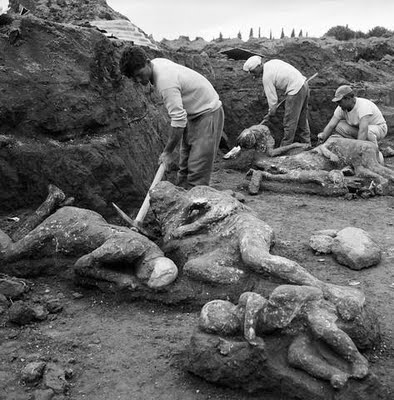
79 – Mount Vesuvius in southern Italy erupts for the first time in centuries, destroying the cities of Pompeii and Herculaneum. The eruption is reported to have lasted 18 hours, burying Pompeii under some 15 feet of volcanic ash and pumice, while Herculaneum is buried under 60 feet of mud and volcanic rock. During the 18th century a farmer found traces of Pompeii on his vineyard, prompting an excavation project that continues to this very day. The ash under which the city was buried preserved many artifacts, including the outlines of the bodies of the poor souls who were buried under it, in a kind of plaster mold, providing great insight into the daily life of the time prior to the eruption.
pompeii

Today in history – August 23

1999 – The first cases of an encephalitis outbreak are reported in New York City on this day in 1999. Seven people died from what turns out to be the first cases of West Nile Virus in the United States.

A cluster of eight cases of St. Louis encephalitis was diagnosed among patients in the borough of Queens in New York City in August 1999. The sudden cases of critical brain swelling were found exclusively among the elderly. At about the same time, people noticed an inordinate number of dead crows throughout the city. Other birds, including exotic varieties housed at the Bronx Zoo, were also found dead.

The Center for Disease Control (CDC) was called in to investigate. They found that the West Nile virus, previously found only in Uganda and the Middle East, had been contracted by birds throughout the area, including robins, ducks and eagles. In addition to birds and humans, horses have also been known to be susceptible to the virus, which is spread by mosquitoes.

1989 – As punishment for betting on baseball, Cincinnati Reds manager Pete Rose accepts a settlement that includes a lifetime ban from the game. A heated debate continues to rage as to whether Rose, a former player who remains the game’s all-time hits leader, should be given a second chance.

It was known in baseball circles since the 1970s that Pete Rose had a gambling problem. Although at first he bet only on horse races and football games, allegations surfaced in early 1989 that Rose was not only betting on baseball, but on his own team. Major League Baseball Commissioner A. Bartlett Giamatti began an inquiry, and hired Washington lawyer John Dowd to head the investigation. Dowd compiled hundreds of hours of testimony from numerous sources that detailed Rose’s history of gambling on baseball while serving as the manager of the Cincinnati Reds, including betting on his own team.

Although Rose continued to proclaim his innocence, he was eventually persuaded to accept a settlement that included a lifetime ban from the game. At a subsequent press conference, Giamatti characterized Rose’s acceptance of the ban as a no-contest plea to the charges against him.

Rose eventually confessed in his book, My Prison Without Bars, but claimed he always bet on the Reds to win.

1979 – In the midst of an international tour and following a performance in NYC, Russian ballet star Aleksandr Godunov defects from the Soviet Unions and seeks asylum in the United States.

He studied locally and at the Bolshoi Ballet School in Moscow, graduating into the company in 1966. He quickly became a soloist and created the role of Karenin in Plisetskaya’s Anna Karenina (1972) and the leading role in Boccadora’s Love for Love (1976). He won the Gold Medal at the Moscow competition in 1973. In 1979, while the Bolshoi was on tour in America, he defected in New York, an act which led to a political confrontation between the US and the Soviet Union. He joined American Ballet Theatre, where he stayed until 1982.

In prepared statements to the press he claimed he defected for artistic reasons.

On May 18, 1995 his friends became concerned when he had been uncharacteristically quiet with his phone calls. A nurse who had not heard from him since May 8 went to his home in the Shoreham Towers, W. Hollywood, CA, where Godunov was found dead of alcohol abuse with complications from hepatitis He was 45 years old.

1963 – The Beatles release “She Loves You” in the UK.

http://youtu.be/vd1R8tIL6tM?t=1s

1877 – Texas Ranger John Armstrong arrests John Wesley Hardin in a Florida rail car, returning the outlaw to Texas to stand trial for murder.  Armstrong, acting on a tip, spotted Hardin in the smoking car of a train stopped at the Pensacola station. Armstrong stationed local deputies at both ends of the car, and the men burst in with guns drawn. Caught by surprise, Hardin nonetheless reacted quickly and reached for the gun holstered under his jacket. The pistol caught in Hardin’s fancy suspenders, giving the lawmen the crucial few seconds they needed and probably saving Hardin’s life–instead of shooting him, Armstrong clubbed Hardin with his long-barreled .45 pistol.

Technically, the Texas Rangers had no authority in Florida, so they spirited Hardin back to Texas on the next train. Tried in Austin, a jury found Hardin guilty of killing Sheriff Webb and sentenced him to life in the Texas state prison at Huntsville. He served 15 years before the governor pardoned him. Released in 1894, an El Paso policeman killed him the following year.

1784 – Four counties in what will eventually become Tennessee declare their independence from the newly formed United States and form the state of Franklin. The four counties had previously been a part of land ceded by North Carolina to the United States Congress, but when their petition for statehood fails to garner the approval of a two-thirds majority of other states, they declare their independence from the US entirely, and go on to survive as an independent nation for 4 years. Suffering from a weak economy and in fear of Indian attacks, Franklin eventually re-joins North Carolina territory.

***************************************************************************************************************

Don’t blame it all on Scott, LMS contributed to this post.

This day in history – August 22

1989 – 42-year old Nolan Ryan, playing for the Texas Rangers, strikes out Rickey Henderson on a 96-MPH fastball, becoming the first pitcher in Major League Baseball history to strike out 5,000 batters. Ryan, probably the greatest pitcher ever to live, finishes his Hall of Fame career with 5,714 strikeout, 7 no-hitters, and 12 one hitters. Unparalleled.

1971 – Monty Python’s Flying Circus hits the big screen in the US, as And Now For Something Completely Different, the film version of their British sketch comedy show, debuts in the US. The film sees limited success in its initial release, but it performs well upon its re-release in 1974, after PBS begins broadcasting the original TV series. (Best MP film: Life of Brian….discuss.) Below, a sketch that would seem appropriate for ATiM.
http://www.youtube.com/watch?v=kQFKtI6gn9Y

1864 – The Geneva Convention of 1864, which calls for nonpartisan care of the sick and wounded in war, is adopted by 12 nations meeting in Geneva, Switzerland. In honor of Jean-Henri Dunant, Swiss humanitarian and strong advocate of the proposal, a red cross on a white background, the inverse of the Swiss flag, is chosen as the emblem to mark medical supplies and personnel during war. The International Red Cross was founded.

1851 – The yacht America of the New York Yacht Club wins the Hundred Guinea Cup by defeating 14 British ships in a regatta around the Isle of Wight. The race was a blowout, with America beating second place by a full 22 minutes. In 1857 the owners of the yacht deed the Cup, which will come to be known as the America’s Cup, to the New York Yacht Club on the condition that the Cup be put up as a prize in a regular international racing competition. The first America’s Cup race,takes place in 1870 and continues to this day, making it the world’s oldest and longest running sporting competition. (Question: what makes a sport a sport, and does boat racing actually qualify?)

This day in history – August 21

1987Dirty Dancing featuring Jennifer Grey and Patrick Swayze, opens in theaters. A coming of age story set in a 1963 summer resort in the Catskill Mountains of New York and involving young love, abortion, and Ayn Rand, this movie is so bad it is a must-watch classic. With dialogue like “Nobody puts baby in the corner!”, who can resist?
http://www.youtube.com/watch?v=28A9Jgo92GQ

1959 – Hawaii officially becomes the 50th, and to date the last, state to join the union. Established as a US protectorate in 1894, Hawaii is officially annexed in 1898 and becomes a formal US territory in 1900. (I have no idea what the distinction is between being annexed and being a formal US territory.) The Japanese attack on the Hawaiian naval base at Pearl Harbor in 1941 firmly establishes Hawaii in the national psyche, and 18 years later it becomes a full fledged member state. Best of the Hawaiian Islands? Maui, without a doubt.

1940 – In a stirring speech to the House of Commons in the midst of the Battle of Britain, the greatest political leader in the history of war, Winston Churchill praises the men of the Royal Air Force for their efforts against the Luftwaffe by exclaiming the now famous line “Never in the field of human conflict was so much owed by so many to so few.” Eventually members of the RAF will come to be known simply as “The Few”. I’m pretty sure that on the top 10 list of history’s great wartime leaders, Winston Churchill holds the top 5 positions.
http://www.youtube.com/watch?v=0y60xvkJ8ko

1858 – The first of seven debates between Senate candidates Abraham Lincoln and Stephen Douglas takes place in Ottowa, Illinois. The debates center on the issue of slavery, and are perhaps the most well-known political debates in the history of the US. The debates are a preview of the very issue that would be the focus of the presidential election 2 years later, in which both Lincoln and Douglas would again be opposing candidates, along with a third, John C. Breckinridge. Although Douglas would win the Senate election (actually, his fellow Democrats would win the Illinois house of representatives, which then appointed him Senator), Lincoln would get his revenge by winning the 1860 presidential election, leading directly to Southern secession and the Civil War.
lincoln douglas

This day in history – August 20

1998 – The Canadian Supremes rule that Quebec cannot unilaterally secede from the Federation. And Canada isn’t even a Union!

1968 – As Czechoslovakian protests against the Soviet Union mount during the course of what will come to be known as Prague Spring, 200,000 Soviet troops cross the border into Czechoslovakia and head to the capitolto crush the protests and reassert Soviet control. Within two days the entire nation is occupied, and further protests are violently put down. The Soviet intervention puts a new chill into US-Soviet relations as President Johnson cancels his planned trip to the USSR.

1940 – Leon Trotsky is attacked in his Mexico City home-in-exile by ice axe weilding Ramon Mercader, a Spanish communist. He will die the next day from his wounds. A founding member of the Russian Revolution, Trotsky had lost the power struggle to succeed Lenin as the head of the Soviet Union upon Lenin’s death. He became the object of Stalin’s persecution, including being expelled from the Soviet Union, which culminated several assassination attempts, the last of which finally proved successful.

1858 – Charles Darwin published the theory of evolution through natural selection in The Journal of the Proceedings of the Linnean Society of London. This became one of the two cornerstones of modern biology and denying it remains a popular pastime.

1000 – This is National Day in Hungary. Supposedly King Stephen founded the state in 1000. I (MIA) have visited St. Stephen’s Cathedral in Vienna but I did not know this was the same Stephen. Stephen was declared a saint in 1087 on this day, as well.

This day in history – August 19

It’s going to be a brief one today….sorry.

1953 – The Iranian military, with the assistance of the CIA, overthrows Premier Mosaddeq and reinstates the Shah of Iran. The Shah, an ally of the US throughout the Cold War, will remain in power until the 1979 Iranian revolution. The 1953 coup and the US relationship with the Shah will be a primary motivating factor in the 1979 hostage crisis, when Iranian “students” storm the US embassy in Tehran and hold 52 Americans hostage for 444 days.

1951 – Eddie Gaedel, at 3 foot 7 inches the smallest person ever to “play” in a MLB game, makes his first and only career plate appearance for the St Louis Browns, taking a walk on 4 straight pitches and promptly being taken out for a pinch runner. Gaedel’s appearance was orchestrated by showman and owner Bill Veeck, who was famous for his unique efforts at trying to increase fan attendance.
gaedel

1942 – Amidst mounting pressure from Stalin to open a second front in the war, the Allies stage a raid on the French town of Dieppe, the first Allied attempt to attack German positions in mainland Europe. The raid, beset by all kinds of logistical and tactical problems, is a complete debacle, being turned back a mere 5 hours after it had begun, with over 60% of the troops being casualties or captured. Nevertheless, the lessons learned are held out by Churchill as being crucial to the later success of the invasion of Normandy on D-Day.

1812 – A naval battle between the USS Constitution and the Guerrière, a British frigate, breaks out off the coast of Nova Scotia. Surprisingly the Constitution gets the best of the 20-minute battle, inflicting serious damage while suffering very little itself. Witnesses to the battle later claim that the British cannon shots simply bounced off the sides of the Constitution, resulting in the eventually legendary ship being nicknamed “Old Ironsides”.