Today in history – September 11

9/11 – On what will prove to be one of the most significant days in United States history, members of the Islamic terrorist organization Al Qaeda successfully attack the US on its own soil, sending shock waves throughout the world. Four teams teams of terrorists board and hijack 4 early morning cross-country flights departing from Boston and New York, with the goal of flying them into various landmark buildings in New York and Washington. Two of the planes are flown into the Twin Towers of New York City’s World Trade Center in southern Manhattan, resulting in the eventual collapse of both and killing nearly 3,000 people, including over 400 NYC firefighters, policemen, and paramedics. A third plane flies to Washington D.C, crashing into the Pentagon, killing nearly 200 passengers, civilians, and military personnel. The fourth plane fails to reach its destination when passengers, made aware of the other crashes after making calls to the ground to report their own hijacking, stage their own attack on the hijackers. Upon breaching the cockpit, the hijackers dive the plane into a field in western Pennsylvania, killing all 45 passengers.

Much of the day’s events are played out in front of a live and captivated television audience, including the second plane hitting the WTC, the collapse of both towers, and perhaps most disturbingly, the sight of desperate office workers, trapped on floors above the infernos caused by the two crashes, making the horrific choice to leap more than a thousand feet to their death rather than be incinerated in the growing flames. The traumatic events of the day immediately enter the national consciousness, to be forever known as, and immediately brought to mind by, the simple numbers, 9-11.

Within a month of the attacks, America will retaliate, with President Bush initiating Operation Enduring Freedom, a military operation aimed at destroying AQ’s terrorist network in Afghanistan and ousting AQ’s Afghani hosts, the Taliban regime. Over the ensuing years the US will capture or kill many high ranking AQ operatives, an effort that will continue even into the presidency of Bush’s successor, Barack Obama, culminating in a 2011 raid on a Pakistani housing compound resulting in the killing of AQ founder and leader, Osama Bin Laden.

Today in history – September 10

1897 – London cab driver George Smith becomes the first person to get arrested for drunk driving after slamming his taxi into a building wall. Although no scientific test exists to establish a blood alcohol level, Smith proclaims himself to be drunk, leading to his arrest. He is eventually fined 25 shillings.
drunk

1833 – President Andrew Jackson announces that he will remove all federal funds from the Second National Bank of the United States, effectively ending central banking in the US and opening an era of “free banking”. The successor to the First National Bank of the US, the Second National Bank was chartered from 1816 – 1836, and was 20% owned by the federal government, but was controversial both constitutionally and with regard to its policies, which many saw as favoring monied interests in the urban northeast. The populist Jackson was opposed to the bank’s existence, and it became a focal point of the 1832 presidential election. Upon being re-elected in 1832, Jackson vetoed congressional efforts to extend the bank’s charter beyond 1836, and eventually used executive power to withdraw federal funds and prevent the bank from taking new deposits. Although the bank continued to exist as a private corporation following the end of its charter, by 1841 it was liquidated.
jackson

1776 – Captain Nathan Hale of the Continental Army answers General Washington’s call for someone to gather intelligence behind enemy lines, becoming America’s first known spy against the British. Hale spent several weeks gathering intelligence, but is eventually detained aftyer being caught on Long Island Sound trying to get back to Colonial controlled territory. In possession of incriminating documents, British General Howe quickly orders Hale to be executed. Although there are no contemporary accounts to establish it, Hale’s legendary last words before being hanged are said to have been “I only regret that I have but one life to give for my country.”
hale

Today in History – September 9

1971 – John Lennon releases “Imagine” album.

http://www.youtube.com/watch?v=DCX3ZNDZAwY

1965 – Los Angeles Dodgers pitcher Sandy Koufax pitches the eighth perfect game in major league history, leading the Dodgers to a 1-0 win over the Chicago Cubs at Dodgers Stadium in Los Angeles.  (I grew up going to Dodger games with my dad and remember seeing one of Koufax’s no-hitters but don’t remember if it was this one or not)

Sandy Koufax was a talented all-around athlete from Borough Park in Brooklyn, New York. His first love was basketball, and he attended the University of Cincinnati on a basketball scholarship. His impressive left arm, however, attracted the attention of major league ball clubs and in 1954 he was signed by the Brooklyn Dodgers. Despite his promising talent, Koufax won just 36 games to 51 losses from 1955 to 1961, and was incredibly inconsistent, blowing hitters away one game and walking in runs the next. Finally, advice from veteran catcher Norm Sherry turned Koufax around. As Koufax recounted in his autobiography, Sherry told him to “take the grunt out of the fastball.” It worked: From 1962 to 1966, Sandy Koufax executed what are arguably the five greatest seasons by a pitcher in baseball history. His new found control limited his walks from 4.8 per game to just 2.1, and he pitched no-hitters in three consecutive years–1962, 1963 and 1964.

1850 – California is admitted as the thirty-first U.S. state.  Mexico had reluctantly ceded California and much of its northern territory to the United States in the 1848 Treaty of Guadalupe Hidalgo. When the Mexican diplomats signed the treaty, they pictured California as a region of sleepy mission towns with a tiny population of about 7,300-not a devastating loss to the Mexican empire. Their regret might have been much sharper had they known that gold had been discovered at Sutter’s Mill in Coloma, California, nine days before they signed the peace treaty. Suddenly, the greatest gold rush in history was on, and “forty-niners” began flooding into California chasing after the fist-sized gold nuggets rumored to be strewn about the ground just waiting to be picked up. California’s population and wealth skyrocketed.

1776 – The Continental Congress formally declares the name of the new nation to be the “United States” of America. This replaced the term “United Colonies,” which had been in general use.

In the Congressional declaration dated September 9, 1776, the delegates wrote, “That in all continental commissions, and other instruments, where, heretofore, the words ‘United Colonies’ have been used, the stile be altered for the future to the “United States.”

A resolution by Richard Henry Lee, which had been presented to Congress on June 7 and approved on July 2, 1776, issued the resolve, “That these United Colonies are, and of right ought to be, free and independent States….” As a result, John Adams thought July 2 would be celebrated as “the most memorable epoch in the history of America.” Instead, the day has been largely forgotten in favor of July 4, when Jefferson’s edited Declaration of Independence was adopted. That document also states, “That these United Colonies are, and of Right ought to be FREE AND INDEPENDENT STATES.” However, Lee began with the line, while Jefferson saved it for the middle of his closing paragraph.

Today in History-September 6

1997 – At the funeral of Diana, Princess of Wales, Elton John—a man not given to understatement—gave a tear-jerking performance of “Candle in the Wind,” his 1973 Marilyn Monroe tribute rewritten in honor of the deceased princess.

It is safe to say that Westminster Abbey had never seen a performance quite like the one Elton John gave on this day in 1997. But then Westminster Abbey had never seen a royal funeral quite like Diana’s, what with her brother, Earl Spencer, openly criticizing the royal family for mistreating her while television cameras beamed a live feed to the hundreds of thousands of mourners gathered directly outside and the millions more watching on television around the world. But it was Elton John’s performance, seated alone at a grand piano, which stole the show.

1901 – President William McKinley is shaking hands at the Pan-American Exhibition in Buffalo, New York, when a 28-year-old anarchist named Leon Czolgosz approaches him and fires two shots into his chest. The president rose slightly on his toes before collapsing forward, saying “be careful how you tell my wife.”

Czolgosz moved over the president with the intent of firing a third shot, but was wrestled to the ground by McKinley’s bodyguards. McKinley, still conscious, told the guards not to hurt his assailant. Other presidential attendants rushed McKinley to the hospital where they found two bullet wounds: one bullet had superficially punctured his sternum and the other had dangerously entered his abdomen. He was rushed into surgery and seemed to be on the mend by September 12. Later that day, however, the president’s condition worsened rapidly and, on September 14, McKinley died from gangrene that had gone undetected in the internal wound. Vice President Theodore Roosevelt was immediately sworn in as president.

1781 – British Brigadier General Benedict Arnold, a former Patriot officer already infamous and much maligned for betraying the United States the previous year, adds to his notoriety by ordering his British command to burn New London, Connecticut.

The Continental Army had been using New London to store a large stash of military supplies, but only stationed Captain Adam Sharpley and a contingent of 24 Continental soldiers there to protect it. General Arnold’s British soldiers, with help from the area’s Loyalists, quickly overwhelmed Captain Sharpley and the Continentals, who had no other option but to retreat and leave New London and the military supplies unguarded.

After looting the town, Arnold ordered his British soldiers to set fire to every building, causing the equivalent of more than $500,000 in damages. Benedict Arnold was already despised throughout the colonies for his attempt to sell the Patriot fort at West Point, New York, to the British in 1780 for a bribe of £20,000. The burning of New London sealed his reputation as a public enemy and his name became a synonym in common American parlance for “traitor.”

Today in History–September 5

1972 – Just before midnight, amidst the backdrop of the twentieth Olympic games, 9 Israeli Olympic athletes are massacred on the tarmac at the Munich airport after a botched rescue attempt turns into a firefight between their Palestinian captors and German security forces. The athletes, most of them members of the Israeli wrestling team, had been taken hostage (2 others were killed) by members of the terrorist organization Black September after the terrorists had sneaked into the Olympic Village and stormed the Israeli apartment complex in the early morning hours. After an initial demand for the release of some 230 prisoners held in Israeli prisons, a day of negotiations is played out in front of a worldwide television audience of millions. Eventually the attackers request a plane to take them to Cairo, a request ostensibly granted by German authorities, who prepare to ambush the attackers after transporting them to an air base in helicopters. The plan, to the extent there really was one, goes drastically awry when security forces posing as airplane attendants take it upon themselves to abort the mission, thus tipping off the terrorists to the trap. In the ensuing firefight, the terrorists turn their fire on the bound hostages in the helicopter, and then toss a grenade into it, incinerating anyone who was still alive.

1836 – Sam Houston is elected as the first president of the Republic of Texas. A year earlier Houston had been appointed to be a military commander of the Texas army during the nascent movement to establish Texas independence from Mexico. Under Houston’s leadership the Texas army had recovered from a disastrous defeat at the Alamo in early 1836, and had gone on to defeat the Mexican army, capturing its general Santa Anna in the process. Santa Anna was subsequently forced to sign an armistice granting Texas its independence. Houston actually gets elected as Texas’ president twice, serving from 1836-1838, and then again from 1841-1844. He would go on to serve as a Senator in the US congress after helping Texas gain admission as state in the US in 1845.
houston

1774 – In response to the passage of the Coercive Acts, more locally known as the Intolerable Acts, 56 delegates representing 12 of the 13 colonies (Georgia was unrepresented) gather in Philadelphia for the first ever session of the Continental Congress. It is the first formal act of unified opposition to British rule among the American colonies. The delegates, who will draft a declaration of rights and grievances to be sent to the King, include Patrick Henry, John Adams, and George Washington.
continetnal congress


Title added by Michi

Today in history – September 4

1972 – US swimmer Mark Spitz helps his team win the medley relay in a record setting time, thus winning his 7th gold medal at the Munich Olympic games, setting a record that would last for 40 years. Spitz also set new world records in each of the other 6 events in which he won the gold. His tally of 7 golds will remain a record until 2012 when Michael Phelps took home 8 at the Beijing Olympics.
http://www.youtube.com/watch?v=moHuIWnqLxE

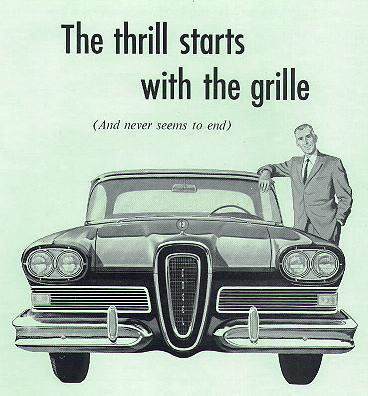
1957 – The Edsel, the first new car brand to be introduced by one of the Big 3 motor companies in 20 years, and perhaps the most infamous flop in car manufacturing history, is presented to the public by the Ford Motor Company. Veiled in secrecy, Ford had hyped the new car with a marketing campaign that showed only the hood ornament and promised simply “The Edsel is coming.” But when it was finally unveiled, the public was not impressed. Coming amidst a changing economic landscape, the car was too big and too expensive, and had a myriad of technical problems, including a hood ornament that tended to fly off on the highway. After only 3 years, and a loss of $250 million, the Edsel division folded.
edsel

1886 – The Indian wars of the American southwest effectively come to an end when Geronimo, the last remaining warrior chief to organize resistance to US forces, surrenders. Geronimo is sent to reservations first in Florida and then in Louisiana, finally ending up in Oklahoma, where he converted to Christianity, became a successful farmer, and even participated in Theodore Roosevelt’s inaugural parade.
geronimo

Today in history – September 3

2004 – A three-day hostage crisis in a school in the town of Beslan, Russia comes to a violent end when a gun battle between Russian security forces and the hostage takers erupts following an explosion. Three days earlier Chechen terrorists had surrounded and then taken over the school, holding some 1,200 children, parents and teachers, who had been celebrating the first day of school, in the school gym. The gym was then rigged with explosives as the terrorists demanded a Russian troop withdrawal from Chechnya. On the third day of the siege, an explosion in the gym, which witnesses later say was accidentally set off, sparks a firefight between the terrorists and security forces. By the time it is over, 31 of the 32 terrorists are dead, along with 331 of the hostages, including 186 children.

1783 – America is officially recognized as an independent nation with the signing of the Treaty of Paris, formally ending the American Revolution. The last major battle of the Revolution had ended two years previously with the surrender of British General Cornwallis to French and American troops, but final peach negotiations had continued throughout 1782 and 1783. The final agreement granted America its independence as well as granting all lands from Florida to the Great Lakes and between the Atlantic and the Mississippi to the US, essentially doubling its size.

Today in history – September 2

1969 – Chemical Bank in Rockville Center, New York introduces the automated teller machine to its customers, the first ATM to appear in the US. ATM’s will go on to alter the face of personal banking across the world, and have become an indispensable feature to every day life.
atm

1959 – Responding to the increasing appeal of smaller imported cars, Ford introduces the Falcon, its first compact, fuel efficient car dubbed “the small car with the big car feel”. Priced at only $1,900, the car is a huge hit, with dealers ordering 97,000 of the cars on the first day alone, and more than 2 million of them are sold in its first two years. My dad had a Falcon when I was a kid.
falcon

1945 – Aboard the USS Missourri, Japanese Foreign Minister Mamoru Shigemitsu and General Yoshijiro Umezu of the Imperial Army formally sign unconditional surrender documents, officially ending World War II. The surrender ceremony in color.

Today in History – September 1

1985 – The R.M.S. Titanic is discovered on the ocean floor 12,000 feet below the surface of the Atlantic by an expedition headed by Robert S. Ballard. Ballard is actually on a secret mission chartered by the US Navy to locate and photograph two sunken nuclear submarines, the USS Thresher and USS Scorpion. Using the search for the Titanic as a cover story, Ballard is allowed to search for the remains of the ship after having located the two submarines. Scanning the ocean floor with an unmanned submersible sub named Argo, Ballard discovers one of Titanic‘s massive boilers, which leads to the wider debris field and eventually the ship itself.
http://www.youtube.com/watch?v=u5J9GpuNb3A

1939 – One week after signing the Molotov-Ribbentrop Pact, a non-aggression treaty between Germany and the Soviet Union, World War II begins when Germany invades Poland. The move prompts both Britain and France to declare war on Germany two days later, and the Soviets will join in the invasion of Poland by mid-September, effectively splitting the nation between Germany and the Soviets. Despite Germany’s defeat 6 years later, it will be 50 years before Poland will regain its independence from the Soviet Union.

1864 – In one of the most decisive battles of the Civil War, Union forces under the command of William Tecumseh Sherman capture Atlanta, an important supply hub for the South. The battle for the city had begun in May, and it will remain occupied by Union forces until November 15 when Sherman leaves the city in ruins and begins his infamous March to the Sea.

This day in history – August 31

2009 – ScottC and lmsinca (posting as lindaS) meet each other and have their first ever interaction on Greg Sargent’s The Plum Line (see the posts starting at 9:52pm). They continue to argue with and annoy each other 4 years later.

1990 – Playing for the Seattle Mariners, Ken Griffey Sr. and Ken Griffey Jr. become the first father and son to ever play in the same game for the same team in MLB history. Each goes 1 for 4. Kinda cool.
http://www.youtube.com/watch?v=_G2AnNdjBu4

1976 – Former Beatle George Harrison is found guilty of “subconscious plagiarism” for his song My Sweet Lord. He was sued by the estate of Ronnie Mack, who had written the song He’s So Fine, recorded by The Chiffons, and from which Harrison was alleged to have plagiarized. Earnings from the song are ordered to be paid to Mack’s estate. Eh….I sort of get it. Sort of. You be the judge:
http://www.youtube.com/watch?v=rinz9Avvq6A

http://www.youtube.com/watch?v=3VUIB41EUFA

1888 – The mutilated body of prostitute Mary Ann Nichols is found in London’s east end neighborhood of Whitechapel. Nichols is the first of five recognized victims of the infamous, and to this day still un-named, serial killer known as Jack the Ripper. If you ever go to London and are looking for something interesting to do in the early evening, do the Jack the Ripper walking tour guided by Donald Rumbelow, a renowned British crime historian. I thought it was pretty good.