Morning Report: Fannie Mae takes up their estimates for 2020

Vital Statistics:


Last Change
S&P futures 3195 -3.25
Oil (WTI) 60.88 -0.04
10 year government bond yield 1.93%
30 year fixed rate mortgage 3.96%


Stocks are flat this morning on no major news. Bonds and MBS are down.


Initial Jobless Claims fell to 234k last week. The prior week had a big jump to over 250k, which really didn’t comport with other labor market data. 234,000 is still above where we were a couple weeks ago, though. As of now, assume this is just noise but it there is going to be a turnaround in the labor market, initial jobless claims is where it first shows up.


Fannie Mae has taken up their estimates for housing in 2020. Tuesday’s strong housing starts numbers, combined with what we are hearing out of the homebuilders, indicate that the US housing market will be an “engine of growth” for the economy in 2020. All of the talk about a trade-driven recession was more partisan wishful thinking than anything else. Fannie expects new home sales to increase 12% in 2020, and has taken up their forecast for GDP growth from 2% to 2.2%. “We now expect single-family housing starts and sales of new homes to increase substantially, aided by a large uptick in new construction as builders work to replenish inventories,” Duncan said. “Despite the expected increase in the pace of construction, the supply of homes for sale remains tight and strong demand for housing is continuing to drive home prices higher.”


Separately, Fannie is offering early retirement to 25% of its workforce as the company readies itself for sale. “As is common in many American companies, Freddie Mac is offering employees who meet certain age and tenure requirements a voluntary opportunity to retire early. As we prepare for our next chapter, we anticipate this will help realign our workforce to create a company attractive to outside investors as well as current and future employees,” a spokesman for Freddie Mac said in an email statement.


Shades of things to come? Sweden is ending its 5 year experiment with negative interest rates. Their central bank expects rates to remain at 0% for the next few years. Global interest rates are rising as a result, with the German 10 year Bund trading at negative 22 basis points, and the Japanese Government Bond trading at a hair under 0%.


Home prices rose 5% in November, according to Redfin. Listings fell by 5.9%, while sales increased 3%. “Given that inventory is falling quickly, we’d expect to see even stronger price growth, especially when compared to last year’s soft market,” said Redfin chief economist Daryl Fairweather. “The fact that homes are selling faster indicates that there are buyers ready to pull the trigger and take advantage of low interest rates. If lack of inventory and high demand continues, buyers who take a wait-and-see approach could face less favorable conditions in the spring season like bidding wars and faster price growth.” Note that the biggest gains were in the areas hardest hit by the real estate bust: Detroit, Camden and Bakersfield.

Morning Report: MBA urges tweaks to the CFPB

Vital Statistics:


Last Change
S&P futures 3199 3.25
Oil (WTI) 60.61 -0.34
10 year government bond yield 1.89%
30 year fixed rate mortgage 3.96%


Stocks are flattish this morning on no real news. Bonds and MBS are flat as well.


Mortgage Applications fell by 5% last wee as purchases fell 2% and refis fell 7%. Mortgage rates were mostly unchanged, even as a potential trade deal between the U.S. and China caused rates to inch forward at the end of last week,” said Mike Fratantoni, MBA Senior Vice President and Chief Economist. “With rates showing little meaningful movement, both refinance and purchase activity took a step back. As we move into the slowest time of the year for home sales, purchase application volume is declining but continues to outperform year-ago levels, when rates were much higher. Purchase activity was 10 percent higher than a year ago.”


Job openings ticked up to 7.3 million at the end of October, according to the BLS. Retail, financial, and durable goods manufacturing saw the biggest increases. The quits rate was stuck at 2.3%, which is odd given that the labor market is strong and wages are increasing.


iBuying, which means buying or selling property via platforms like Zillow, Opendoor or Offerpad accounted for 10% of all sales in several MSAs. These platforms permit the buyer and seller to bypass the traditional realtor and sell their properties directly to the company sponsoring the exchange. Does this save the seller money, since they aren’t paying realtor commissions? Not really. Zillow charges a 7.5% fee on average, which is higher than the 6% in realtor commissions a seller typically pays. That extra 1.5% is a convenience fee – you don’t have to stage the property, you get a non-contingent offer within a few days, and can sew the process up in a week or two.


The MBA and NAR filed amicus briefs urging the Supreme Court to maintain the CFPB, but to remove the language that says a Director can only be removed for cause. “When determining how to remedy an unconstitutional statute, courts seek to give effect to congressional intent and to avoid unnecessary disruption,” the brief said. “Striking down the entirety of the CFPA, or declaring it unconstitutional without addressing severance, would eliminate or call into question the legitimacy of the detailed, technical regulations that govern past and future real estate finance transactions, not to mention the authority of a federal agency responsible for enforcing a host of consumer protection laws. Such an outcome would immediately cause significant disruption to the American economy, overturning regulatory guideposts, upsetting settled expectations, and creating substantial uncertainty in our housing markets, all in contravention of Congress’s clearly expressed intent to promote financial stability. The Court should avoid causing such harm. Accordingly, in the event that the Court finds the for-cause removal provision unconstitutional, it should sever that provision from the statute.”


After yesterday’s blockbuster housing starts data, Fannie Mae took up their estimates for homebuilding in 2020. They anticipate housing starts will increase by 10% and housing will be the sector that leads the economy going forward.

Morning Report: Housing starts at a 12 year high

Vital Statistics:


Last Change
S&P futures 3200 3.25
Oil (WTI) 60.46 0.14
10 year government bond yield 1.87%
30 year fixed rate mortgage 3.97%


Stocks are flattish this morning on no real news. Bonds and MBS are flat.


Housing starts posted a 12 year high, coming in at 1.365 million units. Building Permits also moved up, rising 11% YOY to 1.485 million units. While 12 year highs seem like something big to cheer, in reality, we are still below our pre-bubble historical averages. Shortages of available homes are still at acute levels, however. This homebuilding cycle has a long way to run, and its positive impact on the economy could be one of the big surprises of 2020.


building permits


Builder confidence is at a 20 year high, according to the NAHB. “Builders are continuing to see the housing rebound that began in the spring, supported by a low supply of existing homes, low mortgage rates and a strong labor market,” said NAHB Chief Economist Robert Dietz. “While we are seeing near-term positive market conditions with a 50-year low for the unemployment rate and increased wage growth, we are still underbuilding due to supply-side constraints like labor and land availability. Higher development costs are hurting affordability and dampening more robust construction growth.”


Echoing this number, Toll Brothers noted on their earnings conference call that traffic and orders were better in the November – mid December period compared to July-October. Impressive indeed, given that this is the seasonally slow period.


Industrial production surprised to the upside, rising 1.1% compared to expectations of a 0.9% increase. Manufacturing production and capacity utilization also rose.


You can get a mortgage for under 1% in many European cities. Unsurprisingly, house prices are rising as a result. According to the NY Times: “Prices jumped at least 30 percent in Frankfurt, Amsterdam, Stockholm, Madrid and other metropolitan hot spots, and are up an average of over 40 percent in Portugal, Luxembourg, Slovakia and Ireland.” Denmark has negative mortgage rates. This is bubble material, and shows how central banks are playing with fire when setting interest rates below zero.

Morning Report: China trade deal

Vital Statistics:


Last Change
S&P futures 3190 13.25
Oil (WTI) 60.14 0.14
10 year government bond yield 1.85%
30 year fixed rate mortgage 3.97%


Stocks are up this morning on trade with China. Bonds and MBS are down.


The last full workweek of 2019 won’t have much in the way of market-moving data. We will get some housing data (housing starts and existing home sales) and the third revision to Q3 GDP, but that is about it.


China agreed to purchase more agricultural products from the US as part of an agreement that canceled additional tariffs that were supposed to take effect last night. This deal should end the tit-for-tat tariffs that have been weighing down financial markets for the past several months.


More evidence of weakness in the Eurozone as the German ISM numbers were downright awful, and were echoed by weakness in the UK and France. This will be the push-pull driving interest rates in the near future: an accelerating US economy will push rates higher, while stagnation in Europe will pull them lower.


Retail Sales rose 0.2% MOM in November, which was lower than expectations. Ex autos and gas, sales were flat.


The Fed is injecting liquidity into the system to prevent a repeat of September’s cash crunch, which sent overnight repo rates up to 10% at one point.


Morning Report: The Fed maintains current interest rate policy

Vital Statistics:


Last Change
S&P futures 3140 -3.25
Oil (WTI) 58.90 -0.14
10 year government bond yield 1.79%
30 year fixed rate mortgage 3.97%


Stocks are flattish after the Fed maintained interest rates yesterday. Bonds and MBS are up.


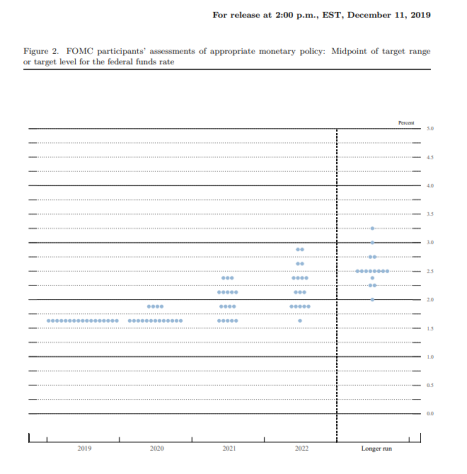
The Fed maintained the Fed Funds rate at current levels and gave a generally upbeat assessment on the economy. The FOMC took down their future unemployment estimates by .2% and left all other projections unchanged. The biggest revelation was the dot plot, which was a bit more dovish than the September plot, but is still forecasting the possibility of a hike in 2020, along with no forecasts for a rate cut.


Dec dot plot


The Fed Funds futures, which have been (a) more dovish than the Fed’s dot plots and (b) more correct, went from forecasting a 50% chance of a cut in 2020 to a 70% chance of a cut. The bond market adjusted as well, with the 10 year bond yield falling about 4 basis points in the afternoon.


The Producer Price Index (PPI) was unchanged in November, and up 1.1% on a year-over-year basis. The PPI measures inflation at the wholesale level, and is a companion inflation index to the Consumer price index. Ex-food and energy, the index fell in November and was up 1.3% YOY.


Initial Jobless Claims jumped to 252,000 last week. This is a huge jump, and I am not sure what drove it. We have been hanging around in the low $200,000s for quite some time. FWIW, this jump in new jobless doesn’t necessarily comport with the other labor market indicators out there, but it is less of a lagging indicator than the others.

Morning Report: Fed Day

Vital Statistics:


Last Change
S&P futures 3139 3.25
Oil (WTI) 58.99 -0.24
10 year government bond yield 1.84%
30 year fixed rate mortgage 3.98%


Stocks are flattish as we await the FOMC decision. Bonds and MBS are flat as well.


Mortgage applications increased 3.8% from a week earlier, according to the MBA. The purchase index dropped 0.4%, while the refi index rose 9%. Interest rates rose one basis point.


The FOMC decision is set for 2:00 pm EST. Given that the Fed is on the sidelines for a while, there shouldn’t be anything market moving in it.


Consumer prices rose 0.3% in November, according to the BLS. Higher shelter and energy prices drove the increase. The index was up 2.1% on an annualized basis. Ex-food and energy, the index was up 0.2%. These numbers were a hair higher than street expectations.


The first time homebuyer is returning, according to the Genworth First Time Buyer report.  The rebound in the third quarter was driven primarily by falling interest rates and increasing home affordability. Supply constraints, particularly at the affordable price points have been the issue. “The first-time homebuyer market rebounded this quarter and although the rebound was modest compared with the number of first-time homebuyers a year ago, and a quarter behind the broad rebound, it was a strong rebound from the previous quarter allowing first-time homebuyers to make up some lost ground,” said Tian Liu, Genworth Mortgage Insurance Chief Economist.


The report noted that repeat buyers (read move-up buyers) have increased as well. The lack of move-up buyers has depressed housing mobility, which may have been driven by lack of home equity from purchases made during the bubble years. Given the change in the house price indices over the past 10 years, negative equity is less of an issue than it was a few years ago.


Interestingly,  the number of first-time homebuyers this quarter was comparable to the peak of the last housing boom in 2005 and 2006, and only modestly below the peak levels of 1999 and 2000. Still, the Millennial generation is bigger than Gen X by a large margin, so there should be more room to run here.


quarterly sales to first time homebuyers

Morning Report: Fannie and Fred are preparing for their IPO

Vital Statistics:


Last Change
S&P futures 3138 3.25
Oil (WTI) 58.87 -0.14
10 year government bond yield 1.82%
30 year fixed rate mortgage 3.98%


Stocks are up as we head into the FOMC meeting. Bonds and MBS are flat.


The FOMC will meet today and tomorrow, with the interest rate announcement expected Wednesday at 2:00 pm. The Fed Funds futures are predicting no change in rates. That doesn’t necessarily mean the markets will ignore what is going on, as subtle changes in language can have out-sized effects on the markets. One such word is “symmetric.” The word symmetric refers to the Fed’s 2% inflation target, and how much they will tolerate inflation above that target. The Fed desperately wants to avoid the low inflation / low growth trap that evolved in Europe and Japan, and is signalling to the markets that they will allow inflation to run above 2% for an extended period of time.


The Fed will also be watching the overnight repurchase market, to ensure we don’t have another situation like late September where overnight rates spiked over 10%. This was due to a shortage of cash in the market. While this sort of thing doesn’t affect mortgage lending directly, it does raise the cost of borrowing for MBS investors, which can cause them to sell these securities to raise cash. That flows through to rate sheets. While the shortage caught the Fed flat-footed in September, they have been discussing the issue, so hopefully we don’t see another replay at the end of this month.


Fannie and Freddie are tightening the restrictions for their Home Ready and Home Possible programs. Previously, borrowers with incomes at the Area Median Income (AMI) were qualified for these 3% down programs; now they will be limited to borrowers at 80% of the AMI. This is all part of the strategy to reduce Fan and Fred’s overall risk prior to setting them free. Note that they are currently interviewing banks to handle the IPO, which will be somewhere between $150 billion and $200 billion. This would dwarf the record for the largest IPOs in history – Saudi Aramco and Alibaba – by over 6x.


Despite a glut of McMansions in some areas, Toll Brothers beat estimates and forecasted a strong 2020.  The company noted demand increased throughout the year, and the recent weeks have been stronger than the prior quarter, which is encouraging given that typically you see a slowdown this time of year. Douglas C. Yearley, Jr., Toll Brothers’ chairman and chief executive officer, stated: “Fiscal 2019 ended on a strong note. Building on steady improvement in buyer demand throughout the year, our fourth quarter contracts were up 18% in units and 12% in dollars, and our contracts per-community were up 10% compared to one year ago. Through the first six weeks of fiscal 2020’s first quarter, we have seen even stronger demand than the order growth of fiscal 2019’s fourth quarter. This market improvement should positively impact gross margins over the course of fiscal 2020.”


Small business optimism grew in November, according to the NFIB. Recession worries faded into the background, and impeachment remains little more than a curious albeit boring sideshow, similar to the Clinton impeachment saga which had zero effect on the markets. Improving labor conditions were a big driver, with 26% of firms planning on raising compensation in the coming months – the highest in 30 years. (BTW, this is music to the Fed’s ears). It looks like the drag from the 2017-2018 rate hikes are behind us, and the headwind has turned into a tailwind courtesy of the recent rate cuts.


Productivity declined in the third quarter as output increased 2.3% and hours worked increased 2.5%. Unit labor costs increased by 2.5%.

Morning Report: Fed Week

Vital Statistics:


Last Change
S&P futures 3144 -6.25
Oil (WTI) 58.59 -0.64
10 year government bond yield 1.81%
30 year fixed rate mortgage 3.98%


Stocks are slightly lower as we head into a Fed Week. Bonds and MBS are up.


There are two big events this week: the FOMC meeting on Tuesday and Wednesday and the spate of new Chinese tariffs expected to take effect at the end of the week. We will get some interesting economic data in productivity, inflation and retail sales, but with the Fed on the sidelines trade and overseas markets will be driving interest rates.


The Fed Funds futures are predicting no changes to interest rate policy at the meeting this week. The June 2020 futures are predicting a roughly 50/50 chance of another rate cut.


The average size of a first-time homebuyer’s mortgage was $231,974 for the first 3 quarters of 2018 and was up 4.2% on a YOY basis.


first time mortgage size


Interesting stat courtesy of the Harvard Joint Center for Housing Studies: annual household growth over the next 10 years is expected to be 1.2 million per year. With housing starts around the same level, we are not taking into account functional obsolescence and deterioration.


Is a homeowner who sells his house via iBuyers (think Zillow and Opendoor) leaving money on the table? Turns out the average discount to market value is about 1.3%. The typical fee charged an iBuyer is around 7%. So the total costs is 8.3%. Compare that to using traditional realtors and paying 6%, along with the expense of showing the home, etc. Essentially the seller is paying for convenience, which is a non-contingent offer in a week, with no showing necessary. In this case the fee is about 2.3%, which represents the additional fee of 1% the iBuyer charges along with the 1.3% market value discount.


Paul Volcker, the Fed Chairman who slayed the 1970s inflation dragon has passed away.

Morning Report: Blowout jobs report

Vital Statistics:


Last Change
S&P futures 3148 22.25
Oil (WTI) 57.99 -0.44
10 year government bond yield 1.85%
30 year fixed rate mortgage 3.94%


Stocks are higher after a blowout jobs report. Bonds and MBS are down.


Jobs report data dump:

  • Nonfarm payrolls up 266,000
  • Unemployment rate 3.5%
  • average hourly earnings up 0.2% MOM / 3.1% YOY
  • Employment-population ratio 61%
  • Labor force participation rate 63.2%

Huge surprise in payrolls given the ADP report only had 67,000. The unemployment rate of 3.5% is the lowest in 50 years. About the only blemish was the small downtick in the labor force participation rate. Note that manufacturing payrolls increased smartly.


What does this mean for the bond markets? Nothing since the Fed is on hold, probably through the 2020 election. It also might mean that the rate cuts of earlier this year are beginning to take effect and the drag from the 2018 tightening cycle is behind us.


Note that the makeup of the 2020 FOMC voting members will be more dovish than 2019. Eric Rosengren and Esther George – two hawks that dissented against rate cuts – rotate off the board next year. In their place, we will be getting Neel Kahskari and Robert Kaplan. Neel Kashkari is considered one of the most dovish members of the FOMC. Will it make much of a difference? Probably not, although the bar for increasing interest rates will be adjusted upward accordingly.


Interesting chart: the median age of US homebuyers since 1980. It has increased from 32 to 47 over that period. Half of that increase came from the Great Recession. Much of this is explained by the muted presence of the first time homebuyer, who has been about 30% of sales as opposed to their historical 40%.


median age of us homebuyer

Morning Report: Jumbo loans remain cheaper than conventional loans

Vital Statistics:


Last Change
S&P futures 3120 8.25
Oil (WTI) 58.69 0.24
10 year government bond yield 1.81%
30 year fixed rate mortgage 3.94%


Stocks are higher this morning on optimism for a trade deal. Bonds and MBS are down.


China maintained that tariffs must be cut if there is to be a phase 1 deal before new tariffs go into effect December 15. Chinese officials said the two sides remain in close communication.


Despite the weak ADP print yesterday, other labor market indicators look healthy. Outplacement Firm Challenger Gray and Christmas reported that announced job cuts fell 11% MOM and 13% YOY to 44,569. Tech was the biggest sector this month however retail is the leader for the year. Year-to-date, companies have announced 556,000 job cuts versus 1.2 million planned hires. Note that Challenger and Gray only looks at press releases, not actual cuts. Separately, initial jobless claims fell to 203,000 for the holiday-shortened week.


The service sector continued to expand, albeit at a slower rate in November, according to the ISM survey. Employment plans accelerated, while production decelerated. “Tariffs are impacting prices for a broad array of products used in the delivery of services and completion of projects for our clients. Upward pressure is impacting suppliers and their pricing to customers. We are seeing no relief from our customers, so we’re being negatively impacted by tariff-driven price increases. Numerous suppliers report looking for alternative manufacturing/supply locations outside of China, but with limited or no success so far.” (Management of Companies & Support Services)


The government has ended the limits on VA mortgages, which means veterans can borrow as much as their incomes and credit allow. So theoretically veterans can buy million dollar homes with no money down.


Mortgage credit increased in November, according to the MBA, especially in the jumbo space. “Most notably, the jumbo index climbed to yet another record high, as investors increased their willingness to purchase loans with lower credit scores and higher LTV ratios,” said Joel Kan, MBA Associate Vice President of Economic and Industry Forecasting. “Additionally, the government index saw its first increase in nine months, driven by streamline refinance programs.”


Speaking of jumbos, the spread between 30 year conforming loans and jumbos remained negative this year, which means jumbo rates are less expensive than conforming rates. This is odd given that conforming loans are government guaranteed and jumbos are not. The spread did rise a bit this year, largely driven by staffing issues. Still, what is going on? According to CoreLogic, an “increase in GSE guarantee fee, a reduction in the GSE funding advantage, and portfolio lenders’ desire to hold jumbo loans explain much of the variation in the jumbo-conforming spread.” The issue of portfolio lenders could be translated to: banks are subsidizing jumbo loans because they are interested in the cross-selling opportunities, especially wealth management services. 


jumbo conforming spread.PNG