I Recommend WaPo’s ‘Spring Cleaning’ – 10 articles for conversation starters

http://www.washingtonpost.com/opinions/its-time-to-toss-the-all-volunteer-military/2012/04/19/gIQAwFV3TT_story.html?sub=AR

I liked Milbanks’ take on the Cabinet –  except for the Big Four, they don’t do anything.  The Departments may be important, but the Cabinet members are mere figureheads, he claims.  He may have exaggerated (what else is new?), but I got the thrust of it.

Morning Report

Vital Statistics:

Last Change Percent
S&P Futures 1359.4 -0.7 -0.05%
Eurostoxx Index 2526.7 -14.9 -0.59%
Oil (WTI) 106.1 -0.2 -0.14%
LIBOR 0.4916 -0.001 -0.20%
US Dollar Index (DXY) 79.286 0.178 0.23%
10 Year Govt Bond Yield 2.05% -0.01%

Markets are weaker this morning on a weaker than expected economic report out of Europe and a lousy forecast from Dell. Mortgage applications fell 4.5% for the week ending Feb 17. Existing Home Sales will be released at 10:00 am.

Obama has laid out the broad brush strokes for a corporate tax overhaul. He plans on lowering the statutory rate to 28%, while eliminating loopholes. His plan will benefit domestic manufacturers and he will target the energy sector for more revenues.  It looks like he is proposing some sort of AMT for corporations, with a minimum tax for overseas earnings. The plan will be revenue-enhancing.

Of course, the devil is always in the details, and hopefully the administration is smart enough to draw a distinction between overseas production meant to be sold overseas and outsourcing to cut costs. He could end up hurting US competitiveness if he doesn’t think this through.

The FHFA sent a letter outlining its plan for the GSEs aptly titled “The Next Chapter in a story that Needs an Ending.” It is a strategic document, not a step-by-step plan. They intend to build a new infrastructure for the secondary market, gradually reduce the footprint of Fannie and Freddie, while maintaining foreclosure prevention activities and credit availability.

With the S&P 500 rallying, bonds have sold off a bit, driving best-ex mortgage rates back over 4%. FWIW (and I am not a big technical analysis guy) it appears the March Treasury futures are stuck in a 140-145 range, which implies a yield range of 1.85% to 2.05%. We are again at the top end of that range. As I have mentioned before, the S&P 500 is right up against resistance and looks like it wants to break out. The Fed has been stepping into the MBS market when rates hit these levels, so we’ll see if that continues.

Morning Report

Vital Statistics:

Last Change Percent
S&P Futures 1347.8 0.8 0.06%
Eurostoxx Index 2535.2 22.2 0.88%
Oil (WTI) 99.73 1.0 1.03%
LIBOR 0.51 -0.003 -0.63%
US Dollar Index (DXY) 78.556 -0.182 -0.23%
10 Year Govt Bond Yield 2.04% 0.06%

Markets are up slightly on a better than expected initial jobless report. Initial Jobless claims were 358k last week versus 370k expected.  The ECB maintained rates and Draghi sounded bearish tones regarding the European economy.  Headlines are coming across right now that claim Greek leaders have agreed on an austerity package.

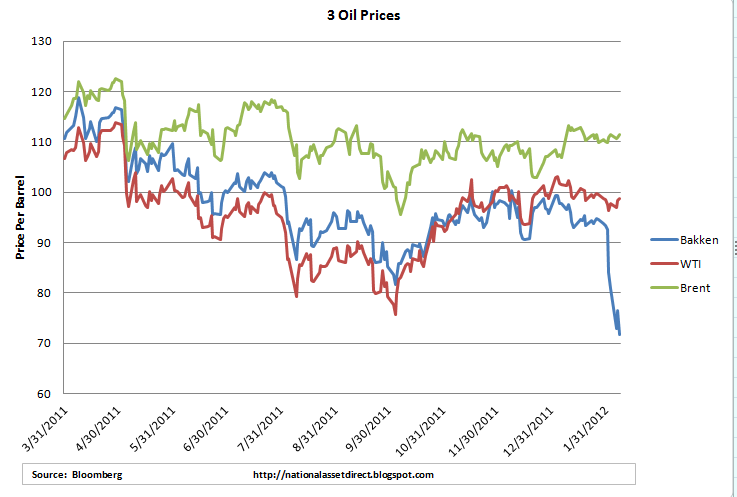
Bloomberg is reporting (on the pay site, not the free site) that the price of Bakken shale oil has fallen out of bed (down 25%) in the last week.  There are no futures contracts on Bakken so it can’t be traded, but it demonstrates how volatile oil can be.  The reason seems to be a lack of demand from the refineries, so the oil is backing up with nowhere to put it. Refineries are probably changing over from heating oil production to gasoline production right about now.  I plotted the prices of Brent, WTI, and Bakken oil over the past year so you can see the volatility.

It looks like we have a settlement with the banks and the state AG’s over foreclosures.  $26 billion from 5 banks.  $20 billion is to be used to cut principal balances and to refi current, but underwater, homeowners.  So, of the AGs and the banks, who won?  Both.  The AGs get their scalp, and the banks will be able to count losses already taken towards the settlement. (You owe $100 on your $70 home.  I’ll be a nice guy and cut your principal to $90.  Of course, I probably am already carrying the loan at 90 on my books anyway).  On the refis, the banks will be simply cutting the interest rate on a $100 loan, which stays marked at $100. So no write downs there either.  My guess is this will be earnings-neutral near term and may cause analysts to take down next year’s numbers a little. But that’s it.  So you might want to resist the urge to take some SKFs (Proshares Ultrashort Financial ETF) on the open.

Will it help support the housing market?  Maybe at the margin.  It is no silver bullet – consider my example above – will the homeowner who now owes $90 instead of $100 go out and spend more money?  Probably not. Plus a chunk of this is simply a direct transfer from the government to borrowers since Ally Bank (the old GMAC) is owned by the government.

Morning Report

Vital Statistics:

Last Change Percent
S&P Futures 1307.6 -3.8 -0.29%
Eurostoxx Index 2412.5 -19.590 -0.81%
Oil (WTI) 98.35 -0.600 -0.61%
LIBOR 0.5566 -0.003 -0.45%
US Dollar Index (DXY) 80.226 0.428 0.54%
10 Year Govt Bond Yield 2.05% -0.01%

Markets are mixed this morning, with the broader indices lower following Europe, and the Nasdaq up on Apple’s earnings.  AAPL is up about 8% pre-market.  Conoco Philips also reported good earnings this morning.   United Rentals reports after the close, which should provide another data point as to the state of the construction industry.  Construction /  Housing has been the achilles heel of this recovery, and if that sector is turning around, the economy could finally be on its way.

I didn’t watch the SOTU last night (I always just read speeches), but it doesn’t sound like there was anything market-moving in it.  Natural Gas is up a little, presumably on the lack of a production target.  The US dollar is stronger this morning and bonds are up 1/3 of a point, presumably on Europe, not necessarily the SOTU.

Perhaps the timing of the robo-signing settlement was not a co-incidence. In the speech last night, Obama laid out a plan for refinancing underwater mortgages.  The fine print will not be available for some time, and it will require Congressional approval.  I have noted in the past that you have to get the originators on board with this plan, and put-back risk is the big hurdle.  Put back risk means the government can decide after the fact that a mortgage violated underwriting standards and can force the originator to buy it back.  Re-financing underwater homes will by definition violate underwriting standards.  The government can tell originators that it will allow underwriting violations for this program, but there is nothing preventing a future administration from changing the rules.  An originator makes exactly the same profit on a 80% LTV loan as they do on a 120% LTV loan.  So why would originators take the additional political risk when the returns are exactly the same?   They won’t.

The FOMC rate decision will be released this afternoon.  I don’t think anyone expects a change in policy, but people will be interested in seeing if the the Fed takes note of the early signs of a turnaround.

Morning Report

Vital Statistics:

Last Change Percent
S&P Futures 1308.1 -2.3 -0.18%
Eurostoxx Index 2427.4 -7.670 -0.31%
Oil (WTI) 99.96 -0.430 -0.43%
LIBOR 0.5611 0.000 -0.02%
US Dollar Index (DXY) 80.3 0.244 0.30%
10 Year Govt Bond Yield 1.99% 0.02%
Futures are down slightly this morning on weakness in Europe and a lackluster earnings report from GE and Google. GE’s Earnings were a penny better (surprise, surprise) but revenues came in light due to weakness in Europe and the finance business. Google stunk up the joint with a miss on the top line and the bottom line. It is down 8% pre-market.
Sorry I wasn’t around yesterday, though I see some people filled in for me.  I was at the CSFB Securitized Products conference yesterday in the city. Congressman David Schweikert (Vice Chairman of te House Financial Services Subcommittee on Capital Markets and Government Sponsored Enterprises) spoke regarding the regulatory environment. A few takeways from the conference:
1) CSFB expects housing to decline 5%-7% this year and that *should* mark the bottom.
2) The government wants to introduce private capital into the mortgage market, but at the same time is trying to drive it away. The SEC is looking at changing the treatment of mortgage REITs which would drain, not add, private capital.
3) To get Fannie Mae capitalized to a reasonable level that would allow it to re-float would take a quarter of a trillion dollars. Nobody has a clue where that much money can be raised in the private sector. Which means Fannie and Fred will continue to be wards of the state.
4) The government is really interested in REOs to rentals. The problem is scalability.
5) 60% of underwater homeowners are current on their mortgages. Any sort of mass refinancing / mass principal cramdown for delinquent borrowers will also contain a massive moral hazard problem. Also, different treatment – the homeowner with a FHA loan gets relief, while the guy who’s mortgage went the private label route gets nothing.
6) There are a few leaders in Washington who get it, but most don’t. The appetite is still for slowing the foreclosure pipeline (in spite of volumes of evidence that it doesn’t do a thing to slow price depreciation – in fact it makes it worse).
7) Democrats want mass principal cramdowns and refis in spite of the fact that it would be an economic drag. It is simply a 1:1 transfer of wealth from investors to borrowers, so there is no multiplier effect, and the additional regulatory risk would drive mortgage rates higher. CSFB has conducted studies showing it is the affordability of the mortgage payment that matters, not the borrower’s equity position.
8) Question of the day: “Congressman, has anyone in Washington thought about just letting the markets clear?”  (The only thing that brought out laughter from the audience all day)
One observation I would make is that we want first time homebuyers, not necessarily hedge funds, to be buying up the excess supply. Yet closing times and down payment requirements for short sales drive many first time homebuyers away. I don’t know if it is because of regulatory reasons. If it is, Washington and the states should figure out a way to streamline the process.
In economic data, existing home sales comes out at 10:00.