Morning Report: Building Permits in the Northeast struggle 7/17/18

Vital Statistics:

Last Change
S&P futures 2794 -2.5
Eurostoxx index 383.01 -1.04
Oil (WTI) 68.12 0.06
10 Year Government Bond Yield 2.85%
30 Year fixed rate mortgage 4.51%

Stocks are lower after Netflix (one of the FAANG leaders of the market) missed earnings. Bonds and MBS are flat.

Industrial Production rebounded in June by 0.6% and manufacturing production increased 0.8%. Capacity utilization is 78%.

Jerome Powell heads to Capitol Hill today to begin his semiannual testimony in front of Congress. Expect a lot of questions regarding wage growth, trade wars, and regulation. Overall, he is expected to say that the economy is in good shape overall with above-trend growth and a strong labor market. He will face some questions from Democrats on regulation, especially since the Fed approved Goldman and Morgan Stanley’s capital plans despite the fact they were technically failed their stress tests. The Fed Funds futures continue to move in a hawkish direction, with the Sep futures pricing in a 88% chance of a hike and the Dec futures pricing in a 63% chance of 2 hikes.

Despite trade tensions, the IMF still expects the global economy to grow 3.9% this year and next. Trade remains a threat, however the impact is relatively small: a decrease of 0.5% in global growth by 2020. They forecast the US economy will grow 2.9% this year. Note many strategists took up their Q2 numbers on the strong retail sales print yesterday.

The Fifth Court of Appeals ruled yesterday that the structure of the FHFA is unconstitutional. Not sure how that is going to play out. Separately it also ruled that the FHFA was within its authority to sweep the profit from the GSEs, which is bad news for shareholders. FNMA stock was hit to the tune of 6% after the ruling.

The difference in sentiment between Northeastern real estate markets and the West is night and day. Growth in single family permits was actually negative for the first 5 months of this year. Compare that to the West, where they are up almost 18%.

The Northeast still has yet to really recover from the Great Recession, although some of that has more to do with secular trends in banking and the securities industry than it does with the real estate bubble. The securities industry has been hit by secular trends (falling commissions, ETFs) that have been great for investors but not great for employment in the industry. 5 cent commissions and 2%/20% hedge fund fees supported a lot of jobs which supported a lot of $1MM + homes. Towns like New Canaan have banned For Sale signs and the only part of the real estate market that is moving is in the sub-$750k segment. Million dollar plus listings languish. It is amazing – we have a housing shortage in the US overall, but you would never know that if you looked at the NYC suburbs.

Morning Report: Robust Housing Starts 2/16/18

Vital Statistics:

Last Change
S&P Futures 2736.0 2.0
Eurostoxx Index 379.5 3.0
Oil (WTI) 61.4 0.1
US dollar index 82.9 0.2
10 Year Govt Bond Yield 2.88%
Current Coupon Fannie Mae TBA 103.591
Current Coupon Ginnie Mae TBA 103.688
30 Year Fixed Rate Mortgage 4.44

Stocks are higher on no real news. Bonds and MBS are up.

Housing starts came in at 1.326MM annualized, better than expectations. Building permits hit 1.4 million – a 10 year high. Both numbers beat estimates by about 100k, a sizeable amount. The jump was largely in the volatile multi-family segment however. Single family starts were up about 4% YOY. That said, we are still well under the historical averages for starts, which was about 1.5 million units a year during from the 60s through the 90s and early 00s.

NAR welcomed the housing starts number: “Terrific news on housing starts in January with a solid 10% gain. This rise in single-family housing construction will help tame home price growth, and the increase in multifamily units should continue to help slow rent growth. The large gain in housing starts in the West (10.7%) is especially welcomed, as that region has been facing acute housing shortages. Ultimately, there is still large room for improvement given the fact overall housing inventory is currently near historic lows.” This is from Lawrence Yun, Chief Economist.

Import prices rose 1% MOM and are up 3.6% YOY. Energy prices were a big driver of the increase, however if you pull out energy, import prices were up just under 2% YOY. The dollar has been selling off for about a year now, and that is adding pressure to import prices which will flow through to inflation.

Consumer sentiment improved in early February despite the stock market sell-off. Sentiment came in at about December levels and is at post-recession highs.

Changes may be coming to TRID disclosure. The House passed a measure requiring more detail in how insurance fees are disclosed. The bill would amend language in the Real Estate Settlement Procedures Act (RESPA) to require the itemization of “all actual charges” and not just the itemization of “all charges.” The bill also would amend RESPA to require that ‘‘Charges for any title insurance premium disclosed on [the TRID rule] forms shall be equal to the amount charged for each individual title insurance policy, subject to any discounts as required by State regulation or the title company rate filings.’’. Thus, the bill would not permit the current approach to the disclosure of title insurance premiums under the TRID rule, and would require that the amounts disclosed for title insurance reflect the actual premium charges, including any discounts.

Thinking of relocating? Here is how much you need to make to be able to qualify for a mortgage on the median house in that MSA. The highest? San Jose, where the median home price is 1.3 million and you need to make just under a quarter of a million.

Morning Report: Housing starts nosedive 12/16/16

Vital Statistics:

Last Change
S&P Futures 2262.0 3.5
Eurostoxx Index 359.6 0.8
Oil (WTI) 51.1 0.2
US dollar index 93.1 -0.1
10 Year Govt Bond Yield 2.58%
Current Coupon Fannie Mae TBA 103
Current Coupon Ginnie Mae TBA 104
30 Year Fixed Rate Mortgage 4.15

Stocks are up this morning on no real news. Bonds and MBS are flat.

Housing starts fell 19% in November to an annualized rate of 1.09 million, which was way below estimates. Both single family and multi-fam fell, but multi bore the brunt of it. This is 7% lower than a year ago. Building Permits came in at 1.2 million, which was also below forecasts. Housing starts can be volatile and I wouldn’t be surprised to see this number revised upward.

Despite the low housing starts number, homebuilder sentiment is at highs not seen since the bubble years. This increase was probably due to a post-election bounce, however builders remain cautious and starts are way below historical averages. Perhaps a change in the regulatory environment will change that. “This notable rise in builder sentiment is largely attributable to a post-election bounce, as builders are hopeful that President-elect Trump will follow through on his pledge to cut burdensome regulations that are harming small businesses and housing affordability,” said NAHB Chairman Ed Brady, a home builder and developer from Bloomington, Ill. “This is particularly important, given that a recent NAHB study shows that regulatory costs for home building have increased 29 percent in the past five years.”

Donald Trump is close to choosing Larry Kudlow for the role of Chief Economist. The focus for economic growth will move from trying to improve demand to trying to improve productivity. Kudlow is a veteran of the Reagan Administration and is a firm believer in supply side economics. He has been historically a very vocal free trader, but will have to soften that approach in this administration.

Morning Report: Housing starts disappoint 10/19/16

Vital Statistics:

Last Change
S&P Futures 2137.5 4.0
Eurostoxx Index 343.1 0.6
Oil (WTI) 51.1 0.8
US dollar index 88.0 0.0
10 Year Govt Bond Yield 1.76%
Current Coupon Fannie Mae TBA 103.3
Current Coupon Ginnie Mae TBA 104.2
30 Year Fixed Rate Mortgage 3.57

Stocks are up this morning as earnings reports continue to pile in. Bonds and MBS are flat.

Mortgage Applications rose 0.6% last week as purchases rose 3% and refis fell 1%.

Housing starts fell to a 1.05 million pace in September, driven by a big drop in multi-fam. Single fam was up around 8%. Building Permits rose to 1.23 million. Housing continues to be the biggest underperformer in the economy, but the subject hasn’t really come up in this election, for either side.

We have some Fed-speak today, with John Williams speaking at 8:45, Rob Kaplan at 1:30 and William Dudley tonight.

The final debate is tonight, and it looks like Hillary is pulling away from Trump at this point. The black swan event for the markets is a Democratic Party sweep, which will probably cause the stock market to spit up a hairball.

Lending standards in the jumbo space are loosening, even as the luxury end of the housing market underperforms. Loan Depot is now offering 40 year jumbo products that are interest-only for the first 10 years. Redwood is now offering a 90 LTV product that goes down to a 660 FICO.

The NAR is releasing its latest Profile of Home Buyers and Sellers. Here are the big changes over the past 35 years.

  • The first time homebuyer is a smaller percentage than it has been in the past.
  • The internet is not replacing the real estate agent
  • Houses have been getting bigger of the past 30 years, but have leveled out in recent years
  • Down payments have been going down
  • The home search process is taking longer than ever due to tight inventory

Zillow has their own report on trends in housing. Here is the executive summary (the report is very long and detailed):

“The home buying experience is both an intimidating financial transaction and an emotional milestone. Half of home buyers in the U.S. are under 36, meaning a new generation— Millennials—is shaping the future of real estate. Despite demographic reports about young adults’ urban lifestyles, Millennials share their parents’ aspirations for a single-family home, often in the suburbs.

The process of finding or selling a home is much more collaborative for Millennials than for older generations. They bring all available tools to the process, including their smartphones, social media and online networks. While older generations rely on real estate agents for information and expertise, Millennials expect real estate agents to become trusted advisers and strategic partners.

Millennial home buyers are also diverse. While only 9 percent of all homeowners are Hispanic, nearly 15 percent of the Millennials buying homes are Hispanic—reflecting the changing demographics of the American middle class.

Homeownership remains a vehicle for wealth in the U.S., but it can also be a financial burden, as families stretch their finances to afford the space they need, and large, dated homes owned by Baby Boomers and the Silent Generation demand maintenance and improvements.”

Morning Report: Janet Yellen gets more dovish 6/21/16

Markets are up this morning as the market frets about Brexit and Janet Yellen speaks. Bonds and MBS are up small.

The latest polls for Brexit are mixed, and the bottom line is that it is too close to call. If the UK leaves the EU, the most likely effect will be a flight to safety, which would mean global flows to US Treasuries, lowering rates. Some of the forecasts I am seeing would be a sub 1.4% on the 10 year if the UK leaves, or a return to the old 1.7% – 1.9% range if they stay. FWIW, spread betting is common in the UK, and the markets there are much deeper than the political betting sites in the US. Right now, the spread betting markets are assigning a 25% probability of Brexit.

Janet Yellen adjusted her language to be slightly more dovish ahead of her testimony today in front of the Senate Banking Committee. She is exhibiting a little more uncertainty over whether the economy is ready to return to moderate growth. Not sure what changed in the last week or so, but there you go.

Homebuilder Lennar beat estimate this morning as the housing market continues to improve and wage growth begins to appear. Interestingly, they are pulling back a little from the market, it appears: “As this year’s spring selling season improved over last year, our second quarter new orders increased 10% to 7,962 homes year-over-year, while our home deliveries and home sales revenue also increased to 6,724 homes and $2.4 billion, respectively.  As the recovery has continued to mature, we have remained focused on our strategy of moderating our growth rate in community count and home sales, as well as on our soft-pivot land strategy, targeting land acquisitions with a shorter average life.” For some reason, the builders don’t seem to trust this recovery in housing.

Perhaps Lennar’s reticence comes from the attitudes of consumers. A recent survey shows housing affordability remains a big problem. That said, perceptions of real estate as a good long-term investment are improving. They should, since rental inflation is generally outpacing house price appreciation and the buy-rent decision is skewed heavily towards buying. That said, consumers are becoming more pessimistic that the housing crisis is over.

Good breakdown on how big of a boost homebuilding is for the economy. Unfortunately, the only discussion of housing in DC revolves around how hard we should be slugging the banks.

Hometown in the NYT

A new mixed-used town center that I frequent was featured in the NYT. Thought I’d pass along so those who are interested can get a sense of life inside (or in this case barely outside) the beltway. My home is about 10 minutes from here. With the new HOT (High Occupancy Toll) lanes on the beltway, it’s about 3 mins and 30 cents. Or free if the whole entire family is in the car. If the development continues, it will be accessible by bicycle. Too much traffic for that now.

The story neglects the best part of the movie theater: the full service bar.

We considered the town homes that are for sale, but decided to stick with our home.

Morning Report

Vital Statistics

Last Change Percent
S&P Futures 1352.7 5.0 0.37%
Eurostoxx Index 2504.6 16.3 0.65%
Oil (WTI) 101.52 0.8 0.77%
LIBOR 0.4951 -0.003 -0.50%
US Dollar Index (DXY) 79.543 0.159 0.20%
10 Year Govt Bond Yield 1.93% -0.01%

Markets are higher this morning on statements from the Bank of China regarding support for the European bailout and its willingness to help. Concerns about an eventual Greek deal are offsetting some of these gains. Bonds and mortgage backed securities are flat.

Mortgage Loan Delinquencies are increasing again, according to TransUnion. 64% of MSAs reported increases, which was flat compared to Q3, but much higher than Q2.  There are seasonal factors at work here, and the continuing decline in real estate prices are certainly playing a part, but that is not an encouraging data point economically. As if the foreclosure pipeline wasn’t big enough already.

Not that the markets really care, but it looks like we have a payroll tax deal.

The Empire State Manufacturing Index came in at stronger than expected. This is a touchy-feely indicator of general business conditions put out by the New York Fed.  This index is notoriously volatile, so big moves should be taken with a grain of salt, but it shows that the expansion is gaining momentum in New York State.  Separately, industrial production was flat and capacity utilization unexpectedly fell.

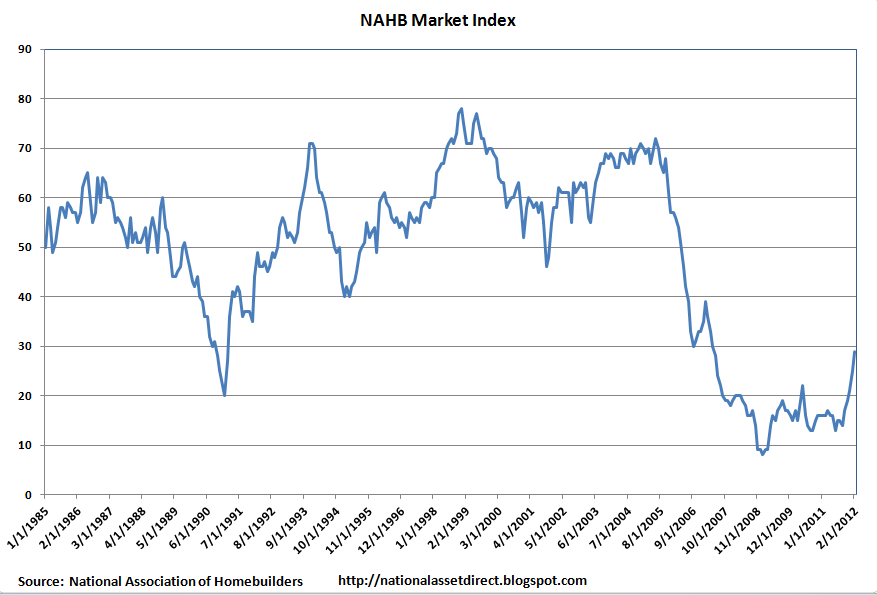
The National Association of Home Builders will release their market index at 10:00 am. Residential construction has been the missing piece of the recovery, but has been showing signs of life lately.  Earnings reports from the homebuilders have been constructive.

The FOMC minutes will be released this afternoon. I am very curious to see why the Fed is behaving as if the economy is rolling over, while the data suggest otherwise.

Last, Ezra Klein at the Washington Post has a story on how the World Cup affects trading.  I can attest to this personally, having been a block trader at Bear Stearns in London for a number of years.  When England was playing a match, the phones would stop ringing and everyone had their backs to their screens, watching the match.  You could actually see major stocks like British Petroleum and Vodafone stop trading.  As an American, it was strange to watch.

****EDIT

The National Association of Homebuilders released their market index at 10:00 am.  The index came in better than expected and it looks like conditions are improving at an accelerating rate.

Chart:  NAHB Market Index:

Morning Report

Vital Statistics:

Last Change Percent
S&P Futures 1292.7 3.4 0.26%
Eurostoxx Index 2397.8 1.190 0.05%
Oil (WTI) 101.93 1.220 1.21%
LIBOR 0.5612 -0.001 -0.20%
US Dollar Index (DXY) 80.634 -0.480 -0.59%
10 Year Govt Bond Yield 1.85% 0.00%
Futures are up slightly on earnings and a lack of market-moving news out of Europe. Bond geeks will note that EURIBOR / OIS (a measure of stress in the banking system) has been moving lower since the year began. It is at 84 basis points, having dropped from 101 basis points six weeks ago. ECB funding probably explains some of it, but it is a welcome sign and helps explain the more sanguine mood of Mr. Market recently.
Goldman reported better than expected results this morning based on cost cuts. Compensation fell 21% and staff decreased 7%. On cue, William Cohan was on Bloomberg TV this morning complaining that Wall Street comp is still 50% too high. US Bancorp also reported better than expected earnings.
The Producer Price Index came in a little hot, but still subdued. PPI ex food and energy was up .3% MOM and 3.0% YOY. Inflation is still a non-issue as far as the Fed is concerned. Tomorrow will be a big economic day with CPI, Housing Starts and Initial Jobless Claims. No report tomorrow as I will be in the city all day.
EDIT:  More bullish economic data:  Capacity Utilization increased again to 78.1% and the NAHB Homebuilder sentiment index increased to 25, confirming what the homebuilders have been saying on their conference calls.