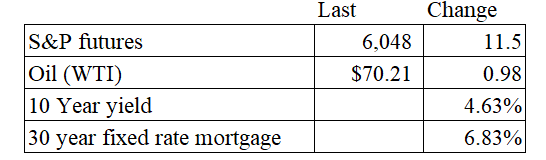
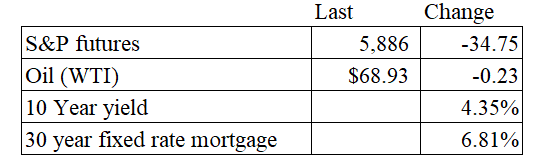
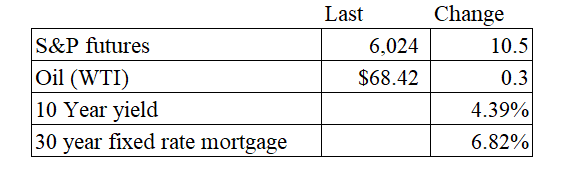
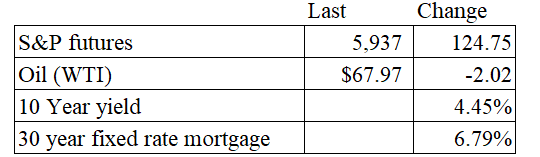
Stocks are higher as we begin 2025. Bonds and MBS are up.
Mortgage applications fell 22% over the past two weeks, according to the MBA. Refis fell 36%, but were up 10% on a year-over-year basis. Purchase volume fell 48% and was down 17% compared to a year ago. “Mortgage rates moved higher through the last full week of 2024, reaching almost 7 percent for 30-year fixed-rate loans,” said Mike Fratantoni, MBA’s SVP and Chief Economist. “Not surprisingly, this increase in rates – at a time when housing activity typically grinds to a halt – resulted in declines in both refinance and purchase applications.”
For-sale housing inventory rose 0.5% MOM and 12.1% YOY in November, according to Redfin. That said, much of this inventory has been hanging around for a while as sellers refuse to cut prices. Over half the inventory has been on market without a contract for over 60 days. This phenomenon is most concentrated in Florida and Texas, where there has been a lot of building. Rising HOA fees and insurance costs are making people re-thing moving to Florida.
Something to watch for 2025: The Chinese Government Bond yield. As the real estate bust settles in, Chinese government bond yields are collapsing as investors rush to put money in safe assets. China has a massive debt problem, similar to the US in 1929 and Japan in 1989. This will send a deflationary pulse throughout the world and should help to (a) push down yields globally, and (b) push down commodity inflation.
In the 1980s, the Japanese were voracious buyers of US real estate, and for the past 10 years, Chinese investors have been big buyers in the US and Canada. Chinese property investors may be forced to liquidate US holdings in order to cover debts. Since domestic demand in China is collapsing, the country should continue to run trade deficits globally, which means increased demand for sovereign debt, pushing global yields lower.
Just something to think about going forward. Have a happy and prosperous new year.
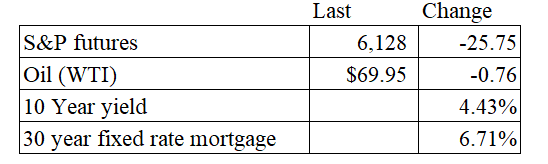
Stocks are up this morning on no real news. Bonds and MBS are down.
The markets close early today in observance of Christmas Eve. Should be a quiet day.
New home sales rose 5.9% to a seasonally adjusted annual rate of 664,000 in November. This was up 8.7% compared to a year ago. The median sales price of new houses sold in November 2024 was $402,600. The average sales price was $484,800. The median price fell 6.3%, while the average price was down about 80 basis points.
Consumer confidence pulled back in December, according to the Conference Board. “The recent rebound in consumer confidence was not sustained in December as the Index dropped back to the middle of the range that has prevailed over the past two years,” said Dana M. Peterson, Chief Economist at The Conference Board. “While weaker consumer assessments of the present situation and expectations contributed to the decline, the expectations component saw the sharpest drop. Consumer views of current labor market conditions continued to improve, consistent with recent jobs and unemployment data, but their assessment of business conditions weakened. Compared to last month, consumers in December were substantially less optimistic about future business conditions and incomes. Moreover, pessimism about future employment prospects returned after cautious optimism prevailed in October and November.”
The CPFB is accusing Rocket Mortgage of illegal kickbacks. “Rocket engaged in a kickback scheme that discouraged home-buyers from comparison shopping and getting the best deal,” CFPB Director Rohit Chopra said in a statement. “At a time when homeownership feels out of reach for so many, companies should not illegally block competition in ways that drive up the cost of housing.”
Rocket responded by saying that one-third of the borrowers with an application in progress chose to go to a different lender: “The facts are clear – data shows one-third of consumers with a loan application already in progress with Rocket Mortgage, before contacting Rocket Homes, chose to close with a different lender,” the company said in a statement. “This proves Rocket Homes is committed to empowering home-buyers to make the best decisions for their unique needs.”
Stocks are lower as the Fed begins its FOMC meeting. Bonds and MBS are up.
Retail sales rose 0.7% MOM in November, which was above expectations. On a year-over-year basis, they rose 3.8%. Motor Vehicles and parts were the big driver of the increase. Excluding vehicles and gas, sales rose 0.2% MOM, which was below expectations. October’s sales numbers were revised upward.
The S&P Flash PMI hit a 33 month high in December. Output rose at the steepest rate in 33 months, and much of the increase was attributed to the incoming administration. That said, the growth was concentrated in the service sector, as manufacturing conditions continued to deteriorate.
“Business is booming in the US services economy, where output is growing at the sharpest rate since the reopening of the economy from COVID lockdowns in 2021. The service sector expansion is helping drive overall growth in the economy to its fastest for nearly three years, consistent with GDP rising at an annualized rate of just over 3% in December.
“It’s a different picture in manufacturing, however, where output is falling sharply and at an increased rate, in part due to weak export demand. Encouragingly, confidence in the 12-month outlook has lifted to a two-and-a-half year high, suggesting the robust economic upturn will persist into the new year and could also become more broad-based by sector. However, some of the high spirits seen after the election in the manufacturing sector have been checked over concerns surrounding tariffs and the potential impact on inflation resulting from the higher cost of imported materials. December saw raw material prices spike sharply higher amid supplier-led price rises and higher shipping costs, in a reflection of busier supply chains in advance of threatened protectionism in the new year.”
Notably, the PMI and the CPI are diverging, and since the PMI generally leads the CPI, we should see further downward pressure on inflation, which is good for the Fed as it fights the last mile of inflation.
Industrial production fell 0.1% MOM in November, according to the Federal Reserve. Manufacturing production rose 0.2%. Capacity Utilization slipped to 76.8%. Note that October’s numbers were revised downward.
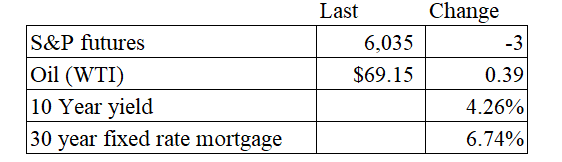
Stocks are flattish this morning on no real news. Bonds and MBS are down small.
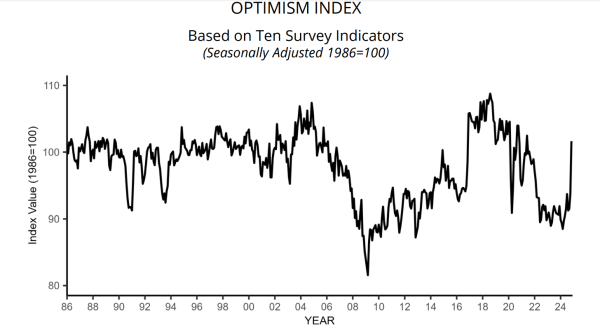
Small business optimism improved markedly in November, according to the NFIB Small Business Optimism Report. The index rose by 8 points to hit the highest level since June 2021, and breaking through the 50 year average for the first time in 34 months.
All components of the index improved as uncertainty over the election faded. The labor market remains tight, with 36% of small businesses reporting they had jobs they were unable to fill. Labor costs remain the biggest concern for small businesses.
Sales remain challenged, however optimism for the future improved. The net number of firms reporting higher sales was negative 13, however a net 18% think things are about to get better.
“After a year of readings at 94 or lower (98 is the 50-year average), the Index of Small Business Optimism rose to 101.7 in November, clearly a response to the presidential election. The election results signal a major shift in economic policy, particularly for tax and regulation policies, that favor economic growth. Economic and employment growth have been dominated by government spending, financed with massive deficits, crowding out private spending with higher prices and interest rates. Average small firm loan costs rose from 4 percent to over 9 percent over the past four years. Government (federal, state, and local) employment (direct and indirect) surged, competing with private firms for employees, mainly those businesses that did not benefit from government spending. Trump’s first term as president produced inflation rates that averaged well under the Fed’s 2 percent target and very strong economic growth. Owners hope for a repeat performance.”
The national delinquency rate improved to 3.45% in October, according to the latest ICE Mortgage Monitor. The 90 day rate continues to tick up, however. Foreclosure activity remains muted, rising 12% MOM, but still down about 12% on a YOY basis.
We saw a spike in rate / term refis in October, which is something that has been non-existent for the past few years. Rate / term refis actually exceeded cash-out refis. Much of the activity came from loans originated in 2023, when mortgage rates were closer to 8%.
Productivity increased 2.2% in the third quarter, according to BLS. Unit labor costs were revised downward from 1.9% to 0.8%. A downward revision to compensation accounted for the change.
People’s household finance outlook improved dramatically, according to the latest data from the New York Fed. The outlook has returned to February 2020 levels (i.e. pre-pandemic) levels.
Stocks are flattish this morning on no real news. Bonds and MBS are flat.
Manufacturing activity contracted for the 8th consecutive month, according to the ISM Report. That said, conditions improved compared to last month. The internals of the report are mainly good news: new orders and production increased, while the prices index fell markedly to near-neutral levels.
“U.S. manufacturing activity contracted again in November, but at a slower rate compared to last month. Demand continues to be weak but may be moderating, output declined again, and inputs stayed accommodative. Positive signs for demand include the (1) New Orders Index returning to expansion territory, (2) New Export Orders Index increasing moderately (up 3.2 percentage points but still in contraction territory), (3) Backlog of Orders Index dipping further into strong contraction territory, and (4) Customers’ Inventories Index indicating levels were only marginally above ‘too low.’ Output continued in contraction: Employment shrunk, but at a much slower rate, and production took a small step in the right direction. Demand remains weak, as companies prepare plans for 2025 with the benefit of the election cycle ending. Production execution eased in November, consistent with demand sluggishness and weak backlogs. Suppliers continue to have capacity, with lead times improving but some product shortages reappearing.”
The issue of potential tariffs barely came up; and its impact will probably be positive in the short term, as companies accelerate spending plans to beat the increases. So, all the sturm and drang in the media over the issue seems to be partisan posturing.
Fed Governor Waller supports a rate cut at the upcoming December FOMC meeting. “At present, I lean towards supporting a cut in the policy rate at our December meeting … Overall, I feel like an MMA fighter who keeps getting inflation in a chokehold, waiting for it to tap out, yet it keeps slipping out of my grasp at the last minute.” Waller emphasized that monetary policy is still restrictive, and cutting rates in December means that the Fed will still have its foot on the brakes, just not as hard.
The odds of a December rate cut have increased from 60% to 72%.
Stocks are flattish this morning on no real news. Bonds and MBS are up.
Third quarter GDP rose 2.8% in the second revision to the estimate. This was in line with Street expectations.
New Home Sales disappointed again, coming in at 610,000, which was well below the Street expectation of 725k. This was down 17.3% compared to September and down 9% compared to a year ago.
The median home price was $437,300, and the average price was $585,800. There was 9.5 months’ worth of supply.
The FOMC minutes were released yesterday. On the subject of inflation, the members sounded pretty confident:
With regard to the outlook for inflation, participants indicated that they remained confident that inflation was moving sustainably toward 2 percent, although a couple noted the possibility that the process could take longer than previously expected. A few participants remarked that insofar as recent robust increases in real GDP reflected favorable supply developments, the strength of economic activity was unlikely to be a source of upward inflation pressures. Participants cited various factors likely to put continuing downward pressure on inflation, including waning business pricing power, the Committee’s still-restrictive monetary policy stance, and well-anchored longer-term inflation expectations. Several participants noted that nominal wage growth had continued to move down and that the wage premium available to job switchers had diminished. In addition, some participants observed that, with supply and demand in the labor market being roughly in balance and in light of recent productivity gains, wage increases were unlikely to be a source of inflationary pressure in the near future.
Further into the minutes, they discussed that the economy has been stronger than expected, and that downside risks to the economy had become less prominent. The Fed Funds futures see a 66% chance of a 25 basis point cut at the next meeting in mid-December.
Mortgage applications rose 6.3% last week, as purchases rose 12% and refis fell 3%. “Purchase activity drove overall applications higher last week, as conventional purchase applications picked up pace and mortgage rates declined for the first time in over two months, with the 30-year fixed rate dropping slightly to 6.86 percent,” said Joel Kan, MBA’s Vice President and Deputy Chief Economist. With the growth in for-sale inventory and signs that the economy remains strong, buyers have remained in the market even though rates have increased recently. The increase in conventional purchase applications helped push the average purchase loan size to $439,200, its highest level in almost a month. The decline in refinance activity was driven by pullbacks in FHA and VA refinances. Applications were significantly higher than a year ago by most measures, but this was compared to the week of Thanksgiving 2023, which was a week earlier than this year’s holiday.”
The new FHFA limits are out, rising 5.2% to $806,500. The high balance limit (for expensive MSAs) is 150% of that or $1,209,750.
Consumer confidence improved in November, according to the Conference Board. “Consumer confidence continued to improve in November and reached the top of the range that has prevailed over the past two years,” said Dana M. Peterson, Chief Economist at The Conference Board. “November’s increase was mainly driven by more positive consumer assessments of the present situation, particularly regarding the labor market. Compared to October, consumers were also substantially more optimistic about future job availability, which reached its highest level in almost three years. Meanwhile, consumers’ expectations about future business conditions were unchanged and they were slightly less positive about future income.”
I am accepting ads for this blog if you would like to make an announcement, highlight something your company is offering or want more visibility. I am running a special for new clients as well. I offer white-label services which give you the ability to use this content for your own daily emails. The blog has thousands of subscribers / followers and an open rate around 50%. Please feel free to reach out to brent@thedailytearsheet.com if you would like to discuss this further
Stocks are lower this morning on Ukraine / Russia fears. Bonds and MBS are up.
Housing starts fell to 1.311 million units in October, according to the Census Bureau. This is down 4% on a year-over-year basis. Building permits fell 7.7% on a YOY basis to 1.534 million units.
Homebuilder confidence improved in November as political uncertainty abated. “With the elections now in the rearview mirror, builders are expressing increasing confidence that Republicans gaining all the levers of power in Washington will result in significant regulatory relief for the industry that will lead to the construction of more homes and apartments,” said NAHB Chairman Carl Harris, a custom home builder from Wichita, Kan. “This is reflected in a huge jump in builder sales expectations over the next six months.”
“While builder confidence is improving, the industry still faces many headwinds such as an ongoing shortage of labor and buildable lots along with elevated building material prices,” said NAHB Chief Economist Robert Dietz. “Moreover, while the stock market cheered the election result, the bond market has concerns, as indicated by a rise for long-term interest rates. There is also policy uncertainty in front of the business sector and housing market as the executive branch changes hands.”
Nomura is out with a call saying that the Fed will not cut rates at the December FOMC meeting. Their argument is that the election of Trump will be inflationary due to tariffs, which will prevent the Fed from easing further. The bank sees the Fed skipping the December meeting and then cutting in May and June of 2025 by 25 basis points. After that, they see the Fed holding rates there.
FWIW, I doubt the Fed is letting policy speculation drive its decision-making. Inflation continues to fall towards the Fed’s 2% target, and policy remains restrictive.
Stocks are higher this morning despite a pick up in inflation. Bonds and MBS are down.
The headline consumer price index rose 0.2% MOM in October, according to the BLS. Shelter rose 0.4% and accounted for half the increase. Energy was flat after a big decline in September.
On a year-over-year basis, the headline CPI rose 2.6%. If you strip out food and energy, the CPI rose 0.3% month over month and 3.3% YOY.
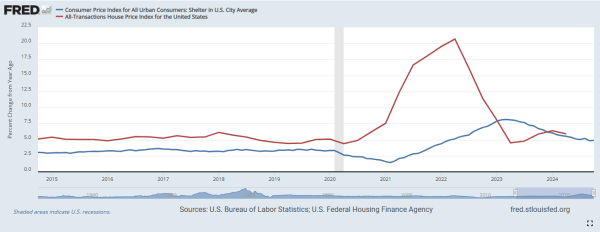
I graphed the CPI shelter index (blue line) versus the FHFA House Price Index (red line). You can see that the FHFA house price index leads the CPI shelter index, and FHFA’s house price growth is returning to pre-2020 levels. This should drag down the shelter component of CPI and return inflation back to pre-pandemic levels.
Mortgage applications increased 0.5% last week as purchases rose 2% and refis fell 2%. “Mortgage rates continued to increase last week, driven by higher Treasury yields as financial markets digested the likely impacts of a Trump presidency. The Federal Reserve’s 25-basis-point rate cut was already anticipated and did little to move the markets,” said Joel Kan, MBA’s Vice President and Deputy Chief Economist. “The 30-year fixed rate was at 6.86 percent last week, its highest since July 2024. However, despite the increase in rates, applications increased for the first time in seven weeks.”
Added Kan, “Purchase applications picked up and remained close to levels from a year ago. FHA and VA purchase applications drove the stronger overall purchase activity, increasing 3 percent and 9 percent, respectively. FHA mortgage rates bucked the overall trend and were lower over the week, which likely helped some borrowers. Conventional purchase applications were also up slightly. Meanwhile, the upward climb in rates led to refinance activity falling to its lowest level since May 2024.”
Stocks are higher this morning as markets digest the Trump victory. Bonds, on the other hand, are getting slammed.
The Trump trade is full swing, with stocks rising in anticipation of a more business-friendly environment. The action in bonds is probably to be expected, as investors adopt a risk-on position. Overall, Trump will probably be negative for long-term bonds for a few reasons. First, the risk-on aspect means that investors will prefer riskier assets like stocks to safe assets like bonds. Second, stronger economic activity will give the Fed less leeway to cut rates. And finally, hawkish trade policy is bad for Treasuries. The reason for this is that our trading partners run trade surpluses, which means they send us goods and services and we send them Treasuries in return. If trade declines, that means less demand for Treasuries and therefore higher rates at the margin.
All attention now turns to the Fed, which starts its meeting today. Longer-term, it will be interesting to see what happens to the GSEs.
The services economy expanded for the fourth consecutive month, according to the ISM Services Index. “The increase in the Services PMI® in October was driven by boosts of more than 4 percentage points for both the Employment and Supplier Deliveries indexes. The Business Activity and New Orders indexes both dropped by at least 2 percentage points. Each of the four subindexes are now above their averages for 2024. The Supplier Deliveries Index remained in expansion in October, indicating slower delivery performance. Concerns over political uncertainty were again more prevalent than the previous month. Impacts from hurricanes and ports labor turbulence were mentioned frequently, although several panelists mentioned that the longshoremen’s strike had less of an impact than feared due to its short duration.”
Mortgage applications fell 10.8% last week as purchases 5.1% and refis fell 18.5%. “Applications decreased for the sixth consecutive week, with purchase activity falling to its lowest level since mid-August and refinance activity declining to the lowest level since May. The average loan size on a refinance application dropped below $300,000, as borrowers with larger loans tend to be more sensitive to any given changes in mortgage rates”
Stocks are lower this morning on no real news. Bonds and MBS are down yet again.
The move in mortgage rates over the past month has been astounding. This is the Optimal Blue Mortgage Market Index for the 30 year conforming mortgage.
The 10 year bond yield has risen as well, but MBS spreads are widening. The ^MOVE index, which tracks bond market volatility is up some 42% over the past month, so that is probably driving it as well.
The media is claiming that this rise in rates is due to fears that the deficit will rise after the election. I guess that is possible, but fiscal rectitude in Washington kind of left the building circa 2009, so I can’t imagine that it is all of a sudden mattering now. The trader in me thinks this will turn out to be a “buy the rumor, sell the fact situation” and rates will peak right before the election, and then come back down as people unwind their Trump trades.
Homebuilder D.R. Horton reported fourth quarter numbers that disappointed the Street, and the stock is getting slammed pre-open. Sales and guidance disappointed.
“Despite continued affordability challenges and competitive market conditions, our net sales orders in the fourth quarter increased slightly from the prior year to 19,035 homes. Our sales pace was in line with normal seasonality from the third to fourth quarter but was below our expectations. While mortgage rates have decreased from their highs earlier this year, many potential homebuyers expect rates to be lower in 2025. We believe that rate volatility and uncertainty are causing some buyers to stay on the sidelines in the near term. To help spur demand and address affordability, we are continuing to use incentives such as mortgage rate buydowns, and we have continued to start and sell more of our homes with smaller floor plans. The supply of both new and existing homes at affordable price points is still generally limited, and demographics supporting housing demand are favorable. With a focus on affordable product offerings, 37,400 homes in inventory and continued improvement in our construction cycle times, we are well positioned for fiscal 2025.”
Home prices rose 4.2% annually in August, which is below the 4.8% annual average. “Home price growth is beginning to show signs of strain, recording the slowest annual gain since mortgage rates peaked in 2023,” says Brian D. Luke, CFA, Head of Commodities, Real & Digital Assets. “As students went back to school, home price shoppers appeared less willing to push the index higher than in the summer months. Prices continue to decelerate for the past six months, pushing appreciation rates below their long-run average of 4.8%.
After smoothing for seasonality in the data, home prices continued to reach all-time highs, for the 15th month in a row. “Regionally, all markets continue to remain positive, barely,” Luke continued. “Denver posted the slowest annual gain of all markets this year, dropping below Portland for the first time since the spring. The Northeast remains the best performing region, with the strongest gains for over a year. Currently, only New York, Las Vegas, and Chicago markets are at an all-time high. Comparing average gains of traditional red and blue states highlight a slight advantage for home price markets of blue states. With stronger gains in the Northeast and West than the South, blue states have outperformed red states dating back to July 2023.”