Morning Report: The labor market begins to weaken

Vital Statistics:

 LastChange
S&P futures4,00140.50
Oil (WTI)89.102.51
10 year government bond yield 3.22%
30 year fixed rate mortgage 5.91%

Stocks are higher this morning after the jobs report showed a deterioration in the labor market. Bonds and MBS are up.

The economy added 315,000 jobs in August, according to the BLS. This was a touch above the 293,000 consensus number, but a big decrease from the 526,000 that were reported in July. The unemployment rate ticked up 0.2% to 3.7%. The labor force participation rate increased to 61.4% from 61.1%, so this uptick in unemployment was driven by both an increase in the unemployed and an increase in the labor force. Average hourly earnings rose 5.1% YOY.

Overall, this report shows the Fed is finally getting some traction in slowing down the economy. Bonds took the report with a sigh of relief and stock have rallied as well.

The Fed Funds futures got a little more dovish after the report, with the Sep futures seeing a 62% chance of 75 basis points and a 38% chance of 50. The December futures are now handicapping a 40% chance of an end-of-year rate of 3.5%-3.75% and a 56% chance of 3.75%-4.0%.

It bears repeating that monetary policy acts with about a 6-9 month lag, so the big increases of the past couple of months have yet to impact the economy.

Home Prices rose 7.4% QOQ and 16.7% YOY according to the Clear Capital Home Data Index. The Northeast had the biggest quarterly growth at 11.6%. The Northeast and the Midwest have been laggards since the housing recovery began. The West looks like it is beginning to decelerate after torrid growth.

Note the Clear Capital index is about a month ahead of Case-Shiller and FHFA.

Construction spending fell 0.4% MOM and rose 8.4% YOY, according to Census. Residential construction fell 1.5% MOM and but is still up 14% YOY.

The median mortgage payment is approaching 150% of the typical rent payment, which is the biggest differential since 2009. In early 2020, the payments were roughly equal. This differential is a huge driver of the rent versus buy decision and is one of the reasons why purchase activity is slowing.

That said, it appears that home price appreciation is at least decelerating and the apartment REITs are all reporting mid-teens increases in rents for new tenants. So as rents rise and (hopefully) rates work back downwards that differential should close.

The combination of rising rates and rising prices have simply priced a lot of people out of the market.

Morning Report: Some good news on inflation

Vital Statistics:

 LastChange
S&P futures3,931-23.50
Oil (WTI)87.76-1.81
10 year government bond yield 3.52%
30 year fixed rate mortgage 5.81%

Stocks are lower on continued Fed fears. Bonds and MBS are down.

The 10 year bond yield soared in the last hour of trading yesterday. I didn’t see anything in particular driving it and I assumed it was just month-end noise. The sell-off is continuing this morning, so perhaps that doesn’t explain it. Regardless, the market seems to be bracing for a blockbuster jobs report tomorrow.

Some bad news for inflation: productivity fell 4.1% in the second quarter as output fell 1.4% and hours worked increased 2.7%. This number was a touch better than expectations, however. The bad number (at least for bonds and the Fed) was the 10.2% increase in unit labor costs, which was the highest since 1982. This as driven by a 5.7% increase in compensation and a 4.1% decrease in productivity. You can see in the chart below that we are getting back to levels last seen in the 1970s.

Interestingly, there is a bifurcation between manufacturing and non-manufacturing. Manufacturing productivity increased as output rose 4.1% and hours worked fell 0.7%. This mean that the service sector became highly inefficient during the quarter. Is this the quiet quitting phenomenon we have been reading about?

Announced job cuts fell 21% MOM to just over 25k, according to outplacement firm Challenger, Gray and Christmas. Announced job cuts are up 30% YOY however. “Employment data continue to point to a strong labor market. Job openings are high, layoffs are low, and workers seem to have slowed their resignations. If a recession is imminent, it’s not yet reflected in the labor data,” said Andrew Challenger, Senior Vice President of Challenger, Gray & Christmas, Inc. Separately, initial jobless claims fell 5k last week. Note job cuts in finance and fintech increased 765% to

Bottom line: while employment is a lagging indicator so far we aren’t seeing any evidence in the numbers that the job market is reacting to the increased fed funds rate. All eyes turn to the employment situation report tomorrow.

The ISM Manufacturing Index was flat in August, however the report generally contained good news. Most notably, the Prices index fell pretty dramatically and is back to June 2020 levels. Production fell while new orders increased. “The U.S. manufacturing sector continues expanding at rates similar to the prior two months. New order rates returned to expansion levels, supplier deliveries remain at appropriate tension levels and prices softened again, reflecting movement toward supply/demand balance. According to Business Survey Committee respondents’ comments, companies continued to hire at strong rates in August, with few indications of layoffs, hiring freezes or head-count reductions through attrition. Panelists reported lower rates of quits, a positive trend. Prices expansion eased dramatically in August, which — when coupled with lead times easing — should bring buyers back into the market, improving new order levels. Sentiment remained optimistic regarding demand, with five positive growth comments for every cautious comment.”

Morning Report: Mortgage applications hit a 22 year low

Vital Statistics:

 LastChange
S&P futures4,01122.00
Oil (WTI)90.21-1.38
10 year government bond yield 3.13%
30 year fixed rate mortgage 5.81%

Stocks are up this morning on no real news. Bonds and MBS are flat.

The Fed Funds futures continue to get more hawkish. The futures now see a 72% chance of a 75 basis point hike in September and a 65% chance of a total of 150 basis points in rate hikes by the end of the year. A month ago the market was circling a fed funds rate of 3.25%, and almost no chance of 3.75%. Today, the market sees a 65% chance of 3.75% and a negligible chance of a 3.25% rate.

Mortgage applications fell to the lowest level in 22 years, according to the MBA. “Application volume dropped and remained at a multi-decade low last week, led by an 8 percent decline in refinance applications, which now make up only 30 percent of all applications,” Kan added. “Purchase applications have declined in eight of the last nine weeks, as demand continues to shrink due to higher rates and a weaker economic outlook. However, rising inventories and slower home-price growth could potentially bring some buyers back into the market later this year.”

The chart for the index looks dismal indeed

FWIW, I think Joel Kan is probably correct, although purchase activity will probably rebound early in 2023 as the spring selling season starts. I don’t see a decline in overall home prices, although appreciation could slow back to normal levels.

I also think that the economy is weakening already and the impact of the Fed’s tightening have yet to be felt. With GDP growth already negative, and many of the supply issues having been solved the Fed Funds futures might be erring on the hawkishness side.

What the US desperately needs is a homebuilding boom, and hopefully we get one in early 2023 to help lead the economy out of recession as they have typically done in the past (2008 notwithstanding, as the recession was due to the bursting of the housing bubble).

FWIW, Goldman Sachs does not see a homebuilding boom in 2023. “Past housing downturns have typically been accompanied by economy wide recessions, which led to an influx of housing supply as unemployment rose and individuals were forced to sell their homes (this was especially the case in the financial crisis). However, an influx of supply from this channel seems unlikely this cycle: the labor market remains robust (and likely will, even in a mild recession) and, as we wrote last week, household balance sheets are extremely strong and loan delinquency rates are likely to remain historically low,” writes Goldman Sachs researchers. “Thereafter, we expect home prices to be flat in 2023.”

I agree with their statement that we won’t see a lot of forced selling – the economy is too strong for that. But I think hanging your hat on a labor market restricting supply as construction wages continue to rise is an awfully thin reed to hang on to. A lack of consumer pain could affect existing home sales, perhaps. But the simple fact is that there is an abject shortage of housing in the US, and homebuilders will take advantage of it at some point. Note that gross margins are sky-high for the builders. I will admit there have been a lot of false dawns for homebuilding, so perhaps the trend will continue.

Morning Report: Dove Neel Kashkari “happy” with stock market sell-off

Vital Statistics:

 LastChange
S&P futures4,04415.00
Oil (WTI)94.07-1.38
10 year government bond yield 3.09%
30 year fixed rate mortgage 5.79%

Stocks are higher this morning on no real news. Bonds and MBS are up small.

Minneapolis Fed President Neel Kashkari said he was “happy” to see the stock market reaction to Jerome Powell’s speech on Friday. “I was actually happy to see how Chair Powell’s Jackson Hole speech was received,” Kashkari said in an interview with Bloomberg’s Odd Lots podcast on Monday, reflecting on the steep drop after Powell spoke. “People now understand the seriousness of our commitment to getting inflation back down to 2%.”

Since Neel Kashkari has historically been one of the biggest doves on the Fed, this statement has even more impact. The market is interpreting Powell’s remarks as the Fed wants to see demand destruction, not just an improvement on the supply side. In other words, falling commodity prices and an improvement in supply chain issues are a necessary, but not sufficient, impetus to get the Fed to pivot. IMO, the Fed wants to see at least 4% unemployment before it thinks of pulling back.

We are seeing some improvements on the inflation front. One indicator that is useful for global demand is the Baltic Dry Index which measures the cost of moving raw materials by sea. When the index falls, it indicates that demand is slowing. We can see the chart below which has been falling.

Fridays jobs report could be a reversion to the old “bad news is good news” phenomenon. If we see an uptick in unemployment, markets could rally since this would mean the Fed’s tightening is gaining traction.

Consumer Confidence improved in August according to the Conference Board. These consumer confidence indices are heavily influenced by gasoline prices, so this does reflect an easing of prices over the past month.

“Consumer confidence increased in August after falling for three straight months,” said Lynn Franco, Senior Director of Economic Indicators at The Conference Board. “The Present Situation Index recorded a gain for the first time since March. The Expectations Index likewise improved from July’s 9-year low, but remains below a reading of 80, suggesting recession risks continue. Concerns about inflation continued their retreat but remained elevated. Meanwhile, purchasing intentions increased after a July pullback, and vacation intentions reached an 8-month high. Looking ahead, August’s improvement in confidence may help support spending, but inflation and additional rate hikes still pose risks to economic growth in the short term.”

Job openings ticked up slightly in July, but the trend is still generally lower as we retreat from record highs. The quits rate (which tends to lead wage growth) ticked down to 2.7%. This is an indication that the labor market is softening a touch. Note this is July data, so it is somewhat dated.

Home prices rose 17.7% YOY and 4% QOQ, according to the FHFA House Price Index. “Housing prices grew quickly through most of the second quarter of 2022, but a deceleration has appeared in the June monthly data” said William Doerner, Ph.D., Supervisory Economist in FHFA’s Division of Research and Statistics. “The pace of growth has subsided recently, which is consistent with other recent housing data.”

Morning Report: Jerome Powell spooks the markets

Vital Statistics:

 LastChange
S&P futures4,027-32.27
Oil (WTI)94.421.38
10 year government bond yield 3.09%
30 year fixed rate mortgage 5.70%

Stocks are lower this morning on follow-through Jerome Powell’s Jackson Hole speech last Friday. Bonds and MBS are down.

Jerome Powell’s Jackson Hole speech was a seismic event in the stock market, although the reaction didn’t really get going until long after. Here were his prepared remarks. It looks like this section was what got everyone’s attention:

Restoring price stability will take some time and requires using our tools forcefully to bring demand and supply into better balance. Reducing inflation is likely to require a sustained period of below-trend growth. Moreover, there will very likely be some softening of labor market conditions. While higher interest rates, slower growth, and softer labor market conditions will bring down inflation, they will also bring some pain to households and businesses. These are the unfortunate costs of reducing inflation. But a failure to restore price stability would mean far greater pain.

The stock market and the bond market sold off and the Fed Funds futures got more hawkish. They are now predicting a 2/3 chance of a 75 basis point hike in September and a 1/3 chance of a 50 basis point hike. The December futures are handicapping a 50% chance that the target rate will be 3.75% – 4.00%. A month ago, that wasn’t even in the mix. So basically over the past month, we have added about 50 basis points to the end-of-the year Fed funds futures forecast.

The reaction in the bond market was to send the 2 year and the 10 year yield higher, and a stronger inversion to the yield curve. The 2s 10s spread is 33 basis points and 2s 30s is 18 basis points. So this is a pretty substantial recessionary indication.

I would summarize the market’s interpretation of Powell’s comments as this: “We are going to raise rates higher than the market is anticipating, and will keep them there longer than the market is anticipating. We are going to cause a recession and if we have a hard landing, so be it.”

Is this an overreaction? Quite possibly. I would ask however if inflation has gotten worse or better since the June meeting. Because in June, the Fed saw a Fed Funds rate of 3.25% – 3.5%.

The month-over-month changes for the CPI were 1.0% in May, 1.3% in June and 0% in July. PCE inflation has been trending down as well. We will get 2 more jobs reports and 1 more CPI report before the Fed meets in September. If inflation is indeed moderating, I don’t see the Fed upping their own Fed Funds forecast, especially since they see the long-term rate (last column) around 2.5%.

The week ahead will contain a lot of important data, with the jobs report on Friday being the most critical. We will also get some house price data with FHFA on Tuesday. On Thursday we get ISM, productivity and costs and construction spending.

Morning Report: Some encouraging news on inflation

Vital Statistics:

 LastChange
S&P futures4,2011.27
Oil (WTI)91.97-0.48
10 year government bond yield 3.05%
30 year fixed rate mortgage 5.73%

Stocks are flat as we await Jerome Powell’s speech at Jackson Hole. Bonds and MBS are up.

Personal Incomes rose 0.2% MOM in July, which was a dramatic slowdown from the 0.7% recorded in June. Personal consumption expenditures fell from 1% to 0.1%.

Finally, the PCE Price Index (which is the Fed’s preferred measure of inflation) fell 0.1% on a MOM basis. Ex-food and energy, it was up 0.1%. This suggests that we have turned the corner on inflation, however the Fed will need to see a string of these before it takes its foot off the brakes. On a YOY basis, the PCE Price Index rose 6.3% on the headline number and 4.6% ex-food and energy.

Blackstone-backed Home Partners of America is stopping purchases of homes in 38 cities and will add more in October. This is the latest sign than institutional investors are getting nervous about the torrid home price appreciation we have seen over the past several years.

Consumers are beginning to improve their mood, according to the University of Michigan Consumer Sentiment Index. The improvement was largely due to better expectations for the economy going forward. Most notably, expectations for year-ahead inflation fell to 4.8%, the lowest in 8 months. The Fed pays close attention to this number.

Morning Report: Second quarter GDP revised upward

Vital Statistics:

 LastChange
S&P futures4,15915.27
Oil (WTI)95.150.26
10 year government bond yield 3.10%
30 year fixed rate mortgage 5.74%

Stocks are higher as we await the Jackson Hole economic summit. Bonds and MBS are down small.

Second quarter GDP was revised upward from -0.9% to -0.6% as the estimate for personal consumption was increased. The GDP Price Index rose 7.7% on a year-over-year basis. Ex-food and energy it rose 4.4%. These rates were the same as the first estimate.

Note the Atlanta Fed’s GDP Now estimate for the third quarter was updated yesterday. They now see Q3 GDP rising at a 1.4% rate, a downward revision from the 1.6% predicted a week ago.

Housing affordability improved for the second straight month, according to the MBA. “Affordability conditions improved modestly in most of the country in July, as slightly lower mortgage rates and a decrease in the median loan amount led to the typical homebuyer’s mortgage payment falling $49 from June,” said Edward Seiler, MBA Associate Vice President of Housing Economics and Executive Director of the MBA Research Institute for Housing America. “Homebuyer demand has faltered this summer, as lingering economic uncertainty, high inflation and still-high mortgage rates caused many prospective buyers to delay their home search. The combination of a strong job market and moderating home-price growth could entice some of these buyers to return in the coming months.”

The silver bullet that will offset rising rates and home prices is wage inflation. Wage inflation generally lags goods and services inflation since raised are usually negotiated at the end of the year.

Note that the college loan forgiveness plan that the Administration recently unveiled might help here too, though it probably will just cause colleges to raise tuition in response.

Initial Jobless Claims ticked down to 243k last week. Despite all of the economic headwinds, the labor market continues to hold up.

Morning Report: Housing recession

Vital Statistics:

 LastChange
S&P futures4,132-1.50
Oil (WTI)93.77-0.01
10 year government bond yield 3.09%
30 year fixed rate mortgage 5.68%

Stocks are flattish this morning on no real news. Bonds and MBS are down small.

Mortgage Applications hit a 22-year low last week as purchases declined 1% and refis fell 3%. “Mortgage applications continued to remain at a 22-year low, held down by significantly reduced refinancing demand and weak home purchase activity,” said Joel Kan, MBA Associate Vice President of Economic and Industry Forecasting. “Last week’s purchase results varied, with conventional applications declining 2 percent and government applications increasing 4 percent, which is potentially a sign of more first-time homebuyer activity. The average purchase loan size continued to trend lower, as purchase activity at the high end of the market is weakening.”

Durable Goods orders were flat in July, according to Census. This is further indication that the rate increases of earlier this year are beginning to be felt. Durable Goods shipments rose 0.4%. Slowing orders are an indication of declining demand, which should help alleviate some of the supply chain issues that are driving up prices.

Home prices are beginning to fall. Part of this is due to seasonality (prices generally peak in June), however they have gone up in such a straight line that a correction is probably due. “House prices are rolling over,” says Mark Zandi, chief economist at Moody’s Analytics. “They’re going from straight north to going sideways and, I expect, would be going south in the not too distant future, certainly by this time next year.”

The hottest markets in the Southwest, Southern California, the Mountain states and Florida could be the most vulnerable. Many of these places saw 30% price appreciation over the past year. “These most juiced-up markets … could see 10% to 15% declines, and that’s assuming no recession,” says Moody Analytics’ Zandi. “If we get into a recession, then we’re talking 15%, 20%. I could even see some markets down 25% from their peak.”

FWIW, I think the supply – demand imbalance will prevent a nationwide price decline of any significance. We aren’t going to experience another 2006 – 2010 time period. This is more of a “buyer’s strike” than a “forced selling” event.

Pending Home Sales fell 8.6% in July to an index level of 91 (where 100 – the 2001 market). “Contract signings to buy a home will keep tumbling down as long as mortgage rates keep climbing, as has happened this year to date,” said NAR Chief Economist Lawrence Yun. “There are indications that mortgage rates may be topping or very close to a cyclical high in July. If so, pending contracts should also begin to stabilize. Home sales will be down by 13% in 2022, according to our latest projection,” Yun added. “With mortgage rates expected to stabilize near 6% and steady job creation, home sales should start to rise by early 2023.”

Between falling home sales and declining mortgage applications, we are in a housing recession that should probably last until at least the Spring Selling Season next year.

Morning Report: New home sales fall

Vital Statistics:

 LastChange
S&P futures4,135-5.50
Oil (WTI)91.87-0.67
10 year government bond yield 3.07%
30 year fixed rate mortgage 5.68%

Stocks are lower this morning as the sell-off continues based on fear of the Fed. Bonds and MBS are down.

New home sales came in at 511,000 in July, which was weaker than expected. This is down 13% MOM and 30% YOY. It is astounding that building is so weak during a shortage. Yes, rates matter but historically the current rate environment is still quite low.

The second quarter of 2022 was brutal for mortgage bankers, with companies losing about 5 basis points on average (or about $82 per loan). Given that the second and third quarters are usually the most profitable for the industry, this is an issue. This was the first second quarter loss since 2008. The industry is in the famine part of the cycle.

Multifamily construction hit a record high in the second quarter, as apartment builders react to soaring rental prices. The biggest driver of rising home prices has been a lack of supply. Rising rents are a function of rising home prices, so this should put at least some downward pressure on rising home prices.

96% of these units were built for rent. This share fell to 47% during the condo-building boom of 2005.

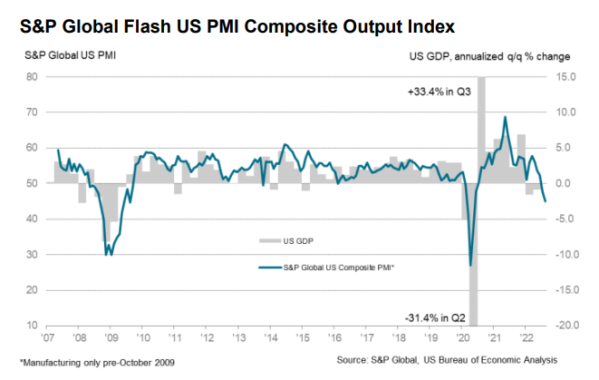
Rising rates are beginning to be felt in the economy, at least according to the S&P Composite flash PMI. Respondents reported softening demand and slowing price increases. This is also easing the labor issue as firms scale back hiring plans.

Since monetary policy generally affects the economy with a 6- 9 month lag, we are only beginning to feel the impact of rising rates. The big increases over the past few months will start to impact late Q4 numbers.

Interestingly, the Atlanta Fed GDP Now Index shows a rebound in expected growth for Q3, after two negative prints in Q1 and Q2. According to this chart at least, that looks optimistic.

Morning Report: The Fed remains hawkish

Vital Statistics:

 LastChange
S&P futures4,187-44.50
Oil (WTI)91.20-0.67
10 year government bond yield 2.98%
30 year fixed rate mortgage 5.60%

Stocks are lower this morning as last week’s selling continues. Bonds and MBS are flat.

The upcoming week will have some important economic data with the second revision to Q2 GDP on Thursday, and personal incomes / spending on Friday. The personal income and spending indices will contain the personal consumption expenditures inflation index which is the Fed’s preferred measure of inflation.

The Jackson Hole summit will also take place this week. Jerome Powell will speak on Friday. There usually isn’t much in the way of market-moving data during these events, but the markets are hyper-attuned to the potential for a Fed pivot.

Investors hoping for the Fed Pivot were left disappointed by the minutes from the July meeting. “Participants agreed that there was little evidence to date that
inflation pressures were subsiding. They judged that inflation would respond to monetary policy tightening and the associated moderation in economic activity with a delay and would likely stay uncomfortably high for some time.”

While some participants thought the Fed Funds rate had hit the “neutral” range, others pointed out that with inflation so high, real interest rates were still stimulative. Some said that the Fed Funds rate needed to get to a restrictive level.

Bottom line: the rate hikes will continue. The Fed Funds futures became slightly more hawkish after the minutes, with the market now looking at 125 basis points in tightening by the end of the year.

Existing home sales fell for the sixth month in a row, according to NAR. The median home price fell about $10,000, although it is up 10.8% on a year-over-year basis. “The ongoing sales decline reflects the impact of the mortgage rate peak of 6% in early June,” said NAR Chief Economist Lawrence Yun. “Home sales may soon stabilize since mortgage rates have fallen to near 5%, thereby giving an additional boost of purchasing power to home buyers…”We’re witnessing a housing recession in terms of declining home sales and home building,” Yun added. “However, it’s not a recession in home prices. Inventory remains tight and prices continue to rise nationally with nearly 40% of homes still commanding the full list price.”

Some MSAs have been pretty hot, especially in Florida and Phoenix. I wouldn’t be surprised to see prices begin to peak in these areas, but the chance for a nationwide decline in prices seems remote. We just don’t have enough supply, and I suspect there are a lot of people who will enter the market on a pullback.

Economic Activity improved in July, according to the Chicago Fed National Activity Index. This is sort of a meta-index that takes into account all sorts of leading and lagging indicators. Production and incomes drove the increase, although all 4 indicators (production, employment, consumption and sales) increased.