Morning Report: Inflation and GDP revised upwards

Vital Statistics:

 LastChange
S&P futures4,02323.50
Oil (WTI)74.93 0.98
10 year government bond yield 3.97%
30 year fixed rate mortgage 6.64%

Stocks are higher this morning on no real news. Bonds and MBS are down again.

Fourth quarter GDP rose 2.7%, in the second revision. Third quarter growth was revised upward to 3.2%. Growth was driven primarily by inventory growth. Services spending rose, driven by housing and health care. Government spending was revised upward as well. Personal consumption expenditures were revised downward from 2% to 1.4%.

The PCE price index was also revised upward by 0.5% to 3.7%. Excluding food and energy, the index rose 0.4% to 4.3%. Needless to say, not good news on the inflation front, however we are talking about data that was far in the past at this point.

The FOMC minutes shed some further light on the comments from Loretta Mester and James Bullard last week. On the decision whether to raise 25 basis points or 50 basis points, they said:

Against this backdrop, and in consideration of the lags with which monetary policy affects economic activity and inflation, almost all participants agreed that it was appropriate to raise the target range for the federal funds rate 25 basis points at this meeting. Many of these participants observed that a further slowing in the pace of rate increases would better allow them to assess the economy’s progress toward the Committee’s goals of maximum employment and price stability as they determine the extent of future policy tightening that will be required to attain a stance that is sufficiently restrictive to achieve these goals. A few participants stated that they favored raising the target range for the federal funds rate 50 basis points at this meeting or that they could have supported raising the target by that amount. The participants favoring a 50 basis point increase noted that a larger increase would more quickly bring the target range close to the levels they believed would achieve a sufficiently restrictive stance, taking into account their views of the risks to achieving price stability in a timely way.

We knew that Mester and Bullard were in the 50 basis point camp, and “a few” implies one more. The Committee noted that we had some welcome inflation prints, but more evidence of stabilization would be needed.

In other economic news, initial jobless claims came in at 192,000 (anything under 200k is exceptional) and the Chicago Fed National Activity index reversed to a positive number, primarily driven by strong employment and consumption data.

The total value of US residential real estate fell by 4.9% (or about $2.3 trillion) from its June peak, according to data from Redfin. “The housing market has shed some of its value, but most homeowners will still reap big rewards from the pandemic housing boom,” said Redfin Economics Research Lead Chen Zhao. “The total value of U.S. homes remains roughly $13 trillion higher than it was in February 2020, the month before the coronavirus was declared a pandemic.”

The Bay Area saw the brunt of the selling. New York City, Seattle and Boise also saw decreases. The suburbs held up better than the cities themselves.

Here is the official notice for the FHA mortgage insurance reduction.

More pain in the commercial real estate sector (particularly office buildings): Columbia Property Trust (owned by PIMCO) defaulted on $1.8 billion in mortgage notes on office buildings in New York City, Boston, and San Francisco. We are also seeing defaults on mortgages for shopping malls. The commercial real estate sector’s pain is being driven by rising short term rates (anyone who has floating rates is feeling the pain) and also a sea-change in office work. Note that S.L. Green keeps hitting new occupancy lows.

The problems in commercial real estate has the potential to impact residential, at least the non-QM sector.

Wells Fargo laid off hundreds of mortgage bankers this week. “We announced in January strategic plans to create a more focused home-lending business,” she said. “As part of these efforts, we have made displacements across our home-lending business in alignment with this strategy and in response to significant decreases in mortgage volume.”

Morning Report: Awaiting the FOMC minutes

Vital Statistics:

 LastChange
S&P futures4,012 5.50
Oil (WTI)75.73-0.60
10 year government bond yield 3.94%
30 year fixed rate mortgage 6.64%

Stocks are flattish after yesterday’s bloodbath. Bonds and MBS are down.

The FOMC minutes will be released at 2:00 pm. We know that Mester and Bullard were considering a 50 basis point hike in February, so it will be interesting to hear if the members were more hawkish than the February press release suggested. Bullard recently said that he sees the Fed Funds rate rising to 5.375%, which presumably means that the terminal Fed Funds rate will be in a range of 5.25%- 5.5%. This comports with the June Fed Funds futures.

Despite the sturm and drang in the bond markets, the Fed Funds futures haven’t changed all that much. The March futures see a 79% chance of a 25 basis point hike and a 21% chance of a 50 basis point hike, while the December futures still see a range of 5%-5.25% as the most likely outcome.

The reversal in rates didn’t help mortgage applications last week. The MBA mortgage application index fell 13.3% as purchases fell 18% and refis fell 2%. The purchase index is 41% lower than a year ago, while the refi index is down 72%. “Mortgage rates increased across all loan types last week, with the 30-year fixed rate jumping 23 basis points to 6.62 percent – the highest rate since November 2022. The jump led to the purchase applications index decreasing 18 percent to its lowest level since 1995,” said Joel Kan, MBA’s Vice President and Deputy Chief Economist. “This time of the year is typically when purchase activity ramps up, but over the past two weeks, rates have increased significantly as financial markets digest data on inflation cooling at a slower pace than expected. The increase in mortgages rates has put many homebuyers back on the sidelines once again, especially first-time homebuyers who are most sensitive to affordability challenges and the impact of higher rates.”

HUD is reducing the mortgage insurance premium for FHA loans. Supposedly the premium is falling from 115 to 85 basis points. This will help affordability issues for this Spring Selling Season, although high prices and rates will matter more.

Luxury homebuilder Toll Brothers announced earnings after the close yesterday. Earnings per share rose, while revenues were up 4%. The cancellation rate was surprisingly low at only 14%. Gross margins rose, so there is no evidence of price-cutting or promotional activity in the luxury home space.

“Since the start of the calendar year, we have seen a marked increase in demand beyond normal seasonality as buyer confidence appears to be improving. We believe the recent pick-up in demand is a sign that the long-term fundamentals underpinning the housing market remain intact. These include favorable demographic and migration trends, a very tight resale market, and growing pent-up demand resulting from over a decade of underproduction. Notwithstanding near-term uncertainty in the economy, we expect these factors will continue to support the housing market well into the future.”

I am accepting ads for this blog if you would like to make an announcement, highlight something your company is offering or want more visibility. I also offer white-label services which give you the ability to use this content for your own daily emails. Please feel free to reach out to nyitray@hotmail.com if you would like to discuss this further.

Morning Report: Existing home sales fall

Vital Statistics:

 LastChange
S&P futures4,052-34.50
Oil (WTI)76.91-0.57
10 year government bond yield 3.89%
30 year fixed rate mortgage 6.52%

Stocks are lower this morning on no real news. Bonds and MBS are down.

The upcoming week will be dominated by the FOMC minutes on Wednesday and PCE inflation on Friday. We will also get the second estimate for Q4 GDP and new home sales.

Stocks are somewhat soggy this morning after disappointing 2023 forecasts from bellwether retailers WalMart and Home Depot. Wage inflation with soft demand will combine to reduce earnings.

Rental inflation declined for the sixth straight month, according to CoreLogic. “U.S. single-family rental price growth closed out 2022 at about half of what it was one year ago,” said Molly Boesel, principal economist at CoreLogic. “However, while rent growth has been slowing, it still rose at more than double the pre-pandemic rate. Rental price gains began increasing near the end of 2020 and have risen by about an average of $300 in the past two years. Annual single-family rent growth is projected to slow throughout 2023, but it will likely not decline by enough to wipe out gains from the past two years.”

The slowdown is most pronounced in the higher priced properties, where the top quartile fell from 11.9% annual growth in 2021 to 5.1% in 2022. The bottom quartile saw rent increases of 9.2%. Orlando saw the biggest price increase at 10.8%, while Phoenix saw the lowest at 1.2%.

Rental inflation tends to lag home price inflation by about 21 months, so this phenomenon should take a while to play out. Note the Fed thinks that housing’s impact on the inflation numbers will fade by this summer.

Homebuilder LGI Homes reported fourth quarter numbers that missed Street expectations. Sales fell 39% and net income fell 69%. The cancellation rate rose to 24%, and backlog decreased 66% in units. “We enter 2023 with tempered optimism. Recent lead and sales trends have been very positive. In the first eight weeks of the year, our retail net orders pace has been 7.2 homes per active community, compared to 2.9 in the fourth quarter of 2022. However, mortgage rates are again rising and the Fed’s interest rate path is still uncertain. Therefore, our focus remains on what we control – driving leads through marketing, controlling input costs, starting affordable, move-in ready homes at a disciplined pace and maintaining our strong balance sheet while investing to support our future growth.”

Existing home sales fell 0.7% MOM to a seasonally-adjusted annual pace of 4 million units. This is down 37% compared to a year ago. “Home sales are bottoming out,” said NAR Chief Economist Lawrence Yun. “Prices vary depending on a market’s affordability, with lower-priced regions witnessing modest growth and more expensive regions experiencing declines. Home sales are bottoming out, prices vary depending on a market’s affordability, with lower-priced regions witnessing modest growth and more expensive regions experiencing declines.”

The median home price came in at $359,000 which is an increase of 1.3% compared to a year ago. Prices rose everywhere except the West.

Morning Report: More hawkish Fed-speak

Vital Statistics:

 LastChange
S&P futures4,077-22.50
Oil (WTI)75.94-2.57
10 year government bond yield 3.89%
30 year fixed rate mortgage 6.52%

Stocks are lower this morning as markets digest hawkish comments from Fed speakers. Bonds and MBS are down.

We had some hawkish Fed-speak yesterday, and markets are in a risk-off mode.

Cleveland Fed President Loretta Mester gave a speech yesterday. “The FOMC has come an appreciable way in bringing policy from a very accommodative stance to a restrictive one, but I believe we have more work to do.  Precisely how much higher the federal funds rate will need to go and for how long policy will need to remain restrictive will depend on how much inflation and inflation expectations are moving down, and that will depend on how much demand is slowing, supply challenges are being resolved, and price pressures are easing.  At this juncture, the incoming data have not changed my view that we will need to bring the fed funds rate above 5 percent and hold it there for some time to be sufficiently restrictive to ensure that inflation is on a sustainable path back to 2 percent.  Indeed, at our meeting two weeks ago, setting aside what financial market participants expected us to do, I saw a compelling economic case for a 50-basis-point increase, which would have brought the top of the target range to 5 percent

In a separate speech, James Bullard said: “I was an advocate for a 50-basis-point hike and I argued that we should get to the level of rates the committee viewed as sufficiently restrictive as soon as we could….Inflation remains too high but has declined,” adding that “continued policy rate increases can help lock in a disinflationary trend during 2023, even with ongoing growth and strong labor markets.”

The March Fed Funds futures are now factoring in a 21% chance of a 50 basis point hike at the March meeting. The 10 year yield has moved up dramatically in the past 2 weeks.

Mortgage originations came in at $498B in Q4, according to the Fed. This resembles pre-pandemic volumes. Delinquency rates ticked up as well. Total household debt rose to $16.9 trillion.

The Index of Leading Economic Indicators declined again in January, according to the Conference Board. “The US LEI remained on a downward trajectory, but its rate of decline moderated slightly in January,” said Ataman Ozyildirim, Senior Director, Economics, at The Conference Board. “Among the leading indicators, deteriorating manufacturing new orders, consumers’ expectations of business conditions, and credit conditions more than offset strengths in labor markets and stock prices to drive the index lower in the month. The contribution of the yield spread component of the LEI also turned negative in the last two months, which is often a signal of recession to come. While the LEI continues to signal recession in the near term, indicators related to the labor market—including employment and personal income—remain robust so far. Nonetheless, The Conference Board still expects high inflation, rising interest rates, and contracting consumer spending to tip the US economy into recession in 2023.”

Morning Report: Wholesale inflation comes in hotter than expected

Vital Statistics:

 LastChange
S&P futures4,122-33.50
Oil (WTI)78.38-0.18
10 year government bond yield 3.82%
30 year fixed rate mortgage 6.49%

Stocks are lower this morning after inflation at the wholesale level came in stronger than expected. Bonds and MBS are down.

Inflation at the wholesale level grew at the fastest rate since June of 2022, according to the Producer Price Index. This was after two months of declines in November and December. The index rose 6.0% on an annual basis. Energy costs were the big driver. This was higher than Street expectations.

Stripping out food, energy and trade services, the index rose 0.6% month-over-month and 4.5% year-over-year. This monthly increase was the fastest in nearly a year.

So, between the jobs report, the CPI report, retail sales and the PPI, we have evidence that growth accelerated in January. The Atlanta Fed’s GDP Now estimate has ticked up as well. The March Fed Funds futures see a 85% chance for a 25 basis point hike and a 15% chance for a 50 basis point hike. The projection materials and dot plot will be interesting.

Is there any gloom? Sure, housing. Housing starts fell to a seasonally-adjusted annual pace of 1.3 million in January. This is a 21% annual decline and the lowest level since June of 2020.

Chris Whalen has a great editorial about how FHFA is changing the rules for servicers as a result of COVID. Essentially loans in forbearance during COVID won’t be offered the same sort of reps and warrants relief as typically granted during a natural disaster. This creates an open-ended liability stream for mortgage bankers. Essentially the government asked servicers to offer forbearance and can now slug them for it.

He also mentions that a lot of banks are sitting on big unrealized losses on their portfolios of mortgages originated in 2020 and 2021. This includes Fannie Mae and Freddie Mac, which might explain the change in policy. He stated that banks have a $350 billion deficit for available for sale securities and loans. Many of these securities and loans are now trading at 15-20 point discounts in the market and might have to be sold. Hedge funds which are flush with cash might be able to pick up a good trade if that happens.

I am accepting ads for this blog if you would like to make an announcement, highlight something your company is offering or want more visibility. I also offer white-label services which give you the ability to use this content for your own daily emails. Please feel free to reach out to nyitray@hotmail.com if you would like to discuss this further.

Credit Suisse is spinning off its investment bank First Boston, which hasn’t existed for 25 years. Makes me wonder if other spin-offs might be in the cards. Synchrony spinning off Kidder Peabody, Bank of America spinning off Merrill Lynch, Deutsche Bank spinning off Bankers Trust, Citi spinning off Salomon Brothers and Smith Barney?

Investors bought 48,445 homes in the fourth quarter of 2022, which is the second biggest quarterly decline. “A lot of investors are on hold because they still see home prices declining,” said Elena Fleck, a Redfin real estate agent in Palm Beach, FL. “The investors who are in the market are selective and aggressive. Many of them are only offering around 60% of the asking price since it’s so difficult to make a profit when flipping homes right now.”

Note that there is a lot of political sturm and drang over investors purchasing single family homes as rentals. In the context of existing home sales (5 million units per year) 50k in a quarter seems like small beer.

“It’s possible that investors will start to wade back into the market this year given that mortgage rates have ticked down from their 2022 high—especially if home prices show signs of bottoming. But it’s unlikely that investors will return with the same vigor they had in 2021. That’s good news for individual buyers, who are still grappling with high housing costs but no longer losing bidding war after bidding war to investors.” Maybe the first time homebuyer might be able to get involved this Spring Selling Season.

Morning Report: Strong retail sales

Vital Statistics:

 LastChange
S&P futures4,130-15.50
Oil (WTI)78.38-0.78
10 year government bond yield 3.75%
30 year fixed rate mortgage 6.44%

Stocks are lower this morning after the strong retail sales number. Bonds and MBS are down.

Retail sales rose 3% month-over-month and 6.4% year-over-year according to the Census Department. This was well above expectations. Excluding vehicles and gas, sales rose 2.6% MOM. Note these numbers are not adjusted for inflation, so retail sales were flat YOY on an inflation-adjusted basis.

Homebuilder confidence improved in February, according to the NAHB. “With the largest monthly increase for builder sentiment since June 2013, the HMI indicates that incremental gains for housing affordability have the ability to price-in buyers to the market,” said NAHB Chairman Alicia Huey, a custom home builder and developer from Birmingham, Ala. “The nation continues to face a sizeable housing shortage that can only be closed by building more affordable, attainable housing. However, the two monthly gains for the HMI at the start of 2023 match the cautious optimism noted by the large number of builders at the recent International Builders’ Show in Las Vegas, who reported a better start to the year than expected last fall.”

“While the HMI remains below the breakeven level of 50, the increase from 31 to 42 from December to February is a positive sign for the market,” said NAHB Chief Economist Robert Dietz. “Even as the Federal Reserve continues to tighten monetary policy conditions, forecasts indicate that the housing market has passed peak mortgage rates for this cycle. And while we expect ongoing volatility for mortgage rates and housing costs, the building market should be able to achieve stability in the coming months, followed by a rebound back to trend home construction levels later in 2023 and the beginning of 2024.”And while builders continue to offer a variety of incentives to attract buyers during this housing downturn, recent data indicate that the housing market is showing signs of stabilizing off a cyclical low

Mortgage applications fell 7.7% last week as purchases fell 5.5% and refis fell 12.5%. “Mortgage rates increased across the board last week, pushed higher by market expectations that inflation will persist, thus requiring the Federal Reserve to keep monetary policy restrictive for a longer time. After five straight weeks of decreases, the 30-year fixed rate increased by 21 basis points to 6.39 percent,” said Joel Kan, MBA’s Vice President and Deputy Chief Economist. “Mortgage applications decreased for the second time in three weeks because of these higher rates. Refinance borrowers, both rate/term and cash-out, remain on the sidelines as current rates provide little financial incentive to act.”

Added Kan, “Purchase applications dropped to their lowest level since the beginning of this year and were more than 40 percent lower than a year ago. Potential buyers remain quite sensitive to the current level of mortgage rates, which are more than two percentage points above last year’s levels and have significantly reduced buyers’ purchasing power.”

Inflationary expectations fell to 2.9%, according to the Atlanta Fed. This comports with the University of Michigan data. That said, we are still well above the 2% target for the Fed.

Industrial production was flat in January, according to the Federal Reserve. Manufacturing output rose 1%. Capacity Utilization fell to 78.3%.

Morning Report: Inflation comes in hotter than expected

Vital Statistics:

 LastChange
S&P futures4,134-12.50
Oil (WTI)78.09-2.78
10 year government bond yield 3.73%
30 year fixed rate mortgage 6.39%

Stocks are lower after the bad inflation print. Bonds and MBS are down.

We will have 3 Fed speakers today. It will be interesting if the CPI print comes up.

The consumer price index rose 0.5% MOM in January, breaking a streak of lower monthly numbers. Excluding food and energy the CPI rose 0.4%. Inflation rose 6.4% on an annual basis. Shelter was the biggest addition to inflation, and that will fade as we get into summer where home prices peaked last year.

The part the Fed is worried most about is services ex-housing, which is basically wage inflation. The labor market remains tight as a drum and wages are still increasing at a faster pace than the Fed would like to see. The White House just put out something on this subject – average hourly earnings for the non-housing services. You can see the spike in this index over the past year

Luckily it is going in the right direction, but we are still above the highest pre-pandemic level going back 30 years. That fact is going to keep the Fed on the inflation beat. People hoping for a Fed pivot will need to watch this index.

Small Business Optimism increased in January, according to the National Federation of Independent Businesses. Prices are still increasing, although the net number of businesses raising prices did moderate a touch.

“The Index of Small Business Optimism has been in recession territory
all last year and into 2023. If it weren’t for the Job Openings and Hiring
Plans components, the Index would be much lower
. Actual capital
spending and inventory investment are very weak as are plans to
spend. Earnings are dismal. Actual sales trends are negative and
expected real sales are also. When we ask owners if they have any job
openings they reply “yes, I’d hire more if I could,” so hiring plans are
historically high as is the level of job openings. Everything else is pretty
much in the tank
. When we ask owners if they were successful in hiring
and filling open positions, the answer is “no,” more firms reported
reducing employment than increasing it and the average addition of
workers is smaller than the reported reduction. These openings and
hiring plans roll over from month to month.”

If you look at the historical chart, you can see things are pretty much lousy, back towards what we saw during the Great Recession.

Black Knight is close to selling its Empower LOS is order to gain antitrust approval to merge with Intercontinental Exchange. The antitrust regulators were almost certain to prohibit Encompass and Empower from being under the same roof. Encompass and Empower are the #1 and #2 loan origination systems in what is a pretty concentrated industry. No mention of who would be the buyer.

Rate lock volumes rose 23% in January according to the Black Knight Mortgage Monitor. Some of this is seasonality, however lower rates are playing a part as well. “Mortgage rates declined in January, continuing a trend that began in early November 2022,” said Kevin McMahon, president of Optimal Blue, a division of Black Knight. “Conforming rates dropped 36 basis points from where they were at the start of the year, and we saw that rates associated with those FHA/VA/jumbo locks all came down in kind. Triggered by this pullback, rate lock volumes rose for the first time since March 2022, driven by declining interest rates and seasonal tailwinds, snapping a nine-month streak of declines.”

Morning Report: Loan demand falls while standards tighten

Vital Statistics:

 LastChange
S&P futures4,109 9.50
Oil (WTI)78.95-0.78
10 year government bond yield 3.75%
30 year fixed rate mortgage 6.33%

Stocks are higher this morning on no real news. Bonds and MBS are down.

The week ahead will have some important data on housing and inflation, with the Consumer Price Index on Tuesday, and the Producer Price Index on Thursday. We will also get housing starts and builder sentiment. Other important data points are retail sales, small business optimism and leading economic indicators.

Mr. Cooper reported fourth quarter numbers on Friday. Funded volume was $3.2 billion, a decrease of 39% QOQ and 82% compared to the fourth quarter of 2021. Servicing income kept the lights on, and Mr. Cooper is valuing its MSR portfolio more conservatively (at 5.1x) than many of the mortgage REITs which seem to have values from 5.5x – 6.1x.

Loan demand is falling, while lending standards are getting tighter, according to the Fed. This is typical for an economy that is poised to enter a recession. Loan demand for residential real estate was weak, and standards tightened for HELOCs, credit cards, auto loans and other consumer debt.

The Fed also observed the same phenomenon for commercial and industrial loans, as well as commercial real estate.

The Atlanta Fed GDP Now Index sees 2.1% GDP growth in Q1, while the Street sees it coming in mildly negative.

Morning Report: Consumer sentiment rises

Vital Statistics:

 LastChange
S&P futures4,073-18.50
Oil (WTI)79.030.92
10 year government bond yield 3.69%
30 year fixed rate mortgage 6.26%

Stocks are lower this morning on no real news. Bonds and MBS are down.

Consumer sentiment rose in February, according to the University of Michigan Consumer Sentiment Survey. The strong jobs report last week probably contributed, however gasoline prices are a factor too. Unfortunately for those who want the Fed out of the way, inflationary expectations increased, rising to 4.2% from 3.9% in January. Longer-term inflationary expectations were steady at 2.9%. To put the current numbers into perspective, we are about 22% below the historical average since 1978.

Mortgage credit availability contracted slightly in January, according to the MBA. “Mortgage credit availability was essentially unchanged in January and remained close to its lowest level since 2013,” said Joel Kan, MBA’s Vice President and Deputy Chief Economist. “Similar to December 2022, the availability of credit has been driven lower by declining originations and shrinking industry capacity as lenders have streamlined their operations to cope with lower volumes. Additionally, as mortgage rates declined over the past month, the share of adjustable-rate mortgages has fallen – consistent with a slight pullback in ARM offerings in this month’s results. However, there has been a revival in mortgage application activity over the past month and our forecast is for rates to continue to decline and housing activity – including home sales and new home construction – to gradually pick up as we approach the spring homebuying season. These developments could potentially change the credit availability landscape in the months ahead.”

Rental growth grew only 2% in January, according to Redfin. This was the slowest increase in 20 months. “We’re watching closely to see whether rents start falling year over year. That would be a welcome relief for renters  because it hasn’t happened since the onset of the pandemic,” said Redfin Chief Economist Daryl Fairweather. “If rents do start falling on a year-over-year basis, it will mean that renters have more room to negotiate. It may also prompt more landlords to sell their properties because they’re no longer getting a good return on their investment.”

There is a seasonal aspect to rental growth, which you can see in the chart above. Rents tend to bottom in January-February and then accelerate as the Spring Selling Season begins. It happened in 2020 and 2021, but not 2022. Historically, rents have lagged home price growth by 21 months, so we should probably see another pickup into the spring.

Morning Report: Servicing valuations look elevated

Vital Statistics:

 LastChange
S&P futures4,16332.50
Oil (WTI)77.61-0.86
10 year government bond yield 3.59%
30 year fixed rate mortgage 6.30%

Stocks are up this morning on positive earnings. Bonds and MBS are up.

Initial Jobless Claims rose to 196,000 last week. This comports with the jobs report last Friday.

New York City is the most “rent-burdened” MSA out there, with people paying 69% of their income in rent. In order to NOT be considered rent-burdened, you have to make $177k. Other MSAs include Miami, Fort Lauderdale and Los Angeles.

Rithm Capital (aka New Rez) reported earnings yesterday. Mortgage origination volume fell 43% QOQ and 80% YOY to $7.9 billion. The company is guiding for Q123 volume to fall further to $5 – 7 billion. On the plus side, gain on sale margins rose 10 bp QOQ and 16 bp YOY to 1.81%. Funds available for distribution came in at $0.33, so the $0.25 dividend is well-covered at least for now.

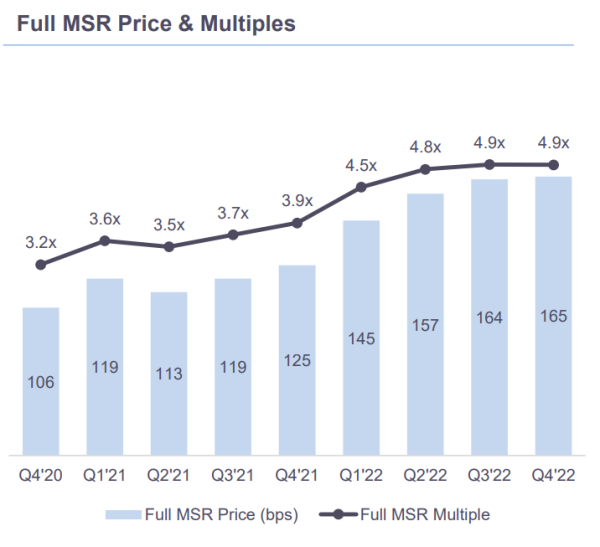
The servicing portfolio has been the engine of growth, but it looks like they are valuing their portfolio pretty much fully at 4.9x servicing revenue.

Rithm is also building other businesses including single family rentals and its reno / construction / bridge loan businesses.

PennyMac Mortgage Investment Trust got beat up in the fourth quarter, as origination income fell. Note where they are valuing their servicing portfolio:

6.1 times is pretty hefty, and with their origination volume at 50% government, I wonder how much is FHA. Government servicing is not trading at 6 times. The MSR market is pretty well-supplied with originators selling their servicing portfolios to raise cash. I have to imagine the actual secondary market is well below that regardless of size.