Morning Report: Productivity falls 8/9/16

Vital Statistics:

Last Change
S&P Futures 2177.0 1.0
Eurostoxx Index 342.8 1.0
Oil (WTI) 42.9 -0.2
US dollar index 86.9 -0.2
10 Year Govt Bond Yield 1.58%
Current Coupon Fannie Mae TBA 103.3
Current Coupon Ginnie Mae TBA 104.2
30 Year Fixed Rate Mortgage 3.5

Markets are flattish this morning on no real news. Bonds and MBS are flat

Small Business Optimism ticked up last month according to the NFIB. Sentiment remains well below its historical average. The interesting thing is that the inability to find quality workers rose to the #3 problem facing small business after taxes and government regulation. While small business is interested in hiring, they still have very little appetite for capital expenditures. Inflation at the small business level remains nowhere to be found, as small business cut prices on average last month.

The lack of capital investment ties into another economic number this morning: productivity (or lack thereof). Nonfarm productivity fell .5% in the second quarter, making it the third negative quarter in a row. The Street was looking for a positive .5% reading so the number was a big miss. Productivity is also negative on a year-over-year basis.

Unit Labor costs rose 2% which was a little higher than expected. Comp costs were up 1.5% and productivity losses added another 50 bps.

Productivity growth is what increases standards of living, which is why a lack of it makes people feel like the recovery is so weak. Part of the explanation is found in the NFIB report – no capital expenditures. Productivity is tough to measure these days, with so much free technology. You know GoToMeeting increases productivity, yet it won’t show up in the output numbers because no one pays for it. Same thing with Skype, LinkedIn, etc. While academia suspects there is a problem with the way we measure productivity, no one has found a good way to correct for it.
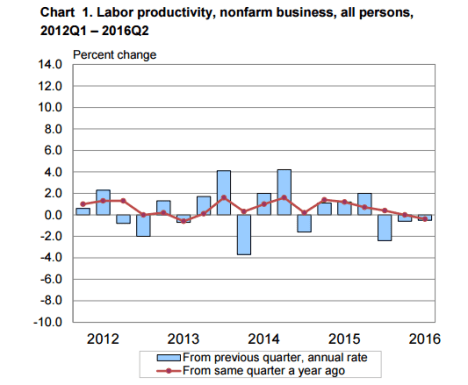
productivity - bls.PNG

Completed foreclosures came in at 38,000 in June, a 4% increase from May and a 5% drop year over year. The national foreclosures inventory stands at 375k homes, which is down 26% from a year ago. The number of mortgages seriously delinquent fell 21% YOY to 2.8%, or about 1.1 million homes. The big judicial states like New York and New Jersey lead the pack in foreclosure inventory.

FHFA says that Fannie Mae and Freddie Mac could require as much as $126 billion in the next housing crisis. Separately, Fannie’s home purchase sentiment index hit a new high, albeit it is a relatively new index.

Wells is saying that the expiration of HARP at the end of the year. Does this mean a dramatic drop in prepay speeds? Not necessarily, in that HARP will probably be replaced with a high LTV refi program.

Morning Report: DJT lays out his financial vision 8/8/16

Vital Statistics:

Last Change
S&P Futures 2179.0 3.0
Eurostoxx Index 351.5 0.5
Oil (WTI) 42.6 0.8
US dollar index 87.0 -0.2
10 Year Govt Bond Yield 1.60%
Current Coupon Fannie Mae TBA 103.3
Current Coupon Ginnie Mae TBA 104.2
30 Year Fixed Rate Mortgage 3.5

Markets are flattish on no real news. Bonds and MBS are down.

There isn’t much in the way of economic data this week – the week after the jobs report is invariably data-light. There will be no Fed-speak either.

TIAA agreed to buy EverBank Financial for about $2.5 billion.

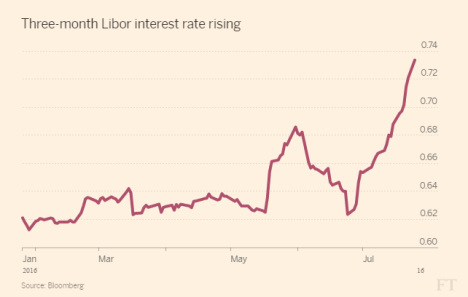
3 month LIBOR hit 81 basis points this morning, which is the highest since May 2009. This will affect ARM pricing.

While US Treasuries have some of the highest yields in the world, foreign investors who want to hedge their currency risk are buying them for a negative yield. New money market rules will go into effect this fall, which will change the landscape for banks. Expect tightened credit conditions.

Donald Trump will lay out his vision for financial regulation today with a speech in Detroit. He proposes a moratorium on new financial regulations, a repeal of Dodd-Frank, eliminating the estate tax, dropping the corporate income tax to 15%, creating 3 tax brackets for individuals, and making bureaucrats in DC more focused on creating jobs.

The CFPB updated their mortgage servicing regulations.

The July Fed Labor Market Conditions index rose by a point in July.

Morning Report: Strong jobs report 8/5/16

Vital Statistics:

Last Change
S&P Futures 2179.0 14.0
Eurostoxx Index 341.0 3.0
Oil (WTI) 41.3 -0.6
US dollar index 87.0 -0.2
10 Year Govt Bond Yield 1.56%
Current Coupon Fannie Mae TBA 103.3
Current Coupon Ginnie Mae TBA 104.2
30 Year Fixed Rate Mortgage 3.52

Markets are higher after a stronger than expected jobs report. Bonds and MBS are down.

Jobs report data dump:

  • Nonfarm payrolls +255,000
  • Unemployment rate 4.9%
  • Labor Force Participation rate 62.8%
  • Average hourly earnings +0.3% (2.6% YOY)

Overall, a good report. Not sure it moves the needle with the Fed in September, but it looks like May’s super-weak report was an aberration. The underemployment rate increased however, which suggests that the long-term unemployed may be coming back to the market, but they have to settle for part time jobs.

Bonds sold off on the report, with the 10 year yield up about 4 basis points, and the 2 year up 6.

Morning Report: The Bank of England cuts rates, sending Treasuries higher 8/4/16

Vital Statistics:

Last Change
S&P Futures 2160.0 3.0
Eurostoxx Index 336.9 1.0
Oil (WTI) 40.8 0.0
US dollar index 86.5 -0.5
10 Year Govt Bond Yield 1.51%
Current Coupon Fannie Mae TBA 103.3
Current Coupon Ginnie Mae TBA 104.2
30 Year Fixed Rate Mortgage 3.5

Stocks are higher this morning after the Bank of England cut rates and instituted QE. Bonds and MBS are up.

In response to Brexit, the Bank of England cut rates and introduced a bond-buying program for corporate and sovereign debt. This is causing global sovereigns to rally, and the German Bund is now trading at -7 basis points again. The US 10-year seems to correlate the most with the German Bund lately, so if it continues to rally, look for lower rates in the US.

Job cuts increased in July to 45,346, which is up 19% from last month, but is down 57% from a year ago. Military discharges and continued cuts in the energy sector drove the increase. Texas and California bore the brunt of the job cuts.

Initial Jobless Claims ticked up to 269k last week, however we have been below 300k for months, which is a very low level.

The Bloomberg Consumer Comfort index ticked up slightly last week to 43 from 42.9.

Factory Orders fell 1.5% from a downward-revised -1.2% in May. The manufacturing sector continues to exhibit a slowdown.

The ISM Services Index ticked down to 55.5 from 56.5 last month. The ISM Services index has been much stronger than the manufacturing index.

Nationstar reported better than expected earnings in the second quarter, although they took a big hit on their servicing portfolio. That said, while others are running from the servicing business, Nationstar is doubling down, and looks to build their business, with the addition of Seneca and USAA as clients. USAA had used Dovenmuhle in the past. Originations were up 24% QOQ and consumer direct accounted for 60% of the volume. Nationstar was up 12% for the day and is the highest in 9 months.

Mortgage REIT Annaly Capital reported a drop in book value per share as volatility hurt results. Given the widening of MBS spreads at the end of the second quarter, this is to be expected, although peer American Capital Agency did report a small increase. Annaly just completed its acquisition of Hatteras. Aside from the Fed, mortgage REITs are some of the biggest purchasers of mortgage backed securities, and can move around TBAs which influences mortgage rates, so it pays to keep tabs on how they are doing.

Separately, Fannie Mae reported a drop in net income.

Morning Report: Buy real estate, sell stocks and bonds 8/3/16

Vital Statistics:

Last Change
S&P Futures 2149.0 -4.0
Eurostoxx Index 334.7 -1.0
Oil (WTI) 39.9 0.4
US dollar index 86.3 -0.5
10 Year Govt Bond Yield 1.54%
Current Coupon Fannie Mae TBA 103.3
Current Coupon Ginnie Mae TBA 104.2
30 Year Fixed Rate Mortgage 3.51

Stocks are lower this morning as oil and emerging markets move lower. Bonds and MBS are down.

Mortgage Applications fell 3.5% last week as purchases fell 2% and refis fell 4%. Rates fell a lot last week, but the biggest move was on Friday, so perhaps we’ll catch up this week.

The ADP payrolls report shows 179k jobs were created in July. Friday’s jobs report is looking for an increase of 185k. The number to watch on Friday isn’t so much payrolls, it is the increase in average hourly earnings.

Shades of the bubble years: Over 50% of all listings in San Francisco and Seattle end up selling for over the listing price. In Washington state, there is 2 month’s worth of inventory for sale and in California it is 2.5 months. A balanced market is 6.5 months.

Once bitten, twice shy. 2010 marks the peak of the foreclosures from the bubble years, and next year, the foreclosure black mark drops off their credit reports. So far, we are only seeing a gradual return to the real estate market.   Many borrowers are unaware that FHA is more forgiving than other programs – you can apply for a loan after 3.5 years with only 3.5% down and a 580 FICO.

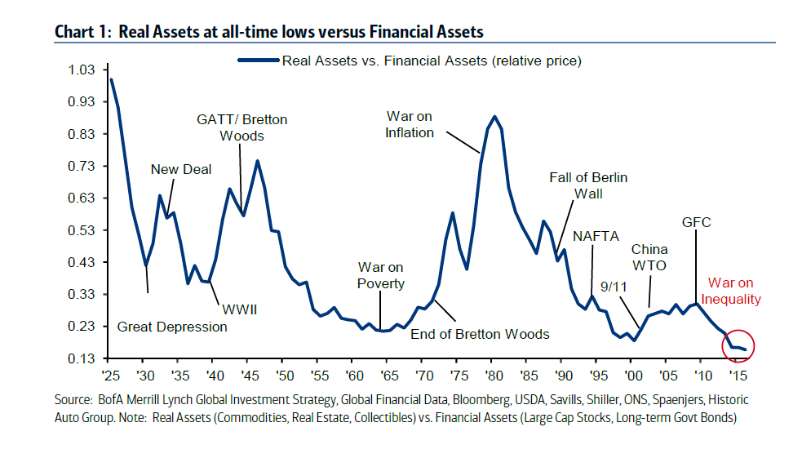
Bill Gross is on the “buy real assets” versus financial assets bandwagon. He dislikes stocks and bonds here, and prefers real estate and gold. With sovereign debt, you are making the bet that inflation is never, ever coming back. Governments seem to be coming to a consensus that more fiscal stimulus is needed, and that should be bond bearish. Theoretically, companies should be investing in property, plant and equipment instead of buying back their own stock. This isn’t good for stock prices short term (and will drive the activists batty), but it is good long-term, provided these investments cover their cost of capital and aren’t just empire-building exercises. You want stock prices supported by a future earnings stream, not artificially low interest rates. Problem is, capacity utilization is already pretty low, so there isn’t much need for additional PP&E, at least at the moment.

While the chart below is complicated, it does suggest that real assets will outperform financial assets going forward. For most people, the biggest “real asset” is their home. With rental inflation still high, having your mortgage payment set for 30 years isn’t a bad deal at all.

a9d26-real2bassets2bversus2bfinancial2bassets

Note both Donald Trump and Hillary Clinton are advocating fiscal stimulus packages. Post-Brexit UK is looking at taking that route as well. FWIW, the bond market is betting nothing comes of it.

Morning Report: The refinanceable population grows 8/2/16

Stocks are lower this morning on no real news. Bonds and MBS are down.

Construction spending fell 0.6% last month as both private and public spending fell. Homebuilding was down 0.1% MOM and is up 2.4% YOY. The prior 3 months were revised downward as well. This at least partially explains why the Q2 GDP print was so low.

Personal Incomes rose 0.2% in June while personal spending rose 0.4%. Just more evidence that the consumer is holding this economy together. The core PCE rate (the inflation measure preferred by the Fed) rose 1.6% YOY.

The Fed Funds futures have been slowly taking down the probability of a September rate hike – it is now below 20%. Between the weak GDP numbers, the weakness in manufacturing, etc it is hard to make a case that the Fed needs to move in September.

Governments worldwide are looking at policies intended to inflict capital punishment on investor portfolios. Whether the result is protectionism, Keynsian spending, or expropriation, look to own real assets (like real estate) versus financial assets. In terms of relative value, real assets are at their lowest ever. The world’s central banks are on a mission to create inflation, and eventually they will succeed. Note that policies that attack corporate profitability are also inflationary – in fact that is the end the line for socialist economies like Venezuela: everyone has money in their pockets, but there is nothing to buy.

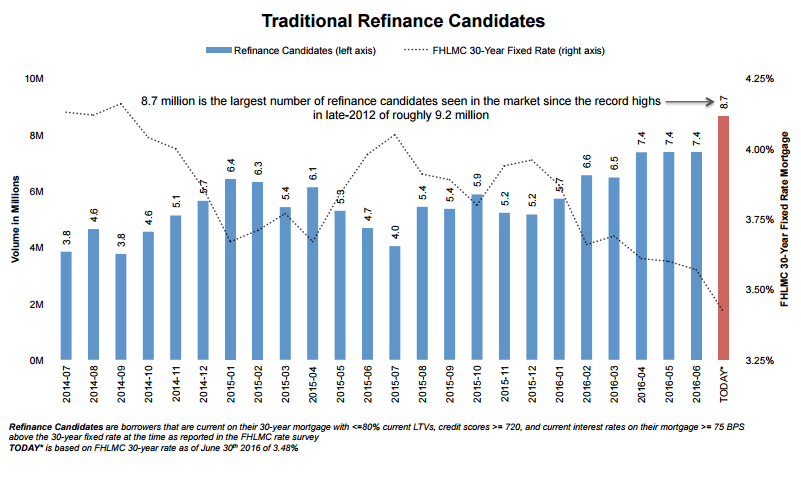
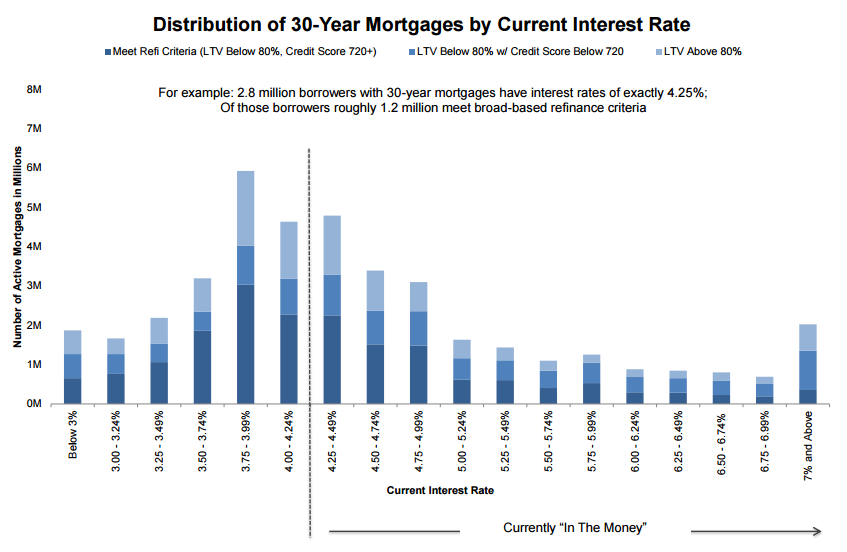
Brexit has created a massive opportunity for lenders. According to Black Knight Financial Services, the refinanceable population is the highest since 2012. Below are charts of the number of candidates that are refinanceable, and the other is a histogram of mortgage rates.

Morning Report: GDP disappoints 7/29/16

Vital Statistics:

Last Change
S&P Futures 2160.5 -4.0
Eurostoxx Index 340.2 1.0
Oil (WTI) 40.9 -0.2
US dollar index 86.8 -0.9
10 Year Govt Bond Yield 1.49%
Current Coupon Fannie Mae TBA 103.3
Current Coupon Ginnie Mae TBA 104.2
30 Year Fixed Rate Mortgage 3.51

Stocks are lower this morning after the advance estimate for 2Q GDP came in well below expectations. Bonds and MBS are up.

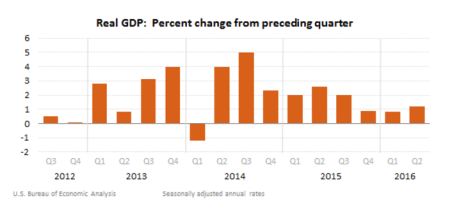
The advance estimate for second quarter GDP came in at +1.2%, which was well below the 2.5% survey estimate. The first quarter number was revised downward to 0.8%. Stronger consumer spending offset weak business investment. Consumer spending rose 4.2% while business investment fell 2.2%. The core personal consumption expenditures index rose at 1.7% ex food and energy, which is still below the Fed’s target rate. The economy has definitely taken a turn slower over the past 3 quarters.

GDP bar chart

The employment cost index rose 0.6% in the second quarter, according to the BLS. Compensation costs were up 2.3% YOY as salaries rose 2.4% and benefit costs rose 2%. Comp costs had been running at a 2% clip for the past year, so this number is actually a pretty big jump.

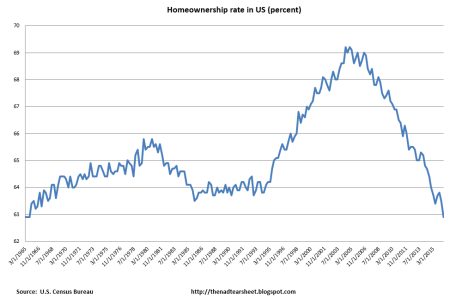
The homeownership rate fell to a 50 year low last quarter, hitting 62.9% which was last seen in the mid 60s. We don’t have data before that. Some of the increase in the homeownership rate was due to social engineering that began with the Clinton Administration, so maybe the heights were somewhat artificial, however it probably does have room to rebound, and that represents pent-up demand. I keep harping on this, but the big reason why GDP is so weak is because housing construction is still well below normalcy. Increasing housing construction would help with the affordability issue, which has been a driver of the decline as well as putting people to work. Unfortunately builders don’t have the confidence to break out of their 1.1 million – 1.2 million start range we have been stuck in for the last year.

homeownership rate NAD

Consumer sentiment slipped in June, according to the University of Michigan.

Morning Report: The Fed stands pat 7/28/16

Vital Statistics:

Last Change
S&P Futures 2159.5 -1.0
Eurostoxx Index 341.6 -1.2
Oil (WTI) 42.0 0.1
US dollar index 87.5 -0.2
10 Year Govt Bond Yield 1.56%
Current Coupon Fannie Mae TBA 103.3
Current Coupon Ginnie Mae TBA 104.2
30 Year Fixed Rate Mortgage 3.52

Stocks are lower this morning after the FOMC statement yesterday. Bonds and MBS are down small.

The FOMC statement from yesterday was relatively upbeat about the economy, but gave none of the signals that a September rate hike would be in the cards. They noted that May’s exceptionally weak jobs report was offset by the improvement in June. There was none of the “risks to the economy balanced” “risks to the economy tilted to the upside” language that would have been taken as a signal that they were contemplating a September hike. Note historically the Fed has tried to stay out of the way during election years, particularly in September, for fears of appearing political. With inflation well contained, they will probably maintain that posture. No reason not to.

There wasn’t much reaction to the statement yesterday. Stocks had been down on the day, rallied on the announcement and then suffered a late day sell-off that took them right back to where they were pre-announcement. The two year bond yields fell 2 basis points and the 10 year fell 4. The Fed Funds futures are now pricing in a 100% chance of a rate hike by next year this time.

Initial Jobless Claims rose to 266k last week. Consumer comfort was flat.

Where is the most expensive place to buy a starter home? Honolulu, where the income required to buy a starter home is over 6 figures and the median income is somewhere around $75k. Unsurprisingly, the West Coast dominates the unaffordable area. On the other side of the coin, if you make just over minimum wage, you can afford a starter home in Pittsburgh.

Meanwhile, here are the top 20 hottest real estate markets in July this year, according to Realtor.com. Interesting mix of West Coast high flyers and Rust Belt bottom fishing..

Morning Report: FOMC decision due at 2:00 pm EST 7/27/16

Vital Statistics:

Last Change
S&P Futures 2168.3 5.0
Eurostoxx Index 343.8 2.5
Oil (WTI) 42.8 -0.2
US dollar index 88.0 0.2
10 Year Govt Bond Yield 1.56%
Current Coupon Fannie Mae TBA 103.3
Current Coupon Ginnie Mae TBA 104.2
30 Year Fixed Rate Mortgage 3.53

Markets are calm ahead of the FOMC decision this afternoon. Bonds and MBS are up small.

The FOMC decision is set to come out around 2:00 pm EST today. Beware of locking around that time. Since there is no press conference scheduled, the odds of a rate hike are extremely low. Investors will parse the language of the statement closely. Note the next time Janet Yellen speaks will be in late August at Jackson Hole, so markets will have all sorts of time to fret without any sort of real input from the Fed.

Mortgage applications fell 11% last week as purchases fell 3% and refis fell 15%. Rates rose 2 basis points last week, but they increased 17 basis points the week before.

Durable Goods orders fell 4% MOM and are down 6.4% YOY. Ex transportation they were down .5% MOM and 3.6% YOY. Capital Goods orders fell as well. For all the talk about an acceleration in the economy, these numbers are a warning sign.

Pending Home sales rose 0.2% last month. Tight inventory remains a problem, and the increase was mainly due to the Northeast which doesn’t have the inventory problem we see on the West Coast. Lawrence Yun, NAR’s chief economist had this to say: “With only the Northeast region having an adequate supply of homes for sale, the reoccurring dilemma of strained supply causing a run-up in home prices continues to play out in several markets, leading to the last two months reflecting a slight, early summer cooldown after a very active spring,” he said. “Unfortunately for prospective buyers trying to take advantage of exceptionally low mortgage rates, housing inventory at the end of last month was down almost 6 percent from a year ago,1 and home prices are showing little evidence of slowing to a healthier pace that more closely mirrors wage and income growth.”

Lost in all the focus on falling / negative bond yields is the rise in LIBOR. LIBOR is a short-term rate that is the basis for lots and lots of financial products, from everything to auto loans to ARM mortgages. New money market regulations have been pushing up LIBOR. The explanation is really inside-baseball sort of stuff, but just be aware as this does affect ARM pricing.

LIBOR

Just one more note on ARMS – in this interest rate environment, where long term rates are steady / falling and short term rates are rising – ARMs are unattractive for borrowers. If there are any borrowers out there who still have ARMs now is the time to refi to a 30 year fixed rate mortgage.

Fannie Mae has announced changes to its 3% down HomeReady program.

Changes that go into effect immediately include:

  • Income limits have been raised to 100 percent of area median income (AMI) in all areas except for low income market tracts which have no limit. The company says this will expand access to affordable credit and also make it easier for lenders to determine eligibility for the loans.
  • The occupant borrower will now be allowed to own other residential properties.
  • Homeownership education courses that fulfill the HomeReady mortgage requirement have been expanded to include one-on-one pre-purchase advising from HUD-approved providers. Fannie Mae will offer lenders a $500 credit to encourage borrowers to take advantage of this option. Homebuyer education will continue to be available through Framework, Fannie Mae’s education partner.

The requirement for homeownership education has been removed for limited cash-out refinances and borrowers for loans secured by two- to four-unit properties will no longer be required to take landlord education although homeownership education will remain a requirement.

  • The Seller Guide announcing the above changes also noted that Fannie Mae expects to make additional enhancements later this year, including:
  • Allowing a maximum loan-to-value up to 97 percent on limited cash-out refinance transactions in Desktop Underwriter (DU) if the existing mortgage is owned or securitized by Fannie Mae.
  • Expanding current HomeReady eligibility for buydowns and adjustable-rate loans to include three- to four-unit properties.

Adding additional incentives for the one-on-one homeownership counseling implemented with the current changes.

The strange, strange world of jumbo lending in the Bay Area. Lenders are now taking into account stock and stock option compensation for determining whether a borrower can afford a mortgage. In a place where the median house price is $1.13 million, lenders have to get creative in finding ways to get working stiffs into a home. I guess if real estate prices and the stock market continue to hit new highs, everything is okay until the music stops.

Speaking of crazy lending, car loans are the new subprime, with 8 year car loans at mortgage rates. As investors reach for yield, they inevitably take more risk. That said, fears of this causing a 2008 style calamity are overblown. Residential real estate bubbles are a fundamentally different animal than this sort of thing.

If you missed the Democratic Convention last night, here is the cliff notes version:

DNC convention.PNG

Morning Report: New Home Sales climb 7/26/16

Vital Statistics:

Last Change
S&P Futures 2163.0 -0.3
Eurostoxx Index 341.8 2.0
Oil (WTI) 42.5 -0.6
US dollar index 88.1 0.2
10 Year Govt Bond Yield 1.56%
Current Coupon Fannie Mae TBA 103.3
Current Coupon Ginnie Mae TBA 104.2
30 Year Fixed Rate Mortgage 3.53

Markets are flattish on no real news. Bonds and MBS are up small.

New Home Sales rose to 592k in June, much higher than the Street expectation. The median new home price rose 6.1% YOY to $306,700. There is about 4.9 month’s worth of inventory right now, compared to 5.1 months in May.

Consumer confidence slipped in June to 97.3 from 97.4.

Home prices continued to appreciate in May, according to the Case-Shiller Home Price Index. “Home prices continue to appreciate across the country,” says David M. Blitzer, Managing Director and Chairman of the Index Committee at S&P Dow Jones Indices. “Overall, housing is doing quite well. In addition to strong prices, sales of existing homes reached the highest monthly level since 2007 as construction of new homes showed continuing gains. The SCE Housing Expectations Survey published by the New York Federal Reserve Bank shows that consumers expect home prices to continue rising, though at a somewhat slower pace.”

The FOMC starts its meeting today, and we will get the decision tomorrow around 2:00 pm. Here is a good take on how to parse the FOMC statement. The key will be the characterization of the economy in the first paragraph. If the Fed notes an improvement in the economy since June, then that could be interpreted as a step towards hiking in September.

Is wage growth beginning to pick up?  One key will be the employment cost indicator, which will be released on Friday. The ECI was depressed in the second quarter of 2015, so we should get a mid 2% YOY comparison. Is that enough to convince the Fed that inflation is returning to their 2% target? Possibly, but the Fed has said they are going to let the labor market run hot for a while. Don’t forget, even if the Fed hikes rates 25 basis points this year, monetary policy is still at emergency-level accommodation. Note that many indicators are showing that the economy is recovering well, and the doves will be on the defensive at some point.

Interesting article about how it is so hard to make affordable housing affordable. Trying to build in an urban area and hold rents down to $500 a month is impossible without government subsidies. Regulatory issues like open space set asides also do not help. This is also an issue with starter homes, especially in high cost urban areas on the West Coast. By the time you build and comply with all the regulations, you are looking at a $500k + price tag, which is way out of the range of the typical first time homebuyer.