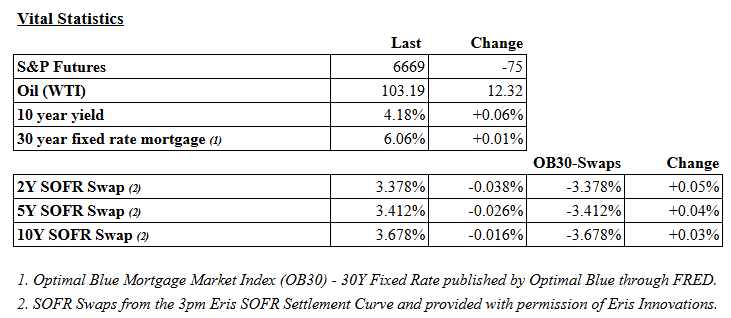
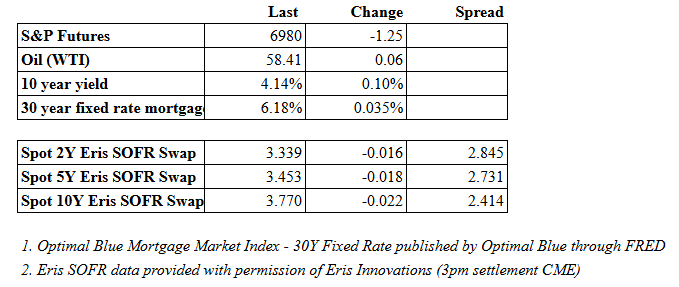
Stocks are flattish this morning on no real news. Bonds and MBS are up.
Today should be a quiet day in the markets as most people usually take today the day after Christmas off.
There is no economic data today, and little remaining from Wednesday. Initial Jobless claims fell to 214k.
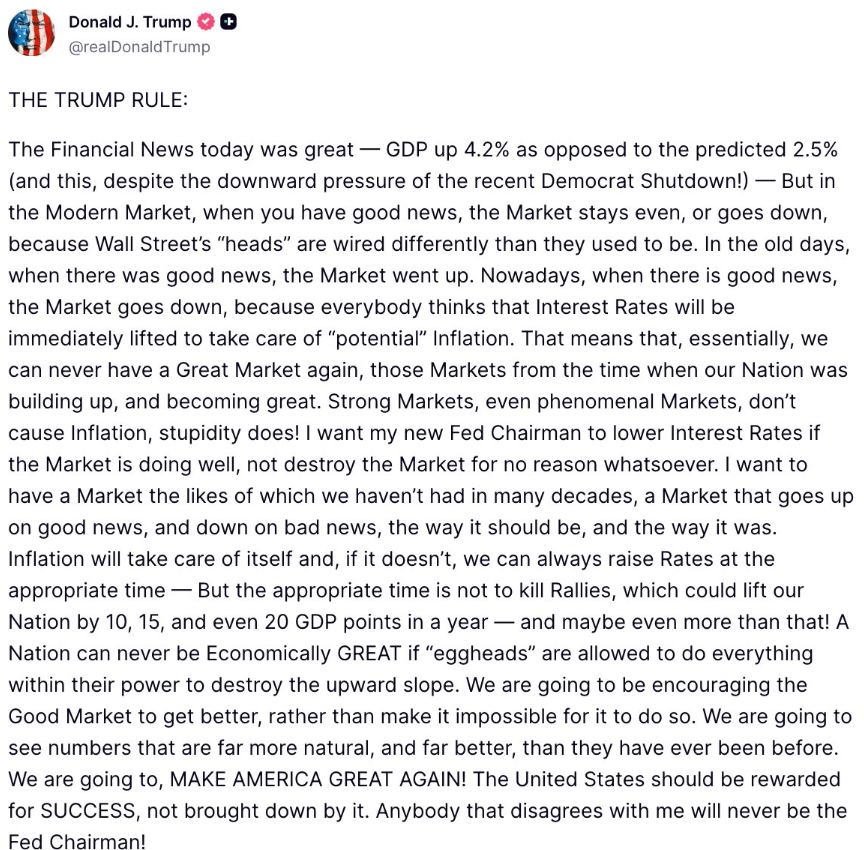
Donald Trump took to social media to talk about what he is looking for in a new Fed Chairman:
In typical Trumpian fashion, he uses a lot of hyperbole and invective which causes people to dismiss what he is saying as unhinged. It is easy to do. However on the main point here, he isn’t wrong.
If you strip out the invective and the hyperbole, he described the issues with the Powell Fed pretty well. The Fed is supposed to fight actual inflation, not potential inflation.
The Fed made this mistake in 2022 – keeping rates low despite actual inflation being in the high single digits. The Fed was betting that this inflation was “transitory” and therefore kept rates low. Powell wasn’t looking at actual inflation, he was making an inflation bet. And he bet wrong, big time. He was so wrong that “transitory” became a laugh line.
Similarly, in 2025, Powell was betting that inflation would return to the high single digits (or thereabouts) and kept the Fed Funds rate higher than it ordinarily would be because he was worried about the effect of tariffs. Again, Powell bet on future inflation and bet wrong.
So Trump’s statement that “When there is good news, the market goes down because everybody thinks interest rates will be immediately lifted to take care of “potential” inflation” is hyperbolic – nobody thinks the Fed is going to hike rates – but is more or less directionally correct. The market is interpreting strong economic data to mean the Fed is going to keep monetary policy needlessly tight.
It is easy to say that inflation IS over the Fed’s target – 2.7% versus 2.0% – however the Fed is wringing its hands over missing the target by 70 basis points, while it whistled past the graveyard in 2022 and missed by 700 basis points. It is hard to miss the double standard here.
His statement: “Strong markets, even phenomenal markets, don’t cause inflation – stupidity does” is needlessly inflammatory, however he isn’t wrong. Inflation is too much money chasing too few goods. Strong markets don’t create inflation by themselves. And that is his main point – don’t hike rates if we get good data or the market is strong simply because you worry that could ignite inflation.
Who Trump picks as a Fed Chairman will still have to deal with a bunch of voting members who (a) don’t like Trump to begin with (b) don’t want to help him politically, and (c) want to remain independent. Still it appears that monetary policy is still tight by 50 – 75 basis points which means the Fed should continue to cut in 2026.
Stocks are higher this morning as we await inflation data. Bonds and MBS are flattish.
The Personal Incomes and Outlays numbers for September were scheduled to be released this morning at 8:30. So far there is nothing on the BEA’s website. It may have been pushed back to later today.
Home Price appreciation continued to decelerate, according to Cotality. Prices rose 1.1% overall on a YOY basis, with declines extending from 6% of MSAs to 32% of MSAs. On a MOM basis, prices declined 0.2%
“The housing market in 2025 demonstrated remarkable resilience despite significant headwinds. Slowing price growth reflects a much-needed rebalancing after years of unsustainable gains. While some markets are experiencing declines, these adjustments will help restore affordability over time and make housing more accessible to a wider group of buyers,” said Cotality’s Chief Economist Dr. Selma Hepp.
“Looking ahead, regional differences will remain pronounced, with demand favoring areas that offer both economic opportunity and relative affordability. In general, home price growth is projected to remain below the long-running average of 4% to 5%. However, mortgage rates will play a critical role in shaping the 2026 housing market. A notable drop in mortgage rates combined with low supply could lead to a re-acceleration of price gains.”
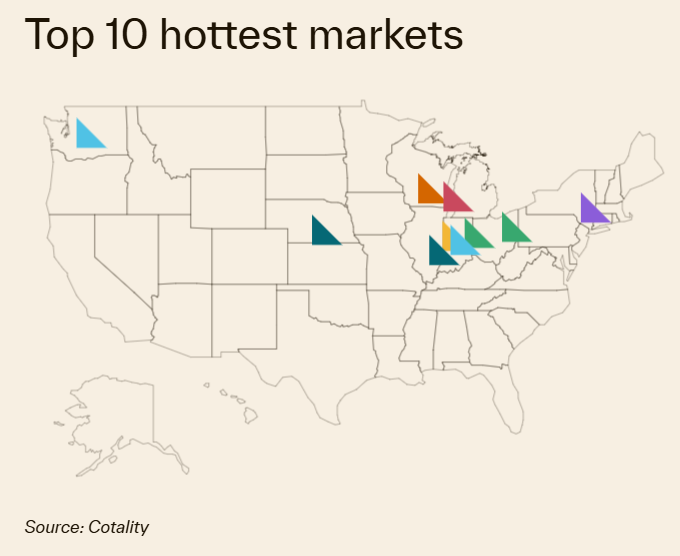
The hip-to-be-square trade continues, with the biggest gain (9%) coming from the tony destination of Bridgeport, CT.
Investor purchase activity was muted in the third quarter, according to research from Redfin. Investor home purchases rose only 1% compared to a year ago. With flattening rents, this shouldn’t be a surprise. “Investor activity is stuck in neutral because profits are harder to come by, more homes are selling at a loss, and the rental market has softened,” said Sheharyar Bokhari, a senior economist at Redfin. “Investors aren’t completely retreating, but they’re not driving the housing market forward.”
The share of homes bought by investors slipped to 17%, which is still on the high side compared to pre-pandemic levels. High home prices, elevated mortgage rates and a sluggish rental market are conspiring to make income properties and fix / flip deals harder to pencil out.
Stocks are flattish this morning on no real news. Bonds and MBS are up small.
The employment market continues to weaken. Announced job cuts surged 175% on a YOY basis to 153,074. “October’s pace of job cutting was much higher than average for the month. Some industries are correcting after the hiring boom of the pandemic, but this comes as AI adoption, softening consumer and corporate spending, and rising costs drive belt-tightening and hiring freezes. Those laid off now are finding it harder to quickly secure new roles, which could further loosen the labor market,” said Andy Challenger, workplace expert and chief revenue officer for Challenger, Gray & Christmas.
Warehousing and Tech saw the biggest number of cuts. “This is the highest total for October in over 20 years, and the highest total for a single month in the fourth quarter since 2008. Like in 2003, a disruptive technology is changing the landscape,” said Challenger.
Bonds got crushed yesterday after a stronger-than-expected ISM Services Report. The services economy improved in October, driven by a big jump in New Orders and Business Activity. It wasn’t all great news however, with employment staying in contraction territory and prices jumping from 69.4 to 70 which was the highest reading in 3 years.
“October’s Services PMI® is a continuation of a downward trend of more than 10 percentage points in the 12-month average since February 2022, when it was 62.6 percent. The rebounds in both the Business Activity and New Orders indexes in October are positive signs, while the continued contraction in the Employment index shows a lack of confidence in the continued strength of the economy. The Backlog of Orders Index continued its 3½ year declining trend; even with a contracting Employment Index, companies can more than keep up with new orders to reduce backlogs. Respondents continued to mention the impact of tariffs on prices paid. There was no indication of widespread layoffs or reductions in force, but the federal government shutdown was mentioned several times as impacting business activity and generating concerns for future layoffs. In the Health Care & Social Assistance and Retail Trade industries, panelists noted seasonal strength in activity, and comments from many industries mentioned continuing demand stability.”
Homebuilders are seeing inventory build up and are offering incentives to move the merchandise. Some builders are offering mortgage rates as low as 4% and still houses are not moving. Unsold inventory is at the highest level since the summer of 2009.
D.R. Horton is offering a 3.99% mortgage, while Lennar is offering discounts of 14%. This is translating into lower margins and a slowdown in building new units. The glut of properties is most pronounced in Southern California and Washington DC.
The Supreme Court seemed skeptical that Trump’s massive use of tariffs without Congressional Approval is Constitutional. “You say tariffs are not taxes, but that’s exactly what they are,” Justice Sonia Sotomayor, one of the court’s liberal members, told Solicitor General D. John Sauer. “They’re generating money from American citizens, revenue,” Sotomayor said.
If the Supreme Court rejects the tariffs, then they would require Congressional Approval, which appears dicey since voters are generally downbeat on the economy.
Even with tariffs, inflation remains around 3%, which is above the Fed’s target but not astronomical. Shelter inflation is about to go from an inflationary pulse to a disinflationary one, and absent these tariffs, inflation might fall below the Fed’s target. If so, then the Fed needs to get to neutrality in a hurry, and might have stayed too late at the party.
Stocks are higher this morning after the consumer price index comes in better than expected. Bonds and MBS are flat.
Inflation at the consumer level rose 0.3% MOM and 3.0% YOY, according to the Consumer Price Index. Gasoline prices were the biggest driver of the increase (something different than shelter, for once). The index for shelter rose 0.2% MOM and 3.5% YOY.
Shelter inflation (YOY) is almost back to pre-pandemic levels:
Given continued downward momentum in rental and home price appreciation, shelter inflation is about to go from foe to friend in the fight against inflation.
Core inflation (ex-food and energy) rose 0.2% MOM and 3.0% YOY. We are over 6 months into the imposition of tariffs and the inflation indices have had nothing more than a negligible increase. Whatever fears of hyperinflation (or stagflation) have not materialized.
This clears the decks for a rate cut next week, and probably another one in December.
Existing Home Sales rose 1.5% to a seasonally adjusted annual rate of 4.06 million units. “As anticipated, falling mortgage rates are lifting home sales,” said NAR Chief Economist Dr. Lawrence Yun. “Improving housing affordability is also contributing to the increase in sales.”
“Inventory is matching a five-year high, though it remains below pre-COVID levels,” Yun added. “Many homeowners are financially comfortable, resulting in very few distressed properties and forced sales. Home prices continue to rise in most parts of the country, further contributing to overall household wealth.”
Sales increased in the Northeast, South and West, while falling in the Midwest. The median home price rose 2.1% YOY to $415,200. Inventory rose 14% YOY to 1.55 million units, which represents a 4.6 month supply.
Fannie Mae CEO Priscilla Almodovar has resigned and Peter Akwaboah, Fannie Mae’s current Chief Operating Officer has been tapped as Interim CEO. “Peter’s deep operating background, as the former Morgan Stanley COO of Global Technology, makes him the perfect fit for the Acting CEO position while the Board conducts its search for a permanent CEO. With the addition of Peter as Acting CEO and John Roscoe and Brandon Hamara as Co-Presidents, we now have a deep bench of three experienced leaders at the very top of Fannie Mae. This means a safer, sounder Fannie Mae, all while growing our great Fortune 25 Company,” Pulte continued.
Stocks are lower this morning after the government shut down at midnight. Bonds and MBS are up.
The government shut down at midnight as funding ran out. Worried about how the shutdown will impact the mortgage industry? The MBA has you covered. Main points:
The shutdown will impact HUD, which means FHA / VA / USDA loans may be slower. Of these three, USDA will be the most affected.
Fannie and Freddie are not government agencies, so the impact there would be limited.
New flood insurance policies will be on hold until the program is re-authorized. The IRS will still honor tax transcript requests.
The private sector shed 32,000 jobs in September, according to ADP. “Despite the strong economic growth we saw in the second quarter, this month’s release further validates what we’ve been seeing in the labor market, that U.S. employers have been cautious with hiring,” said Dr. Nela Richardson, chief economist, ADP.
Education and health services added 33,000 jobs, while leisure and hospitality lost 19,000. Professional/business services and finance also declined. The Midwest bore the brunt of the job losses. Pay growth for job stayers was steady at 4.5%, while the pay growth for job switchers fell from 7.1% to 6.6%.
FWIW, the Street is looking for an increase of 50,000 jobs in Friday’s jobs report, assuming it comes out. BLS has said it will not release the jobs report if the government is still shut down, so this report carries additional weight.
Job openings ticked up slightly in August, from 7.21 to 7.23 million. The quits rate fell from 2.0 to 1.9%, which is further evidence of the “job-hugging” phenomenon where workers hold employees hold onto their current jobs, even if they are unhappy, due to economic uncertainty and fear of the labor market, rather than seeking new opportunities.
The labor market is weakening, and the Fed stayed tight for too long.
Consumer confidence fell in September, according to the Conference Board. “Consumer confidence weakened in September, declining to the lowest level since April 2025,” said Stephanie Guichard, Senior Economist, Global Indicators at The Conference Board. “The present situation component registered its largest drop in a year. Consumers’ assessment of business conditions was much less positive than in recent months, while their appraisal of current job availability fell for the ninth straight month to reach a new multiyear low. This is consistent with the decline in job openings. Expectations also weakened in September, but to a lesser extent. Consumers were a bit more pessimistic about future job availability and future business conditions but optimism about future income increased, mitigating the overall decline in the Expectations Index.”
IMO it looks like the weakening labor market is beginning to affect the consumer confidence numbers.
Mortgage applications decreased 13% last week as purchases fell 1% and refis fell 13%. “Mortgage rates increased to their highest level in three weeks as Treasury yields pushed higher on recent, stronger than expected economic data. After the burst in refinancing activity over the past month, this reversal in mortgage rates led to a sizeable drop in refinance applications, consistent with our view that refinance opportunities this year will be short-lived,” said Joel Kan, MBA’s Vice President and Deputy Chief Economist. “With the 30-year fixed rate now at 6.46 percent, refinance activity declined for all loan types, including a 22 percent decrease in conventional refinances and 27 percent decrease in VA refinances. The average loan size for refinances dropped to $380,100 from $461,300 two weeks ago as these higher rates eliminated the refinance incentive for many borrowers with large loans.”
Stocks are flattish this morning on no real news. Bonds and MBS are down.
Why has the bond market sold off in the wake of the rate cut on Wednesday? IMO, it is because the dot plot for 2026 is much more hawkish than the Fed Funds futures were predicting.
Before the FOMC meeting, the December 2026 futures saw a range of 2.75%-3.0% rate as the most likely, 3.0% – 3.25% as the second most likely and 2.5%-2.75% as the third most likely. Today, the futures see 3.0% – 3.25% as the most likely scenario, 2.75%-3.0% as the second most likely scenario, and 3.25% – 3.5% as the third most likely scenario.
In essence the Fed Funds futures have increased their 2026 forecast by roughly 25 basis points, and that is what is driving the action in the 10 year.
The Index of Leading Economic Indicators declined in August, according to the Conference Board. The index declined by 0.5%, after rising 0.1% in July. The only positives in the index are market-related (i.e. credit spreads and the movement in the stock market). All other components (anything real-economy related) were negative. These include initial jobless claims, building permits, and new orders.
“In August, the US LEI registered its largest monthly decline since April 2025, signaling more headwinds ahead,” said Justyna Zabinska-La Monica, Senior Manager, Business Cycle Indicators, at The Conference Board. “Among its components, only stock prices and the Leading Credit Index supported the LEI in August and over the past six months. Meanwhile, the contribution of the yield spread turned slightly negative for the first time since April.
“Besides persistently weak manufacturing new orders and consumer expectation indicators, labor market developments also weighed on the Index with an increase in unemployment claims and a decline in average weekly hours in manufacturing. Overall, the LEI suggests that economic activity will continue to slow. A major driver of this slowdown has been higher tariffs, which already trimmed growth in H1 2025 and will continue to be a drag on GDP growth in the second half of this year and in H1 2026. The Conference Board, while not forecasting recession currently, expects GDP to grow by only 1.6% in 2025, a substantial slowdown from 2.8% in 2024.”
In other words, the only thing holding up the economy is the stock market, and the stock market cannot ignore the real economy forever.
Homebuilder Lennar disappointed this morning with soggy third quarter earnings. Earnings fell over 50% compared to a year ago.
“Our third quarter results reflect both the continued pressures of today’s housing market and the consistency of Lennar’s operating strategy. This quarter, we delivered 21,584 homes and recorded 23,004 new orders. Achieving these results required additional incentives, resulting in a reduced average sales price of $383,000, and our gross margin drifted down to 17.5%, while our SG&A expenses came in at 8.2%, reflecting the soft market conditions.”
“requiring additional incentives” is corporate-speak for cutting prices to move the merchandise. Builders have generally been doing this via cut-rate mortgages.
Note famed value investor Warren Buffett bought a big slug of Lennar this year.
Stocks are flat ahead of the long weekend. Bonds and MBS are down small.
Personal Incomes rose 0.4% MOM in July, which was in line with Street expectations. Personal Expenditures rose 0.5%, again in line with expectations.
The PCE Price Index (The Fed’s preferred measure of inflation) rose 0.2% MOM and 2.6% YOY. If you exclude food and energy, the index rose 0.3% MOM and 2.9% YOY.
Durable goods inflation increased to 1.1%, while non-durable goods inflation decreased to 0.2%.
Inflation has picked up a touch from Liberation Day, rising about 30 or 40 basis points. But it has not created this huge acceleration back to 6%. At least not yet.
This probably still gives the Fed the green light to cut rates at the September meeting, especially if the jobs report next week is soft again. The Sep Fed Funds futures still see a 87% chance of a rate cut.
Pending Home Sales fell 0.4% MOM in July, according to NAR. This was still a 0.7% YOY increase. “Even with modest improvements in mortgage rates, housing affordability, and inventory, buyers still remain hesitant,” said NAR Chief Economist Lawrence Yun. “Buying a home is often the most expensive purchase people will make in their lives. This means that going under contract is not a decision home buyers make quickly. Instead, people take their time to ensure the timing and home are right for them.”
“Rising mortgage applications for home purchase are an early indicator of more serious buyers in the marketplace, though many have not yet committed to a pending contract. The Federal Reserve signaling that they may enact a lower interest rate policy should steadily enlarge the pool of eligible home buyers in the upcoming months.”
MBS spreads continue to improve. MBS spreads are being defined here as the difference between the 30 year fixed rate mortgage and the 10 year Treasury. MBS traders will note that this isn’t exactly correct, but it is close enough for our purposes. The spread has been narrowing for the past couple of years and currently stands at 230 basis points.
On a historical basis going back 40 years, this is still an elevated level. The pre-pandemic years of ZIRP were much lower, and even the pre GFC levels were lower. We are still around 50-60 basis points above normalcy.
Stocks are higher as we await Jerome Powell’s speech in Jackson Hole. Bonds and MBS are up small.
Jerome Powell will be speaking at 10:00 am today. I don’t see the prepared remarks anywhere yet.
Existing home sales rose 2% last month, according to NAR. “The ever-so-slight improvement in housing affordability is inching up home sales,” said NAR Chief Economist Lawrence Yun. “Wage growth is now comfortably outpacing home price growth, and buyers have more choices. Condominium sales increased in the South region, where prices had been falling for the past year.”
“Near-zero growth in home prices suggests that roughly half the country is experiencing price reductions. Overall, homeowners are doing well financially. Only 2% of sales were foreclosures or short sales – essentially a historic low. The market’s health is supported by a cumulative 49% home price appreciation for a typical American homeowner from pre-COVID July 2019 to July this year,” Dr. Yun continued.
“Homebuyers are in the best position in more than five years to find the right home and negotiate for a better price. Current inventory is at its highest since May 2020, during the COVID lockdown.”
The index of leading economic indicators fell in July, according to the Conference Board. “The leading economic index for the US decreased just slightly in July,” said Justyna Zabinska-La Monica, Senior Manager, Business Cycle Indicators, at The Conference Board. “Pessimistic consumer expectations for business conditions and weak new orders continued to weigh down the index. Meanwhile, stock prices remained a key positive support of the LEI. Initial claims for unemployment insurance were much lower in July than in June and were the second most positive component of the LEI, after contributing negatively to the index over the previous three months. While the LEI’s six-month growth rate remains negative, it improved slighlty in July—but not enough to avoid triggering the recession signal again. Despite that, The Conference Board does not currently project a recession, though we do expect the economy to weaken in H2 2025, as the negative impacts from tariffs become more visible. Overall, real GDP is projected to grow by 1.6% year-over-year in 2025, before slowing in 2026 to 1.3%.”
The stock market component of the LEI is holding the index up. The other components are deteriorating.
Stocks are flat despite a hotter-than-expected PPI print. Bonds and MBS are down.
Inflation at the wholesale level rose 0.9% MOM in July, which was much higher than the Street estimate of 0.2%. On a YOY basis, prices rose 3.3%. If you exclude food and energy, the numbers were even worse: a 0.9% MOM jump and a 3.9% YOY increase. The core rate, which excludes food, energy and trade services rose 0.6% MOM and 2.8% YOY.
June’s numbers were unusually low, showing zero monthly inflation, so perhaps the July numbers were exhibiting some “catch up.” Trade services were the big driver, which represents retail and wholesaler margins. Machinery and equipment accounted for 30% of the jump. On the goods side, about of a quarter of the increase came from vegetables.
While some of the increase can be traced to tariffs (the equipment and machinery probably is), it appears a lot of it (hotels, portfolio management, investment advice, trucking) are not. Note this reading is the first with a new methodology which eliminated some 350 categories it used to track. As a result, the numbers are not really comparable to previous readings. So you might want to put an asterisk next to this.
The initial reaction in the bond market is negative, with the 10 year down about 3 basis points since the report came out.
Treasury Secretary Scott Bessent made some comments regarding Fed policy and possible replacements for Jerome Powell when he steps down. When asked about Powell’s replacement, Bessent laid out a laundry list of names including the two Kevins (Warsh and Hassett), along with Michelle Bowman, Laurie Logan and a few other names.
Bessent’s comments on monetary policy urged rate cuts: “If we’d seen those numbers in May, in June, I suspect we could have had rate cuts in June and July. So that tells me that there’s a very good chance of a 50 basis-point rate cut,” in September, Bessent said in an interview on Bloomberg television.
“Rates are too constrictive…We should probably be 150 to 175 basis points lower,” Bessent said, adding to the Trump administration’s penchant for public criticism and detailed policy advice for the independent central bank. While Trump would like to see rates around 1%, Bessent was arguing for a 2 handle on the Fed Funds rate, which is below neutrality (r*).
Next week is the Jackson Hole Summit, and markets will be anticipating a signal that rates are coming down in September. The Fed Funds futures see a cut as a certainty and are pricing in a small chance of a 50 basis point cut. The December futures are starting to price in a small chance of 100 basis points in cuts this year.
The Trump Administration teased the idea of IPO-ing Fannie Mae and Freddie Mac “I am working on TAKING THESE AMAZING COMPANIES PUBLIC, but I want to be clear, the U.S. Government will keep its implicit GUARANTEES, and I will stay strong in my position on overseeing them as President,” Trump added.
Generally speaking the term “taking a company public” means an IPO (initial public offering). If you issue stock for a company that is already trading, it is called a secondary offering.
Fannie Mae trades already on the OTC Bulletin Board Exchange (aka the pink sheets). Freddie Mac does as well. Fannie Mae’s ticker is FNMA and Freddie’s is FMCC. These stocks have been on a tear since Trump got elected, and trade nearly 10 million shares a day. The companies have a market cap of about $12 billion.
So if Trump wants to sell Fannie and Freddie stock to the public, why would he characterize it as “taking these companies public” and not as a secondary offering? That language implies that a new stock is coming, not a sale of additional shares of FNMA or FMCC. So if that is the case, what happens to the older stock that is currently trading? It is helpful to remember how we got here.
During the Great Recession and Financial Crisis, the government took over 80% of Fannie and Freddie and placed them in conservatorship. Why did they take over 80% and not 100%? Because then the government would have had to consolidate all of Fannie and Freddie’s outstanding MBS into the national debt. This would have added trillions of liabilities to the US balance sheet. Instead, it is treated as a contingent liability – a form of off-balance sheet financing. The Fannie and Freddie stock currently trading exists solely as an accounting convenience for the government. The government is entitled to all of Fan and Fred’s profits, and FMCC / FNMA shareholders have no claim to it nor do they have voting rights. This isn’t a normal stock, like owning shares of Apple.
The Obama Administration was adamant that if the GSEs were ever released from conservatorship that the extant shareholders should get nothing. The company was insolvent when it was taken over and under a normal bankruptcy / reorganization the shareholders would have been wiped out. Granted Trump isn’t Obama, but the logic hasn’t changed and the use of the term “taking the companies public” should be taken as an ominous sign.
So if there is an IPO, what would become of the old stock? It probably won’t be fungible with the new stock and won’t be entitled to dividends, a vote, or have a claim on the profits / assets of the company. If the government declares the old stock worthless, it will become a litigation lottery ticket as activist hedge funds sue the government to force them to give the shareholders something. But anyone getting excited about Fan and Fred going public should keep in the back of their minds that the current FNMA and FMCC stock might not participate in the emancipated entity and could be worthless even if Fan and Fred thrive.
Nobody knows what Trump is thinking here, but if this was happening under Biden or Obama the stock would be worthless.
Stocks are lower this morning on a disappointing jobs report. Bonds and MBS are up.
The economy added 73,000 jobs in July, which was lower than expected. The unemployment rate ticked up 4.2%, while the labor force participation rate fell again. Healthcare and social assistance led the job growth, while manufacturing fell.
The internals of the jobs report are bad yet again. The jobs created were completely driven by statistical and seasonal adjustments. The number of people actually collecting paychecks fell from 163.37 million to 163.1 million, or a decrease of 260,000. The number of people unemployed rose from 7 million to 7.2 million, while 239,000 people exited the labor force.
The labor force participation rate and the employment-population ratios both fell:
The two month revisions were godawful as well, with May falling from +144,000 to +19,000 and June decreasing from +147,000 to +14,000. Bottom line: The labor market is a lot weaker than the Fed is giving it credit for.
The Fed’s dual mandate it to target PCE Price Inflation along with unemployment. The unemployment rate is being held down by people exiting the labor force, which is not indicative of a healthy job market. We have had a solid string of job losses in professional and business services, which is Ground Zero for AI.
WSJ reporter Nick Timaros quietly signaled to the markets that a September rate cut is unlikely. “Officials are betting they can afford to wait at least two months for clarity on whether tariffs will slow economic activity, fuel inflation, or pass by with little effect. That patience comes with risks—on both sides.”
Two months = August and September. Meanwhile, the labor market continues to deteriorate.
The bright side is that the yield curve is beginning to do the work for the Fed. The 10 year is now at the lower band of the Fed Funds target rate, which means we are looking at an inversion. So mortgage bankers can take at least some solace.