Does It Matter If You Don’t Believe In Evolution?

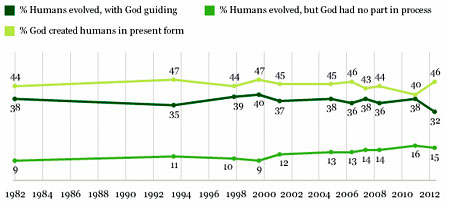
It’s not often I see an ATiM discussion echoed nearly word for word in the bigger blogosphere, but an item in Andrew Sullivan’s Dish gave me an odd sense of deja vu. He had reacted in horror to a Gallup poll which showed that 46% of Americans believe God created man as-is. Another 32% believe in what I call ‘guided evolution’ where there is divine influence. Only 15% believe that God had nothing to do with us looking as we do.
Sullivan’s alarm is stated thusly:

I’m not sure how many of the 46 percent actually believe the story of 10,000 years ago. Surely some of them know it’s less empirically supported than Bigfoot. {snip} I simply do not know how you construct a civil discourse indispensable to a functioning democracy with this vast a gulf between citizens in their basic understanding of the world.

Kevin Drum of Mother Jones rolled his eyes by noting that the 46% number is essentially unchanged since the question has been tracked and it is hardly a concern.

The fact is that belief in evolution has virtually no real-life impact on anything. That’s why 46% of the country can safely choose not to believe it: their lack of belief has precisely zero effect on their lives. Sure, it’s a handy way of saying that they’re God-fearing Christians — a “cultural signifier,” as Andrew puts it — but our lives are jam-packed with cultural signifiers.

Basically, Drum is saying that denying evolution is the price of admission to a not very exclusive club and most people are able to compartmentalize the cognitive dissonance it creates when relying on medicine or agriculture or anything that requires the actual mechanisms of evolution to work.

And lots of smart people don’t ‘believe’ in evolution (and I put ‘believe’ in air quotes because I personally ‘believe’ that is as silly as not believing in gravity) and still do quite well in their professional lives. I heard from colleagues of a prominent engineering professor who was a Young Earther, that is, he thought the Grand Canyon was created from backwash from Noah’s flood. I went to a public lecture of his and his thoughts on thermodynamics and the like were very mainstream and enlightening. Only at the end did he make a slightly veiled cryptic comment about having to conserve energy because we were stewards of the Earth.

Saying that God made Man in an afternoon and then used some spare parts to make Woman is a harmless fairy tale demonstrating a reliance on faith over a trust in reason. Evolution makes intellectual sense because it explains observable phenomena such as there being so many different types of plants and animals, far more than would fit on a raft 300 cubits long.

Not believing in evolution has very little effect on tax policy or road funding or the vast majority of governmental issues. It’s only when the theology drips into policy that I grow concerned. Jame Watt famously saw harvesting trees on a non-sustainable basis as no problem since he was imminently expecting The Rapture and then it wouldn’t matter any more. And we don’t want to even begin opening the can of worms of how religious dogma has affected the debate over reproductive rights.

So if someone wants to believe in folk tales on the origin of the world, I can only shake my head and shrug. To me these are people that in their devotion to their beliefs refuse to separate the moral and ethical authority that have been the traditional realm of religion from the mythmaking mumbo jumbo which science has supplanted. For some “God said it. I believe it. That settles it.” is all they need. For me, I expect a higher standard of intellectual rigor when deciding whose opinions I trust, I but don’t require it when selecting a plumber.

A Song For The 1 Percent

Not enough folk songs are written in praise of the rich since by definition ‘folk’ tends to exclude the Masters of the Universe. Thankfully the singing duo of Garfunkel and Oates (not that Garfunkel nor that Oates) have admirably stepped into the breach.

(Warning: Lyrics may not be work-safe.)

Hopefully they can snag a gig at the Republican National Convention.

Walking Up The Laffer Curve

A Financial Times article posits that we are undertaxing the rich.

Another reason advanced for not raising taxes on the highest incomes is that it would not make much of a difference. In fact, the income shares at the top are so high that this is no longer true. Thus, raising the average income tax rate on the top percentile to 43.5 per cent from the low level of 22.4 per cent in 2007 would raise revenue by 3 per cent of GDP, closing much of the structural fiscal deficit, while still leaving the after-tax income share of the top percentile more than twice as high as in 1970.

However this assumes that capital gains are taxed at the same rate as wages, otherwise the income is just renamed and the effect of the higher rate is nullified.

Comics and Politics

Recently a newspaper comic strip took on a hot button political issue in a provocative stand in a week-long series which ignited controversy and outrage:

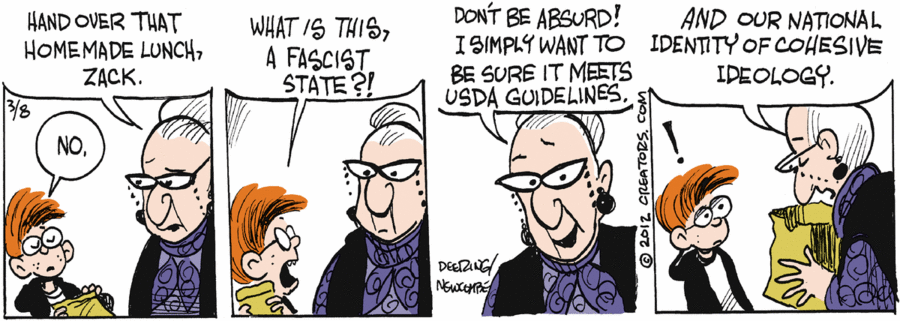
I kid. Zack Hill is a minor comic and this series of strips went practically unnoticed. The story line for the comic seems to be based on this real news story about a preschooler who had her lunch confiscated because it was not well-balanced enough for the person checking lunches, whoever that may have been. For a week or so this became a cause celebre with all sorts of people decrying rampant Nanny State-ism. The primary complaint seemed to be over-reach into the personal decisions of a parent to determine what is an adequate meal.

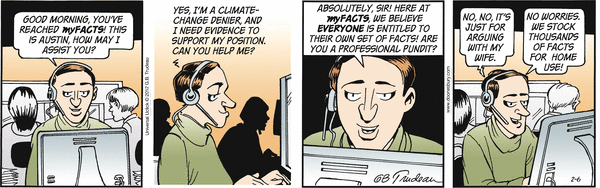
This week the more high-profile comics and/or editorial page stalwart Doonesbury also took on a topical issue with this strip summing up the tone:

(click image for a more legible version)

This topic is very familiar to ATiM readers. It also tackles the issue as one of government over-reach and excessive Nanny State-ism. Feel free to draw your own additional parallels.

Monday Funnies

A few more political-tinged cartoons that struck my fancy over the past week.

The first one seem particularly apropos for this week.

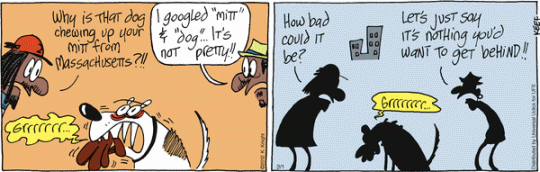
It seems Santorum isn’t the only one with a Google problem.

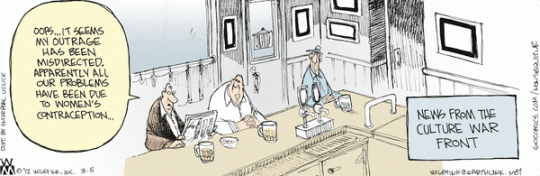
Finally, with the deadlines inherent in the comics business, I am amazed at how prescient this one is. It’s as if he knew Rush was going to keep fanning the flames of this issue.

Hope you enjoy.

Funday Sunnies

I don’t want to step on any toes, but here are some politically tinged comic strips which made me chuckle this week. Doonesbury ran with this concept all week, which kept getting funnier and funnier:

Doonesbury

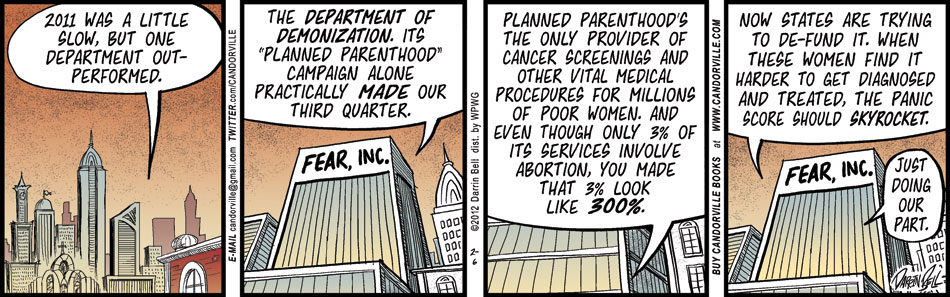
Given the lead time of newspaper comic strips, this one was rather presciently timed to coincide with the Komen Kerfuffle:

Candorville 2-10-2012

Candorville

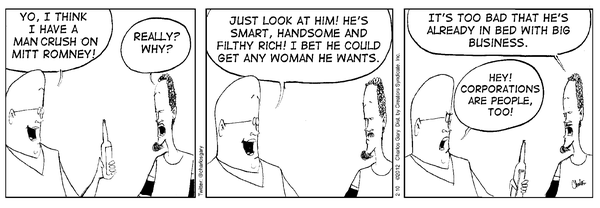
And that Mitt Romney is one handsome devil:

Cafe Con Leche 2/10/2012

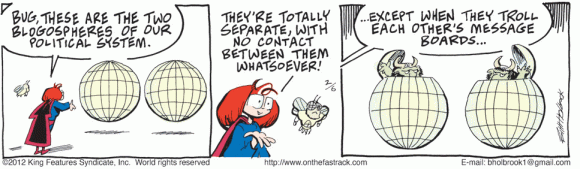
Finally, this one in particular seems to sum up what is wrong with the internet:

On The Fastrack 2/6/2012

On The Fastrack

See you in the funny papers.

(edited to increase image size and add hyperlinks)

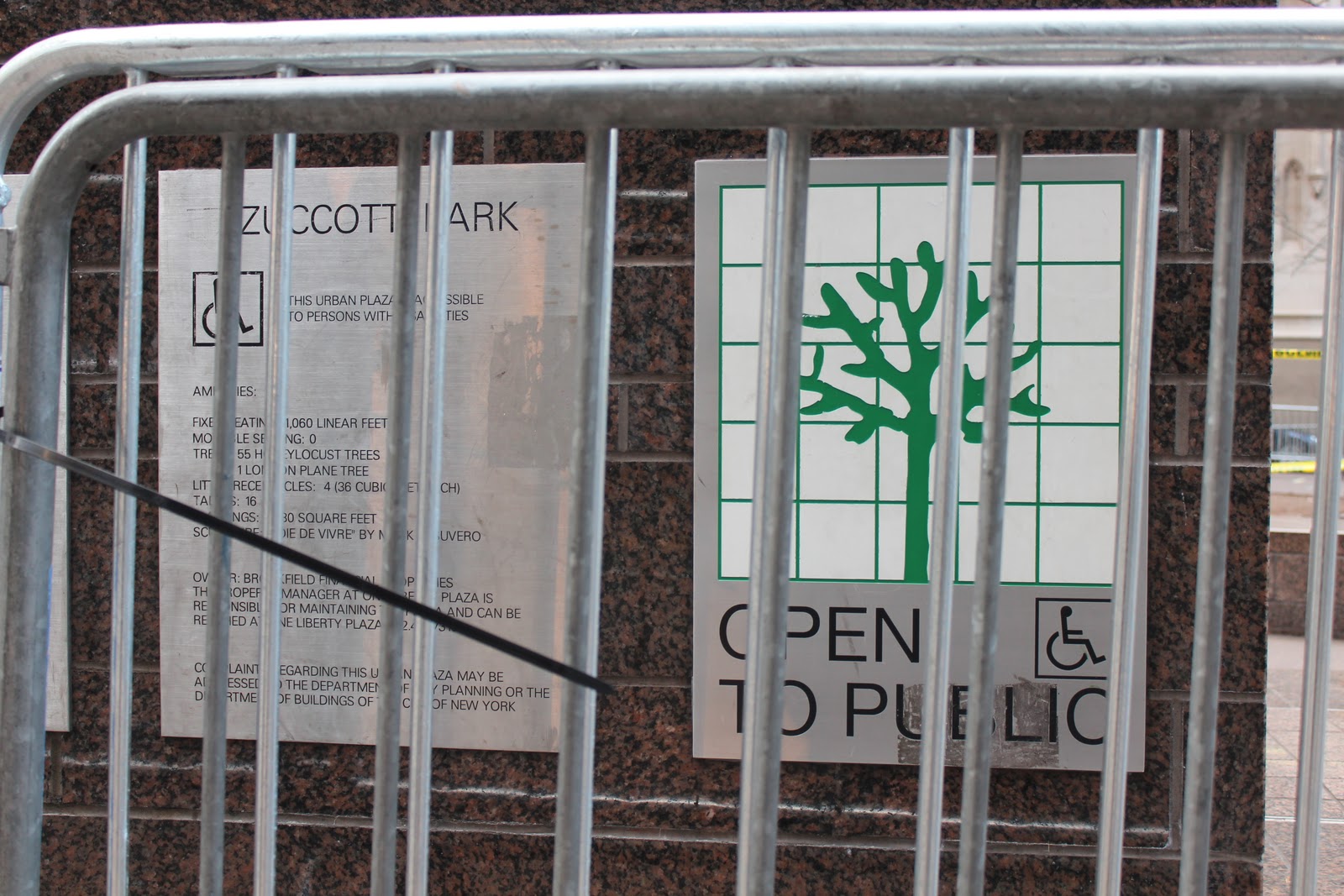
Zuccotti Park Unoccupied

I found myself in lower Manhattan yesterday with some time to kill before my timed pass for the newly opened 9/11 Memorial, so I wandered through Zuccotti Park, former ground zero of the Occupy Wall Street encampment.

Zuccotti Park is typical of several New York City semi-public spaces in that it is not a park in the conventional sense as there are no green spaces. It is a tiered totally hardscaped sliver of a city block with a wide assortment of benches and tables presumably for the enjoyment of nearby office workers on breaks.

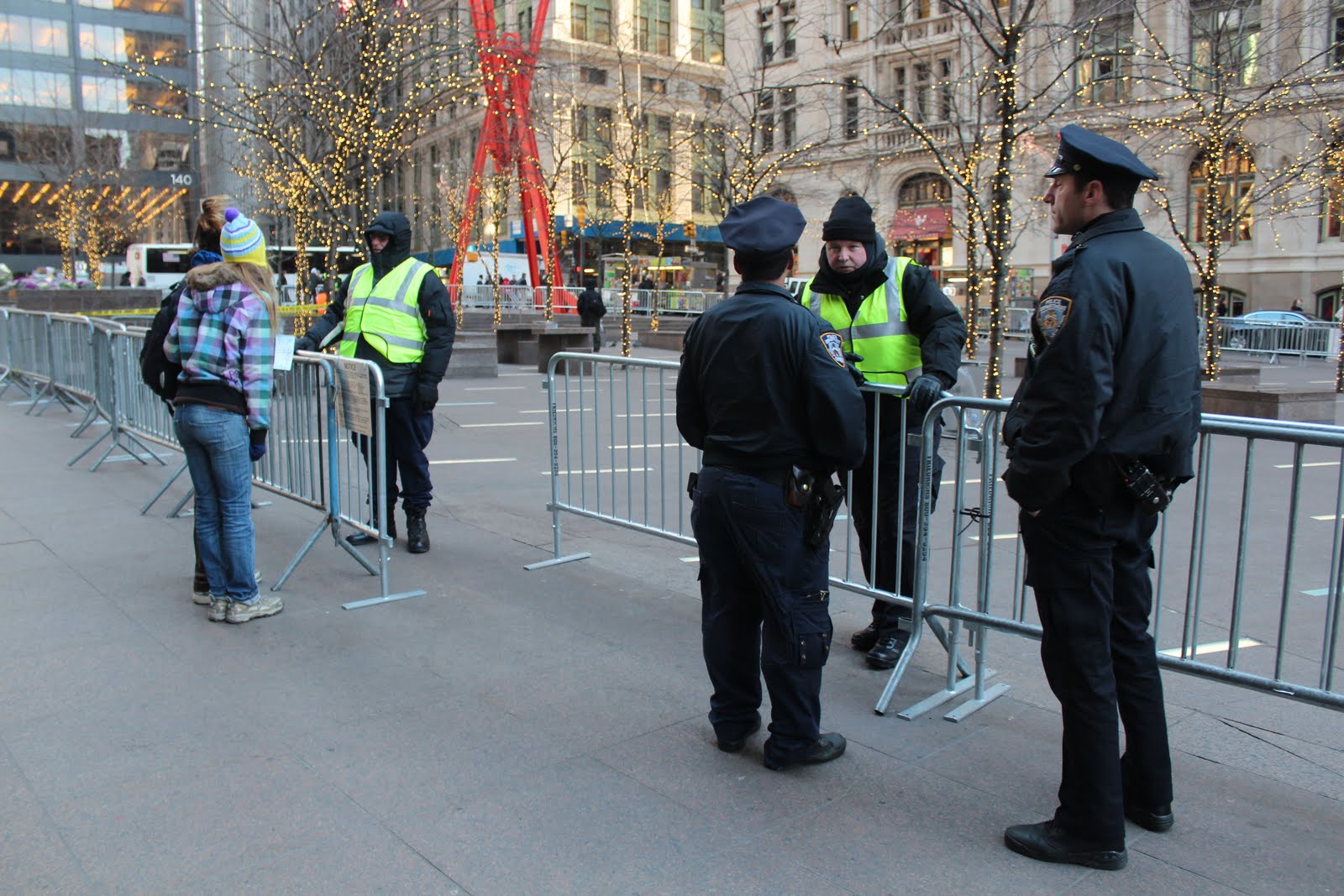
Since the police evicted the occupiers/protesters/squatters in the dead of the night, the park has been ringed with two sets of portable crowd control barricades. The inner ring which is double thick in places encircles the park itself except for two difficult to discern cattle gate style entrances inconveniently located so as to make using the park as a short cut between Church Street and Broadway useless despite the crowded holiday pedestrian traffic around the park. The outer ring was another set of barricades at the curb-street line allowing for street crossing at corners but otherwise restricting access for jaywalkers.

Indeed, the park was deserted except for the occasional determined pedestrian and two people huddled at the stone tables, one looking none too warm and definitely on the unhoused end of the homeless-hipster continuum and the other awaiting to hustle chess opponents who never seemed to arrive.

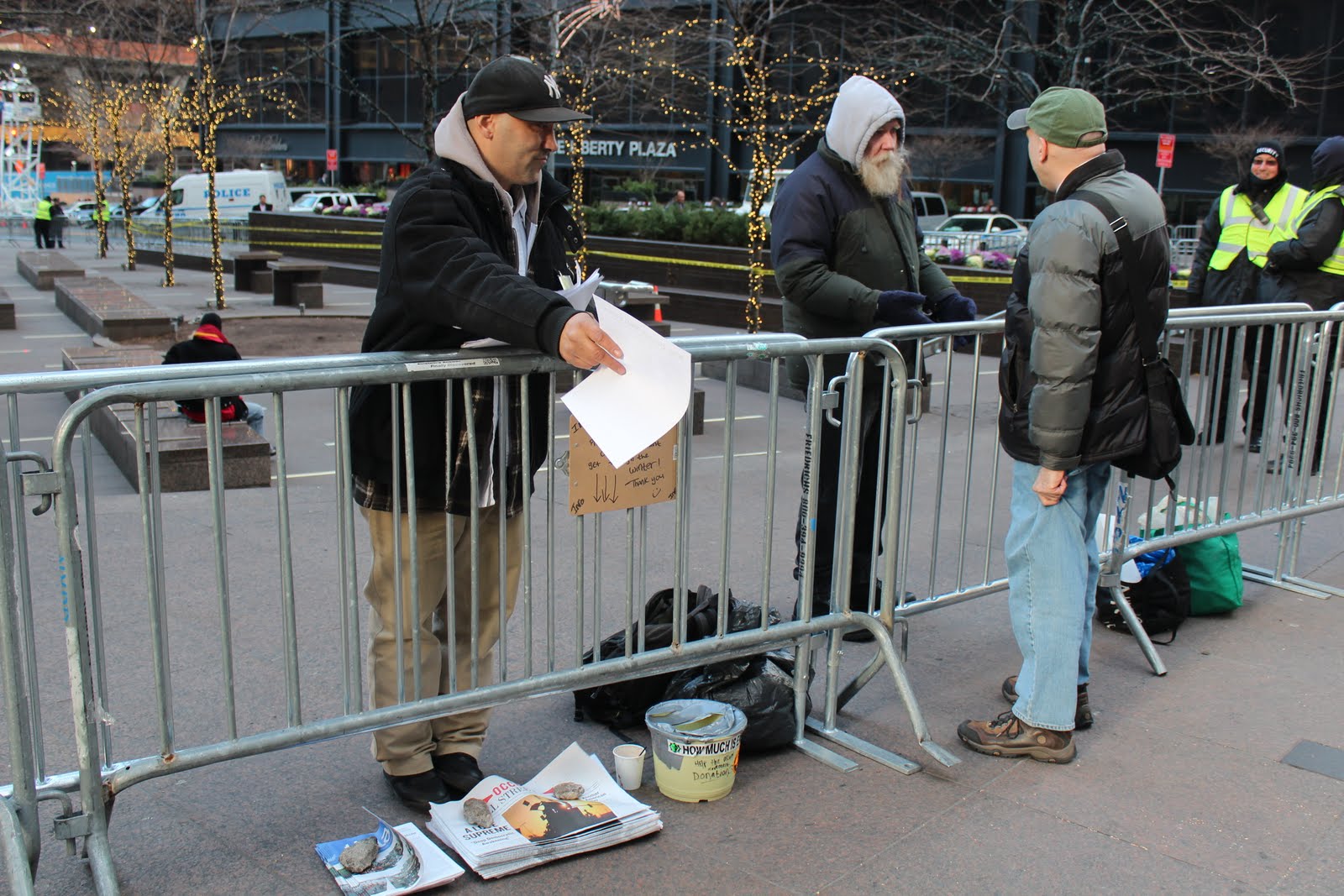
The only two protesters to be seen were at the far east end of the park. One had an incoherent cardboard sign about livestreaming the protest. The other was the ‘official’ OWS representative who was collecting donations while clutching a cup of coffee for warmth. I chatted with him for just a few minutes while he explained how the cops were doing their best to make the park look inaccessible while nominally maintaining it open.

At any given time there were more than a dozen policemen circulating in and around the park, frequently congregating in small groups to chat and joke. There was no serious crowd control going on except for maintaining a highly visible presence.

The OWS protesters are in search of another base of operation, most recently on property owned by nearby Trinity Church who has rebuffed them. I can see why they have to because nobody is going to be occupying Zuccotti Park any time soon.

More photos here.

How Many Americans Don’t Pay Taxes?

From an unexpected source, National Review Online, there is a take-down of the talking point about how “47 percent of Americans don’t pay [income] tax”.

Ramesh Ponnuru in his article “The Freeloader Myth” dismisses many of the misconceptions about the number of people who don’t pay income tax, in particular that the statistic ignores payroll taxes which for many Americans are a bigger burden than income taxes.

Federal taxes are still “progressive” — higher earners pay a disproportionate share of federal taxes — but the Tax Policy Center estimates that only about 18 percent of filers pay neither income nor payroll tax.

Ponnuru explains that the separation of income and payroll taxes is a false one often propagated for political purposes by both sides.

Many conservatives argue that since payroll taxes are dedicated to Medicare and Social Security, people who pay only payroll taxes are contributing to their retirements but not to the general operations of the government. The irony here is that FDR deliberately and explicitly introduced the payroll tax to accompany Social Security because it would encourage people to draw this false connection.

This hits on one of my favorite hot buttons. Money is fungible. A dollar sent to the government is a dollar sent to government no matter what its intended purpose. Even when it is earmarked or lock-boxed or whatever, those are just accounting fictions and it all goes into and out of the same big pool.

And here is the crux:

Count both the payroll and income tax and there is no trend toward lighter federal taxes on the lower-middle class.

He also addresses the implicit free-rider fear that somehow getting something for nothing drives poor voters into the hands of tax-and-spend liberals.

In one respect, the fixation on the number of people paying income tax is absurdly optimistic. Conservatives who worry about the political implications of this number are assuming that people who pay no income tax will conclude that expansions of government serve their material interests and vote accordingly. {snip} Under those circumstances merely requiring everyone to pay some amount in income taxes would change nothing. Any welfare state will have a large number of net beneficiaries. In a welfare state that runs routine, large deficits, almost everyone may be among them.

So is the answer to get more people with skin in the game? Not according to Ponnuru:

To seek to raise taxes on poor and middle-class people would be a terrible mistake. The idea is bound to be unpopular. And it would alter the character of conservatism for the worse. 

The phrase ‘compassionate conservativism’ has been permanantly sullied by its inventor, but balancing the finances of our country on the backs of the poor is not something to be wished for.

Occupy DC Field Report

I was in DC today doing tourist-in-your-town stuff and had some time to kill before my dinner reservation, so I wandered over to McPherson Square to see for myself the scope and magnitude of the Occupy DC protests.

I arrived at dusk but it was clear that the entire park had been taken over by the protesters with tents randomly placed everywhere except for one big wedge of green space on the southwest section of the park. When I arrived there was music playing with some people dancing on the grass. Later there had been some sort of evening meeting and people were dispersing with cooking equipment while others lingered to talk and kids played.

The center of the park has a statue of James B. McPherson, a Civil War general who had been killed in the Battle of Atlanta.

Ringing the statue were a wide variety of signs espousing various ODC positions in a range of detail from simple slogans to long treatises.

Beyond the vast number of tents, there were all the trappings of a semi-permanent encampment. There was a headquarters tent with a daily schedule as well as a medical tent.

Additionally, there was a large area set aside to boxes filled with clothes. I couldn’t quite figure out if it was a donation collection point or a distribution center or both. There was also an organized recycling center.

Around the encampment there were a variety of semi-official activities going on. Under one tent, after a human megaphone announcement, there was a lightly attended class at the ODC ‘university’ while on the other side of the park were the archetypal drummers.

But for the most part, people were just milling around enjoying the pleasant evening. Some people seemed to be reluctant to have their picture taken while others just took it in stride. And I was not the only person using the spectacle as a photo-op.

I really hadn’t know what to expect. There was far more infrastructure than I had imagined despite the tent city being a rather disheveled mish-mash of camping gear and tarps and canopies. What impressed me most was the casual sense of community. People were there with purpose. And they didn’t look like they were leaving anytime soon. You can see higher resolution versions of these photos as well as others in my Flickr set.

Nuke The Gay Unborn Whales

As a joking observation about the ‘Oops’ Heard Around The World, I suggested that Rick Perry’s incoherent fumbling was the result of there just being too many agencies that he wanted to ax.

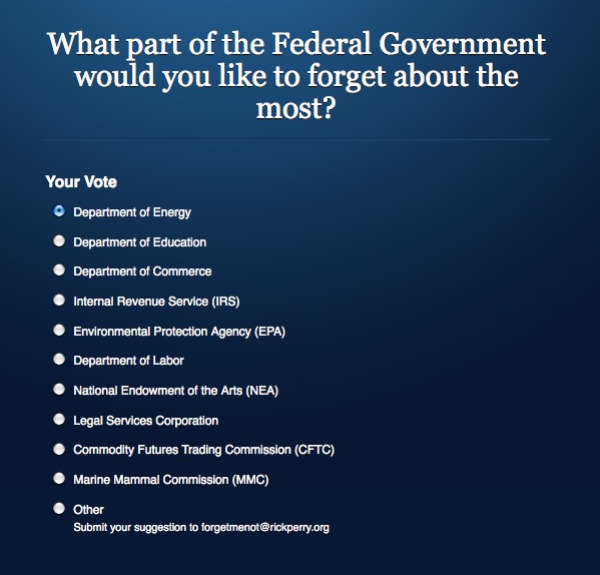
In an odd piece of trying to make lemonade out of lemons, the Perry campaign is confirming my suspicion with a straw poll of what other agencies Perry should also pledge to ax. It includes the usual suspects, the Department of Labor, the IRS, the NEA, and so forth. A very odd inclusion at the very bottom is the Marine Mammal Commission.

Compared to the other big massive targets in his crosshairs, this seems like pretty small beer. Is Rick Perry really courting the Club The Seals crowd?