Happy Anniversary, ATiM

Today is ATiM’s first anniversary, and I think a hearty congratulations are in order, both for the site and for everyone involved in making it the success it has become.

Success, of course, was (and, if we are honest, remains) not assured. Bringing together strong personalities with passionate opinions from as wide a range of ideologies and perspectives as we have here to discuss political issues was always a risky prospect. And while many blogs survive and thrive on the combustible energy and oftentimes unpleasant atmosphere created by such a diverse mix of opinions, from the beginning All Things in Moderation was, as the name implies, intended to be something different. As I wrote in What ATiM is All About, “we created ATiM as a place where political discussion and debate can take place in the absence of the kind of unproductive vitriol that has come to characterize much of blog commentary these days.”

Naturally, we’ve (and especially I’ve) not always succeeded. We lost a few early invitees almost immediately, and a couple more along the way. We’ve had our share of sharp and pissed off exchanges, and a couple of times it seemed, to me at least, like the whole enterprise was going to collapse. But here we still are, going strong, and a lot more positive than negative to show for it.

On a personal level, I truly appreciate ATiM. I have long been a political blog junkie and have been posting on comment boards since I first discovered them over 15 years ago. I’ve jumped from place to place, and had spent the two years prior to ATiM’s inception posting at Greg Sargent’s Plum Line. It had become an extremely unpleasant place to be, but I hung around primarily because of some of the relationships I had developed while there, notably with QB, McWing, and lms. ATiM has allowed me to maintain those relationships, and develop others I never would have, outside of the cesspool that is the Plum Line. I know many of you still participate there, but I for one am thankful that I have no more reason to visit there anymore.

I want to send out a couple of personal thank you’s on this first anniversary. First, to Brent, who’s Morning Report has been crucial to ATiM’s continued existence. I truly believe that without his daily efforts ATiM probably would have died more than once over the last year. He is the unsung hero of ATiM. Also to Mark and Kevin for their efforts at getting ATiM started, Mark behind the scenes recruiting and Kevin for being the technical genius at actually creating the site itself. (I also miss Kevin’s daily Bits n Pieces). And finally, a big thanks to lms. She was the catalyst that got ATiM off the ground. If I am not mistaken, lms and I were debating each other at the Plum Line for longer than anyone else here (except for possibly QB), and given the tone of some of those debates (one early one resulted in lms literally telling me she hated me), she could easily have chosen to leave me out. But she didn’t and for that I am eternally grateful. Here’s to hoping for a lot more debates in the future, lms.

Happy anniversary, ATiM.

ScottC

(Please feel free to add your own anniversary thoughts to the bottom of this post, if you don’t want to make your own new post.)

Sunday Open Thread

Question:  If  Lawrence O’Donnell hears these dog-whistles, doesn’t that make him the dog?

http://youtu.be/bUlzH2NUM80

In other contexts, of course, the PGA tour would be mocked for being as lily white as the Republican Party, but in O’Donnell’s fevered imagination, a reference to the PGA is intended to invoke images of sexually obsessed black men.   What I really wonder is whether O’Donnell is as deranged as a true belief in this theory suggests, or if he just assumes MSNBC’s audience is.

Host Martin Bashir was certainly right when he said “Wow, things are getting lower and lower each day,” although not in the way he probably meant it.

On LIBOR, finis

As I said in my original post, there are two distinct aspects to the LIBOR manipulation story.  My previous two posts have addressed the possibility that LIBOR was being routinely manipulated by traders to suit their positions.  But the alleged manipulation during the crisis of 2008 was of an entirely different nature, done (presumably) not to profit from existing trading positions but rather to obscure from the public the true depth of the on-going crisis by submitting too-low estimates of the cost of borrowing.  At first glance, this “manipulation” seems more troubling than that discussed previously, primarily because the intent seems to be precisely to deceive.   But I do think any judgment must ultimately take into account the context of the crisis itself and what was going on at the time.  It is not my intent here to pass my own judgment on the matter, but rather to present what I think are relevant issues for anyone wishing to consider the matter before they condemn Barclays (or anyone else) for their actions.

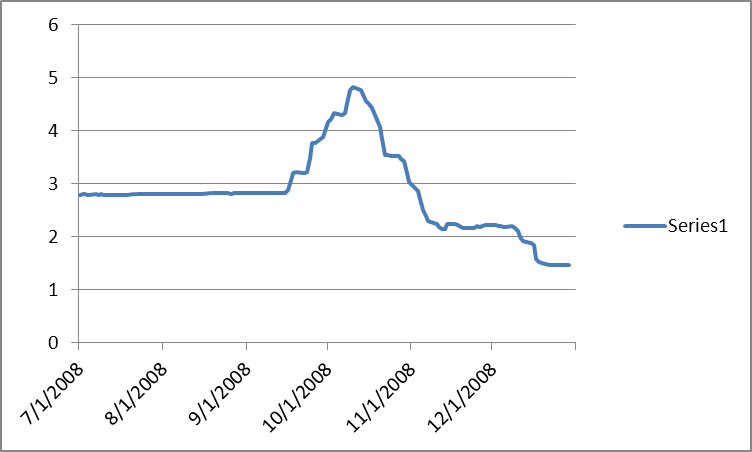
First, just as background, take a look at a graph of LIBOR rates throughout the worst of the crisis, starting in pre-crisis July and ending in December.


What was basically a flat-line through mid-September starts to spike on the day that Lehman failed, and continued to rise quite drastically every day, by about 200 basis points in the span of less than a month, until the Fed began in earnest its efforts to alleviate credit fears and get the capital markets functioning again.  That 200 basis point rise in the span of a few weeks really is quite extraordinary, and is testament to the degree to which fear had taken over the market, and the extent to which credit markets had seized up.   It is also testament to the fact that, whatever individual banks were submitting to the BBA as reported LIBOR contributions, LIBOR itself was clearly reflecting deep problems in the credit market.  As I said, a 200 bp move in such a short time really is quite extraordinary.

Should the spike have been even sharper, but for the “false” reporting of banks such as Barclays?  Perhaps.  But consider the possibility that at times Barclays (and others?) probably couldn’t borrow at all in the interbank markets.  Again, fear was rampant, and everyone was hoarding cash.  Many banks that had cash were holding it as reserves rather than lending it out regardless of the rate.  The credit markets had largely stopped functioning.  So what is a contributing member of the LIBOR panel supposed to report as its borrowing rate when it hasn’t been able to borrow at all?  Infinity?  It is possible that the whole process of establishing a LIBOR rate could/should have broken down entirely.

Consider also the fact that members of the BBA’s LIBOR panel were placed in a distinctly disadvantageous market position relative to non-members.  A non-member would have no obligation to post daily proclamations of their ability (or lack thereof) to borrow in the interbank market, and so would have less to fear from a negative feedback loop, whereby increasing credit fears lead to rising borrowing costs, which in turn would lead to even more increasing fears about one’s ability to pay it off, thus sparking even higher borrowing costs.  LIBOR panel members, on the other hand, were in a position of having to announce to the world every day at 11 am GMT just how much the rest of the interbank market feared their collapse.  Honesty, that is, had the potential to do even more damage to the company than was already occurring.

Finally the Fed, along with other central banks, was clearly spending much of its time trying to quell the contagion of credit fear.   They didn’t want LIBOR increasing by leaps and bounds every day either, and would certainly have been in daily contact with all of the major banks.  So I find it entirely plausible that either or both the Bank of England and the Fed  knew of any low-balling of the submissions and either explicitly or implicitly approved it.

Again, I am not necessarily trying to absolve Barclays or anyone else of any possible wrong-doing here.  Even given the points I’ve raised, I don’t know for sure what the right course of action was.  But I do think it is necessary to judge whatever was done in the context of the times.  We were in extraordinary circumstances and in some respects in entirely uncharted territory.  In such circumstances, it is not clear to me that the normal rules necessarily apply.

(I fear that my points above are not as clear or coherent as I would like them to be.  I am currently working on 3 hours of sleep in the last 2 days, and am falling asleep as I write, but I really wanted to get this up today, so I hope  it at least makes some sense and you can get the gist of what I am trying to say.)

On LIBOR, part 2

At the end of my last post, I posed the question of whether or not any possible attempts to manipulate the daily LIBOR quote had been successful.  To look at this question, I analyzed 3 years worth of  daily 3-month LIBOR data, from January 2005 thru December 2007, a time during which routine manipulation was allegedly being attempted.

Now, just to be clear, my analysis cannot be said to be definitive.  To determine if, on any given day, an attempted manipulation was successful, and to what degree, one would need to look at all of the individual submissions that comprised the average resulting in the published LIBOR rate that day,   determine which if any of those submissions should have been a different rate, establish what the submission should have been, and then recalculate the average using that new rate.  That is beyond the bounds of what I can do here.  Nor have I attempted to determine the effect of any possible collusion between two or more panel members, which would be even more complicated.  All I will attempt to do here is to look at daily LIBOR settings in the context of the rates before and after, and the longer term trends, both actual and expected given market conditions at the time, to determine if the published rate makes sense and seems reasonable or if it seems odd and counterintuitive.

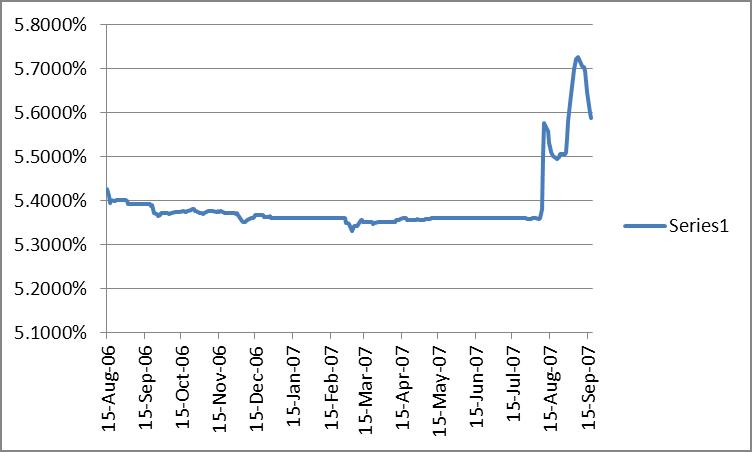
In looking at the data, one interesting thing appears immediately.   For almost an entire year, from mid-September 2006 until mid-August 2007, the daily LIBOR quote barely moved at all.

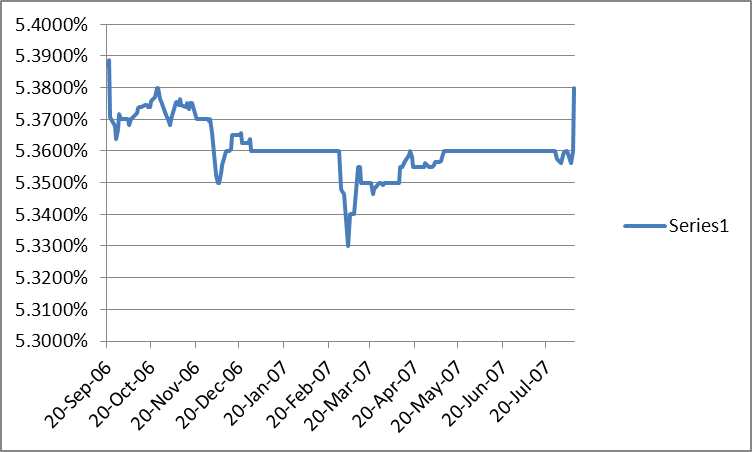
From September 20, 2006 until August 7, 2007 the high rate was 5.3875% (on September 20, 2006) and the low rate was 5.33% (on March 5, 2007).  Why were rates so steady during this time period?  Primarily because the Fed was maintaining a steady rates policy, and in the absence of any credit crisis, LIBOR will tend to mirror Fed policy.  So, with rate policy on hold for nearly a year, this would seem like an ideal time period to look for manipulation of LIBOR.  If it was going on during this time period, one would expect to see seemingly arbitrary daily moves both up and down in the otherwise steady published rate.

In fact what we see is remarkable consistency.  Indeed, for two extended periods, from Dec 26, 2006 until February 27, 2007, and then again from May 10, 2007 until July 26, 2007, we saw quite literally not a single change in the daily LIBOR rate of 5.36%.  For these two periods the graph is a perfectly flat line.

It seems highly unlikely that any manipulation could have been taking place during these two flat-line periods.   Overall, from Sep 20, ’06 until August 7, ’07, on days in which LIBOR did change from the previous day, the average change was .0029%, or less than one-third of a basis point.  And there were only 5 days over the course of this entire  222 day period in which the change in LIBOR from the previous day was even greater than 1 bp, with the biggest single change being 1.8 bps.

Now, perhaps it might be interesting to investigate further into why the rate changed by more than 1 bp on the 5 days in which it did, with an eye towards whether the change was the result of the same bank or banks altering their LIBOR submission on those days, and whether those days coincided with e-mails from traders requesting a higher or lower submission.  But regardless of the outcome of such an investigation, we can say, I think, that whatever attempted manipulation may have gone on during this period, it was neither all that regularly successful nor, if it was successful, did it alter the rate all that significantly, averaging barely a quarter of a basis point.

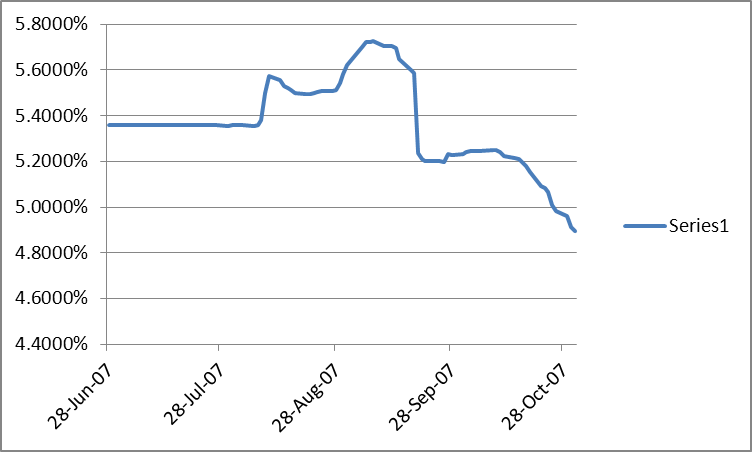
As an aside, some of you may be wondering why I chose September 20 and August 7 as a starting/stopping point for this particular analysis.  I chose September 20 because that was the date on which the Fed first announced that it was holding rates steady after over a year of rate hikes, and I chose August 7 because it was in early August that Bear Stearns’ impending meltdown began to really effect the market, with the collapse of two of its sub-prime funds and the requested resignation of its president Warren Specter.  This graph shows how rates began to react first to the news of Bear Stearns in early August by spiking from what had been essentially a flat-line, and then to the 50 bp rate cut by the Fed on Sep 18, the first of many cuts that would result in the zero rate policy that we still have today.

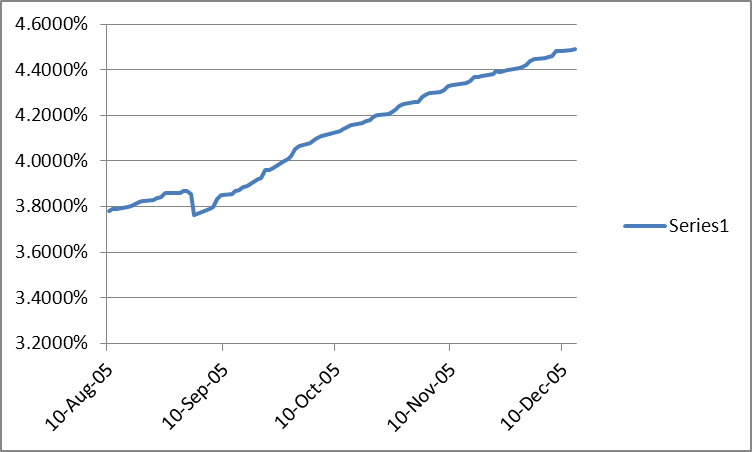
What about periods prior to September 2006?  Can evidence of successful manipulation be found there?  Well, it is somewhat more difficult to analyze this period because the Fed had an active rate-hiking policy prior to September 2006, and so the LIBOR rate was changing pretty much on a daily basis in response to this rate hiking policy.  For example, see this graph for the period between August 9, 2005 and December 13, 2005, a period in which the Fed hiked rates by 25 bps on September 20, November 1, and again on December 13.

With the exception of two consecutive days, September 1 and 2 on which the rate oddly dropped first by 1.5 bps and then by 9.4 bps, the graph looks pretty much exactly as you would expect it to, slowly increasing incrementally every day to keep up with the anticipated (and ultimately realized) Fed actions of raising rates.  For example, between the November 1 and December 13 Fed announcement dates, on which the FED announced a 25 bp rate hike, the average daily change in LIBOR was .9 bp, with a max of 2 bps (both times over weekends, so accounting for 3 days worth of change) and the rate steadily moved from 4.2606% to 4.4913%, almost exactly the expected 25 bps.   This steady and consistent change is not indicative of any manipulation, or, if there was any, its effect was just fractions of a basis point.

That 9 bp drop on September 2 is certainly an interesting outlier.  What could have caused that?  Frankly I don’t know.   It is possible that it is the result of manipulation, although I doubt it because in order to get that much of a change, any manipulation would have to have been both coordinated with many other panel members and fairly egregious.  The absence of other equally odd outliers at other points suggests to me that something peculiar happened that particular day in the market causing the drop rather than being an example of regular manipulation.  But, again, I don’t really know the answer, so I could be wrong.

In any event, my look at the 3 years prior to 2008 does not suggest to me any obvious evidence of significant, successful alteration of LIBOR from what one would expect.  Which brings us to what I originally said needed to be the subject of a separate discussion:  possible manipulation of LIBOR during the crisis of 2008 in order to hide funding difficulties from the market.  That will be the subject of my next post.

On LIBOR, part 1

So I figured it was time to weigh in with a post about the LIBOR scandal.  I will say upfront that, while it is a scandal, I think that, because of the general bank-bashing atmosphere that prevails in certain media and political circles right now, it has been blown far out of all proportion.  Our own jnc has tended to focus, not unreasonably, on the implications that the scandal presents for the kind of culture that prevails in the finance industry.  While I don’t agree that it is nearly as indicative of a widespread culture of dishonesty and corruption as jnc seems to, I think it is at least a fair question.  I have no time, however, for the Taibbis and Simpsons of the world who are doing their utmost to portray this as some kind of huge and concerted rip-off of Main Street, municipalities, widows and orphans, or whoever else is their latest chosen victim. That is just a bunch of bunk.

There are actually two separate issues here, and they need to be discussed separately. The first is the claim that individual traders were routinely manipulating the daily LIBOR set, both higher and lower, to benefit their trading positions on any given day.  The second is that, during the crisis of ’08, some banks were reporting falsely low borrowing costs in order to keep their funding difficulties from becoming public information.  Let’s address the former first, and perhaps a little history would be useful.  

Prior to the advent of LIBOR swap contracts used many different floating rate indices such as Prime or T-Bills (which is of course manipulated by the Fed as a matter of course), and even at times an individual bank’s own lending rate, determined solely at it’s own discretion.   Then in the mid ’80’s the demon derivatives market invented LIBOR in order to standardize swap contracts by basing them all off of a single, reasonable and standard measure of a “premium” bank’s borrowing cost.   Banks liked this because, even if the published rate was not exactly their own borrowing cost, it was a fair enough approximation to make their contracts sensible. Spreads could be added to this standard for individual contracts to account for the varying credit quality of the contracting parties, but LIBOR would represent a baseline index. In the beginning there were actually competing publishers of daily LIBOR rates, each with their own methodology of calculating the rates.  There were different contributors as well as different averaging and rounding conventions, and so the “standard” wasn’t quite that.  But over time the British Bankers Association’s published BBA Libor became the dominant rate and eventually the market standard.

From the first, LIBOR was defined broadly and was never meant to be some exact rate that mirrored an already established market rate.    In the first place, it’s nature as an average of many different bank rates, with both high and low submissions being deliberately excluded, makes it nothing more than an approximation anyway.  Second, the rate that the BBA requested as submissions was always very subjective.  Originally the BBA simply asked each contributing bank’s opinion of  where an unnamed, generic “prime” bank might be able to borrow:  ““At what rate do you think interbank term deposits will be offered by one prime bank to another prime bank for a reasonable market size today at 11am?”. 

Later, in 1998, it changed it’s question to “At what rate could you borrow funds, were you to do so by asking for and then accepting inter-bank offers in a reasonable market size just prior to 11 am?” So now, rather than asking about a hypothetical bank’s borrowing costs, it was asking about the bank’s own borrowing costs.  But note the qualifying and indeterminate language.  What is “reasonable”?  What if you weren’t actually in the market “just prior” to 11 am?  What if you borrowed from three different banks at three slightly different rates? What if you borrowed at 10am, and then saw that the market sold off between then and 11 am? Do you submit your actual rate or what you guess it would have been an hour later? What if you weren’t a borrower at all, but were in fact lending to other banks on a given day?

The main point here is that, contrary to the perception being fostered by outraged pundits and opportunistic politicians, there is no single, objectively knowable “correct” rate to be submitted by any given bank.  Obviously there is not only room for a subjective interpretation and judgment on the part of the  individual submitters, such a judgement is often actually required.  There is some range of rates within which it is perfectly reasonable to have submitted, even of it is not an actual rate that you transacted.  

Now, if one is tasked with submitting the daily rate to the BBA, how does one make this judgement, and is it ethical to be influenced by the entreaties of traders who stand to benefit or lose from your judgement?  That is a fair question and perhaps a point worth debating.  But I actually think it is debatable.  If the nonexistent “correct” rate falls within a range of, say, 3 or 4 basis points, is it really wrong or unethical to take into consideration the financial well being of the company you work for when deciding whether to report the high or low end of the range?  I don’t think so, at least not necessarily.  And the fact that one rate within the band is chosen and not another does not mean that the rate has been criminally “manipulated” or that the rate has been “fraudulently” submitted. As long as the submitted rate is defensible on the merits, regardless of how the judgement was arrived at, I don’t see a problem.  Certainly, in any event, this is not some “criminal conspiracy” akin to the mob shaking people down.  

And in fact the whole process of calculating LIBOR takes all of this into account.  That is precisely one of the reasons that such a wide number of banks (18) are polled and averaged, and why the high and low submissions are excluded from the average. As the BBA itself says, “The decision to trim the bottom and top quartiles in the calculation was taken to exclude outliers from the final calculation. By doing this, it is out of the control of any individual panel contributor to influence the calculation and affect the bbalibor quote.” Which brings us to another, and I think more important question:  Regardless of whether routine attempts to influence the submissions are ethical, were they successful in changing the rate?

That will be the subject of a future post.

My Top Five Founding Fathers

This was going to be a Top Ten list, but I ran out of time.  Have to get going to the town get-together for food, music, and fireworks.

5. Benjamin Franklin – Delegate to the Second Continental Congress; helped form what was to become the Declaration of Independence; as a diplomat to France during the war he played the crucial role in securing French military support against the British, without which the outcome of the Revolution would have been very different.  As an emissary to Britain, he worked hard to keep the colonies within the Empire, but once the Revolution started he never looked back – “We must all hang together, or we will surely hang separately.”

4. Thomas Jefferson – Incredibly smart; author of one of the finest documents every produced, the Declaration of Independence; as a diplomat to France was crucial in maintaining foreign relations with the new nation’s primary ally; third President.  Jefferson was a jumble of contradictions, both politically and personally, and I have many reservations about him, but he undeniably played a crucial role in the founding of the nation.

3. John Adams – Member of both Continental Congresses; was central to the choice of George Washington as Commander in Chief of the Continental Army;  instrumental in the drafting and adoption of the Declaration of Independence; first Vice-President and second President of the US.  One of my favorites.

2.  Alexander Hamilton – The epitome of the self-made man and a model for achieving what has become the American dream; he actively fought in the war; author of the Federalist Papers; as the nation’s first Treasury Secretary and trusted confidant of Washington, he almost single-handedly laid the groundwork for the US’s rise as an economic power.  Easily the most under-appreciated Founding Father.

1.  George Washington – Architect of the defeat of the greatest military power in the world by a rag-tag group of untrained colonials; resisted the pull of establishing monarchical powers for himself;  precedent-setter for Presidential traditions including term limits.  Quite simply the single most important person in the history of these United States.

Honorable mention:

James Madison – Co-author with Hamilton of the Federalist Papers and the writer of most of the Constitution.

Thomas Paine – Author of Common Sense in 1776, a powerful treatise on the need for independence from Britain.

Samuel Adams – Brewer and patriot.  What more need be said?

The Speech

One of my favorite moments of the American independence movement has always been Patrick Henry’s speech to the Virginia Convention in March of 1775.   The official beginning of the Revolution, the skirmishes at Lexington and Concord in Massachusetts on April 19, were still a month away, but the situation had been coming to a boil for some time.  A year prior Massachusetts had been placed under British military rule, and on February 9, 1775, the British Parliament had officially declared Massachusetts to be in a state of rebellion.  Delegates had been sent from Massachusetts to seek support for the nascent independence movement, and conventions had been formed in the various colonies to discuss what to do.  There is no official transcription of Henry’s speech that day of March 23, 1775, but his first biographer, through notes, contemporary accounts in newspapers and interviews with people who were there, was able to piece together what was said and what is now recognized as the speech he gave.  We are all aware of Henry’s most famous conclusion, but I think the speech itself, and especially the final two paragraphs, are equally moving.

MR. PRESIDENT: No man thinks more highly than I do of the patriotism, as well as abilities, of the very worthy gentlemen who have just addressed the House. But different men often see the same subject in different lights; and, therefore, I hope it will not be thought disrespectful to those gentlemen if, entertaining as I do, opinions of a character very opposite to theirs, I shall speak forth my sentiments freely, and without reserve. This is no time for ceremony. The question before the House is one of awful moment to this country. For my own part, I consider it as nothing less than a question of freedom or slavery; and in proportion to the magnitude of the subject ought to be the freedom of the debate. It is only in this way that we can hope to arrive at truth, and fulfil the great responsibility which we hold to God and our country. Should I keep back my opinions at such a time, through fear of giving offence, I should consider myself as guilty of treason towards my country, and of an act of disloyalty toward the majesty of heaven, which I revere above all earthly kings.

Mr. President, it is natural to man to indulge in the illusions of hope. We are apt to shut our eyes against a painful truth, and listen to the song of that siren till she transforms us into beasts. Is this the part of wise men, engaged in a great and arduous struggle for liberty? Are we disposed to be of the number of those who, having eyes, see not, and, having ears, hear not, the things which so nearly concern their temporal salvation? For my part, whatever anguish of spirit it may cost, I am willing to know the whole truth; to know the worst, and to provide for it.

I have but one lamp by which my feet are guided; and that is the lamp of experience. I know of no way of judging of the future but by the past. And judging by the past, I wish to know what there has been in the conduct of the British ministry for the last ten years, to justify those hopes with which gentlemen have been pleased to solace themselves, and the House? Is it that insidious smile with which our petition has been lately received? Trust it not, sir; it will prove a snare to your feet. Suffer not yourselves to be betrayed with a kiss. Ask yourselves how this gracious reception of our petition comports with these war-like preparations which cover our waters and darken our land. Are fleets and armies necessary to a work of love and reconciliation? Have we shown ourselves so unwilling to be reconciled, that force must be called in to win back our love? Let us not deceive ourselves, sir. These are the implements of war and subjugation; the last arguments to which kings resort. I ask, gentlemen, sir, what means this martial array, if its purpose be not to force us to submission? Can gentlemen assign any other possible motive for it? Has Great Britain any enemy, in this quarter of the world, to call for all this accumulation of navies and armies? No, sir, she has none. They are meant for us; they can be meant for no other. They are sent over to bind and rivet upon us those chains which the British ministry have been so long forging. And what have we to oppose to them? Shall we try argument? Sir, we have been trying that for the last ten years. Have we anything new to offer upon the subject? Nothing. We have held the subject up in every light of which it is capable; but it has been all in vain. Shall we resort to entreaty and humble supplication? What terms shall we find which have not been already exhausted? Let us not, I beseech you, sir, deceive ourselves. Sir, we have done everything that could be done, to avert the storm which is now coming on. We have petitioned; we have remonstrated; we have supplicated; we have prostrated ourselves before the throne, and have implored its interposition to arrest the tyrannical hands of the ministry and Parliament. Our petitions have been slighted; our remonstrances have produced additional violence and insult; our supplications have been disregarded; and we have been spurned, with contempt, from the foot of the throne. In vain, after these things, may we indulge the fond hope of peace and reconciliation. There is no longer any room for hope. If we wish to be free² if we mean to preserve inviolate those inestimable privileges for which we have been so long contending²if we mean not basely to abandon the noble struggle in which we have been so long engaged, and which we have pledged ourselves never to abandon until the glorious object of our contest shall be obtained, we must fight! I repeat it, sir, we must fight! An appeal to arms and to the God of Hosts is all that is left us!

They tell us, sir, that we are weak; unable to cope with so formidable an adversary. But when shall we be stronger? Will it be the next week, or the next year? Will it be when we are totally disarmed, and when a British guard shall be stationed in every house? Shall we gather strength by irresolution and inaction? Shall we acquire the means of effectual resistance, by lying supinely on our backs, and hugging the delusive phantom of hope, until our enemies shall have bound us hand and foot? Sir, we are not weak if we make a proper use of those means which the God of nature hath placed in our power. Three millions of people, armed in the holy cause of liberty, and in such a country as that which we possess, are invincible by any force which our enemy can send against us. Besides, sir, we shall not fight our battles alone. There is a just God who presides over the destinies of nations; and who will raise up friends to fight our battles for us. The battle, sir, is not to the strong alone; it is to the vigilant, the active, the brave. Besides, sir, we have no election. If we were base enough to desire it, it is now too late to retire from the contest. There is no retreat but in submission and slavery! Our chains are forged! Their clanking may be heard on the plains of Boston! The war is inevitable²and let it come! I repeat it, sir, let it come.

It is in vain, sir, to extenuate the matter. Gentlemen may cry, Peace, Peace²but there is no peace. The war is actually begun! The next gale that sweeps from the north will bring to our ears the clash of resounding arms! Our brethren are already in the field! Why stand we here idle? What is it that gentlemen wish? What would they have? Is life so dear, or peace so sweet, as to be purchased at the price of chains and slavery? Forbid it, Almighty God! I know not what course others may take; but as for me, give me liberty or give me death!

It gives me chills

There are many dates that could have been adopted as America’s Independence Day.  The Continental Congress officially voted to approve a resolution of independence on July 2, 1776 and John Adams even predicted, in a letter to his wife, that the 2nd day of July “will be the most memorable epoch in the history of America. ”  He was wrong.  The Declaration of Independence was  adopted by the Congress 2 days later, and it was officialy read in public for the first time on July 8, while Washington ordered it read in front of the Continental Army on July 9.  There is some dispute as to exactly when it got signed, but it was definitely not signed by all signatories until well after July 4th, and it was eventually signed by some people who were not even in Philadelphia when it was adopted.    November 30th, the date of the signing of the Paris peace treaty ending the American revolution is probably the date on which American independence was actually and officially achieved.

Still, from the outset, July 4th became the day of celebration for American Independence.   It was first celebrated in Philadelphia in 1777 with fireworks, toasts, parades and speeches, thus setting a tradition that we follow to this very day.   The fourth of July has become such an iconic phrase that we often forget that it even refers to  a date on the same calender used by everyone.  Canada’s independence day, July 1, is often referred to by Americans as Canada’s Fourth of July, and if you ask someone if the British have a fourth of July, you are likely to get a laugh and a “Of course not”.

Only two of the original signers of the Declaration of Independence ever managed to go on to become President of the United States, first John Adams from Massachusetts and then Thomas Jefferson of Virginia, and it is interesting that of all of the signers, they were the ones who survived the longest.  The two had had a very interesting history together.  Early on in the revolutionary movement, they had forged a friendship, but following independence and during the forming of the new nation, they found themselves on opposite sides of the  political spectrum, and subsequently became bitter enemies.  After each had served his term as president and began to step away from national politics, the friendship was tentatively renewed, and eventually grew again with many letters passing between them.

By 1826, they were the only two remaining of the men who signed the original Declaration of Independence.   Old and failing, as the 90 year old Adams lay on his death bed in Massachusetts, it is reported that his last words were “Thomas Jefferson survives.”  If this is indeed what he said, he was wrong yet again, for the 83 year old Jefferson had died 5 hours earlier down in Virginia, on the same day.

The day was July 4, 1826, the fiftieth anniversary of American Independence.

The Original

Picture of the Declaration of Independence

Bye Bye, Great Britain

In CONGRESS, July 4 1776

The unanimous Declaration of the thirteen united States of America.

When in the Course of human events, it becomes necessary for one people to dissolve the political bands which have connected them with another, and to assume among the powers of the earth, the separate and equal station to which the Laws of Nature and of Nature’s God entitle them, a decent respect to the opinions of mankind requires that they should declare the causes which impel them to the separation.

We hold these truths to be self-evident, that all men are created equal, that they are endowed by their Creator with certain unalienable Rights, that among these are Life, Liberty and the pursuit of Happiness.–That to secure these rights, Governments are instituted among Men, deriving their just powers from the consent of the governed, –That whenever any Form of Government becomes destructive of these ends, it is the Right of the People to alter or to abolish it, and to institute new Government, laying its foundation on such principles and organizing its powers in such form, as to them shall seem most likely to effect their Safety and Happiness. Prudence, indeed, will dictate that Governments long established should not be changed for light and transient causes; and accordingly all experience hath shewn, that mankind are more disposed to suffer, while evils are sufferable, than to right themselves by abolishing the forms to which they are accustomed. But when a long train of abuses and usurpations, pursuing invariably the same Object evinces a design to reduce them under absolute Despotism, it is their right, it is their duty, to throw off such Government, and to provide new Guards for their future security.–Such has been the patient sufferance of these Colonies; and such is now the necessity which constrains them to alter their former Systems of Government. The history of the present King of Great Britain is a history of repeated injuries and usurpations, all having in direct object the establishment of an absolute Tyranny over these States. To prove this, let Facts be submitted to a candid world.

He has refused his Assent to Laws, the most wholesome and necessary for the public good.

He has forbidden his Governors to pass Laws of immediate and pressing importance, unless suspended in their operation till his Assent should be obtained; and when so suspended, he has utterly neglected to attend to them.

He has refused to pass other Laws for the accommodation of large districts of people, unless those people would relinquish the right of Representation in the Legislature, a right inestimable to them and formidable to tyrants only.

He has called together legislative bodies at places unusual, uncomfortable, and distant from the depository of their public Records, for the sole purpose of fatiguing them into compliance with his measures.

He has dissolved Representative Houses repeatedly, for opposing with manly firmness his invasions on the rights of the people.

He has refused for a long time, after such dissolutions, to cause others to be elected; whereby the Legislative powers, incapable of Annihilation, have returned to the People at large for their exercise; the State remaining in the mean time exposed to all the dangers of invasion from without, and convulsions within.

He has endeavoured to prevent the population of these States; for that purpose obstructing the Laws for Naturalization of Foreigners; refusing to pass others to encourage their migrations hither, and raising the conditions of new Appropriations of Lands.

He has obstructed the Administration of Justice, by refusing his Assent to Laws for establishing Judiciary powers.

He has made Judges dependent on his Will alone, for the tenure of their offices, and the amount and payment of their salaries.

He has erected a multitude of New Offices, and sent hither swarms of Officers to harrass our people, and eat out their substance.

He has kept among us, in times of peace, Standing Armies without the Consent of our legislatures.

He has affected to render the Military independent of and superior to the Civil power.

He has combined with others to subject us to a jurisdiction foreign to our constitution, and unacknowledged by our laws; giving his Assent to their Acts of pretended Legislation:
For Quartering large bodies of armed troops among us:
For protecting them, by a mock Trial, from punishment for any Murders which they should commit on the Inhabitants of these States:
For cutting off our Trade with all parts of the world:
For imposing Taxes on us without our Consent:
For depriving us in many cases, of the benefits of Trial by Jury:
For transporting us beyond Seas to be tried for pretended offences
For abolishing the free System of English Laws in a neighbouring Province, establishing therein an Arbitrary government, and enlarging its Boundaries so as to render it at once an example and fit instrument for introducing the same absolute rule into these Colonies:
For taking away our Charters, abolishing our most valuable Laws, and altering fundamentally the Forms of our Governments:
For suspending our own Legislatures, and declaring themselves invested with power to legislate for us in all cases whatsoever.

He has abdicated Government here, by declaring us out of his Protection and waging War against us.

He has plundered our seas, ravaged our Coasts, burnt our towns, and destroyed the lives of our people.

He is at this time transporting large Armies of foreign Mercenaries to compleat the works of death, desolation and tyranny, already begun with circumstances of Cruelty & perfidy scarcely paralleled in the most barbarous ages, and totally unworthy the Head of a civilized nation.

He has constrained our fellow Citizens taken Captive on the high Seas to bear Arms against their Country, to become the executioners of their friends and Brethren, or to fall themselves by their Hands.

He has excited domestic insurrections amongst us, and has endeavoured to bring on the inhabitants of our frontiers, the merciless Indian Savages, whose known rule of warfare, is an undistinguished destruction of all ages, sexes and conditions.

In every stage of these Oppressions We have Petitioned for Redress in the most humble terms: Our repeated Petitions have been answered only by repeated injury. A Prince whose character is thus marked by every act which may define a Tyrant, is unfit to be the ruler of a free people.

Nor have We been wanting in attentions to our Brittish brethren. We have warned them from time to time of attempts by their legislature to extend an unwarrantable jurisdiction over us. We have reminded them of the circumstances of our emigration and settlement here. We have appealed to their native justice and magnanimity, and we have conjured them by the ties of our common kindred to disavow these usurpations, which, would inevitably interrupt our connections and correspondence. They too have been deaf to the voice of justice and of consanguinity. We must, therefore, acquiesce in the necessity, which denounces our Separation, and hold them, as we hold the rest of mankind, Enemies in War, in Peace Friends.

We, therefore, the Representatives of the united States of America, in General Congress, Assembled, appealing to the Supreme Judge of the world for the rectitude of our intentions, do, in the Name, and by Authority of the good People of these Colonies, solemnly publish and declare, That these United Colonies are, and of Right ought to be Free and Independent States; that they are Absolved from all Allegiance to the British Crown, and that all political connection between them and the State of Great Britain, is and ought to be totally dissolved; and that as Free and Independent States, they have full Power to levy War, conclude Peace, contract Alliances, establish Commerce, and to do all other Acts and Things which Independent States may of right do. And for the support of this Declaration, with a firm reliance on the protection of divine Providence, we mutually pledge to each other our Lives, our Fortunes and our sacred Honor.

Button Gwinnett
Lyman Hall
George Walton

William Hooper
Joseph Hewes
John Penn
Edward Rutledge
Thomas Heyward, Jr.
Thomas Lynch, Jr.
Arthur Middleton

John Hancock
Samuel Chase
William Paca
Thomas Stone
Charles Carroll of Carrollton
George Wythe
Richard Henry Lee
Thomas Jefferson
Benjamin Harrison
Thomas Nelson, Jr.
Francis Lightfoot Lee
Carter Braxton

Robert Morris
Benjamin Rush
Benjamin Franklin
John Morton
George Clymer
James Smith
George Taylor
James Wilson
George Ross
Caesar Rodney
George Read
Thomas McKean

William Floyd
Philip Livingston
Francis Lewis
Lewis Morris
Richard Stockton
John Witherspoon
Francis Hopkinson
John Hart
Abraham Clark

Josiah Bartlett
William Whipple
Samuel Adams
John Adams
Robert Treat Paine
Elbridge Gerry
Stephen Hopkins
William Ellery
Roger Sherman
Samuel Huntington
William Williams
Oliver Wolcott
Matthew Thornton