Today in history – September 18

1996 – Boston Red Sox Roger Clemens strikes out 20 batters for the second time in his career. Subsequent allegations of steroid use will place forever make Clemens’ many achievements suspect. I’m ashamed he became a Yankee.

1975 – Patty Hearst, 19-year old daughter and heiress of newspaper magnate Randolph Hearst, is finally captured in a San Francisco apartment after a months long manhunt for her. Over 7 months earlier, Hearst had been kidnapped by a leftist (!) terrorist group calling itself the Symbionese Liberation Front (SLF). Initially the SLF had demanded that Randolph Hearst hand out $70 worth of food to every needy person in California in exchange for her return, but after her father had donated more than $6 million worth of food to the Bay area’s poor, an audiotape was released in which Hearst herself announced that she had willingly joined the SLF and had changed her name to Tania. Two weeks after her announcement, Hearst is captured on a surveillance camera wielding an M1 carbine while robbing a San Francisco branch of the Hibernia Bank. A warrant is issued for her arrest, resulting in her capture in September. Despite claiming that she was a victim of brainwashing, Hearst will go on to be convicted and sentenced to 7 years in prison, although her sentence will be commuted by President Jimmy Carter and Hearst will join Marc Rich as a beneficiary of President Bill Clinton’s controversial pardon program executed on his last day in office, January 20 2001.

1862 – Following the battle of Antietam, Union General George McCLellan misses a chance to end the Civil War by allowing the retreating Confederate army to escape across the Potomac. Although the Union army had superior numbers and fresh troops following the original inconclusive battle, and might well have been able to destroy General Robert E. Lee’s battered rebels, McClellan allowed Lee’s army to cross the Potomac unmolested and refused to give chase for nearly the next 2 months, despite the urging of both the War Department and President Lincoln himself that he do so. Lincoln eventually dismisses McClellan from his command. The war will carry on for nearly another 3 years.

Today in history – September 13

2011 – A motley crew of political junkies and refugees from other blogs join forces to create All Things in Moderation, “a place where political discussion and debate can take place in the absence of the kind of unproductive vitriol that has come to characterize much of blog commentary these days.” The significance of this on the world outside their little bubble is highly questionable, but since this post is inside that bubble, it remains worth noting.

1971 – A four day riot in Attica prison in New York, during which prisoners held employees hostage and took over portions of the prison, ends abruptly when police open fire on the prisoners, killing 29 inmates and 10 hostages. Four days earlier, an inmate attack on a guard had grown into a full-fledged riot and inmate take-over. Three days of negotiations ensue, with prisoners demanding improved living conditions. When negotiations fail, Governor Nelson Rockefellar authorizes the police to re-take the prison by force. Lawsuits surrounding the event will carry on for decades, with New York State being ordered by a federal judge to pay $8 million in damages to sruviving inmates in 2000, and in 2005 the state finally settles with the families of those employees who were killed, for at total of $12 million.
http://www.youtube.com/watch?v=JPHRnMQULrw

1814 – As the British bombard Fort McHenry from the waters of the Chesapeake Bay, American Francis Scott Key pens The Defense of Fort McHenry, a poem that will eventually be set to music, renamed The Star Spangled Banner, and go on to become the US national anthem. Key had gone to Baltimore in order to negotiate the release of a friend of his who had been captured by the British. Brought aboard a British ship, Key secures the release of his friend, but is prevented from going ashore until the British finish their attack on Fort McHenry. Key was inspired to write his poem when, after an all night barrage, he awoke in the morning to the sight of the Stars and Stripes still flying over the fort. The Star Spangled Banner is now heard virtually daily in sports stadiums throughout the nation.

Two Years and Still Hanging On…Barely

Happy birthday, ATiM. Hard to imagine, but yes, it was 2 years ago today that our long lost colleague Kevin Willis put up the first ever ATiM post. In many respects it has been a long haul. Too much of a haul for some as, truth be told, we are currently a much diminished operation from last year. We operate now on what is basically a skeleton crew, with barely a comment on some days. Unfortunately I think the future of ATiM is much in doubt. But still, a special thanks to Brent for his daily efforts in the Morning Post, and thanks also to everyone else who continues to find the time in their busy schedules to contribute, and the fortitude to tolerate both the thoughts of those they disagree with and the rough and tumble that it sometimes produces. I wish there were more of us, but those who remain are a solid crew. Thanks.

Here’s to another year….I hope.

Today in history – September 11

9/11 – On what will prove to be one of the most significant days in United States history, members of the Islamic terrorist organization Al Qaeda successfully attack the US on its own soil, sending shock waves throughout the world. Four teams teams of terrorists board and hijack 4 early morning cross-country flights departing from Boston and New York, with the goal of flying them into various landmark buildings in New York and Washington. Two of the planes are flown into the Twin Towers of New York City’s World Trade Center in southern Manhattan, resulting in the eventual collapse of both and killing nearly 3,000 people, including over 400 NYC firefighters, policemen, and paramedics. A third plane flies to Washington D.C, crashing into the Pentagon, killing nearly 200 passengers, civilians, and military personnel. The fourth plane fails to reach its destination when passengers, made aware of the other crashes after making calls to the ground to report their own hijacking, stage their own attack on the hijackers. Upon breaching the cockpit, the hijackers dive the plane into a field in western Pennsylvania, killing all 45 passengers.

Much of the day’s events are played out in front of a live and captivated television audience, including the second plane hitting the WTC, the collapse of both towers, and perhaps most disturbingly, the sight of desperate office workers, trapped on floors above the infernos caused by the two crashes, making the horrific choice to leap more than a thousand feet to their death rather than be incinerated in the growing flames. The traumatic events of the day immediately enter the national consciousness, to be forever known as, and immediately brought to mind by, the simple numbers, 9-11.

Within a month of the attacks, America will retaliate, with President Bush initiating Operation Enduring Freedom, a military operation aimed at destroying AQ’s terrorist network in Afghanistan and ousting AQ’s Afghani hosts, the Taliban regime. Over the ensuing years the US will capture or kill many high ranking AQ operatives, an effort that will continue even into the presidency of Bush’s successor, Barack Obama, culminating in a 2011 raid on a Pakistani housing compound resulting in the killing of AQ founder and leader, Osama Bin Laden.

Today in history – September 10

1897 – London cab driver George Smith becomes the first person to get arrested for drunk driving after slamming his taxi into a building wall. Although no scientific test exists to establish a blood alcohol level, Smith proclaims himself to be drunk, leading to his arrest. He is eventually fined 25 shillings.
drunk

1833 – President Andrew Jackson announces that he will remove all federal funds from the Second National Bank of the United States, effectively ending central banking in the US and opening an era of “free banking”. The successor to the First National Bank of the US, the Second National Bank was chartered from 1816 – 1836, and was 20% owned by the federal government, but was controversial both constitutionally and with regard to its policies, which many saw as favoring monied interests in the urban northeast. The populist Jackson was opposed to the bank’s existence, and it became a focal point of the 1832 presidential election. Upon being re-elected in 1832, Jackson vetoed congressional efforts to extend the bank’s charter beyond 1836, and eventually used executive power to withdraw federal funds and prevent the bank from taking new deposits. Although the bank continued to exist as a private corporation following the end of its charter, by 1841 it was liquidated.
jackson

1776 – Captain Nathan Hale of the Continental Army answers General Washington’s call for someone to gather intelligence behind enemy lines, becoming America’s first known spy against the British. Hale spent several weeks gathering intelligence, but is eventually detained aftyer being caught on Long Island Sound trying to get back to Colonial controlled territory. In possession of incriminating documents, British General Howe quickly orders Hale to be executed. Although there are no contemporary accounts to establish it, Hale’s legendary last words before being hanged are said to have been “I only regret that I have but one life to give for my country.”
hale

Today in History–September 5

1972 – Just before midnight, amidst the backdrop of the twentieth Olympic games, 9 Israeli Olympic athletes are massacred on the tarmac at the Munich airport after a botched rescue attempt turns into a firefight between their Palestinian captors and German security forces. The athletes, most of them members of the Israeli wrestling team, had been taken hostage (2 others were killed) by members of the terrorist organization Black September after the terrorists had sneaked into the Olympic Village and stormed the Israeli apartment complex in the early morning hours. After an initial demand for the release of some 230 prisoners held in Israeli prisons, a day of negotiations is played out in front of a worldwide television audience of millions. Eventually the attackers request a plane to take them to Cairo, a request ostensibly granted by German authorities, who prepare to ambush the attackers after transporting them to an air base in helicopters. The plan, to the extent there really was one, goes drastically awry when security forces posing as airplane attendants take it upon themselves to abort the mission, thus tipping off the terrorists to the trap. In the ensuing firefight, the terrorists turn their fire on the bound hostages in the helicopter, and then toss a grenade into it, incinerating anyone who was still alive.

1836 – Sam Houston is elected as the first president of the Republic of Texas. A year earlier Houston had been appointed to be a military commander of the Texas army during the nascent movement to establish Texas independence from Mexico. Under Houston’s leadership the Texas army had recovered from a disastrous defeat at the Alamo in early 1836, and had gone on to defeat the Mexican army, capturing its general Santa Anna in the process. Santa Anna was subsequently forced to sign an armistice granting Texas its independence. Houston actually gets elected as Texas’ president twice, serving from 1836-1838, and then again from 1841-1844. He would go on to serve as a Senator in the US congress after helping Texas gain admission as state in the US in 1845.
houston

1774 – In response to the passage of the Coercive Acts, more locally known as the Intolerable Acts, 56 delegates representing 12 of the 13 colonies (Georgia was unrepresented) gather in Philadelphia for the first ever session of the Continental Congress. It is the first formal act of unified opposition to British rule among the American colonies. The delegates, who will draft a declaration of rights and grievances to be sent to the King, include Patrick Henry, John Adams, and George Washington.
continetnal congress


Title added by Michi

Today in history – September 4

1972 – US swimmer Mark Spitz helps his team win the medley relay in a record setting time, thus winning his 7th gold medal at the Munich Olympic games, setting a record that would last for 40 years. Spitz also set new world records in each of the other 6 events in which he won the gold. His tally of 7 golds will remain a record until 2012 when Michael Phelps took home 8 at the Beijing Olympics.
http://www.youtube.com/watch?v=moHuIWnqLxE

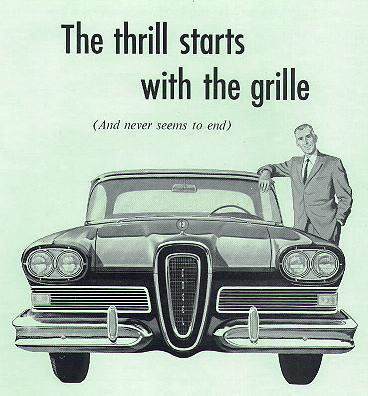
1957 – The Edsel, the first new car brand to be introduced by one of the Big 3 motor companies in 20 years, and perhaps the most infamous flop in car manufacturing history, is presented to the public by the Ford Motor Company. Veiled in secrecy, Ford had hyped the new car with a marketing campaign that showed only the hood ornament and promised simply “The Edsel is coming.” But when it was finally unveiled, the public was not impressed. Coming amidst a changing economic landscape, the car was too big and too expensive, and had a myriad of technical problems, including a hood ornament that tended to fly off on the highway. After only 3 years, and a loss of $250 million, the Edsel division folded.
edsel

1886 – The Indian wars of the American southwest effectively come to an end when Geronimo, the last remaining warrior chief to organize resistance to US forces, surrenders. Geronimo is sent to reservations first in Florida and then in Louisiana, finally ending up in Oklahoma, where he converted to Christianity, became a successful farmer, and even participated in Theodore Roosevelt’s inaugural parade.
geronimo

Today in history – September 3

2004 – A three-day hostage crisis in a school in the town of Beslan, Russia comes to a violent end when a gun battle between Russian security forces and the hostage takers erupts following an explosion. Three days earlier Chechen terrorists had surrounded and then taken over the school, holding some 1,200 children, parents and teachers, who had been celebrating the first day of school, in the school gym. The gym was then rigged with explosives as the terrorists demanded a Russian troop withdrawal from Chechnya. On the third day of the siege, an explosion in the gym, which witnesses later say was accidentally set off, sparks a firefight between the terrorists and security forces. By the time it is over, 31 of the 32 terrorists are dead, along with 331 of the hostages, including 186 children.

1783 – America is officially recognized as an independent nation with the signing of the Treaty of Paris, formally ending the American Revolution. The last major battle of the Revolution had ended two years previously with the surrender of British General Cornwallis to French and American troops, but final peach negotiations had continued throughout 1782 and 1783. The final agreement granted America its independence as well as granting all lands from Florida to the Great Lakes and between the Atlantic and the Mississippi to the US, essentially doubling its size.

Today in history – September 2

1969 – Chemical Bank in Rockville Center, New York introduces the automated teller machine to its customers, the first ATM to appear in the US. ATM’s will go on to alter the face of personal banking across the world, and have become an indispensable feature to every day life.
atm

1959 – Responding to the increasing appeal of smaller imported cars, Ford introduces the Falcon, its first compact, fuel efficient car dubbed “the small car with the big car feel”. Priced at only $1,900, the car is a huge hit, with dealers ordering 97,000 of the cars on the first day alone, and more than 2 million of them are sold in its first two years. My dad had a Falcon when I was a kid.
falcon

1945 – Aboard the USS Missourri, Japanese Foreign Minister Mamoru Shigemitsu and General Yoshijiro Umezu of the Imperial Army formally sign unconditional surrender documents, officially ending World War II. The surrender ceremony in color.

Today in History – September 1

1985 – The R.M.S. Titanic is discovered on the ocean floor 12,000 feet below the surface of the Atlantic by an expedition headed by Robert S. Ballard. Ballard is actually on a secret mission chartered by the US Navy to locate and photograph two sunken nuclear submarines, the USS Thresher and USS Scorpion. Using the search for the Titanic as a cover story, Ballard is allowed to search for the remains of the ship after having located the two submarines. Scanning the ocean floor with an unmanned submersible sub named Argo, Ballard discovers one of Titanic‘s massive boilers, which leads to the wider debris field and eventually the ship itself.
http://www.youtube.com/watch?v=u5J9GpuNb3A

1939 – One week after signing the Molotov-Ribbentrop Pact, a non-aggression treaty between Germany and the Soviet Union, World War II begins when Germany invades Poland. The move prompts both Britain and France to declare war on Germany two days later, and the Soviets will join in the invasion of Poland by mid-September, effectively splitting the nation between Germany and the Soviets. Despite Germany’s defeat 6 years later, it will be 50 years before Poland will regain its independence from the Soviet Union.

1864 – In one of the most decisive battles of the Civil War, Union forces under the command of William Tecumseh Sherman capture Atlanta, an important supply hub for the South. The battle for the city had begun in May, and it will remain occupied by Union forces until November 15 when Sherman leaves the city in ruins and begins his infamous March to the Sea.