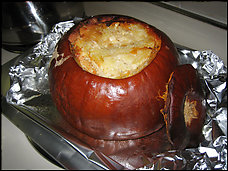
Got a pumpkin? Stuff it!

Fall is my favorite time of year. Don’t get me wrong. Lazy summer evenings are nice, but DC is too warm for my taste. Fresh tomatoes almost make it worthwhile. Wintertime has its own pleasures, particularly snuggling under the comforter. Spring is a wonderful awakening and I love the arrival of fresh greens and strawberries.

Ah, but fall. It’s relief from that long, hot summer. I can enjoy the clear warm days and love the cool rainy ones. And comfort food comes back on the menu along with those fruits and vegetables that have been growing all year, just waiting for me to happen by.

We went apple picking out in Front Royal last year. It’s a long trip, so we’ll see if we can find something closer this year. One of my favorites is homemade apple sauce. It’s so easy. Good apples, a bit of sugar and spice, heat and plenty of time. This stuff is to the jarred as a summer tomato is to the ones you see in the supermarket. I bought a food mill specifically for the aim of making apple sauce. I used a potato ricer last year. It works, but it’s messy.

I’m looking forward to our annual Thanksgiving bash. That’s a post in and of itself. I tried my first organic turkey last year. It was pretty good, though I think my favorite of the meal was the beets I picked up a MoM’s (My Organic Market) in Del Ray.

Perhaps the purest fall food for me is the pumpkin. I remember that I used to make an occasional pumpkin pie and have it for breakfast for the better part of a weak. There are other things you can do with it, though. My favorite of these is to stuff it. Here is an absurdly simple recipe a former Post food writer (Kim O’Donnell) clued me into three years ago.

The first time I ever made this, Primo and Secondo were sick and so I had to leave the pumpkin in a warm oven. An interesting thing happened. The skin began to fall away from the pumpkin, so I peeled it and served it all mixed. It’s cheesy, pumpkin goodness. Here are a few of source links:

http://voices.washingtonpost.com/mighty-appetite/2008/11/the_great_sugar_pumpkin.html

http://www.thekitchn.com/thekitchn/fall/autumn-supper-savory-stuffed-pumpkin-099843

http://www.doriegreenspan.com/dorie_greenspan/2008/09/pumpkin-packed-with-bread-and-cheese-a-recipe-in-progress.html

http://blog.streaminggourmet.com/2009/10/25/ruth-reichls-cheesy-bread-in-a-pumpkin/

BB

Stuffed Pumpkin

Ingredients
1 sugar pumpkin, 2 – 3 pounds
4 – 6 oz. of stale bread, cut into ½” chunks
4 – 6 oz. of cheese, cut into chunks
Several cloves of garlic, chopped
½ – 1 cup whole milk
Seasoning (nutmeg or herbs)
Method
Cut a cap off the top of the pumpkin. Cut off any seeds and strings off the cap and scoop out everything from the pumpkin. Give the inside of the pumpkin a good rinse.
Combine the stuffing and, well, stuff that pumpkin. Put the pumpkin in a baking pan (or oven save pot) and place into an oven at 375 degrees. Bake for about an hour or so.
Notes
The seeds are a great snack if you wash them off and roast them.
Go with whatever you like for the cheese. Gruyere works well. I love a good blue cheese in this recipe. I’m guessing that some cooked bacon, broken into pieces, would add additional yumminess.
The recipes that I’ve seen call for using half and half, but I think it works fine with milk. You can also mix the dairy with chicken stock.
I’ve seen nutmeg used for the seasoning, but I prefer to use a dry herb mix such as Herbs de Provence.
I’ve seen different cooking methods to be used. One can go with a higher temperature oven and that’ll add a nice char to the pumpkin. Just keep an eye on it and reduce the temperature as needed.

Into The Mystery

Case closed
I was certain in my youth
God knows
Had my scientfiic proof
And in my mind
I thought I saw the truth
I never looked beyond my lenses
Never saw that it was you
I mentioned that I am a father of children with autism in my introductory post. I thought I might write a little about that. Both of my sons have a diagnosis of Pervasive Developmental Disorder – Not Otherwise Specified. PDD NOS is a bit of a mouthful, so I like the new term—atypical autism. AA is a lot easier to say, even if it does give rise to some amusing images.  Having twins meant that one saved the other who then returned the favor. We’ve used Primo and Secondo, characters from the movie Big Night, as their pseudonyms, so I’ll keep to that.
I’m a let them get dirty, don’t sweat it if your child doesn’t hit the milestone from What to Expect kinduva guy. Kids seemed to thrive pre-Dr. Spock, so let them grow at their own pace. Still, at some point you realize on a deep level that something’s not quite right. We brought up our concerns at their 2 year check-up and got some reassurance. To my everlasting shame, I held back on evaluation. Most of the time, it’s not a big deal. That isn’t the case for my sons.
It was in their second year of life when our concerns grew serious. I’m tempted to say it’s like a stomach ache that doesn’t go away. That happened to the husband of a friend of mine. His stomach troubles turned out to be pancreatic cancer. He didn’t make it. Our children are seen at an excellent pediatric practice. There’s a developmental specialist every other Friday. Once those concerns wouldn’t go away, we made an appointment with her. Incidentally, there’s no coverage for that initial screening. $100 is no big deal for us, but it’s gotta be hard for parents who are just getting by. We quickly got the word that he’s delayed and possibly autistic. I can’t say as it was a shock at that moment.
Out of the Question
Can’t catch the wind inside my fist
No, it’s Out of the Question.
Try to trap you and I know I missed
Out of the Question
You’re closer than the air I breathe
but Out of the Question
and Into the Mystery
I do not know if getting a diagnosis four or five months earlier would have made a difference. Here’s two things that a parent of a developmentally delayed child learns quickly. Every second counts. It is important to get therapy yesterday. Hell, do it in six months ago! Here’s the other thing that you’ll learn. You’ll be waiting months for an appointment. Following that initial appointment, we had a few words of advice, whatever books we could find. We were on our own for a few months, but I think they made a difference. The big point was to engage Secondo. Get him out of his world and into ours.
I wound up inventing a game they still love, though it’s harder on my back now. Hug, beso (kiss), blast-off. The idea being that Primo or Secondo runs from the kitchen to me sitting on the sofa. I give him a big hug, then a kiss, then toss him onto the sofa. It’s a lot easier with a 2 year old than a kindergartener! That summer was pretty much a matter of teaching what should come naturally. It felt great to finally be doing something.
We then got in line. We were told to contact Dr. Jean Thomas, who was head of psychiatry at Childrens National Hosptial. Trust me folks, if you’re told by a professional that this is the specialist you should see, you get in line. It doesn’t hurt that Dr. Thomas works at a premier hospital for pediatric care. At one point, I’d actually given up on getting through with them. The gates may not be barred, my friends, but they’re sticky. Fortunately, Dr. Thomas left a message with us and we got through to Intake.  One also leans the magic words to get past the gatekeepers.
My heart
Brings me to my knees
There’s God
Forest before the trees
Move me
Like the wind will stir the leaves
I give way to the Mystery
Like the Branches in the breeze
The initial evaluation was an interesting experience. You have two terrified parents and a clueless toddler. The team consisted of Dr. Thomas, a colleague, and what I presume were a couple of interns. One problem was that we had to sit in the waiting room for a better part of an hour. Secondo wasn’t at his best by then, which may not have been a bad thing. At the end of it all, we got the news that he had autism and to make a follow-up appointment. My wife broke down upon getting the news. Not that she was crushed by the news, but it was almost a relief to finally have it verified. The hospital isn’t that far from where she used to work frequently, so I dropped her and Secondo off on my way back to work. I’m not sure how I felt that day. I knew it would be a long journey, just didn’t know the path.
We had a follow-up appointment a couple of weeks later. Dr. Thomas introduced us to Dr. Bhavin Dave (he’s Indian). Dr. Dave had interned at Kennedy Krieger (another fine institution in this area) and was about to take up the position of head of Pediatric Psychiatry. Here’s a tough choice. You’re directed to this one person. Mind you, we knew relatively little about the developmental specialist. Still, when you’re clueless and told this is THE PERSON, it’s a tough decision. t was a difficult choice at the time, but we figured it’d be good to get in on the ground floor. We were one of his first patients. He’s become a valued family friend. Early on, I think it was more about keeping my wife and I in the game than counseling Secondo.
And I’m Out of the Question
Can’t catch the wind inside my fist
No, it’s Out of the Question.
Try to trap you and I know I missed
Out of the Question.
You’re closer than the air I breathe
but Out of the Question.
and Into the Mystery
In parallel with this track, I learned a lot about the Americans with Disabilities Act. I’m not necessarily a small government guy (big shock there), but I have always been deeply skeptical of a federal role in education. Some of this comes from having a mother in the primary system—she’s a semi retired speech therapist. It seemed like massive amounts of paperwork for modest amounts of funding. Education has always seemed like a local responsibility to me.
Well, my sons would not be thriving in kindergarten were it not for federal interference in education. To be exact, something called Child Find. It’s a system designed to detect developmentally delayed children and get them services so that they can thrive. My wife and I are pretty well prepared for educating kids. I have a BA in Physics and Mathematics and a PhD in Condensed Matter Physics . My wife actually trained for elementary education before finding her calling as an interpreter. [Bachelor’s at Redmond in Education and a Masters in Translation and Interpretation from the Monterey Institute for International Studies). I’m not throwing the degrees out there to brag. Rather to note that we’re two highly educated parents who are well prepared for the task of getting our children ready. And we didn’t have a fucking clue what we were getting into.
I think we could have cobbled together something, but it wouldn’t have been close to what the “system” did for them. I’m overwhelmed by the care given to my sons. And yeah, it’s because of that interfering federal government. We probably could have worked out something. We both make good money and probably afford specialized schooling. Providing we had a clue what to get. My best friend at work has a son on the spectrum. They didn’t realize his needs until he was hitting kindergarten and dealt with a serious quack. Then I think about parents of delayed kids who couldn’t afford expensive services and specialized education. There was a story in the Post a few years about a woman whose son was “cured” of autism. They went through enormous stress and bankruptcy. How the hell could a family of limited means thread this gauntlet?
OK. End of political sermon. This is one case where I came in general agreement with small government conservatives. Then I saw what effective government could do. It opened my eyes.
Truth is there for finding
But the logic that’s involved.
It’s a mystery unwinding
Not a problem to be solved
I have twin sons. To my thinking, they saved each other. We picked up on Secondo’s delays a lot faster because of direct comparison with Primo. At the point when Primo’s language took off, Secondo seemed to plateau. We pushed for an evaluation earlier than I think we would have had it not been for the comparison. Primo helped to save Secondo. Secondo later returned the favor.
Coming into their second year of life, we had a family friend caring for them in our home. We got Secondo into a pre-K program for developmentally delayed children. It seemed unfair for Primo to stay at home on his own, so we enrolled him in the neighborhood preschool. I think it was two or three days a week, several days a week.
Now, Primo is brilliant. I know it’s natural for a dad to brag, but I don’t know of many kindergarteners that understand exponents. [I’m not kidding. He wrote 6 squared and I assumed that he’d seen it somewhere. He informed me that it meant 6 times 6. OMG.] He was an early reader and has been obsessed with symbols from an early age. We assumed that we had a very bright boy, clueless to the fact that wasn’t all that was going on.
In the first week at the neighborhood preschool, the teacher had concerns. Primo was the old child in his class and was totally freaked out. He’d obsess on the calendar. He wouldn’t join in circle time. He eventually got to the point where he would be willing to sit on a little chair outside the circle. By now we were “pros” at the system and so called Child Find. The plan was that he would continue at the neighborhood preschool and go to the special needs program on other days of the week.
I got a call in August two years ago. They asked why we were going with the morning program. It was mainly to try and match the schedules of the special needs program and the regular preschool I was told that Secondo could continue with his previous teacher (yay!) and asked if we’d be interested in enrolling Primo in a new class that would be half developmentally delayed children and half “peer models”. Yay!!!!!
Out of the Question
The wind inside my fist
No, it’s out of the Question.
Try to trap you and I know I missed
Out of the Question.
You’re closer than the air I breathe
But out of the Question.
And Into the Mystery
Since then, Primo spent 2 years in Bridget Mancke’s class and Secondo joined him the following year. It is overwhelming to me how far they have come. It is not easy raising kids with autism. I want to post about that at a later date. I figured that the story of getting into the system was enough for one.
My kids are in kindergarten now and I think it’s going OK. We’ve had some relapses related to potty training, but I think we’ve got it under control. Other matters are really tough right now. Still, they’re in regular classes and thriving. I’ll take it for now and tell you about day to day at a later date.
Oh yeah, you might be wondering why I keep lapsing into verse. The lyrics are from a song by David Wilcox, Into the Mystery. I was introduced to David Wilcox by my wife almost ten years ago. We’ve seen him perform three or four times. I was searching for the right metaphor and then I realized that David had it right ten years ago. I’m almost 6 years Into the Mystery. It’s a rewarding journey, but oh can it be tough.
Update: thanks to whoever (Kevin?) fixed the link. I also meant to add a picture. This was taken this past summer during their annual Costa Rica vacation. You talkin’ to me?

BB

My Sign-Off

I totally missed the point of Goose’s question on a previous thread. I do respect Troll and the Tea Party. I’d like to relate my experience of being a Washingtonian during the TP rallies. I saw a lot of folks out and about. My impression was that they were simply good people who care about their country. They’re not my enemy, even though I think they are profoundly mistaken.

So, why does the Fairlington Blade sign his posts with BB? It’s shorthand for buh-bye. Also for BuckyBall. Kraetschmer and Huffman first figured out how to synthesize buckyballs when I was a graduate student. My first big paper was on magnetic resonance spectroscopy of buckyballs and they’ve come back in my career. I recently submitted a paper on a study of zinc phthalocyanine and buckyballs. [Note – if you’ve used blue paint, you’ve used a phthalocyanine.]

Buckyball is shorthand for Buckminsterfullerene. Put in your mind a soccer ball. Black pentagons and white hexagons. Put a carbon atom at every corner. You’ll find that there are 60 corners. A buckyball is a geodesic sphere. It’s also a truncated icoshedron (a 20 sided die for us D&D geeks). Buckminster Fuller was an architect who invented the geodesic dome and so this molecule is named in his honor.

At some point, I decided to have a sign-off. My favorite might be Chevy Chase (I’m Chevy Chase and you’re…. not). Dennis Miller had a pretty good one too (I am out of here). Mine is succinct and says a little about me.

Wait for it.

Buh-Bye

Stepping away from The Pledge

Back in July, Tom Coburn raised some eyebrows when he suggested on C-Span that tax increases couldn’t be avoided forever in solving the debt problem. Coburn said:

“I would rather fix the country and lose a battle with Grover Norquist than send our country down the tubes and pay attention to a point of view that is just suicide,” Coburn said. “And the fact is that there’s a lot of ways to enhance the revenue to the federal government. Reforming the tax code is a way to do it but we have to get $4 trillion.”

Not unexpectedly, Grover was less than pleased with Coburn’s stance, and replied:

“The Republican leadership in the House have made it very clear that if Coburn continues to be for tax increases, he’s by his lonesome on that and nobody else has joined him.”

Over the summer recess, a few GOP congressmen were confronted at town hall meetings with constituents about signing Grover Norquist’s tax pledge. Freshman Chris Gibson from NY, Lee Terry from Nebraska, Rick Berg of North Dakota, and Dan Lundgren-CA, all faced constituents questioning their signing The Pledge.

Looks now like Grover is losing a little more support.

Senator John Thune of South Dakota suggested that antitax pledges ought to be revisited, because they can be interpreted too broadly in closing loopholes or eliminating tax deductions. “We shouldn’t be bound by something that could be interpreted different ways if what we’re trying to accomplish is broad-based tax reform,” he said.

“There is pledge fatigue,” said Representative Jeff Fortenberry of Nebraska, who signed the Norquist pledge when he first ran for office in 2004 but has since jettisoned his support. “Many Americans are very cynical about the motives of politicians, so they want something harder to be able to believe in a person. But the pledge turns the power over to someone else to interpret whether what you did was right or wrong and limits your creativity.”

Senator Jeff Sessions, Republican of Alabama, who also signed it, said in an interview: “I’ve signed more pledges than I should have over the years. All of us ought to be somewhat reluctant to make these pledges. I think people who have been here longer do fewer.”

All the GOP POTUS candidates have signed Grover’s tax pledge with one exception: Jon Huntsman. From where I sit, he’s the only one who got it right when he said: I’d love to get everybody to take a pledge to take no more pledges.”

Two Deaths

I was just working on a belated post about the killing of al Awlaki. In short, I wanted to add my two cents to any general conversation and say I don’t think the slippery slope argument is really relevant. If a man can be targeted in an area where his activities put him beyond the reach of arrest and legal proceedings, that doesn’t make it automatic that the president can and will start killing people at will on U.S. soil where they actually are subject to arrest. These are wholly different situations. And the second point, one the lawyers here might have something to say about, is that as important as the rule of law and due process are, the law itself is a construct based on our need to have rules that allow us to function together. Judges exist because someone has to say what the law means in a given situation; it’s not transparent. And in situations where there is no legal recourse–including no judges–someone else has to make calls like the one about al Awlaki. We can argue about what the calls should be, but they shouldn’t just be made on an sbsolutist notion of the law itself.

I’m shortening what I meant to say on that because I wanted to put in a note about Steve Jobs and his death. I’ve not heard it mentioned often, if at all, but the technological innovations of the last quarter century, particularly those spearheaded by Jobs, have made the world a far more manageable place for the disabled, the aging, and those with various degrees of infirmity. For people who don’t have what we would consider “normal” access to the world, the virtual world has becomes actual due to these changes. I can think of so many examples, including many quite personal ones, but my favorite concerns my friend Gogi who was born with cerebral palsy and is now in her forties. Two things transformed her life. The first was her electric wheelchair that, combined with ramps and curb cuts, meant she could physically go where she wanted to go on her own. The second was the home computer that meant she could travel the world with a few keystrokes. It was a remarkable change for her. It’s been remarkable for all of us.

"Boomerang"

Jon Stewart interviews author Michael Lewis.

Part One:
Part Two:

For the foodies: Cleaning Garlic a Head at a Time!

Raw Fish

Hi all,

I’m going to try to make a weekly food post to the group. This one involves, well, raw fish. I remember my first experience with sushi. The only thing that I really liked was the shrimp. I later learned that’s because it was cooked. The first time I really enjoyed sushi was my third crack at it, when I got together with a grad student from an old group and we were at a sushi place in San Francisco. It’s slowly grown on me, but came on with a vengeance.

My first experience with raw oysters was during the week that I interviewed for a job in Boston. The interview had gone well and I was out with my best friend from college. I tried the oysters on a whim and loved them. This is odd as my previous experience with oysters had been negative (oyster stew). As Men on Film would say, Hated It.

Many years later, I was down in Costa Rica at a pricey Italian restaurant. I ordered fish carpaccio and loved it. In essence, very thinly sliced raw fish  that is marinated in olive oil and citrus. Add in some capers, parsley, pepper and such. I loved it on its own, but it was a bit much for my wife. Then inspiration hit.

One can order Chirashi at a sushi place. Literally, it means scattered rice. The dish consists of a bed of sushi rice with pieces of sashimi placed on top. It’s a household staple as one need not do any complicated rolling. In this case, I prepare the carpaccio and then serve it over a bed of rice. The sauce from the carpaccio (olive oil, citrus, and a few flavors) seeps into the rice. The starch of the rice balances out the fish. Japan meets Italy. It’s a good combination.

Fish Carpaccio
Ingredients
500 grams white fish
100 ml fresh squeezed citrus juice
100 ml extra virgin olive oil
1 teaspoon capers
1 tablespoon freshly chopped flat leaf parsley
1 teaspoon freshly chopped dill
2 pinches grated lemon zest
Sea salt
freshly ground pepper
baby silverbeet leaves (optional)
Method
Using a sharp knife, slice the fish very thinly. Arrange the fish on a serving platter.
Combine the citrus juice, olive oil, capers, herbs and lemon zest, then pour over the fish. Season to taste with salt and pepper. Allow to marinate for at least 30 minutes.

Optional, but sublime, serve the fish over a bed of sushi rice.
Notes
A combination of orange juice and lemon juice works well in this recipe. Blood orange is wonderful if you can get it. If not, a bit of pomegranate juice in the mix adds a beautiful color.

King salmon is my favorite fish to use with this recipe. The fattiness of the fish helps it stand up against the marinade. Be sure to use sushi grade salmon unless you want to risk a tapeworm. A mild white fish is also good—halibut in particular. 

She is a disturbed child

Why do doctors make so much? Why is medical care so expensive?

It is the law of supply and demand: The AMA restricts the supply of doctors. 

The best article that I came across is: old.  More recent and an established history of the practice..

But, why? Why on earth would you restrict access to health care, a necessity for all people; young, old, middle-aged, fat, thin, tall, short……..WHY?

I don’t buy that medical practioners are that much smarter than the rest of us.

So, is it to make it more simple to regulate practitioners? Or just up the salary? Or is an ego thing?

Does it disturb you? Why?

Flat tax vs. fair tax

This topic came up in a bit of back and forth recently, so I thought I’d hold forth and dodge a few soft tomatoes. Sauce!

There seem to be two sharp divisions between conservatives and liberals on taxation. The first of these is what kind of taxes people should pay. I have heard the refrain from conservative economists that taxes such as capital gains and estate taxes are the worst and consumption taxes are the best. I’m sure it’s pure coincidence that the wealthy pay the former taxes whereas lower wage earners are hit more heavily by the latter. I see this division as a philosophical one. I support taxing capital gains as ordinary income with indexing for inflation. Or perhaps a rate lowered by the inflation rate.

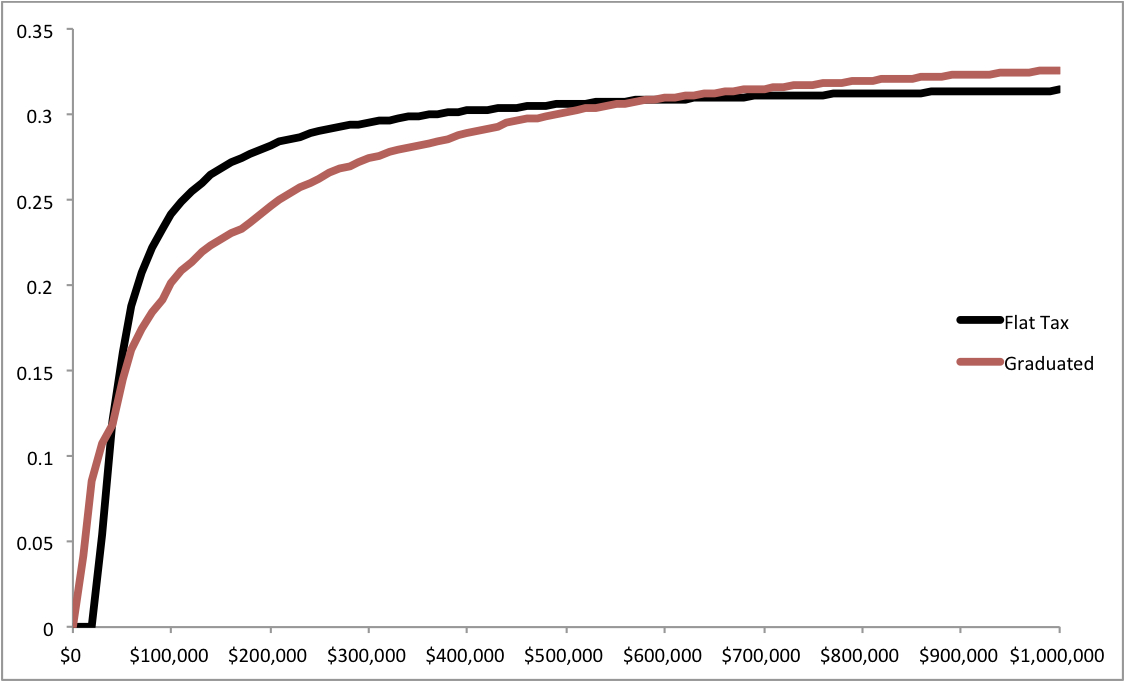
The flat tax vs. graduated rates is more interesting to me. As it has been proposed, the flat income tax is reasonably progressive due to the large personal exemption that is attached to it. But how do they compare? I took as a proposition to compare the current tax rates with a hypothetical flat tax. I put in a significant exemption for the flat tax and required it to raise roughly the same revenue as the current system. I even went to the census to get the income distribution. It’s a little tricky as 26% of households earn $100k or more and that wasn’t broken out. I assumed a gradually falling fraction from $100K upwards (using a Lorentzian distribution). It misses those earning $1M+, but I’ve heard enough times that this is a small fraction of the total. Anyway, this is a thought experiment, so my theoretical America has an income cap of $1M.

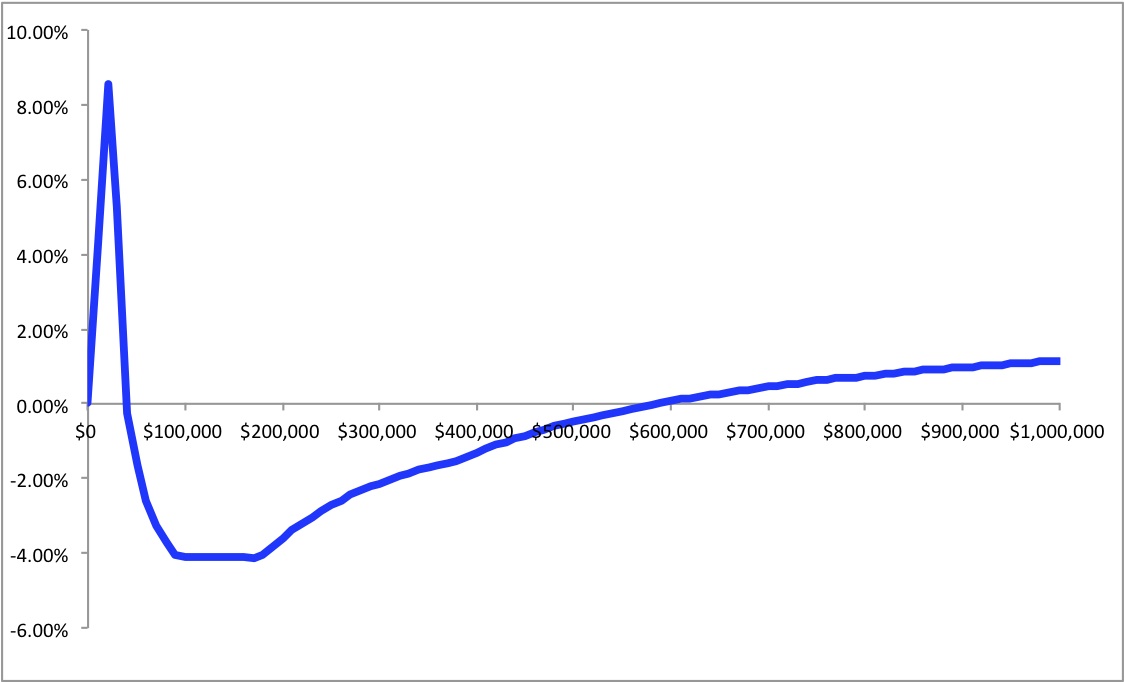
The requirements on my flat tax are that it has a $25K personal exemption and must raise the same amount as the current system. Turns out that you need a 32% rate. Here’s the plot of the two rates compared and the difference.

My flat tax is a little more progressive for incomes under $40K, though neither system generates much income from that portion of the electorate. The real story is that the upper middle class, roughly the 50% to 90% percentile, will see a rise in their effective rates of a few percent and those in the top 10% pay somewhat reduced rates. Now, there’s lots missing. Households have more than one person and there’s plenty of exemptions. So, this should really be a case of the taxation for net income after deductions, but I don’t have the demographics on that one.
Both sides are proposing a progressive system, so what’s the point? The main effect of a flat tax reform will be to redistribute the tax burden more evenly across the top half of the income spectrum. True, a flat tax is simpler to administrate, but so would a graduated system with several brackets. One can look that information up in a table anyway.
BB