Statement from the UC President

Students across the UC campus system are protesting in solidarity with the UC Davis students, all of whom are protesting yet another 9% hike in tuition/fees after a 32% hike in 2009 across the 10 campus university.  The image of a police officer emptying a canister of pepper spray directly into the faces of sitting students has caused quite a stir out here.

University of California President Mark G. Yudof today (Nov. 20) announced the actions he is taking in response to recent campus protest issues:

I am appalled by images of University of California students being doused with pepper spray and jabbed with police batons on our campuses.


I intend to do everything in my power as president of this university to protect the rights of our students, faculty and staff to engage in non-violent protest.


Chancellors at the UC Davis and UC Berkeley campuses already have initiated reviews of incidents that occurred on their campuses. I applaud this rapid response and eagerly await the results.


The University of California, however, is a single university with 10 campuses, and the incidents in recent days cry out for a systemwide response.


Therefore I will be taking immediate steps to set that response in motion.


I intend to convene all 10 chancellors, either in person or by telephone, to engage in a full and unfettered discussion about how to ensure proportional law enforcement response to non-violent protest.


To that end, I will be asking the chancellors to forward to me at once all relevant protocols and policies already in place on their individual campuses, as well as those that apply to the engagement of non-campus police agencies through mutual aid agreements.


Further, I already have taken steps to assemble experts and stakeholders to conduct a thorough, far-reaching and urgent assessment of campus police procedures involving use of force, including post-incident review processes.


My intention is not to micromanage our campus police forces. The sworn officers who serve on our campuses are professionals dedicated to the protection of the UC community.


Nor do I wish to micromanage the chancellors. They are the leaders of our campuses and they have my full trust and confidence.


Nonetheless, the recent incidents make clear the time has come to take strong action to recommit to the ideal of peaceful protest.
As I have said before, free speech is part of the DNA of this university, and non-violent protest has long been central to our history. It is a value we must protect with vigilance. I implore students who wish to demonstrate to do so in a peaceful and lawful fashion. I expect campus authorities to honor that right.

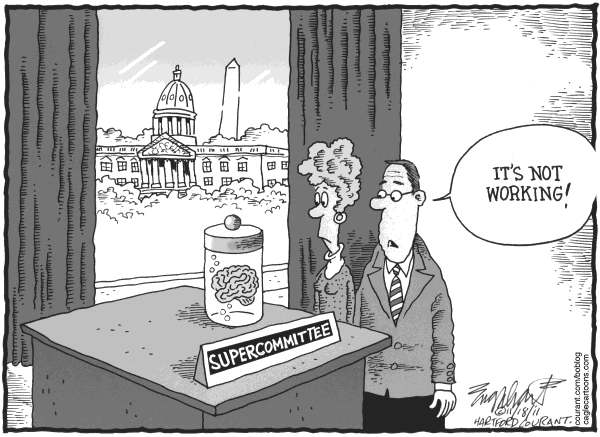
Nov. 21st.- The Day the Super Committee Died

In order to vote on any proposal of the Super Committee by Wed. Nov. 23rd. the proposal needs to come before the committee members by tonight at midnight.  Apparently, the Sunday shows were full of committee members and other members of Congress discussing it’s failure but more importantly pointing fingers at the other side for the inability to reach a compromise.  Do they think the American people ever believed they would reach some decision regarding the future budget of the country?  Congressional approval hovers at 9%, that should tell you all you need to know.

Here’s a little from the WaPo regarding Super Committee failure:

“If the supercommittee fails, I think there will be a stark realization by every member of the U.S. Senate that we’re at the end of the year and these complex challenges have not been dealt with,” Sessions said. “It’s likely to be a really difficult period.”

The policy battle comes as the parties are gearing up for a high-stakes election season dominated by economic concerns, with both the White House and Congress in play. The political pressure that has helped keep the 12-member supercommittee from compromising on hot-button issues such as taxes is sure to grow more intense.

If the supercommittee does not finish on time, it would lose special procedural powers to push a tax-and-spending plan through a bitterly divided House and Senate, leaving congressional leaders without an easy path to compromise on the expiring provisions — and a potentially nasty holiday-season fight on their hands.
“We don’t have the answers,” Sen. Richard J. Durbin (Ill.), the No. 2 Democrat in the Senate, conceded recently as it became evident that the panel’s effort had stalled. “The supercommittee was put in place” to develop “a strategy to take us through the election” by resolving the toughest outstanding budget problems, he said. “If they don’t succeed, then we have to address these issues.”

David Dayen suggests burial for the super committee.

This does raise a set of key issues going forward as we reach the end of the year, however. The Super Committee is a dead letter. They are exceedingly likely not to recommend anything at all. Jon Kyl talked about the committee in the past tense on the morning shows today. It’s all over except for the finger-pointing, which will be as meaningless as it is intense.

But there are all these loose ends out there, and all of them would actually increase the deficit, just to show you what a joke fiscal responsibility has always been. First, there are the aforementioned payroll tax cut and unemployment benefits extension. Those expire at the end of the year. So do two other notable measures: the patch that avoids a cut to Medicare reimbursement for providers by over 20%, colloquially known as the “doc fix,” and the adjustment to the alternative minimum tax that helps the upper middle class avoid the additional levy. Then there are a host of other expiring tax breaks, many for businesses, that usually get lumped in and called “tax extenders.” The thumbnail cost for extending every single one of the above-mentioned items is $300 billion. By the same token, that’s the amount you would take out of the economy if you failed to extend any of these measures. And that would, as noted above, be a significant fiscal drag on the economy.

Sunday Funnies

Here’s an interesting story in the LA Times this morning.  Oh yay, another confusing tax increase/decrease coming to a ballot initiative near you.  We’ll see how this one pans out as details are pretty sketchy at this point.


The Think Long Committee, which includes Google Chairman Eric Schmidt, former governors Gray DavisEli Broad, says its proposal would provide $5 billion more for public schools every year and billions for public universities and local governments. and Arnold Schwarzenegger and Los Angeles philanthropist


Although the group has prepared a report outlining its proposals, it has not taken the preliminary steps needed to place the ideas before voters. Members have not filed any potential initiatives with the state attorney general’s office or created a campaign committee to finance such an effort. A spokesman for Think Long said those moves would come in the next couple of weeks.


The group’s plan is based on a reshuffling of California’s tax system. It would lower the state’s personal income and sales tax rates and create a new levy of more than 5% on services that are not currently taxed, such as legal work or accounting.


Think Long spokesman Nathan Gardels said members want to “maintain California’s progressive tax system.” Under their proposal, families earning up to $45,000 a year would pay no state income tax, while those making up to $95,000 annually would pay 2%. This would lower some taxpayers’ obligations significantly.


The group also wants to double the current exemption for homeowners and renters on their state income tax and eliminate most other California income tax credits.

Nevada Goes After the Robo-signers


Photo above is apropos of nothing, just a pretty pic of our loofah scrubs we make every year.

Here’s the real story. I can’t count the number of times over the past year I’ve been told this was a non-story. A few people on the left said it was peanuts compared to the real criminal behavior and some on the right said it didn’t matter, the people being foreclosed on were behind on their payments and would lose their homes anyway. Of course, I may have been wrong but I always believed that fraud is still fraud, and on this scale it indicates a much larger danger to the rule of law than people were willing to admit. It’s a little frightening when you realize the scope IMO.

The Nevada attorney general Catherine Cortez Masto has just filed a 606 count indictment against two title officers in a single county, Clark County, for supervising the filing of tens of thousands of fraudulent documents in a robo-signing scheme.

On the one hand, this indictment is not as gratifying, say, as busting Angelo Mozilo. On the other hand, if low level supervisors in bank frauds face the risk of serving time, you are going to find a ton fewer people willing to take that job. Those higher up on the food chain might also have to be a lot more careful and pay the people involved more money, which in turn undermines the basic logic of these abuses, which is cost savings.

In addition, as mob prosecutions have shown again and again, you start by going after the foot soldiers in the hope that they roll people higher up on the food chain.

And at a minimum, this action says that the law and due process matter, and violations, particularly large scale, systematic violations, can and will be punished.

From the press release:

“According to the indictment, defendant Gary Trafford, a California resident, is charged with 102 counts of offering false instruments for recording (category C felony); false certification on certain instruments (category D felony); and notarization of the signature of a person not in the presence of a notary public (a gross misdemeanor). The indictment charges defendant Gerri Sheppard, also a California resident, with 100 counts of offering false instruments for recording (category C felony); false certification on certain instruments (category D felony); and notarization of the signature of a person not in the presence of a notary public (a gross misdemeanor)…

The indictment alleges that both defendants directed the fraudulent notarization and filing of documents which were used to initiate foreclosure on local homeowners.

The State alleges that these documents, referred to as Notices of Default, or “NODs”, were prepared locally. The State alleges that the defendants directed employees under their supervision, to forge their names on foreclosure documents, then notarize the signatures they just forged, thereby fraudulently attesting that the defendants actually signed the documents, which was untrue and in violation of State law. The defendants then allegedly directed the employees under their supervision to file the fraudulent documents with the Clark County Recorder’s office, to be used to start foreclosures on homes throughout the County.

The indictment alleges that these crimes were done in secret in order to avoid detection.”

Pre Morning Report-We’re Spending


I wrote a fatalistic comment yesterday that the only people who can save the economy of the US is the middle class. We’re the only substantial enough population to do it. In general, the uber wealthy have been fighting tooth and nail to protect their wealth. I believe it’s a little like cutting off their nose to spite their face but as someone who has never amassed great sums of wealth maybe I just don’t understand that need. I was born into the middle class and managed to hang onto that while putting five kids through college and living a well adjusted and happy life so I don’t think I’d want to trade places with them. Amassing huge sums of wealth was never a particular desire or fantasy for us.

I’m in favor of protecting the safety net but realize and accept that changes are coming which really means that myself and my friends will be spending more time in the trenches helping where we can to bridge the difference between minimal subsistence and something worse. Okay. I accept the fact that my grandchildren will have larger classes and more trouble finding colleges their parents can afford or that will accept them based on the need surpassing the availability. Luckily they’re smart kids and so are their parents, I’m pretty sure they’ll figure it out. There may not be as many manufacturing jobs for high school graduates but we still need plumbers and restaurant workers and eventually the construction industry will come back. And guess what the American consumer is already coming back, we’re spending our savings to do it, and Europe may bring us down yet, but for now demand is back. Good for us, we’re the heart of America. It’s not even a left right issue, it’s as American as apple pie.

Lots of good charts and cautionary tales at the link but I’m trying to look on the bright side.

Personal income growth is running at about 2% a year at best. Note as well that personal savings have begun to fall. Outside of cars and student loans, consumer credit has fallen in the last three months so I conclude that the current round of consumption is funded largely from a savings rundown, following the big spike post GFC. We’ve been here before, of course, and such cycles can run for longer than anyone expects so we can’t discount that possibility.

This is a Problem (IMO)

I’ve been corresponding with someone from the Plumline for the past couple of weeks, since I finally left, and I haven’t read the comments over there since. But the quote below which I was provided (via email) causes me great concern. It’s no wonder we have so much trouble finding common or even compromised ground in our political debate. Since when did fellow Americans become our sworn enemies along with those of us who are trying to bring the sides, if not together, to at least discuss the issues in an intelligent and persuasive manner. There is a huge divide between what I believe and some of my friends on the right believe, especially when taken to the logical conclusion, but the path below leads to very nasty consequences. I hope we’ll continue to do a little better than this at ATiM. I don’t think we’re being naive to hope for a better result from our dialogue.


“We’ll have to agree to disagree on some things but I hope we can stay friends and I’d like to close with a post that shrink put up on the PL this morning.

This pretty much encapsulates my feelings.”

Well I can see we don’t like each other, the left and the right. But that’s not news. I’ve considered the right the enemy all my life, it makes no difference to me if they are Americans or Iranians. So I find people who appoint themselves the role of bringing us together, changing the tone of politics etc., arrogant and naive to the point of being dangerous themselves. I don’t believe in the narrative, dominant or otherwise.

I think there is truth and falsehood, right and wrong, better people and worse people, just as I believe there are advanced and primitive social structures and even cultures. And so the better people must battle the worse and work to minimize the damage done by the necessary evils we can never wholly eradicate, the evil that people do, everything from income disparity, to ignorance.

Sunday Funnies and the Sisters of St. Francis


These gals prefer to actually occupy the boardrooms of Wall Street.

In 1980, Sister Nora and her community formed a corporate responsibility committee to combat what they saw as troubling developments at the businesses in which they invested their retirement fund. A year later, in coordination with groups like the Philadelphia Area Coalition for Responsible Investment, they mounted their offensive. They boycotted Big Oil, took aim at Nestlé over labor policies, and urged Big Tobacco to change its ways.

Eventually, they developed a strategy combining moral philosophy and public shaming. Once they took aim at a company, they bought the minimum number of shares that would allow them to submit resolutions at that company’s annual shareholder meeting. (Securities laws require shareholders to own at least $2,000 of stock before submitting resolutions.) That gave them a nuclear option, in the event the company’s executives refused to meet with them.

Unsurprisingly, most companies decided they would rather let the nuns in the door than confront religious dissenters in public.

“You’re not going to get any sympathy for cutting off a nun at your annual meeting,” says Robert McCormick, chief policy officer of Glass, Lewis & Company, a firm that specializes in shareholder proxy votes. With their moral authority, he said, the Sisters of St. Francis “can really bring attention to issues.”

Sister Nora and her cohorts have gained access to some of the most illustrious boardrooms in America. Robert J. Stevens, the chief executive of Lockheed Martin, has lent her an ear, as has Carl-Henric Svanberg, the chairman of BP. Jack Welch, the former chief executive of General Electric, was so impressed by their campaign against G.E.’s involvement in nuclear weapons development that he took a helicopter to their convent to meet with the nuns. He landed the helicopter in a field across the street.

Memories from WWII

My Dad was a Lieutenant in the Army Air Corps during World War II and flew 35 missions over Germany as a bombardier in a B-17. He wanted to be a pilot but a deviated septum kept him out of the cock pit. He celebrated his 20th. birthday over there at the end of 1944 and kept a diary of his missions, summarizing the first 11, and then documenting each one after that in a 3” X 5” brown spiral notebook written in pencil. When I was in 8th grade I was home sick from school one day and, being a “nosey parker”, was going through his photos of the war and came across his little book. The front page simply said “Secret!” and so naturally I spent the rest of the day reading it and even took it to school the next day to share with one of my classes. Boy, did I get into a lot of trouble for that. Shortly before my Dad died I again rummaged through all his war memorabilia and put together a beautiful shadow box piece for him for Father’s Day. We invited a lot of his friends and our family over to honor his life and his service but I couldn’t find the diary. I asked him about it but he indicated he didn’t know what happened to it. A few weeks after his death I finally came across it again, a little post it on the front with my name on it, and to this day it is a treasured keepsake in our family.

Here are just a few of the entries.

September, 1944

The raid on Magdeburg was very successful. Visibility was good but flak was very accurate. Think it was as rough as any mission we have been on. It was on this raid that we believe we saw a “jet plane”, the first and only enemy aircraft to be seen by any of our crew so far.

Next day came Ludwigshafen, a target which has been attacked again and again by the 8th Air Force. I have never seen it hit really successfully. Again the flak was very accurate. Tail gunner saw a B-17 go down in pieces and flames and I saw one circling slowly with #3 engine spurting flames and also saw three chutes.

It was on the 17th of Sept. that we got our Air Medal mission. Was a milk run to Holland. We bombed flak installations around the Arnhem. This was in preparation for the great airborne invasion. Arnhem later became quite the headline news.

October 4, 1944

We have now earned a cluster for the Air Medal. Could have been a rough mission but I guess we were just lucky. The bombing was done PFF and the target was marshalling yards at Koln (Cologne). They briefed us on 290 guns but the gunners must have been out to lunch. Some of them came close but there wasn’t too much. Barney picked up a few holes and was forced to feather #4. It was colder than it has ever been so far, -40 C. The flag’s up so maybe will get #13 in tomorrow. Could hope for an easy one but I think they are a thing of the past. By the way, the bombing today was in support of the attack on Aachen.

November 5, 1944

We just got back from a rough one to Ludwigshafen. They really threw up everything at us. I believe there was more flak than ever before. We lost two ships over the target. They were out of the low squadron. Our primary target, visual only, was in direct support of a drive by Gen. Patton. However it was 10/10 and we had to go on to Ludwigshafen. This broke clear and all 270 guns had a shot at us. Am anxious to hear how Patton did without us. We were to bomb some big guns north of Metz. That was number 19, getting right along.

December 4, 1944

Not a bad mission! Things went fairly well until we made the bomb run, didn’t drop the bombs and made a tight 180 turn. Our squadron was flying the high and we were on the inside of the turn. The air speed (115) really dropped and our formation broke all to hell. We were really wide open for fighter attack. Luckily none were around. There was a big hole in the clouds and so we visually bombed the marshalling yards at Friedberg. There was no flak over the target and therefore we were able to enjoy the impact of the bombs. Was the first time I had seen incendiaries hit. First came the usual upheaval of the dermis and then these hundreds of little fires like fire flies all over the area. It is indescribable. The only difficulty was in the fact that we hit a little short. We did start a fire in the middle of the yards though, all in all not bad.

December 16, 1944

Well we really flew a good one today. The weather was such that the whole 8th. Air Force consisted of but 9 groups, 3 from each division. Even at that, the 1st. scrubbed and we think the 2nd. did also. Had a hell of a time forming because of all kinds of clouds and contrails. After we left England and hit the continent the high and middle clouds broke up and we almost had a visual run. In fact the high squadron did final bombing visual. They hit the target but the lead missed it.

The rough part came on return when we ran into these clouds which we could neither climb over nor go beneath. We peeled off here (near Brussels) and came back individually. I really started to sweat when we hit the English coast at 250’ and were still in the clouds. We could see patches of the ground which made it a little better. We were sort of afraid to let down much lower. Well anyway, we found the field, made our landing and now have in 29 missions. The flak was very light which made things rather nice over the target. I would have hated to fly through that stuff with a feathered engine or the like.

Gen. Partridge commended the group for this mission. He did this without knowing any of the results. It was purely because of the adverse weather conditions. Col. Good said it was the first time he had heard of a mission being flown in such lousy weather. Ain’t we good? By the way the target was the R.R. Marshalling Yards just north of Stuttgart and was in direct support of Gen. Patton’s Army. Seems they are having a little trouble with the Huns in that area. Number 30 tomorrow, I hope.

He counted down every mission until the 35th. and always wanted to fly every chance he had. There were a few close calls, but in general he thought he lead a charmed existence to live through it and took that confidence and what he liked to call luck with him and went on to live a great and happy life.

Happy Veteran’s Day to all you guys and gals out there who had the courage to serve your country.

The Avastin Controversy and 12BarBlues

Some of you may remember last year the FDA began consideration to not recommend Avastin as a treatment for late stage breast cancer. There was speculation at the time that this was the first “death panel” decision from ACA’s advisory panel. Originally it was believed to prolong life for anywhere from 6 months to several years but then some conflicting results started coming in and the numbers were revised downward for 30% to 60% of patients. I’ve heard the costs per month given as anywhere from $8,000 to $20,000, which is pretty confusing in itself. Doctors appear to be split in their opinions of its effectiveness and whether some of the side effects are worth it.

The reason I bring this up is because our own Plumline friend 12BarBlues has recently been diagnosed with stage 4 breast cancer with bone mets and is beginning a clinical trial as soon as tomorrow for Avastin. She gave me permission to mention her situation as she thought it might encourage some of us to be more vigilant. I won’t share her private thoughts and concerns but I thought some of you may want to send a prayer or wish her way and she seemed interested in sharing what she finds out regarding Avastin, so I’ll keep you posted if I hear anything new. As a cancer survivor, it’s my understanding 12Bar was only able to acquire major medical coverage, and so her situation is less than ideal financially regarding her treatment, but she’s a survivor and hopefully she’ll prove to be one of the success stories of the trial.

This is one of the most recent articles I could find on Avastin, the controversy, and what doctors are saying.

FDA commissioner Margaret Hamburg has yet to finalize the decision, but some insurers have already decided to stop paying for the $8,000-a-month drug. Others, including the federal Centers for Medicare and Medicaid Services, announced they will continue to cover the drug regardless of the FDA’s decision.

Avastin’s use for lung, kidney and brain cancers hasn’t been challenged.

Dawood, of Dubai Hospital in United Arab Emirates, and her colleagues sent the survey to about 3,000 cancer doctors. Only 564 responded, however, limiting how representative the new findings are.

More than four out of 10 doctors said they would continue to use the drug under certain circumstances even if the FDA rejected it, and eight percent said, “of course I will use it.”

A fifth of the respondents said they would not use the drug at all, and nine percent said they would be reluctant to use it.

Sunday Funnies and Open Thread


Here’s a bit of good news for consumers. Looks like the banks are backing off.

Joining an industry’s retreat in the face of customer protests, Wells Fargo has abandoned the idea of charging debit card fees — the third major bank to back away from such plans in a day.

The San Francisco banking giant had planned to test a monthly $3 fee for users of its debit cards in five states. It said in a statement Friday that it had called off that pilot program “as a response to customer feedback the bank has received.”

“We will continue to stay attuned to what our customers want,” said Ed Kadletz, head of Wells Fargo’s debit card division.

A host of critics including President Obama have attacked Bank of America’s plan to charge account holders $5 a month if they use their debit cards to make purchases. The populist outrage, highlighted by protests staged by the Occupy Wall Street movement, has caused other major U.S. banks to hold off on imposing similar fees.

Earlier Friday, Bank of America backpedaled, saying it would make it easier for its customers to avoid the fee by waiving the charge if they also used BofA credit cards, maintained minimum account balances or made certain direct deposits. Details of the revised plan had not been finalized, a person familiar with the changes said.

Also Friday, JPMorgan Chase said that after its own eight-month testing of $3 monthly debit card fees it had decided against imposing them on its customers.

Citibank, US Bank and Union Bank are among other major institutions that have now taken the no-debit-fee pledge. However, certain regional banks, such as SunTrust and Regions, already have implemented fees similar to those at Bank of America.