Happy Father’s Day

Another Father’s Day.  I have a husband and a son who are both fathers and I will be celebrating with both of them tomorrow.  The person missing, and someone I miss every day, is my own father of course.  I’ve been trying to think of the most important lesson I learned from my dad, something I could pass along to the young fathers here.  There are a few of you.

My father and I were estranged for nearly four years from the time I was 20 until I was 24.  He missed the birth of his first grandchild, my college graduation and against the law of averages at the time, me receiving a Masters Degree.  Not to get too sappy but he told me before he died that our time apart was the biggest regret of his life.  What drove us apart is less important than how we repaired our relationship and the deposits he made to my life when I was young.

My sister was a momma’s girl and I was Daddy’s Girl and a tomboy to boot.  My parents never took a vacation without us until we moved out of the house, and most of our vacations were two or three week road trips and camping all across the western United States, Mexico and Canada.  I grew up going to Dodger games and USC football games.  When I was stumped over a math question he guided me through with more patience than I probably deserved.  He taught me to swim when I was four and body surf by the time I was 10 as well as how to survive a rip tide.   It was from him that I learned to love and respect the ocean and the beach.  When I was 13 and wanted to learn to surf, he bought two surf boards, one for him and one for me.  And at 15 we learned to ski together.

From the time I can remember we took walks after dinner and talked.  I learned most of life’s lessons on those evenings.  And so, when it came time to forgive each other and forge a new, adult father/daughter relationship, I was able to look back with love and gratitude to my childhood and remember all the lessons, patience and devotion he’d shown me.

I hope all you fathers and children enjoy your day tomorrow.  I’ll be watching my son and his father interact in their own special way and be missing my own father for the times we spent together as well as the times we were apart.

Happy Father’s Day!

Bits and Pieces (Lulu’s Garden)

We’ve had one of those years at our house.  You know, one of the memorable ones for crappiness.  Things are looking up however, for the most part.  We even received rent money and the security deposit this week on our rental property, and the new family begins moving in today.  They don’t appear to be hoarders, and yes we did have the house fumigated.  Last weekend my husband and I painted all four bedrooms and this week I cleaned all the floors (again), the bathrooms (again), windows and the broiler.  He cleaned the windows on the enclosed patio, put in a new toilet and cleaned the fireplaces etc.  That’s over finally.  We’ve had a few health issues, some accidental, some related to being over 60 I guess, but so far we’re carrying on pretty well.

One thing that has always kept me from panicking when the worry sets in is working in my garden.  That’s right, the garden comes in ahead of ATiM.  I will try to participate a little more going forward however, as I have missed our discussions.

Anyway, I’ve been growing veggies since I rented my first house at age 20.  When the kids were little we had a fruit orchard and really large garden in the back part of our property (we have a half acre).  That’s all been replaced with a rather large warehouse for the business.  We did manage to find a nice growing spot on the side of the house, outside the bedroom window, for a small garden.  Since it’s just the two of us now it’s perfect and I can look out the window and see our handiwork.

This year I planted a couple of things I’ve never had in my garden before, bok choi and Japanese cucumbers.  In the photo below the bok choi is in the center bottom of the picture between the beets, on the left, and the Japanese cucumber.  At the back of the photo is swiss chard, which we have in our garden nearly year round.   I saute the chard in safflower oil and then add tamari and a little sesame oil and add it to brown rice after the rice is cooked……………………..yummy.

In the photos below are three kinds of summer squash, a few remaining green beans (the dogs dug up most of them), three kinds of lettuce, more swiss chard, and I just planted pumpkins and acorn squash last weekend.  These new veggies took the place of the snow peas, which we already ate, also yummy.

We’re taking a couple of days off this weekend and heading to the beach tomorrow, my favorite destination, so have a great weekend everyone.

Life in Desolation Canyon

Haaaaaahaaaaaa, did I catch you with the title?  Since it’s a bit of a slow news day, except for the fact that Obama finally evolved, and I’m not particularly interested in controversy right this second, I’ll just go ahead and put up a boring post.

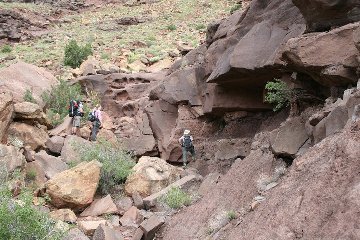
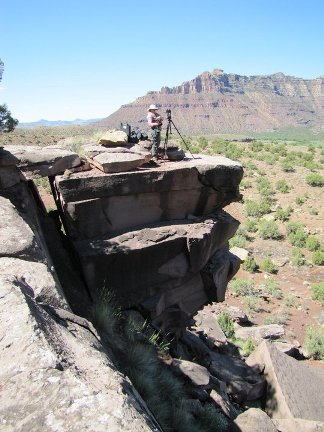
I’m not sure if any of you will be interested in this or not but I thought I’d mention that our youngest daughter is off to Desolation Canyon again to finish her research in fluvial geology (her mountain pictured above).   She’s working on her Master’s at the Colorado School of Mines and will be finished with her thesis by the end of Sept. or early Oct. and has a job with an oil company in Denver beginning on Nov. 1st.   This will be her last opportunity to get all the information she needs to complete her research.

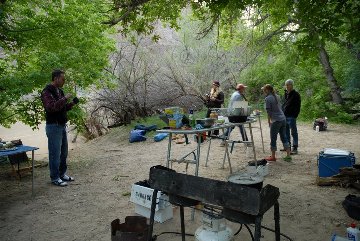
I thought some of you might be curious about life on the river.

Apparently, her research area is somewhat unique, even for a geologist, in that it is so remote and lacking in amenities, so to speak.  She is one of only two students on campus allowed to requisition the satellite phone and also takes a gps locator device she uses to send a message every day with their location mapped out.  There are three possible messages which are pre-recorded, “all’s well”, “send help soon”, and “send help now”.  She will use the satellite phone to get weather updates every five or six days and also of course, if there is an extreme emergency or if the locator doesn’t work for some reason.

This will be her third trip.  The first was about this time last year and it was a group consisting of her academic adviser, her industry adviser, a PhD student, two river guides and herself.  They spent 10 days on the river in two different locations and she was able to see the lay of the land, and begin measurements and analysis of “her mountain”, which apparently is a fantastic out crop with lots of useful information for the oil industry.  She’s taken a real right turn since being a water consultant.

The weather was dicey this time last year and still very cold at night and they had several thunder storms and plenty of hail.  During the first big down pour most of the tents were flooded at their primary camp and they had to dry everything out, not easy in cool weather and then set up new sleeping quarters on higher ground and dig moats around the tents for drainage.   She and her advisers spent a lot of time on the mountain investigating the most useful areas and setting up a strategy to acquire all the information she was going to need to finish her research in two additional trips.  There is a very narrow window of opportunity to get to the site because of weather and river conditions.

The second trip was at the end of August last year and she and Chelsea, her river guide for all three of her trips, spent 21 days in the baking sun (average temp of 100).   The raft above is packed for two people for 21 days. Her site is only accessible by rafting down the Green River for three days and then another full day rafting out.  They spent some time directly across the river photographing the outcrop with a gigapan system and visiting a natural spring where they were able to acquire fresh water to bring back to camp for purification.   They set up a secondary camp near the old McPherson Ranch and spent a couple of nights there.  The rest of the time they spent hiking up “her mountain” and while Chelsea found a shady spot to read, our daughter “worked the channels”.  Chelsea was there just in case of accident or injury as the site itself is several miles from camp across a large meadow and then up.  Even with really good walkie-talkies it would still take someone a couple hours to get from camp to the research site so Chelsea was her shadow in the field.

After the first couple of days and a little experience with heat exhaustion, they began heading out in the pre-dawn hours of the morning using their head lamps to begin the hike.  This way she was able to begin her work as the sun came up and get off the mountain before the most intense heat of the day did them in.  Back at camp, after cooling down in the river, and with a gas powered generator she would upload her photos from the day and work on her notes for several hours.  Chelsea would cook and maintain the camp.  This was followed by dinner and a quick game or two of rummy and then lights out.

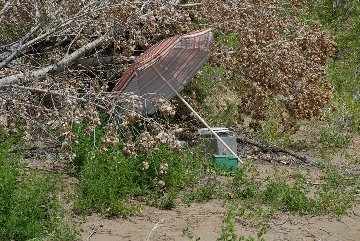
By day 14 or 15 they were out of ice and perishables were either gone or inedible.  They kept water and beer (yep) cool by floating them in the river.  The toilet (above) was full of flying bugs, which was a little nerve wracking, and their clothes, hair and bodies looked and smelled as if they were never going to be clean again.  The Green River is not exactly the clearest water in the world for bathing or doing laundry.  She’s a very accomplished outdoor person and has spent quite a bit of time in the middle of nowhere for days on end but this trip really tested her.  Of course afterward a sense of accomplishment and the benefit of some great stories and useful research information erase most of the worst memories of the trip, and there were more than a few.  She’s actually looking forward to the next trip.

She leaves Saturday for her third trip.  This one will be four weeks (28 days) and she’s taking along another geologist as well as her trusted side kick and new best friend Chelsea, the river guide.  Our daughter is 6’ tall and no shrinking violet but she needs help this time because there are a few areas on the mountain she needs to scale down in order to get the last batch of measurements she’d really like to get.  They’re also going to work on a project that will depict scale as it’s critical to her project.  Her search for a research assistant lasted all year and finally she found Neil, who is apparently excited to experience all the mountain has to offer.  He’s also really smart and will be a good brain storming partner to help solve the remaining challenges.   She’s hoping of course that they’ll still be friends once it’s over.   We’ll be looking for the “all’s well” signal everyday and waiting for that phone call once they get off the raft in the little town of Green River on June 9th.

Discussion of Suite Harmonic by Emily Meier

There’s something about the words below that resonate with me and remind me, again, how truly awful war is.  This is toward the end of John Given’s enlistment in the Union Army and he’s quite close to returning home to Harmony, a greatly changed man, in a greatly changed nation.

……it struck him even more how blasted Decatur was.  It was very easy to get tired of looking at nothing except a soldier’s face and, without women, there was singular lack of beauty.  And color was missing.  Clothes were the sea of uniforms, faded to a vague blue, which the men, in the heat, shed as often as they could.  In a place where a normal year would have meant a host of summer flowers everywhere, the ground was unplanted-chewed up and battered by the boots of so many men.  There were no blossoms of any color.  There was no foliage.  There was only the wasted, treeless town and the mud and wood of the fort.

Emily will be checking in periodically so if you want to leave a question for her I’m sure she’ll be more than happy to respond.  It’s impossible to pin everyone down to a specific discussion time so just come in and out as time allows over the weekend.

***

Mark adds:

Suite Harmonic is a lovingly crafted narrative of war and family woven from personal written histories, especially from the letters of John Given and his sister Kate.  It is essentially a novel of manners interspersed with battle scenes.  For those of us who love Civil War stories, as I do, it is satisfying.  The main characters, John and Kate, become known to us as they become assimilated, as their Irish Catholicism fades, as they mature, and as they internalize the issues of their time.

That John survives Shiloh is amazing, that he learns that he will keep his head in combat is what gives him resiliency throughout the War.  Kate, back home in Indiana, is an interesting study in both duty and stepping out of her “place” as an Irish maid to wealthy Protestants.  Both siblings are smart and literate, which is how so much of their material survived.

The eventual love stories, after the War, especially Kate and Harry’s, are truly sweet.

The tragedies of 19th C. health care follow the characters into peace time.

A picky critic might find two anachronisms of speech, but I was not picky and did not catalog them.  My own disappointment with the novel was limited to my high expectations for it – I love historical novels.  I have been through all of Patrick O’Brian’s Aubrey-Maturin novels twice.  Suite Harmonic has no plot.  Think of a lifetime series of interconnected events as told through the eyes of two siblings, in which there is no struggle between good and evil, no climax, no anti-climax, and no denouement.  John and Kate were surely so likable and admirable as presented by ABC, and the incidents themselves so fascinating in detail and social (or combat) observation, as to allow Suite Harmonic to stand without a plot.  I think it does actually present a harmonic suite of the interplay of lives shaped by the Civil War, and by the integration of immigrants into society, and by the daily struggles of people we can still recognize, although their hardships were of a different time.  I am sure it does what Emily intended it to do, and that my expectations were irrelevant.

We Finally Met our First Hoarder

There are very few things that shock me but when my husband came home Friday from the lockout of our tenant by the sheriff’s department he began preparing me for the shock I was about to experience.

Some of you may remember we’ve been involved in an eviction process on our rental property (the bulk of our retirement income) since January and even hired some legally challenged lawyers to represent us in the misadventure.  I call it a misadventure because it feels like a miracle to us that we finally got our home back.

The lockout would have occurred a month earlier but the city recently decided that our street was one of the ones that needed a new street sign.  A problem arose when the sheriffs attempted to post the final eviction notice about six weeks ago and the spelling on the street sign didn’t match the spelling on our legal documents.  The city had changed an “e” to an “o” and so we had to wait two weeks for a new sign and another two weeks for the city workers to install it.  Cha-ching, another $1600 down the drain.  Of course our lawyers thought it would have been better to change all the paperwork to the incorrect spelling………………………idiots.

Anyway, my husband met the officer and the locksmith at the house Friday morning and originally told our tenant she could have 1/2 hour to vacate.  The sheriff informed him that we had to store whatever was left at the house for 15 days, either at the house or a storage facility, charging her reasonable rates, and then could either sell it or trash it.  Then my husband went inside.  Needless to say, when she said her boyfriend was on the way with a big truck to move some stuff, he gave her the rest of the day to vacate.

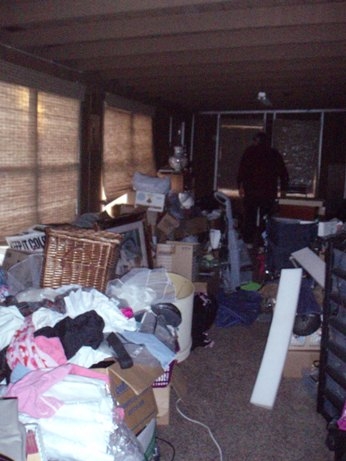
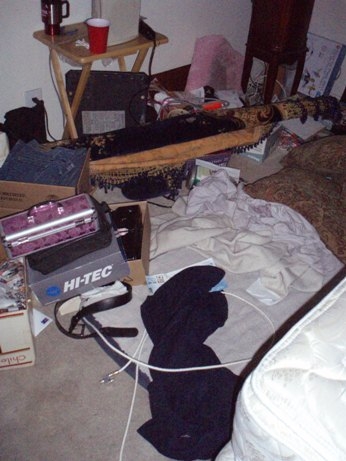
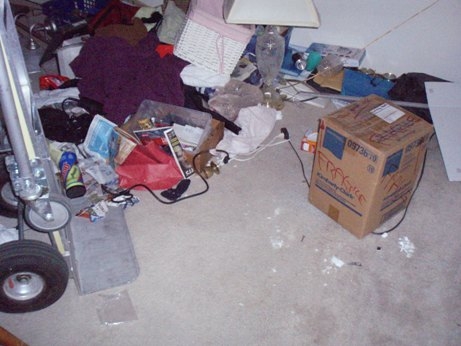
Every room, save one, looks exactly like the pictures below, and that one room is pristine…………………….bizarre.

All of this was left after two big truckloads had already carted away some of her belongings.  So now our house is a storage facility for another 12 days and we’re hoping they’re coming back for more although they already cancelled the appointment to meet my husband over there today.

I feel sorry for anyone who is for some reason compelled to live like this, but right now I feel more sorry for us, because we’re going to be stuck with the cleanup………………………………….yuck.

Bites & Pieces OR Do Alpha Males Eat Quiche?

I have a basic quiche recipe that can be adapted for all sorts of dietary restrictions and preferences.  I’m trying to gradually add a few pounds back on that I misplaced this year and I can make this once a week and add a few calories to my diet.  On the other hand, it can be made with lower fat/calorie ingredients and still be delicious.

Basic Ingredients:

3 whole eggs, you can substitute egg whites for part of them or all, two egg whites equals one whole egg

1 can evaporated milk, you can use low fat or non fat and honestly you won’t be able to tell the difference

2 1/2 TBS of flour

Salt, pepper and other spices depending on the rest of your ingredients.  I use thyme, parsley, basil and herbs de provence  pretty frequently, but please experiment.

Additional Ingredients:

1 1/2 cups cheese, again low fat versions are fine and I frequently use a combination of mozzarella, parmesan and feta.  Of course you can use cheddar, swiss or really any kind of cheese.

5 to 6 diced green onions

2 tomatoes, seeded and chopped

1 to 2  cups of veggies.  I generally use a combination of broccoli/cauliflower or a variety of summer squash.  Experiment.

1 cup of  meat (cooked).  If you use meat, cut back on the veggies.  For a breakfast quiche the obvious meats are ham, bacon or sausage.  For dinner, chicken would probably work fine.

Directions:

Beat the eggs, milk, flour and spices until well blended.  Sir in the other ingredients, adding the cheeses last and pour into greased 9″X9″ baking dish and bake for about 45 minutes at 350 or until center is set.

By the way, my husband loves this recipe.

****************************************************************

And from okiegirl, who is still finding gorgeous asparagus at an even more gorgeous price, a couple of faves.

Asparagus with Curry Butter

Ingredients

2 teaspoons butter, melted

1 teaspoon curry powder

1/2 teaspoon lemon juice

1/4 teaspoon salt, or to taste

2 teaspoons extra-virgin olive oil

1 shallot, finely diced

1 bunch asparagus, (about 1 pound), trimmed and cut into 1-inch pieces

Preparation

Combine butter, curry powder, lemon juice and salt in a small bowl.  Omit salt if your curry powder has salt in it already.

Heat oil in a large nonstick skillet over medium heat. Add shallot and cook, stirring, until softened, about 2 minutes. Add asparagus and cook, stirring, until just tender, 3 to 5 minutes. Stir the curry butter into the asparagus; toss to coat.

Yummy with grilled salmon!

Spring Pizza

Ingredients

3 tablespoons extra-virgin olive oil, divided

3 cloves garlic, minced (or to taste — this is a lot of garlic)

2 medium tomatoes, sliced

1 bunch asparagus (about 1 pound)

1/2 cup snipped fresh chives, divided

1/4 teaspoon salt

1/4 teaspoon freshly ground pepper

1 pound whole-wheat pizza dough

1 cup shredded fontina or mozzarella cheese

Preparation

Position rack in lower third of oven, place a pizza stone or large pizza pan on the rack and preheat oven to 450°F for at least 15 minutes.

Meanwhile, combine 2 tablespoons oil and garlic in a small bowl; set aside. Trim asparagus spears to about 6 inches long; slice any thicker stalks in half lengthwise. Toss in a bowl with the remaining 1 tablespoon oil, 1/4 cup chives, salt and pepper.

Roll out dough on a lightly floured surface to about a 14-inch circle.  (I cheat and buy ready made pizza crust.)

Carefully remove the pizza stone or pan from the oven and set on a heatproof surface, such as your stovetop. Place the dough on the stone or pan and brush with the reserved garlic-oil mixture. Cover with a layer of tomato slices.  Arrange the asparagus in a circular pattern on the dough with the tips facing out (like spokes). Top with cheese and the remaining chives.

Carefully return the stone or pan to the oven and bake the pizza on the lower rack until crispy and golden and the cheese is melted, about 15 minutes.

This makes a lovely spring supper, but also is a nice (if unusual) side dish.

Bites & Pieces (Appetizers)

We’re having a small party next Saturday and so I’ve been thinking about the menu and what kind of appetizers to serve.  I’ve asked a few family members for suggestions and all of them requested this one.  It’s not the healthiest dish on the planet but since it’s one of those things I only make on rare occasions it falls into the eat in “Moderation” category.  Below I’ll jot down another recipe for an eggplant dip that’s quite a bit more nutritious although Michi may have already given us a similar one.

When I was growing up the popular appetizer at cocktail parties was Rumaki (chicken liver, water chestnut, bacon) so I guess mine isn’t any worse than that.  My father was the Rumaki King and so my sister and I helped make and serve a lot of it…………………………….yuck.

Fried Artichoke Hearts (serves 4 to 6)

Ingredients:

1 can artichoke hearts, not the marinated variety, you can buy them whole or quartered.  Quartered are more work but go further with a crowd.

3/4 cup flour

salt and garlic powder added to flour (dash of salt, 1 tsp garlic powder)

2 eggs lightly beaten

3/4 to 1 cup panko bread crumbs

oil for frying

2 to 3 tablespoons butter

juice of 1/4 lemon

Parmesan, freshly grated or Kraft

Directions:

Drain artichoke hearts.  Measure the seasoned flour and bread crumbs into individual bowls and likewise the eggs.  First coat the hearts with flour, then dip into the eggs coating thoroughly and last, roll in bread crumbs.  I generally do three or four at a time and use a separate fork for each bowl to keep my fingers from building up with all the sticky ingredients.  Place in a single layer on a plate and cover.  Refrigerate for several hours as they are best fried when really cold.

I generally fry them in a hot pan with just a 1/4″ layer of oil on the bottom and flip them several times until they turn a golden brown, but you can deep fry them it you want.  Drain on paper towels for a few minutes and while they’re draining melt the butter and add lemon juice.  Place the hearts into a serving dish and drizzle with lemon butter and sprinkle the top with Parmesan cheese………………Voila!!!!!

Eggplant Dip (Serves 4 to 6)

Ingredients:

5 large eggplants

5 cloves garlic

Juice of 1 large lemon

1 to 2 tablespoons tahini

5 green onions, chopped

salt and black pepper

Directions:

Heat the oven or grill to 400.  Roast whole eggplants on a baking sheet in the oven or directly on the grill for 40 to 50 minutes until soft and let cool.  Scoop out the insides of the eggplants and put them into a bowl, discard the peels.  Mash the eggplant and then let stand for about 30 minutes.  Discard any accumulated juices.

Add the garlic, lemon juice, tahini and green onions to the eggplant and mix together.  Add salt and pepper.  Keep refrigerated until serving.  Serve with crackers, cut vegetable or bread cubes.

And lastly, this piece from the Nation might clarify a few things for the girls here, or at least the ones who used to be here.  I’m not trying to start another fight please, just thought the girls might find something useful from this perspective.

Why I Volunteer for Hospice

Before discussing my involvement with hospice and how it came about, I suppose I should give you a few generic facts regarding hospice.  Remember though, I’m just a small speck in a very large and complicated organization so I’ll not only be brief, but I can only comment on aspects of hospice that I am knowledgeable about as a volunteer.  A few of you asked for this post so I’ll give it my best effort.

In order to qualify for reimbursement through Medicare, Medicaid and private insurance there are four levels of care that must be met, which I’ll get to below.  I imagine most of you already know that hospice is defined primarily as palliative care during what doctors and patients together determine is the last six months of a terminal illness, when treatment options have run their course or the days and months appear to be dwindling.  In addition to this though, and the primary reason I became involved with hospice, is the goal of incorporating the family into the process of dying.   The words comfort and dignity are two popular words in mission statements from most hospice care groups.  Here are the essential goals of hospice as outlined by the National Hospice and Palliative Care Organization.

Hospice provides support and care for persons in the last phases of an incurable disease so that they may live as fully and as comfortably as possible. Hospice recognizes that the dying process is a part of the normal process of living and focuses on enhancing the quality of remaining life. Hospice affirms life and neither hastens nor postpones death. Hospice exists in the hope and belief that through appropriate care, and the promotion of a caring community sensitive to their needs that individuals and their families may be free to attain a degree of satisfaction in preparation for death. Hospice recognizes that human growth and development can be a lifelong process. Hospice seeks to preserve and promote the inherent potential for growth within individuals and families during the last phase of life. (emphasis mine)

As I mentioned above, there are four required levels of care in order to maintain certification by Medicare, Medicaid and private insurance.  These are really the basics of hospice care, as far as my understanding of it anyway, and will vary slightly with enhancement from one hospice group to another.  The first is routine home care, which isn’t necessarily only provided in the home, although most hospice patients are treated at home, and is the essential backbone of hospice care.  Routine care provides a variety of services including access to and delivery of medical equipment, medications, gauze, bandages, etc. and 24 hour on-call service by a registered nurse as well as nurse evaluation visits and emotional support to the families and patient.

To satisfy this first requirement our group typically sends a nurse out on house calls two or three times per week and an aide at least that many times depending on the status of the patient.  We have three doctors on staff part-time, one of whom is in charge of our program.  One doctor is on call at all times as medication changes are frequent and occasionally one of our patients needs to be seen for a medical event other than their terminal illness.   The most common are falls.   Our nurses’ aides are primarily in charge of personal care such as bathing and changing dressings etc.  We also have sitters by request who will come and sit with the patient while the caregiver gets out for a few hours once or twice a week.   And then of course we have our social workers and counselors, whose duties I’ll describe below.

Locally we have a number of small, independently operated 4 to 6 patient facilities, situated in homes, and staffed by trained nurses’ aides, which accept our hospice patients, as well as other patients.   The family pays a monthly fee and our hospice group provides the routine care as described above to enhance the services.  These facilities are recommended for families who are unable to care for their loved ones at home for whatever reason and only if it’s deemed affordable to the family.  These providers typically charge in the neighborhood of $3000-$4000 per month and are not covered by Medicare or Medicaid.  We generally try to keep patients in the home though as long as possible.  In other areas there are hospice homes or larger facilities but I’m not as familiar with the particulars of those, or how they’re funded, beyond the typical funding we receive, but I do know some are supported, at least partially, by charitable contributions.

Continuous care is always provided in the home and is defined as a temporary allocation of resources to promote the alleviation of more severe symptoms and increased needs by placing a trained health care worker in the home for up to eight hours per day.  Because of the demands on the staff this is always a short term arrangement generally for no longer than 5 to 7 days.

On a similar short term basis Medicare will reimburse for what they call general inpatient care, in a hospital facility, when symptoms require daily intervention of a more intense level.  Typically this is when a patient’s remaining life is measured in days rather than weeks or months and is in the active phase of dying.

And finally, respite care, which focuses on the family, is a five day institutional placement of the patient, generally in a nursing home, in order to give the caregiver a break for a variety of acceptable reasons.  The burden on families when caring for a loved one at home can be enormous in some cases and so we try to give support whenever possible.

Above are the basics required for reimbursement and the general parameters of what is provided by hospice to its patients and families as well as some of the services our group offers our patients and their families in addition to the requirements.  In order to accomplish the goals of hospice care, a network or hospice group is set up generally incorporating doctors, registered nurses, social workers, nurses’ aides, counselors, including clergy, and many volunteers and other support staff.  This is an interdisciplinary team and is required by Medicare to meet every 14 days to evaluate the current status of patients and design a strategy to meet the needs of the patients and their families.  The team approaches the patient and their caregivers as a unit and designs a flexible plan to provide not only medical necessities, but the practical and emotional needs of everyone involved in the dying process. I happen to be one of the over 500,000 volunteers nationally, like I said, a tiny speck.

I can’t figure out a way to fully describe hospice without a personal story, and as I feel bound by privacy not to discuss the people I work with, I’ll tell  one of my own in order to give everyone a familiarity with what I consider to be the valuable services hospice provides.  My association with hospice began in 1985 although I would not become a volunteer for several more years.  In May of 1985 my sister-in-law discovered the melanoma she’d been treated for a year and a half earlier had metastasized to her brain.  She was an unmarried career girl, age 35, and both her parents, my husband’s parents, were deceased.  After investigating all the options for treatment and care, she moved in with us as I was the best suited to care for her even though we had three young children and my husband worked about 12 hours per day.  She and I spent 6 weeks that summer traveling to UCLA several days a week for radiation as she progressively became more ill.  I don’t know what the statistics are now on survival rates for this type of cancer but at the time we weren’t very hopeful.  At the end of the six weeks her prognosis was dire and while there was an experimental treatment available to her, she and the rest of the family decided against it, and so she came home to die.

I won’t go into all the details of how our daily lives changed or the impact her illness had on us as a family, suffice it to say that 27 years later I still recall every tiny detail, some with affection and love and some with profound sadness.  I wasn’t aware of hospice until a nurse mentioned it to me on one or our many emergency room visits.  Generally we landed in the ER once or twice a week for a variety of ever changing symptoms and calamities that seemed to pop up in the middle of the night or on weekends.  I called our doctor’s office the next day and we were immediately contacted by the local hospice group.  I felt at the time as if we’d been thrown a life line.  Some of you may have experienced something similar in your lives but if not, it’s like receiving a gift you weren’t aware you were desperate for until it was given.  You know how sometimes you just keep moving forward, putting one foot in front of the other no matter how difficult it is, thinking you have no other choice but to struggle through by sheer will power?  That’s the way I felt, and then suddenly a hand reached out and said no, we’re going to take that walk with you.  It was remarkable, truly.

Two months later she was gone.  Even then they followed us around for another year offering counseling and the opportunity to share our thoughts and feelings with others in similar circumstances.  And that’s where I come in.  All volunteers and paid staff wear many hats in our hospice group, but my main job is helping families muddle through the grieving process.  I run two or three group meetings every month, am on call at the death bed if one of our nurses thinks my services are warranted and make monthly phone calls to keep in touch with some of our families as needed.  Occasionally I go out on the initial visit with our social worker if there is the anticipation that my advice will be helpful and also visit families when they seem to need a little extra support.  There are two of us who fill this need at our facility along with rotating clergy when requested.  And by the way our social workers are really on the front line of making sure we’re not bringing people into hospice too early or reluctantly.  Obviously, that wouldn’t be one of our goals.  When I’m not performing these duties, I sometimes answer phones, do filing and paperwork (there’s so much of it) or whatever else the office needs based on the level of staff we have at any given time.   I normally spend about 10 to 12 hours per week on hospice related activities.

I don’t talk about hospice very frequently, unless someone asks, as it’s almost another universe I live in when I’m working and when I come home I try to turn the intensity off.  Just in the past year we’ve begun to add children into our hospice group and it’s been a really tough transition for many of us.  Of course another reason hospice doesn’t come up in conversation very often is that generally people don’t particularly enjoy discussing the details surrounding death.

With all the recent changes in our health care delivery system and rising end of life costs, I think a clear understanding of hospice is beneficial, although I’m not convinced I’m the best one to provide it, as I don’t participate in the medical aspect of care or the cost analysis.  One of the requirements to become a hospice patient is to have signed an Advance Directive, and in some cases a Do Not Resuscitate order is also required, it is with our group, except for children.  In most cases once you’re in hospice it’s a “no-no” to change your mind, go back to treatment, and then later try to get back into hospice, although it’s not impossible.  They prefer to be the first ones called at all times in order to evaluate whatever medical issues arise and determine if outside help or treatment is needed.  We discourage calling emergency personnel unless absolutely necessary, as it generally leads to what we consider unnecessary hospitalization and can also affect your status as a hospice patient.  These are a few of the perceived negatives that I’m aware of and I do know from personal experience that there are some medical personnel who aren’t particularly supportive of hospice care, although I believe their numbers are possibly shrinking.  I try to stay away from hospice controversy, such as it exists, and just stay focused on the job and the people.  I’m what is called a hospice loyalist.

Sometimes I hear regret in our group sessions in the territory of, maybe we gave up too soon, which is entirely understandable and one of the issues we work through.  I tell my mother’s story occasionally.   She suffered from congestive heart failure and at the end of 2008 decided she was ready for hospice, but I wasn’t entirely convinced.   She died in early 2009 and after her death I found a letter she’d written to me in July of 2008 explaining that recently something had changed and she felt she was no longer able to keep up with the symptoms and was failing, and of course went on to tell me all the personal things only a mother can tell a daughter.  That letter meant the world to me.  Even hospice volunteers have doubts sometimes.

One of the lessons I’ve learned over the years is that if you’re afforded the opportunity and time to work through the dying process as a family, surrounded by loved ones, the grieving process for those left behind is much more manageable and the memories created during those last months or days can be just as poignant and cherished as memories from happier times.

Hiatus

I’m trying to decide if my continued participation here is necessary or even valuable for the blog in general or for me personally.  As one of the founders of the blog this is an important question for me but in the overall scheme of my life and interests it’s actually pretty minor.  In other words, it wouldn’t be that difficult to just walk away.  I have other projects waiting in the wings and as someone on the edge of becoming a senior citizen (yikes), I’m beginning to feel the increased value of time well spent.

I don’t want anyone to get the impression that I’m being thin skinned or overly sensitive to disagreement or intense questioning of my opinions, it’s actually a little more of a respect issue for me.  Perhaps I’ve simply over estimated my value as a dissenting voice and a woman’s perspective, I really can’t tell.  I’m not generally confused by stuff like this, but for now I haven’t been able to work through it, so I’m going to be on hiatus a little longer until I figure it out.

I have two issues, one is that during the last big ATiM kerfuffle, or the “thread that shall not be named”, I worked very hard publicly and privately, behind the scenes, to help  save the blog and keep “all” participants on board.  I swallowed a lot of pride and nearly prostrated myself at the feet of others in order to resolve our differences.  I didn’t mind too much, but it was difficult as I didn’t necessarily believe it was all about mistakes I had made.   It’s fine, we moved on and I think became better for it in the long run.  ****A number of us across the political divide worked together to bridge our differences rather than assigning blame.  I think I’m surprised there hasn’t been the same reciprocal effort in this case.  After reading the comments there appears to be a hardening of positions rather than the opposite which fosters further understanding.

In the thread regarding the VA legislation there was one issue the three of us, Michi, Okie and myself, couldn’t get the men to respond to, the issue of coercion/ invasion of personal space.  Mark and ashot were the only two who seemed to even respond to it or recognize it for a legitimate concern.  There was a lot of dancing around other issues which I don’t want to rehash, some were valid and some weren’t IMO, but as someone who raised five teenagers one of our major focuses here as parents was the distinction in sexual matters between force/coercion and free will.  I wouldn’t expect everyone else to agree that this legislation crossed those boundaries but I do believe recognition that this was the primary issue for some of us was in order, and yes we did feel summarily dismissed on this.

And so, I’m continuing my hiatus while I assess my value here and whether the blog is still valuable to me.  I’m honestly not looking for a lot of discussion, I just felt a certain responsibility as someone who dragged so many people over here with me to give you all an explanation of my thoughts on this, and then continue to work through it on my own.

____________________________________________________

UPDATE:  Regardless of anything else I will be here for the discussion of ABC’s book on the weekend of April 13th.  This is an ATiM feature I was excited about on several levels, so I do hope some of you are reading the book.

****Post edited slightly

Book Review – New ATiM Feature

Welcome to the launch of our first ATiM Book Review.  This is something I’ve been thinking about since we first envisioned ATiM and honestly, I don’t know why it’s taken me so long to get around to it.  I’m going to pull a popular Presidential move and choose our first book by “Executive Order” and have therefore chosen Suite Harmonic by Emily Meier.  Next time we’ll take suggestions and vote or something.  I’m reading I,Judas next, by Mark’s son-in-law, but don’t let that influence your vote.

Emily Meier (AllButCertain here at ATiM) has not only published six books, but has also launched her own publishing company, Sky Spinner Press, in the past year.  Suite Harmonic is her longest novel so we’ll get back together the weekend of April 13th  for a discussion, that should be enough time for everyone to read it.  In the meantime, be thinking of suggestions for our next reading assignment……and try not to think of it as homework.

From a recent interview:

Her honors include Minnesota State Arts Board and National Endowment for the Arts fellowships and Loft Mentor and Loft McKnight awards. Her stories have been published in national literary journals, and she’s won national fiction contests at Florida Review and Passages North. One of her stories is in “The Second Penguin Book of Modern Women’s Short Stories.”

From her website:

During this 150th anniversary year of the beginning of the Civil War, Suite Harmonic:  A Civil War Novel of Rediscovery is the indispensable novel for readers interested in discovering the intense experience of both battlefield and homefront in the teeming world of the Civil War.

Excerpt from Chapter One:

It was eleven charged days since the 25th Indiana, Volunteer Infantry, had left St. Louis on the Continental and traveled with the fleet down the Mississippi. The men had watched warily as flatboats edged between ice floes. They’d rushed to fill buckets to keep the deck wet beneath the boat’s fiery chimneys. Steaming past canebrakes and turkeys perched on tree branches, they’d kept a lookout for guerrillas and spotted herons and red-tailed hawks flying at water’s edge, eyed pignut hickories and saw Judas trees not yet in bud. A steamer suddenly crossed their bow, and the captain reversed engines just in time to avoid a collision.

At Cairo, its broad levee swarming with soldiers, they escorted angry mutineers to quarters. One of them, hearing the west of Ireland in John’s voice, cursed him in Gaelic. At Paducah they saw an otherworldly boat, brightly lit: plumed officers and beautifully gowned women strolling its upper deck. Then, the Iatan had turned from the Ohio into the Tennessee. It had pushed down the western knob of Kentucky. It had steamed into Tennessee. It had entered the Confederacy itself where the citizens weren’t just wavering but gone. When at last the boat came into view of the Stars and Stripes newly flying on Fort Henry after the navy’s victory, a thunderous, foot-stomping yell erupted around John. The wood of the boat shuddered clear through him. He was cheering so loud his throat hurt. A big fight was coming. He knew it. They all did. 

Now, after a night bivouacking at Fort Henry and the march to Fort Donelson and the long, sleepless hours in front of the Confederate rifle pits, the fight had arrived.

You can purchase Emily’s book, Suite Harmonic, from Amazon here, or from her website here.  I hope many of you will read it and enjoy it, and then we can have a lively discussion afterward, beginning the weekend of April 13th.  I’ve added a sidebar under the log in feature as a friendly reminder of our (my) choice of book and the date we’ll have our discussion as well as links for purchasing the book.