Thursday Morning Edition

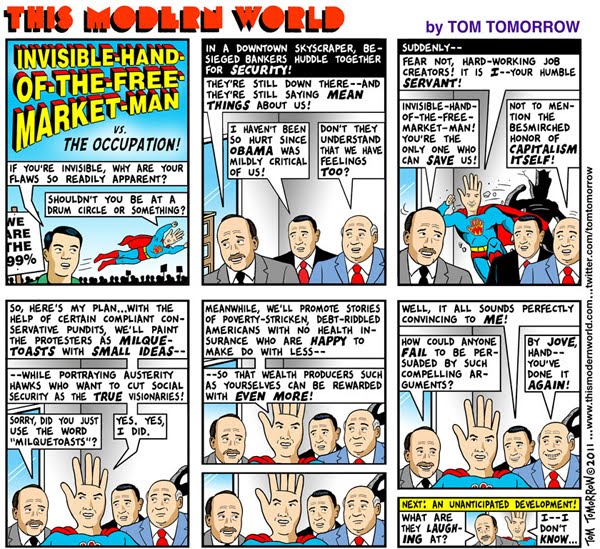
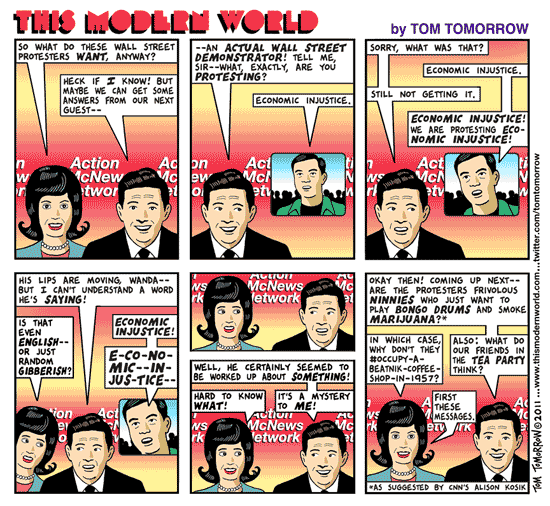
People keep asking what the OWS protesters want. Honestly, I don’t really know. But I do know what some of them are angry about, income inequality, student loan debt, unemployment, crony capitalism, and now that one has been critically injured in Oakland I think the movement, if that’s what they’re calling it, will face a critical test. Can they maintain their commitment to non-violence in the face of law enforcement and city leaders losing patience with their occupations? Also, winter and cold weather are quickly materializing, how will this factor affect their resolve? There is also concern among the protesters themselves that there are anarchists among their ranks which may undermine the peaceful image they’re trying to maintain.

The LA Time has a good rundown of the dilemma facing city officials and police departments across the country. I thought it was a little derelict though that they didn’t mention the Iraqi Vet who was critically injured in Tuesday nights clash with Oakland PD.

Looming large is the cautionary spectacle of Oakland. Police there arrested about 100 protesters before dawn Tuesday, using tear gas and riot gear to break up encampments — only to face a massive evening protest and threats of continued unrest from angry backers of the movement.

Leaders in other cities said they don’t want a repeat of that chaos, but it’s unclear how they will eventually oust protesters who refuse to leave.

Even in Los Angeles, where city leaders have greeted the demonstrators warmly, there are signs of protest fatigue and increasing anxiety about what happens next.

Los Angeles Mayor Antonio Villaraigosa, who earlier this month had ponchos distributed to rain-soaked Occupy L.A. protesters, said Wednesday that the encampment next to City Hall “cannot continue indefinitely.”

Villaraigosa has instructed city officials to draft a plan for another location for the demonstration.

Here’s a little more about the wounded protester and highlights of attempts to break up the occupation.

OAKLAND, Calif (Reuters) – More than 1,000 activists protesting economic inequality reclaimed a downtown Oakland plaza late on Wednesday, a day after demonstrators were driven out and an Iraq war veteran was critically hurt in clashes with police.

The severe injury of Scott Olsen, 24, a former U.S. Marine who friends said served two tours of duty in Iraq, became a rallying cry among Occupy Wall Street supporters in Oakland and beyond as organizers urged protesters back into the streets.

Police kept their distance as protesters returned to the scene of Tuesday’s confrontations, while protesters largely avoided provoking them, although one activist defiantly set up a single, small tent in the square after midnight.

The “Occupy Wall Street” protests, which began in New York City last month, take issue with a financial system they say most benefits corporations and the wealthy. They are critical of U.S. government bailouts of big banks, high unemployment and economic inequality.

Loosely organized protest groups have since sprung up across the United States and in countries around the world. Tensions were building in several cities where authorities have been treading a fine line between allowing peaceful protest and addressing concerns about trespassing, noise and safety.

In an early morning raid in Atlanta, police evicted dozens of protesters from a downtown park and arrested 53 who refused to leave. They were allowed to camp in the park for three weeks, but Mayor Kasim Reed said he decided to evict them because of fire code violations and crowd control issues.

Kristof discusses some of the issues he thinks are driving the protests.

That alarmist view of the movement is a credit to the (prurient) imagination of its critics, and voyeurs of Occupy Wall Street will be disappointed. More important, while alarmists seem to think that the movement is a “mob” trying to overthrow capitalism, one can make a case that, on the contrary, it highlights the need to restore basic capitalist principles like accountability.

To put it another way, this is a chance to save capitalism from crony capitalists.

But, in recent years, some financiers have chosen to live in a government-backed featherbed. Their platform seems to be socialism for tycoons and capitalism for the rest of us. They’re not evil at all. But when the system allows you more than your fair share, it’s human to grab. That’s what explains featherbedding by both unions and tycoons, and both are impediments to a well-functioning market economy.

Capitalism is so successful an economic system partly because of an internal discipline that allows for loss and even bankruptcy. It’s the possibility of failure that creates the opportunity for triumph. Yet many of America’s major banks are too big to fail, so they can privatize profits while socializing risk.

The upshot is that financial institutions boost leverage in search of supersize profits and bonuses. Banks pretend that risk is eliminated because it’s securitized. Rating agencies accept money to issue an imprimatur that turns out to be meaningless. The system teeters, and then the taxpayer rushes in to bail bankers out. Where’s the accountability.

Sunday Funnies and Asset Bubbles


I have several bloggers on the left that I regularly follow. Sometimes they’re a little over the partisan top but I am generally able to separate the nuggets of truth from the red meat. Here’s David Atkins discussing the difference between an asset economy and a wage economy. He’s not placing blame only on Republicans but policy makers in general since before Reagan. Both Atkins and David Dayen over at FDL work hard, I think, to understand what’s going on without blinders to their own side’s shortcomings and both do a good job of analyzing policy and the repercussions. Of course in the interest of moderation I’ll say they don’t always get it right but I think they do a lot of research and thought before throwing up any “ole thang”.

It would be comforting in a way to think that most every public official in Washington were eating luxurious dinners while rubbing their hands in glee at how best to destroy American families to benefit corporate contributors, so that those same public officials could buy houses in the Hamptons and eat filet mignon every night. Then it would just be a question of rooting them all out and putting “good” people into office. But that’s not really how most people, including elected officials, operate. Some are overtly corrupt to be sure, but a large number of them think they’re doing what they do for the right reasons.

I think this is true in the same way I believe my opponents on the right, you know who you are, believe in both their support of our heavily subsidized capitalist system and their prescription to bring us back from the economic precipice we’ve been on for three years now. Sure there are men and women in government and private markets who are only interested in their own bottom line but I’m hoping that most Americans would want to see a prospering economy and citizenry.

The real bipartisan agenda can be neatly summed up in this much overlooked but central Ronald Reagan quote from 1975:

“Roughly 94 percent of the people in capitalist America make their living from wage or salary. Only 6 percent are true capitalists in the sense of deriving income from ownership of the means of production…We can win the argument once and for all by simply making more of our people Capitalists.”

Understanding this idea is the key to understanding what is happening in America today, without resorting to Snidely Whiplash caricatures of elected officials.

Obviously policy makers thought by expanding home ownership, access to easy credit and inexpensive imported goods, and investing retirement funds in the market would lift us all. Unfortunately, it didn’t work out all that well for most of the middle class, regardless of how many refrigerators or tech gadgets they own.

The bipartisan idea from a public policy standpoint was not simply to enrich the wealthy at the expense of the middle class. The idea was to make the American middle class dependent on assets rather than wages.

On its face, the idea is insane. In a capitalist system, assets do often rise in value. But they also decline, and often sharply. Without significant wage growth and redundancies in the economy that provide stability at the expense of efficiency for asset growth, the popping of economic bubbles produces Great-Depression-style economic pain. The only way an asset-based economy can work is if assets grow reliably forever into the future. Not even the most “pro-growth” policies can promise that. In fact, those policies usually inflate bubbles that ensure just the opposite.

When policymakers attempt to privatize Social Security and Medicare, they aren’t necessarily supervillains hoping to turn America into a nation of nobles and peasants. Some are, but not all. The objective is to convert what they see as “useless” money sitting in the financial equivalent of a freezer, and put it to “productive” use in asset investments.

I think this is an important point and when I or others say that asset captitalists such as Pete Peterson are anxiously waiting to invest SS taxes paid by Americans into private investment opportunities this is what we mean. Many of us don’t believe this will work out very well for the little guy.

The recklessness and stupidity of this sort of approach to public policy should have been proven by the 2008 financial crisis that saw the rapid destruction of asset values in stocks, bonds, and housing. Predicating economic health on asset growth is a pipe dream: most people will never have enough assets to make it work, and asset growth is far too unstable to serve as the basis for a functional economy.

I think his conclusion is something to think about but I don’t see any real change in direction on the horizon so in the meantime, I’ll just try to protect our assets and push for a change in policy makers.

America will only return to real economic health when the asset-crazed insanity of the last 30 years is brought to heel, and America returns to a public policy that is far more interested in wage growth and economic stability than it is in asset inflation. Until then, we can expect continued political and economic shocks from an angry electorate and an economy that has run off the rails due to 30 years of deeply misguided anti-inflation, pro-asset-growth ideology.

Bits & Pieces-Game One Baby (Open Thread)


Sunday Funnies and Liz Warren


Maybe I’m wrong, it sure wouldn’t be the first time, but I think the middle class has finally woken up to the fact that the deck is stacked against them. I hope we’ve realized we don’t need a savior, we’re on our own, that much is clear. But people are finally expressing their anger and frustration outside of the voting booth so maybe someone will get the hint. I’m a little cynical, they just passed another free trade deal that most Americans didn’t want, so who knows what’s really going on. A Liz Warren in the Senate may be able to level the playing field a little, that’s the hope anyway.

People are frustrated with Washington, Republicans and Democrats alike. Congressional approval hovers below 15% and Obama’s not faring all that well in the polls himself. Whether, as some claim, we believe the so-called liberal media blitz blaming “Wall Street” for our woes or you believe the conservative claim that “government” was largely to blame, it’s tough to deny that we’re having trouble climbing out of this recession. While the economy would undoubtedly have been worse without TARP, “Main Street” isn’t in recovery yet. The Tea Party and the OWS protesters aren’t characters in a children’s book, an Ayn Rand novel or science fiction, they’re real people with real concerns for their future. It’s pretty obvious conservatives are worried about Liz Warren. Scott Brown’s campaign coffers have grown substantially since she announced her Senate run.

She had gained millions of supporters. With her passionate defense of America’s beleaguered middle class, under assault today from seemingly every direction, she had become like a modern-day Mr. Smith, giving voice to regular citizens astonished at the failure of Washington to protect Main Street—and what increasingly appeared to be its abandonment of middle-class America.

If you read this piece in Vanity Fair you’ll discover why she appeals to many of us, and also why she might just be a little different from the usual beltway corporate sponsored politician. I know, I know, corporations are people too, but oddly enough, so are people.

Arrayed against Warren, and today against the very existence of the C.F.P.B., was the full force of what many, most notably Simon Johnson, the M.I.T. professor and former International Monetary Fund chief economist, have called the American financial oligarchy: Wall Street firms and banks supported mainly by Republican members of Congress, but also politicians on the other side of the aisle, along with members of Obama’s own inner circle.

She has enemies in the White House and particularly at Treasury. There’s no love lost between Warren and Geithner, especially after her questions during heated oversight hearings. Chris Dodd wasn’t particularly thrilled having her in charge of setting up the CFPB, he wasn’t all that enthusiastic about bringing transparency or consumer protections to the banking industry in the first place. Does anyone miss Chris Dodd?

Reid asked Warren to head the congressional panel overseeing the $700 billion bailout. The job was vague, with no clear goals, but Warren would turn it into a tough, prosecutorial committee. She did real investigations, grilled government officials, and issued blunt monthly reports demanding more accountability from banks and better returns for the taxpayer. She held public hearings that were televised, asking the questions that many taxpayers wanted asked—and questions that bankers and Treasury officials did not want to answer. Perhaps the most widely watched hearing is the one that took place in September 2009. A video of part of that hearing can still be found on YouTube, under the title “Elizabeth Warren Makes Timmy Geithner Squirm.” It opens with Warren asking the question that was on the minds of many taxpayers: “A.I.G. has received about $70 billion in TARP money, about $100 billion in loans from the Fed. Do you know where the money went?” What followed during the rest of the hearing was the spectacle of the Treasury secretary tripping over his words, his eyes darting around the room as Warren, calm and prosecutorial, kept hammering him with questions.

She wasn’t always a Democrat. Her first big foray into bankruptcy, via a study she conducted to uncover fraud, had a much different result than she expected.

In 1978, Congress had passed a law that made it easier for companies and individuals to declare bankruptcy. Warren decided to investigate the reasons why Americans were ending up in bankruptcy court. “I set out to prove they were all a bunch of cheaters,” she said in a 2007 interview. “I was going to expose these people who were taking advantage of the rest of us.” What she found, after conducting with two colleagues one of the most rigorous bankruptcy studies ever, shook her deeply. The vast majority of those in bankruptcy courts, she discovered, were from hardworking middle-class families, people who lost jobs or had “family breakups” or illnesses that wiped out their savings. “It changed my vision,” she said.

And of course the vigor with which the banking sector and Republicans continue to vilify, demean, and label her will only increase the support and campaign donations she receives in response.

In those speeches, sometimes using slides filled with numbers and graphs, she would, as she did at a speech in Manhattan in early June, outline the impact on middle-class Americans of rising health-care costs, burgeoning debt, and the depletion of not only their savings but also, with the rise in joblessness, their confidence. She spoke of “the Wild West” conditions deregulation had created, where banks could sell virtually any product they wanted, on any terms: mortgages they knew consumers could not pay off, credit cards whose rates they could raise at whim, products that came with a mind-boggling array of penalty fees, many of them not fully disclosed. But it was her final remarks that brought down the standing-room-only house in June. “We cannot run our country without a strong middle class. We cannot run a democracy without a strong middle class,” she said, her voice quavering slightly. “If we hollow out the middle class,” she said, “then the country we know is gone.”

But while audiences applauded her, Warren’s opponents lacerated her. She was called incompetent, power-hungry, ignorant, a media whore, and, in a widely televised moment, a liar, by a Republican congressman during a hearing in May. “It was like she was the Antichrist,” says Roger Beverage, the president of the Oklahoma Bankers Association and one of the few bankers who publicly supported her. She had become the lightning rod for the opposition to the C.F.P.B.

Her critics characterize her as an elitist or a shark in school marms clothing, but while she speaks the language of the middle class, she also knows the secret handshakes and tricks of the trade of the financial elite. It’s no wonder they’ve spent so much money trying to keep her away from the levers of power.

That bluntness was evident in an interview even in late May, when Warren, who learned only in July that she wouldn’t get the job, still believed that Obama might ask her to run the C.F.P.B. “It’s money and power, the only two things we are talking about here,” she said, speaking of the people who were trying to kill the C.F.P.B. “in the back alleys,” as she put it. “There are many who are rich and powerful who say the system works fine as it is,” she continued. “America had been a boom-and-bust economy going into the Great Depression—just over and over and over, fortunes were wiped out, ordinary families were crushed under it. Coming out of the Great Depression we said, We can build a structure that makes us all safer. And notice, it’s from the end of the Great Depression to the 1980s that we built America’s middle class. That’s when we got stronger as a country. That’s when that big, solid, boring, hardworking, play-by-the-rules group in the middle emerged and defined what America was. You still had the ability to become a billionaire, but the center stayed strong and, notice, provided opportunity for growth, opportunity for getting ahead, opportunity that your kids were going to do better than you did. That was what defined America. And then we started, inch by inch, pulling the threads out of that regulatory fabric, starting in the 1980s.”

We’ll see how tough she is, she’ll need it, but I believe she’s got what it takes to both win and make a difference. There will be a lot of eyes on the Senate race in Massachusetts.

Marketing OWS (Sat. Open Thread) unless someone comes up with something better

We could have some fun with this today. Oct. 15th. is the day OWS, or versions of it, goes global so it’s high time we advertise and capitalize it. I love the stock quotes in there.

A few comments from “hedge fund” and “bankster” types:

Citi’s CEO Vikram Pandit said at a breakfast meeting on Wednesday that he’d be happy to meet with protesters, and he added that their sentiments were “completely understandable,” according to reports by Bloomberg and Fortune magazine.

“Trust has been broken between financial institutions and the citizens of the U.S., and that is Wall Street’s job to reach out to Main Street and rebuild that trust,” Pandit said.

What better way to do it than a corporate sponsorship? Doesn’t “Occupy Wall Street By Citigroup” sound more friendly? And wouldn’t America make a faster comeback if corporations would simply pay people to protest against them?

Bill Gross, co-founder of PIMCO, one of the world’s largest investment firms, put his jingle on Twitter on Tuesday: “Class warfare by the 99%? Of course, they’re fighting back after 30 years of being shot at.”

Bank of America /quotes/zigman/190927/quotes/nls/bac BAC -0.48% : “If you like anarchy and chaos, you’ll love the court filings in our foreclosure cases.”

Samuel Adams /quotes/zigman/131652/quotes/nls/sam SAM +2.02% : “Boston beer: Never as harsh as Boston police.”

Netflix /quotes/zigman/87598/quotes/nls/nflx NFLX -0.83% : “We stopped saying ‘Qwikster.’ You stop should stop staying ‘Bankster.’”

United Airlines /quotes/zigman/617037/quotes/nls/ual UAL -0.72% : “We love people with too much baggage.”

General Electric /quotes/zigman/227468/quotes/nls/ge GE +2.34% : “Thanks for paying your taxes so we don’t have to.”

BP /quotes/zigman/247026/quotes/nls/bp BP +2.92% : “Why does there always have to be this Gulf between us?”

Dr. Pepper /quotes/zigman/507521/quotes/nls/dps DPS +0.25% : “Be a Pepper. Don’t be pepper sprayed.”

Blackberry /quotes/zigman/18534/quotes/nls/rimm RIMM +1.52% : “Could you please try texting whatever it is that you’re so mad about, again.”

Sotheby’s /quotes/zigman/241211/quotes/nls/bid BID +0.70% : “Next time you unwashed hippie activists go barging into to one of our fine auctions, buy something.”

"Free Trade" ?

I don’t see how anyone on the right or the left can deny the influence of money in politics. I don’t think it’s a partisan issue. The middle class keeps slipping further and further behind and last time I checked they weren’t all Democrats.

On Wednesday afternoon, the House was steamrolling toward passage of a trio of free-trade agreements without a whisper of objection from the Republican side. Finally, hours into the debate, Rep. Walter Jones (R-N.C.) rose to appeal to his fellow Tea Partyers to heed the people who elected them.

“Here we have roughly 9.1 percent unemployment in this country, due in no small part to the Washington elite jamming these job-destroying trade agreements down our throats,” Jones pleaded on the House floor. “It’s time we started listening to the will of the American people, doing what’s in the best interest of the American people, not in the best interest of the foreign nationals who desperately want to take our jobs.”

It was a passionate speech but useless. Lawmakers, including the overwhelming majority of Tea Party Republicans, voted in support of the three trade deals, which had been at the top of corporate America’s wish list.

For all the talk of populist foment – the Tea Party on the right and the new Occupy Wall Street movement on the left – business interests remain firmly in control. Forced to choose between their voters and their donors, lawmakers don’t hesitate before choosing the latter.

There is little doubt about where the Tea Party faithful stands on free trade. A year ago, a Wall Street Journal-NBC News poll found that 61 percent of Tea Party supporters thought free-trade agreements had hurt the country, compared to 53 percent of Americans overall who held that view. Shortly after that, a Pew Research Center poll found that only 24 percent of Tea Party supporters thought free-trade agreements were good for America.

Bits & Pieces – Columbus Day Open Thread

Gov. Jerry Brown of CA has signed California’s own version of the Dream Act. It’s odd to compare this with what they’re doing in Alabama. I saw a photo of a sign in front of a local water department in AL over the weekend that said you could no longer have an account with the city for water without a picture ID.

Declaring the need to expand educational opportunity, Gov. Jerry Brown announced Saturday that he has signed legislation making illegal immigrants eligible to receive state financial aid to attend California universities and community colleges.

Brown said he signed the California Dream Act because it makes sense to allow high-achieving students access to college financial aid.

“Going to college is a dream that promises intellectual excitement and creative thinking,” Brown said in a statement. “The Dream Act benefits us all by giving top students a chance to improve their lives and the lives of all of us.”

(lms)


I’ve been reading lots of negatives regarding the possibility of the Super Committee actually accomplishing much. Considering Obama’s Jobs Bill appears dead in the water and the Super Committee has pretty low expectations along with the debt ceiling battle, these guys are beginning to get a little worried.

This is from Gates, the other two are Bernanke and Geithner.

“I do believe that we are now in uncharted waters when it comes to the dysfunction in our political system–and it is no longer a joking matter,” former Defense Secretary Robert Gates told an audience two weeks ago at the Constitution Center in Philadelphia, where he received the Liberty Medal for national service. “It appears that as a result of several long-building, polarizing trends in American politics and culture, we have lost the ability to execute even the basic functions of government much less solve the most difficult and divisive problems facing the country. Thus, I am more concerned than I have ever been about the state of American governance.”

(lms)


And I couldn’t resist another OWS link

As Gregory Djerejian writes, this was inevitable. A seemingly endless recession sparked by a financial meltdown was bound to create a backlash, one way or another. The President famously said in a meeting with 13 Bankers that he was the only thing standing between them and the pitchforks. He cannot hold them back any longer. Djerejian sums up the national mood:

“Speaking to several of these protesters today, I met MBA students who cannot find jobs (one even told me his GPA at business school, a respectable 3.2) and law students in a similar predicament. As money gets wasted in epic fashion overseas for desperately flawed ‘provincial reconstruction teams’ in Iraq and risible ‘Government-in-a-Box’ initiatives in Afghanistan, these kids are staring at mountains of debt and an equally daunting lack of viable employment prospects (the MBA student was underemployed working as a barista at Starbucks). So there are intelligent faces and voices in these crowds—not just aimless rabble-rousers out for a rise—and I can sense this movement becoming more contagious (for instance, I detected among several of the more junior police officers perhaps some degree of sympathy for the protesters). To some extent, after all, these are our young screaming out in need, meriting not kettling and reprimands, but job prospects and dignity […] They want accountability and dignity and prospects. Their leaders have failed them. So they have taken to the street to lead themselves.”

Former State Department official Anne-Marie Slaughter actually had some good thoughts as well. Whether the Democrats can get fuel from this movement or whether they become terrified of it, what is happening around the country is ultimately a statement of hope from a disaffected group of people who want to build something and will not let the constraints of politics or big money get in the way.

(lms)


In a Reflective Mood

I came across an interesting piece this morning and while I am already in a reflective mood I thought I might just share it. Today would have been my nieces 34th. birthday. Some of you know a little about her story but that’s not really what I’m interested in sharing today. There has been a lot of criticism from the Plumline about what we are attempting to do here at ATiM and so I thought I’d share both my thoughts and a quote from a piece I read this morning.

I love a good ideological fight and I appreciate both passion and resolve. What I don’t find particularly beneficial to the fight is pitting citizen against citizen. We have a long tradition here of right vs. left and consequently we end up with a lot of middle of the road legislation that doesn’t always solve our problems. I think the health care debate was one such battle. In the midst of demeaning and knocking the feet out from under our enemies, each other, we ended up with a bill that could only have been drafted by someone in the middle. I blame Obama and a dysfunctional Congress for that and I’ll tell you why.

He and others were much more interested in defending and preserving a system that is putting access to health care out of reach of many Americans. Instead of defending and championing the people he was fighting for Obama was appeasing those who were fighting against him, while the rest of us were laying claim to self-righteousness. In the midst of this epic battle great animosity was created, sides were taken, superlatives embraced and those of us who hoped for a healthier tomorrow for all citizens lost our leader and our way. We consequently ended up with a bill that only inches our way forward when we needed a bold design for the future.

I believe we can embrace our enemy as a fellow traveler without impugning their motives or humanity. That’s what drives me. I will fight and advocate for those who have and are suffering but choose not to make such an enemy of those I disagree with that I lose sight of their genuine belief that their solutions are, or may be, better than mine. I hold out hope that citizens can come together and form a more perfect union. I also believe the greed of a few has changed the future of many and to me that is the epic battle I want to fight and hope that others will realize that championing the middle class, working class, working poor and uneducated is what will bring prosperity back to this country. We may disagree on how to do this, therein lies the battle line, but as long as we all want a prosperous nation again I don’t see a reason to disparage the motive of other citizens. I do think however the motives of our leaders can be called into question and is another venue for a great ideological battle and legitimate questions as to who actually benefits from legislation can and should be raised.

My niece died 3 years, 7 months and 2 days ago at the age of 30. She was sick, but her insurance coverage was rescinded in the middle of a fight for her life, and I believe most people who are mothers, fathers, aunts, uncles, brothers and sisters would agree that we need to find a way beyond a health care system that carries such a risk. Maybe I’m wrong but I believe most other Americans wouldn’t intentionally wish this on a family. The question is how do we move forward in a way that does the most good with the least amount of threat to both individual freedom and prosperity.

Here’s that quote:

Before you disappear, before you can no longer hear
my words from beyond the beyond and inside the ground,
before your run ends in downfall and rout and retreat,
let this old heart beating with the Earth and the stars
and the need for not one child, not one, to die for lack of love,
let me tell you one last secret found in the abyss of despair.
It is true that he who is mighty is he who makes of an enemy
a friend, mighty and wise is he who offers the foe
a way out, a bed to sleep in, a meal to share.
But not without a fight. Not without a fight.


LMS, I tried to post the following as a comment, but I was thwarted.  So forgive the appendage to your thought provoking post that follows.  Mark.

The ACA would have put your niece in a better position to maintain coverage.

Let me defend moderation, here.

1]  Every nation that is “like us” that has developed UHC has done it by evolving from what went before.

Canada has socialized insurance.  UK has socialized medicine.  Switzerland has private insurance, regulated; and regulated hospitals.  Switzerland evolved in the 90s from a system just like ours in most ways.  Germany, France, and Japan have mixed systems with private regulated insurance, private docs, and widespread clinic care. All these nations have UHC which costs half as much as ours, or less, and which has gross statistical results as good as ours, or better.

2]  We have a shortage of docs and of nurse practitioners, and pharmacists.  In our “like” countries, nurse practitioners and pharmacists do pick up more of the first response than we have them do here.

These shortages must be addressed if we are to achieve widespread clinic care [and we know that even here, clinic care is far cheaper than the “national average” and a relative drop in the bucket when it can substitute for ER care].

3]  Certain end of life choices must be borne by the individual rather than by the group, because the cost/benefit is individual, not societal.

I am 68 and my five year colonoscopy, by my count, is the first time that I have cost the system as much as one year of my continuing pay into it.  In other words, I am still a net contributor to the group plan and hope to be until I die.  My friend Jimmy, who turned 66 on Thursday, has been treated for cancer the entire year he has been on medicare.  His 20% [he had no gap or advantage policy] will likely not be paid by him, or his estate, most of which is exempt from creditors [homestead, truck, tools of his profession].  There came a point when further chemo was considered irrelevant, 9 weeks ago.  He has chosen hospice since.  The trickiest propositions are the end of life balloon of cost and the nursing care balloon.  Rosanne and I have nursing care insurance.  I do not know how Switzerland and Germany do this, but I am interested to read about it.

THE ONLY REALLY TOUGH PROBLEM, IMO.

4]  I think it is natural to evolve to the Swiss-and-or-German model but not toward the UK or even toward Canada.  In any case, ACA was a step in the direction of Swiss, not the direction of UK.  It will address near universality and pure insurance cost, but not basic medical cost.  For that we have to go back primarily to

INCREASING SUPPLY AND REDUCING DEMAND.

5]  While we are evolving and training the suppliers, and promoting healthier lifestyles, we can address the efficiency issues as well.

a]  automated computerized record keeping;

b]  doctor-lawyer evaluation panels for malpractice claims, aimed at reducing actual malpractice, but also at filtering out the weak claims at an early stage;

c]  first dollar payment by the patient, and co-pays, to reduce overindulgence as described by NoVaH;

d]  ending price discrimination by the pharmaceutical manufacturers by opening the borders to pharmacy inports – I note that we are actually subsidizing Euro drug makers as much as we are American ones, now;

e]  attempting to have an adult discussion about what a “basic” care package entails;

and

f]  getting the non exigent poverty cases OUT of the ERs.  

6]  As a lawyer for small business folks and employers I actually had to read the bill.  It is intentionally not onerous on small business; it will not be a job killer from that perspective.  But it cannot contain basic medical costs because of the shortage of basic medical personnel, which it only addresses in “pilot” programs.

If instead of evolving toward Switzerland we had chosen the UK model, the shortage would have been immediately and shockingly felt as docs scrambled to leave the program, unless it had been structured at such a high cost as to simply absorb most of the tax resources of the federal government.

Max Baucus had in mind the evolution of which I speak, according to some interviews with him that I saw during the period.  I think BHO did, too.  In short, I argue “Fuggedaboud” single payer.
———————————–
The Libertarian view questions the government’s role in HC. If ECA were repealed and Medicaid were repealed; if the VA was shut down and Medicare repealed, at least prospectively; does anyone posit that the supply of medical services would expand to meet the need?

No.  No one suggests that outcome.  Ron Paul hopes for it, but he does not predict it.  Would the body politic accept that as status quo?  What do you think?  LMS’s niece, 100 times over?


Open Thread Friday

Not to beat a dead horse from yesterday and again today, but here are a few pics from the “We are the 99%” OWS “radicals”, not from the protest signs, but the messages they really want heard. I’m enjoying watching people, especially young ones, finally get up and express their fears, anger and solidarity with one another in an attempt to change their future. I’m an old softie, I admit it, so I found some of these messages of personal misfortune very poignant.


I missed this from earlier in the week.

Tens of millions of U.S. citizens remain burdened with mortgages they can no longer afford, in addition to soaring credit card bills and sky high student loans.

Trillions of dollars in outstanding consumer debt is stifling demand for goods and services and that’s one reason economists say cash-rich U.S. companies are reluctant to hire and unemployment remains stubbornly high.

In an August appearance on CNBC, Roach said debt forgiveness would help consumers get through “the pain of deleveraging sooner rather than later.” But it’s not just the liberal economists and doom-and-gloom financial analysts calling for a great haircut.

Even some institutional investors, who might suffer some of the impact of debt reductions on their portfolios, are seeing a need for a creative solution to the mess.

“If there is something constructive that can be done it should be,” said Ash Williams, executive director of the Florida State Board of Administration, which oversees $145 billion in public investments and pension money.

“You don’t want to reward bad behavior and you don’t want to reward people who were irresponsible.

But if there is a way to do well by doing good, then let’s take a look at it.” To be sure, consumer debt levels have been coming down since the crisis began.


Here are a couple of interesting reads from Tom Engelhardt and Andy Kroll over at TomDispatch (just one of those financially esoteric economic blogs I enjoy reading).

Tom on the protesters:

It’s true, as many have pointed out, that they don’t have a list of well thought out demands, but the demand to have such a list is just their elders trying to bring them to heel. The fact is, they don’t have to know just what they’re doing, any more than a writer or filmmaker has to understand the book being written or the film shot. It’s not a necessity. It’s not the price of admission. If there’s one thing that’s obvious and heartening, as my friend, the novelist Beverly Gologorsky, said to me while we oldsters circumnavigated the park, “The overwhelming feeling I have is that no one here is planning to go home any time soon.”

Andy on the Lost Decade:

Food pantries picked over. Incomes drying up. Shelters bursting with the homeless. Job seekers spilling out the doors of employment centers. College grads moving back in with their parents. The angry and disillusioned filling the streets.

Pan your camera from one coast to the other, from city to suburb to farm and back again, and you’ll witness scenes like these. They are the legacy of the Great Recession, the Lesser Depression, or whatever you choose to call it.

In recent months, a blizzard of new data, the hardest of hard numbers, has laid bare the dilapidated condition of the American economy, and particularly of the once-mighty American middle class. Each report sparks a flurry of news stories and pundit chatter, but never much reflection on what it all means now that we have just enough distance to look back on the first decade of the twenty-first century and see how Americans fared in that turbulent period.

And yet the verdict couldn’t be more clear-cut. For the American middle class, long the pride of this country and the envy of the world, the past 10 years were a bust. A washout. A decade from hell.


A note from me:

I’m apologizing in advance for only really caring about health care and the economy. I’m an old political activist who cut her teeth in the 60’s and while I care about and participate in politics, I am very cynical regarding the political landscape and so I tend to keep my posts focused on areas of my greatest concern. I did notice though that Obama seems to be channeling Harry Truman lately.

Also, if you make me laugh you’ll get a big virtual hug. Haaaaaahaaaaaaa

It’s a Carnival

I’m sure you’ve all been waiting for a post about “Occupy Wall Street” (jk). I’ve inserted a link here and there and have been looking for the best launching pad to begin a post of my own. I’ve read lots of comments making fun of the protesters or telling them to grow up, get a job, put down the pipe, you know, all the usual. That seems to be the reaction of some people on both sides of the aisle but I don’t think it’s very useful in understanding what’s going on. As these groups grow and spread out across the nation, assuming they do, I think it behooves us to understand what’s behind it and what, if anything, they’re trying to accomplish. I heard a young grad student speak to a local reporter last weekend here in LA and she said something that I’ve been thinking about ever since, which I loosely paraphrase as, we’re talking to each other and listening to each other. We don’t know if anyone else is listening or not and right now we don’t care. I thought that was really interesting for some reason and then this morning Matt Stoller authored a piece that explained what she meant without hearing her say it.

What do the people at #OccupyWallStreet actually want? What are their demands? For many people, this is THE question.

So let me answer it. What they want… is to do exactly what they are doing. They want to occupy Wall Street. They have built a campsite full of life, where power is exercised according to their voices. It’s a small space, it’s a relatively modest group of people at any one time, and the resources they command are few. But they are practicing the politics of place, the politics of building a truly public space. They are explicitly rejecting the politics of narrow media, the politics of the shopping mall. To understand #OccupyWallStreet, you have to get that it is not a media object or a march. It is first and foremost, a church of dissent, a space made sacred by a community. But like Medieval churches, it is also now the physical center of that community. It has become many things. Public square. Carnival. Place to get news. Daycare center. Health care center. Concert venue. Library. Performance space. School.

Few people, though an increasing number daily, have actually taken the time to go through a general assembly, to listen to what the people at #OccupyWallStreet actually want. General assemblies are the consensus-oriented group conversations at the heart of the occupations, where endlessly repeating the speaking of others is the painstaking and frustrating way that the group comes to make decisions.

There’s no electronic amplification allowed in Zuccotti Square. So the organizers have figured out an organic microphone system. A speaker says a half a sentence, everyone in earshot repeats, until the whole park can hear that half a sentence. Then the speaker says another half a sentence.

I felt completely included as part of a community forum even though I had not been a speaker. But what I realized is that the act of listening, embedded in the active reflecting of what the speaker was saying, created a far richer conversational space. Actually reflecting back to one another what someone just said is a technique used by therapists, and by pandering politicians. There is nothing so euphoric in a community sense as truly feeling heard. That’s what the general assembly was about, not a democracy in the sense of voting, but a democracy in the sense of truly respecting the humanity of everyone in the forum. It took work. It took patience. But it created a communal sense of power.

The premise of their politics is that #OccupyWallStreet isn’t designed to fit into your TV or newspaper. Nothing human really is, which is why our politics is so utterly deformed. It’s why they don’t want to be “on message” – what kind of human society can truly be reduced to a slogan? I’m not sure I agree with their political premise. But in the carnival they have created, in the liveliness and beauty and art and fun and utter humanity of it all, they make a damn good case.