Morning Report: Adverse fee delayed

Vital Statistics:


Last Change
S&P futures 3446 2.6
Oil (WTI) 43.54 0.87
10 year government bond yield 0.71%
30 year fixed rate mortgage 2.94%


Stocks are flat this morning as Hurricane Laura is expected to make landfall sometime tonight. Bonds and MBS are flat.


The FHFA delayed the 50 basis point adverse market fee until December 1. It also carved out refinances below $125,000. From the press release: “The fee is necessary to cover projected COVID-19 losses of at least $6 billion at the Enterprises. Specifically, the actions taken by the Enterprises during the pandemic to protect renters and borrowers are conservatively projected to cost the Enterprises at least $6 billion and could be higher depending on the path of the economic recovery.” Now the big question will be whether the aggregators remove the fee or keep it in their rate sheets. Quicken and PennyMac have already. Here is the MBA’s take on it.


Mortgage applications fell by 6.5% last week as purchases increased by 0.4% and refis decreased by 10%. “Mortgage rates were mixed last week, but the rates for 30-year fixed mortgages and 15-year fixed mortgages declined,” said Joel Kan, MBA Associate Vice President of Economic and Industry Forecasting. “Despite the lower rates, conventional refinance applications fell 11 percent and government refinance applications fell 6 percent, which pushed the total refinance index to its lowest weekly level since July.” Rates had been ticking up for a while, with the 10 year bond stuck around 70 basis points.


Luxury homebuilder Toll Brothers reported earnings yesterday. Sales revenue fell due to the pandemic, but orders were up 23% in units and 18% in dollar value. The $2.21 billion in new contracts was a record third quarter (they have an October fiscal) for the company.


Consumer confidence declined in August as expectations of a quick economic recovery were quashed. “Consumer Confidence declined in August for the second consecutive month,” said Lynn Franco, Senior Director of Economic Indicators at The Conference Board. “The Present Situation Index decreased sharply, with consumers stating that both business and employment conditions had deteriorated over the past month. Consumers’ optimism about the short-term outlook, and their financial prospects, also declined and continues on a downward path. Consumer spending has rebounded in recent months but increasing concerns amongst consumers about the economic outlook and their financial well-being will likely cause spending to cool in the months ahead.”


Durable Goods orders rose 11.2% in July, which was much higher than expectations. Ex-transportation orders rose 2.4% and core capital goods orders (a proxy for capital expenditures) rose 1.9%.

Morning Report: New Home Sales surge

Vital Statistics:


Last Change
S&P futures 3439 12.6
Oil (WTI) 43.54 0.87
10 year government bond yield 0.69%
30 year fixed rate mortgage 2.92%


Stocks are higher this morning after the US and China reaffirmed their commitment to a trade deal. Bonds and MBS are down.


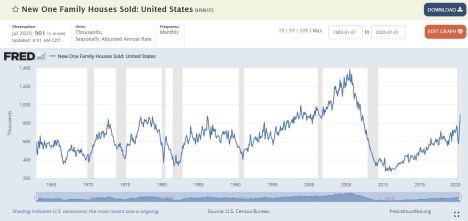
New Home Sales came in at 900k, much higher than the 754k expected. This is the highest print since 2006.


new home sales


Energy prices are rising as Hurricane Laura has shut down natural gas and oil terminals. Servicers already lugging portfolios of loans in forbearance will now have to deal with additional disaster-related delinquencies.


Home prices were flat MOM in June, according to the Case-Shiller index. On an annual basis they were up 4.3%. The FHFA Index, which uses a different methodology, reported home prices rose 0.9% MOM and are up 5.7% on a YOY basis.


The Mortgage Bankers Association reported that the share of loans in forbearance was flat last week as 3.6 million homeowners (or about 7.2% of loans) are in plans. Ginnie Mae loans were flat at 9.54% and private label (jumbo and non-QM) are 10.37%. “The share of loans in forbearance declined for the 10th week in a row, but the rate of improvement has slowed markedly,” said MBA Chief Economist Mike Fratantoni. “The extremely high rate of initial claims for unemployment insurance and high level of unemployment remain a concern, and are indications of the challenges many households are facing. While new forbearance requests remain low, particularly for Fannie Mae and Freddie Mac loans, the pace of exits from forbearance has declined for two straight weeks.”


Economic activity decelerated in July however it is still growing above trend, according to the Chicago Fed National Activity Index.


Mortgage lenders are asking borrowers to confirm they don’t plan to seek forbearance right away. While the language varies, it generally says that borrowers certify they won’t seek forbearance until the loan is guaranteed by the government. Given that Fannie and Freddie charge either 5% or 7% to buy loans in forbearance, this is important. For mortgage lenders, the forbearance penalty is an added concern. “The hit more than wipes out your margin—over something you have no control over,” said Esther Phillips, senior vice president of sales at Key Mortgage Services Inc. “You can’t control what customers do after you close.” Key’s form asks borrowers to certify they haven’t applied for forbearance from any mortgage payments and have no plans to ask for it.

Morning Report: Home Prices rise 10%

Vital Statistics:


Last Change
S&P futures 3421 28.6
Oil (WTI) 42.54 0.17
10 year government bond yield 0.64%
30 year fixed rate mortgage 2.91%


Stocks are higher this morning on no real news. Bonds and MBS are flat.


The upcoming week will be pretty data-light, although we will get real estate prices and new home sales on Tuesday and personal incomes / spending on Friday. Jerome Powell speaks on Thursday.


The Wall Street Journal is reporting that the FHFA is negotiating with the mortgage industry to delay the 50 basis point hike for refinances:

As of Friday, the agency was negotiating delaying the fee with industry groups but was opposed to canceling it outright, according to people familiar with the discussions. Industry groups, including the American Bankers Association and the Mortgage Bankers Association, have generally sought to eliminate the surcharge altogether, the people said.

That said, the 50 basis point fee probably equates to something like 1/8% in rate, so it probably won’t end the refi wave. The industry was most concerned about the short fuse on the announcement, and the prospect of losing 50 basis points on loans that are already locked and in the pipeline.

Housing Wire got a quote from ex-MBA president Dave Stevens:

Dave Stevens, former president and CEO of the Mortgage Bankers Association and former commissioner of the Federal Housing Administration, told HousingWire on Saturday that, “If true, it seems clear that Director Calabria listened to industry concerns about the impact of this short time frame to implement. And while the logic of the fee remains in question, this is a good sign and hopefully will lead to a change in behavior going forward where impact assessment conversations can take place prior to major policy announcements.”

Even if they delayed the implementation by a month, it would give people a chance to clear out their pipelines.


Loan aggregator Amerihome is no longer doing self-employed borrowers for non-delegated. I guess with so many W2 refinancings out there, why mess around with harder files? Expect to see other aggregators make similar announcements.


Lower rates and tight supply has home prices rising at a double-digit clip. The issue is that these increases are happening in a period of economic weakness, which has some pros worried. That said, the COVID crisis has caused many builders to temporarily slow building, and many sellers to pull their listings since they don’t want to have people walking through their homes.


Morning Report: Existing home sales jump

Vital Statistics:


Last Change
S&P futures 3377 -3.6
Oil (WTI) 41.94 -0.82
10 year government bond yield 0.64%
30 year fixed rate mortgage 2.89%


Stocks are flattish this morning on no real news. Bonds and MBS are up.


Exiting home sales increased 24.7% in July, according to NAR. “Homebuyers’ eagerness to secure housing has helped rejuvenate our nation’s economy despite incredibly difficult circumstances,” said NAR President Vince Malta, broker at Malta & Co., Inc., in San Francisco, Calif. “Admittedly, we have a way to go toward full recovery, but I have faith in our communities, the real estate industry and in NAR’s 1.4 million members, and I know collectively we will continue to mount an impressive recovery.”  The annualized pace of sales puts it at 5.86 million units. The median home price increased 8% to $280k. First time homebuyers were up 35%.


The 50 basis point LLPA will wipe out millions in mortgage banking profit, according to an article in American Banker. “The way they did this is very, very damaging to banks and other mortgage bankers and brokers who have loans in the pipeline,” said Scott Buchta, head of fixed-income strategy at Brean Capital. “In the first month, the bulk of the fee will come out of the pockets of bankers and brokers that locked in a lot of loans.”


More than three dozen ex-Fed officials have signed a letter urging the Senate to reject Fed nominee Judy Shelton. Her crime is having the audacity to say something positive about the gold standard. Perhaps that is out of step with today’s army of progressive economists who are trying to fine-tune the economy by intervening directly in markets. If so, that is a good thing. The US Federal Reserve is thick in the biggest economic experiment the world has ever seen, and is highly susceptible to groupthink. The last think we need is a bunch Janet Yellens all saying the same thing.


The Fed has increased its balance sheet almost tenfold in the last twelve years. The US debt-to-GDP ratio (a measure of how leveraged the economy is) has increased from 67% to 107%. This should be massively stimulative to the US economy, yet the best we have been able to muster is “meh” for most of the past 10 years. Why is that? The velocity of money (basically how many times a dollar gets used) has fallen off a cliff. This has kept inflation in check, but the downside is that the US is slouching towards Japan, where disinflation (or outright deflation) has taken hold.


velocity of money


Morning Report: Stocks swoon on pessimistic FOMC minutes

Vital Statistics:


Last Change
S&P futures 3357 -16.6
Oil (WTI) 42.54 -0.32
10 year government bond yield 0.65%
30 year fixed rate mortgage 2.89%


Stocks are down this morning after the Fed minutes revealed pessimism about the economy. Bonds an MBS are up.


Initial Jobless Claims rose back above the 1 million market last week.


The Fed released its minutes from the July FOMC meeting yesterday. The big revelation was a moderating of economic expectations into the end of the year. The money quote: (note this is from the staff economists)

The projected rate of recovery in real GDP, and the pace of declines in the unemployment rate, over the second half of this year were expected to be somewhat less robust than in the previous forecast.

There was also discussion about the concept of yield caps, in other words the Fed targeting specific maturities in the Treasury market to keep the 10-year or 5-year bond yield below a certain target level.

A majority of participants commented on yield caps and targets—approaches that cap or target interest rates along the yield curve—as a monetary policy tool. Of those participants who discussed this option, most judged that yield caps and targets would likely provide only modest benefits in the current environment, as the Committee’s forward guidance regarding the path of the federal funds rate already appeared highly credible and longer-term interest rates were already low.

This is generally good news, at least for those that still cling to the idea that interest rates should be determined by a market. Still, the Fed and the US continues its “slouching towards Japan” strategy. Given the theory that increases in government debt as a percentage of GDP creates sluggish growth and low rates, not inflation (certainly borne out in Japan and Europe), low rates may be around for quite some time.


Mortgage Applications decreased 3.3% last week as rates rose. The purchase index rose by 1%, while refis fell by 5%. “Positive economic data reported last week on retail sales, as well as a large U.S. Treasury auction, drove mortgage rates to their highest level in two weeks,”  said Joel Kan, MBA Associate Vice President of Economic and Industry Forecasting. “The rise in rates dampened refinance activity, but purchase applications continued their strong run and were 27 percent higher than a year ago – the third straight month of year-over-year increases.”


There were a lot of rumors going around that the GSEs are looking to delay the 50 basis point LLPA for mortgage refinances. The industry has been dead set against it, and we have seen bipartisan opposition to it. The industry’s main gripe is the short fuse: loans that were locked before the announcement but expected to close after would require the lender to eat the additional cost. A longer runway (say Jan 1) would prevent this. Another option is to apply the LLPA on locks after Sep 1. The word on the street is that the next shoe to drop will be investment properties, so we could see higher LLPAs there in the future.


Fannie CEO Hugh Frater and Freddie CEO David Brickman threw cold water on that idea in a blog post.

Contrary to much of the criticism we have received since making this announcement, this will generally not cause mortgage payments to “go up.” The fee applies only to refinancing borrowers, who almost always use a refinancing to lower their monthly rate…

Some have asserted that this price adjustment could impact borrowers by as much as $1,500—but this life of the loan estimate is a misrepresentation of how this cost would be applied. For an average refinanced mortgage, we estimate a reduction in savings of about $15 per month, meaning refinancing homeowners who were previously saving $133 on their monthly payments will now save $118 per month, on average.

This estimate also assumes lenders pass on the entire fee to borrowers. That is up to them. If they do not, the $15-per-month figure would go down, potentially to zero.

Does this sound like someone reconsidering the idea? It sounds more like “I am altering the deal. Pray I don’t alter it any further.”


Despite the economic gloom, renting households are making their rent payments, according to the National Multifamily Housing Council. Almost 87% of renters have paid August rent, which is down about 2% from a year ago. Note that NYC is bringing up the rear at a sub-80% rate. Writer James Altucher wrote an interesting essay about why this time is indeed different for NYC.

Morning Report: Big jump in housing starts

Vital Statistics:


Last Change
S&P futures 3384 6.6
Oil (WTI) 42.24 0.52
10 year government bond yield 0.68%
30 year fixed rate mortgage 2.93%


Stocks are higher this morning on strong numbers out of WalMart and the Home Despot. Bonds and MBS are up small.


It looks like we are getting bipartisan push-back against the 50 basis point adverse market fee. Trump criticized the fee, and we have a chorus of Democrats opposed to it as well. It seems like no one is actually supporting this move. This is as just about every industry group lines up against it as well.


Housing starts increased to a seasonally-adjusted annual rate of 1.5 million in July, which is a 23% increase from a year ago. Building permits came in at 1.5 million as well, which is a 9% increase from last year. Certainly the COVID-related pause is over, and we are approaching the highs of earlier this year.

housing starts


Mortgage delinquencies increased to 8.2% in the second quarter, compared to 4.4% in the first quarter and 4.5% a year ago.

The COVID-19 pandemic’s effects on some homeowners’ ability to make their mortgage payments could not be more apparent,” said Marina Walsh, MBA Vice President of Industry Analysis. “The nearly 4 percentage point jump in the delinquency rate was the biggest quarterly rise in the history of MBA’s survey. The second quarter results also mark the highest overall delinquency rate in nine years, and a survey-high delinquency rate for FHA loans.

The conventional delinquency rate rose to 6.7% while the FHA delinquency rate rose to 15.7%, the highest rate since the survey began in the late 70s. DQs spiked in NY, NJ, FL, NV, and HI.


The number of loans in forbearance decreased to 7.2% last week, according to the MBA. Interesting data point on non-QM: big NQM investor MFA Financial said that roughly a third of its non-QM portfolio was in forbearance (though many were still paying). Ginnie remains a rough spot, with 9.5% in forbearance, and that doesn’t include the Ginnie loans which have been bought out of pools.


Morning Report: Builder sentiment close to record highs

Vital Statistics:


Last Change
S&P futures 3377 16.6
Oil (WTI) 42.64 0.02
10 year government bond yield 0.69%
30 year fixed rate mortgage 2.95%


Stocks are higher this morning on no real news. Bonds and MBS are up small.


The MBA is pushing Congress to rescind the “adverse market refinance fee,” which is the 50 basis point increase announced by the GSEs last week.

Requiring Fannie Mae and Freddie Mac to charge a 0.5% fee on refinance mortgages they purchase will raise interest rates on families trying to make ends meet in these challenging times,” Killmer said. “This means the average consumer will be paying $1,400 more than they otherwise would have paid. Even worse, the September 1 effective date means that thousands of borrowers who did not lock in their rates could face unanticipated cost increases just days from closing.

As many have pointed out, the irony of the Fed pushing down mortgage rates by buying mortgage backed securities in the market versus FHFA trying to raise mortgage rates via the fee is striking.


There isn’t a lot of market-moving data this week, although we have a good amount of housing data with the NAHB Housing Market Index, Existing Homes Sales, and Housing starts.


Homebuilder Sentiment is close to record highs, according to the NAHB. The index rose to 78 in August from 72. 50 is considered neutral. Take a look at the chart below, it looks like we are pretty much at the record highs of the late 90s. Those highs were then followed by a 50% jump in housing starts.

NAHB HMI


Home prices are rising across the board, but rural properties are seeing the biggest increases, rising 11%.

We’ve been speculating about increasing interest in the suburbs and rural areas since the start of the pandemic,” said Redfin economist Taylor Marr. “Now we’re seeing concrete evidence that rural and suburban neighborhoods are more attractive to homebuyers than the city, partly because working from home means commute times are no longer a major factor for some people. And due to historically low mortgage rates, interest is turning into action. There will always be buyers who choose the city because their jobs don’t allow for remote work or they place a premium on cultural amenities like restaurants and bars—which will eventually come back—but right now the pendulum is swinging toward farther-flung places.

Redfin rural prices


New Home purchase applications are up 39% YOY, according to the MBA. That said, the COVID-19 pandemic has wreaked havoc with seasonal adjustments, so that number could be overstated.

Morning Report: Homes selling at a record pace

Vital Statistics:


Last Change
S&P futures 3356 25.6
Oil (WTI) 42.44 0.82
10 year government bond yield 0.68%
30 year fixed rate mortgage 2.85%


Stocks are higher this morning on no real news. Bonds and MBS are down.


Inflation remains muted. The producer price index (which measures wholesale inflation) rose 0.6% month-over-month, but is down 0.4% on a year-over-year basis. The consumer price index rose 0.6% MOM and is up 1% YOY. This is well below the Fed’s target of 2%.


Mortgage applications rose 6.8% last week as purchases increased 2% and refis increased 9%. “Mortgage rates fell across the board last week, as investors grew less optimistic of the economic rebound given the resurgence of virus cases,” said Joel Kan, MBA Associate Vice President of Economic and Industry Forecasting. “Loan types such as the 30-year fixed, 15-year fixed, and jumbo all reached survey lows. Refi activity responded to these lower rates, with the refi share reaching almost 66 percent of all applications, its highest level since May. And the refi index jumped 9 percent, reaching its highest level since April, as both conventional and government applications for refinances increased.”


United Wholesale is offering a 1.99% 30 year mortgage. Of course you are going to have to pay points to get that rate, and some of it will depend on broker comp.


Solution to the affordable housing issue? Converting COVID-driven office and hotels to affordable housing. “That’s going to free up a lot of commercial space, which can be converted to affordable housing,” U.S. Housing and Urban Development Secretary Ben Carson said of the pandemic in a June 24 Fox News interview. “We are very much looking at that right now, looking at ways to be able to facilitate that transformation.” This model was used in the Rust Belt to help revitalize abandoned downtown areas.


The pace of homebuying is accelerating. According to Redfin, 46% of sellers are accepting an offer within two weeks. Home sale prices were up 9% YOY to a new high of $311,000. Meanwhile, on the supply side, listings are down 2.7% and the active inventory of homes for sale is down 28%. The list-to-sale ratio is 99%, a record.

Morning Report: M&A in the mortgage space

Vital Statistics:


Last Change
S&P futures 3372 23.6
Oil (WTI) 42.83 0.52
10 year government bond yield 0.63%
30 year fixed rate mortgage 2.85%


Stocks are higher this morning on no real news. Bonds and MBS are down.


Job openings increased to 5.9 million at the end of June according to the JOLTs jobs report. Hires fell to 6.7 million, but that was the second-highest reading for the series. The quits rate fell to 1.9%, which is to be expected during a recession.


Small Business optimism slipped in July, according to the NFIB. “This summer has been challenging for many small business owners who are working hard to keep their doors open and remain in business,” said NFIB’s Chief Economist Bill Dunkelberg. “Small business represents nearly half of the GDP and this month we saw a dip in optimism. There is still plenty of work to be done to get businesses back to pre-crisis numbers.”


The Intercontinental Exchange bought Ellie Mae from private equity firm Thoma Bravo for $11 billion last week. Note Thoma Bravo paid $3.7 billion for Ellie Mae just a year before. The Intercontinental Exchange is best known for owning the New York Stock Exchange, but it has been building a mortgage business. ICE owns MERS and Simplifile, and believes the acquisition of Ellie Mae gives it access to the entire mortgage value chain, from origination to post-closing. Analysts did raise their eyebrows on the announcement conference call regarding the price, but it does make strategic sense for ICE to do the acquisition. That said, Ellie Mae is expected to do about $470 million in EBITDA this year, and 23x EBITDA is not cheap.


Black Knight is buying Optimal Blue as well. On the earnings conference call, Black Knight explained some of the reasoning behind the acquisition:

Sure. Good morning Tien-Tsin. Thank you. Yeah, we’re obviously very excited with Optimal Blue. We think that there are a lot of opportunities there. In addition to the reasons that we’re excited to acquire them, they’ve got a really sticky network effect in their marketplace where they bring mortgage originators and investors together. And we see a lot of cross-sell opportunity in terms of us selling some of our capabilities into their client base and for them to sell some of those capabilities to our client base. So as we look at it, from that perspective, we think there are, as you can imagine with any acquisition, you always find the obvious. And then there’s always hidden gems, we always look for, and we see some of those as well, such as, the trading platform that they have. We’ve been talking about that for a while, adding our loans — seasoned loans on top of that, as well as all of our data and our analytics that have tremendous insight into those loans and facilitating trading. So we see a lot of areas of revenue synergy from that perspective.


Meanwhile, CoreLogic continues to be pursued by Cannae (which sold Optimal Blue to Black Knight). Cannae is offering $65 in cash for Corelogic, and hopes to call a special meeting of stockholders to replace half of CoreLogic’s Board.


30 day delinquencies increased in May to 7.3% of all mortgages, according to CoreLogic. Frank Martell, CEO of CoreLogic had this to say:

“Government and industry relief programs have helped to cushion the initial financial blow of the pandemic for millions of U.S. homeowners. COVID-19 and the resulting pressures continue to influence the economic activity of many households. Barring additional intervention from the Federal and State governments, we are likely to see meaningful spikes in delinquencies over the short to medium term.”


Meanwhile, the number of mortgages in forbearance fell for the 8th straight week, according to the MBA. Forbearances fell by 23 basis points to 7.44% of homes with a mortgage. Many borrowers who were making payments while in forbearance decided to exit their plans.

Morning Report: Bidding wars continue

Vital Statistics:


Last Change
S&P futures 3346 3.6
Oil (WTI) 41.83 -0.52
10 year government bond yield 0.55%
30 year fixed rate mortgage 2.85%


Stocks are flattish this morning on no real news. Bonds and MBS are flat.


The week after the jobs report is usually data-light and this week is no exception. We will get inflation data and productivity, but neither should be market-moving. We will also have Fed-Speak on Monday, Tuesday and Wednesday.


PennyMac reported strong second quarter earnings, with EPS rising from $0.92 to $4.39 per share. Production was $37.6 billion and the company earned $538 million in pretax income from origination, or about 143 basis points. Servicing was a drag however, losing $62 million.


79% of renters had paid their August rent by the 6th, according to the National Multifamily Housing Council. “Over the past few months apartment residents have largely been able to meet their housing obligations. In no small part, this is due to the enhanced unemployment benefits enacted under the CARES Act and significant steps by apartment owners and operators to help their residents. These unemployment benefits that have proven so important to so many households have now lapsed, meaning greater financial distress for millions and the potential worsening of America’s housing affordability crisis,” said David Schwartz, NMHC Chair, and CEO and Chairman of Chicago-based Waterton.


Bidding wars continue, according to Redfin. Over half of their offers were competitive. “Bidding wars may slow down if interest rates tick up again, which could happen if we get good news about a coronavirus vaccine or more clarity around the outcome of the upcoming U.S. presidential election,” said Redfin chief economist Daryl Fairweather. “At the same time, we may still be in the early innings of the pandemic migration wave. If coronavirus cases continue to climb, more employers will likely make flexible remote work policies standard procedure, which will drive further migration out of large, expensive cities. As a result, we may see bidding wars gain more traction in suburban areas and small towns.”