Morning Report 11/28/12

Vital Statistics:

  Last Change Percent
S&P Futures  1392.3 -5.1 -0.36%
Eurostoxx Index 2526.2 -17.3 -0.68%
Oil (WTI) 86.22 -1.0 -1.10%
LIBOR 0.311 -0.001 -0.32%
US Dollar Index (DXY) 80.53 0.125 0.16%
10 Year Govt Bond Yield 1.61% -0.02%  
RPX Composite Real Estate Index 191.3 0.5  

Markets are lower this morning on no real news.  Expect stocks and bonds to be choppy as they react to every new clue about the fiscal cliff.  Harry Reid said he was “disappointed” in how the talks were going yesterday. This one will probably go down to the wire. Bonds and MBS are up.

Bob Schiller told CNBC that the possibility of the US curbing mortgage interest deductions could prompt a sea change from buying houses to renting. He is cautious on house prices:  “Persistently high unemployment and low growth in wages are reasons to be skeptical of this recovery. People that haven’t recovered their economic situation yet and we have threats from abroad.  I still think it’s a risky market.”

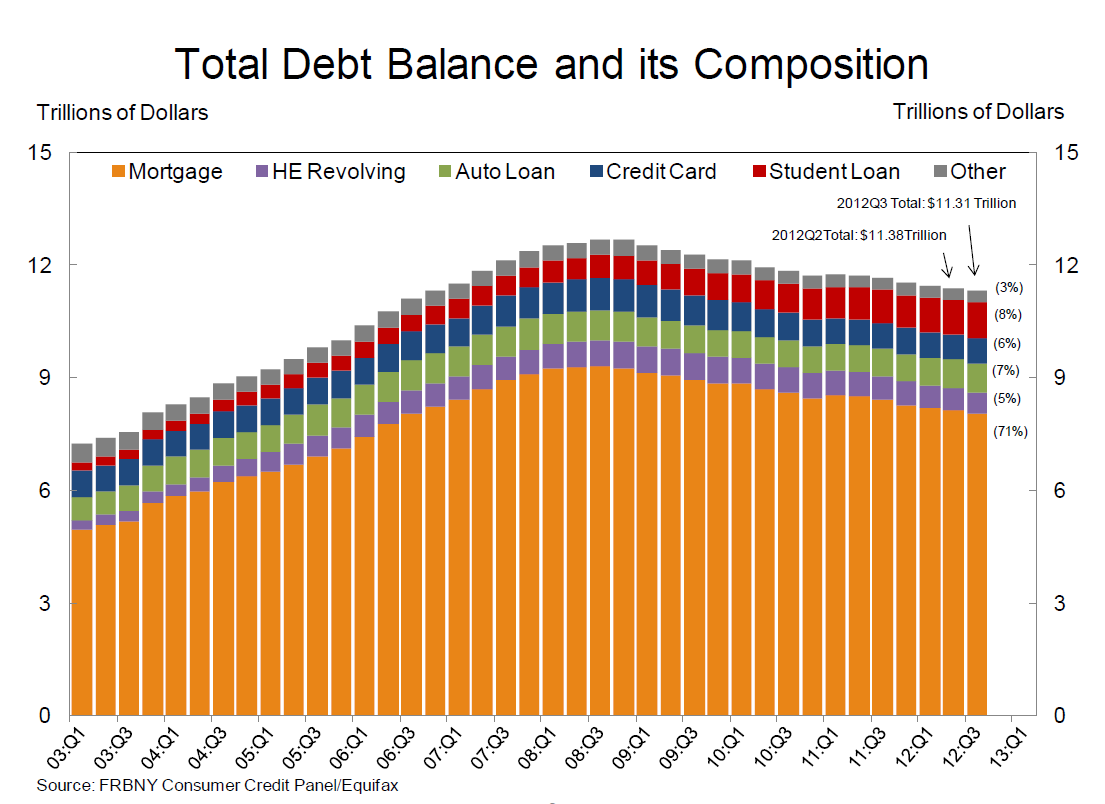
To Schiller’s point about people not yet recovering from their economic situation, the NY Fed has a report out on the pace of consumer de-leveraging. Aggregate consumer debt fell by .7% YOY to 11.31 trillion, which is down 11% from the peak in Q308. Still, the excesses of the housing bubble have yet to be worked off.  That said, debt service payments are at multi-decade lows, due to lower interest rates.  If you are wondering why the Fed is keeping interest rates so low for so long, this is why.  Inflation is a debtor’s best friend, and that is why the Fed is so sanguine about inflation.

Chart:  Debt balance and composition:
For what it is worth, I do not share Schiller’s caution.  I am bullish on residential real estate and think it will be the best performing asset in the US next year.

The Washington Post picked up on the Brown-Forman special dividend.  Expect companies with excess cash to distribute it to shareholders before taxes go up next year. 

Investor’s Business Daily has a good write-up on how HUD and the GSEs helped inflate the housing bubble through affordable housing goals.  They include a very interesting chart showing homeownership rates and different policy actions:  Given that the interpretation of what went wrong has fallen completely along partisan lines, this piece of the puzzle has yet to be officially examined. And explains why Franklin Raines (who ran Fannie Mae in the early 00s and instituted the American Dream Commitment) has escaped prosecution despite presiding over an accounting fraud that rivaled Enron.


Morning Report 11/27/12

Vital Statistics:

  Last Change Percent
S&P Futures  1403.2 -0.1 -0.01%
Eurostoxx Index 2549.8 7.3 0.29%
Oil (WTI) 87.92 0.2 0.21%
LIBOR 0.312 0.000 0.00%
US Dollar Index (DXY) 80.28 0.033 0.04%
10 Year Govt Bond Yield 1.67% 0.01%  
RPX Composite Real Estate Index 190.8 -0.3  

Markets are flat this morning after a better than expected durable goods report. The Commerce Department said no companies reported disruption from Hurricane Sandy, although I wonder how much of the orders were caused by Sandy (generators, for example).  Bonds and MBS are flat

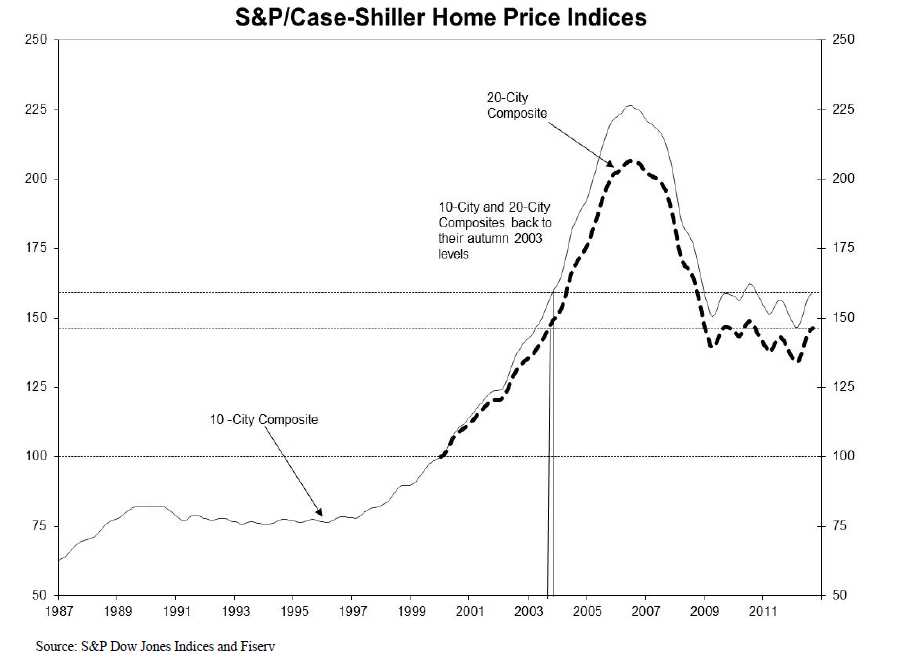
The Case-Schiller index rose 3.6% YOY, and is now sitting where prices were in Autumn of 2003. We will get the FHFA Home Price Index later today. 


Mary Schapiro has stepped down from the head of the SEC. Elise Walter, one of the Democratic Commissioners has stepped in to take her place.  The criticism of her performance largely centered around the view that she was too lenient with Wall Street. The Walter appointment has the feeling of an interim appointment.  In the meantime, the panel will be evenly split between Democrats and Republicans, which means that enacting controversial new regulations will be almost impossible, especially those regarding prop trading and money-market funds.  That said, my gut tells me that a more aggressive SEC is on the way.  Batten down the hatches.

Brown Forman, the liquor manufacturer, has announced a special dividend, as a way to return capital to shareholders prior to an expected hike in dividend taxes. Expect to see more of this. The stock is up 5%.

CNN discusses the political realities of the mortgage interest deduction.

Fannie Mae discusses the fact that many borrowers don’t get competing rates when shopping for a mortgage.

Morning Report 11/26/12

Vital Statistics:

  Last Change Percent
S&P Futures  1398.6 -6.7 -0.48%
Eurostoxx Index 2541.1 -15.9 -0.62%
Oil (WTI) 87.88 -0.4 -0.45%
LIBOR 0.312 0.000 0.00%
US Dollar Index (DXY) 80.24 0.052 0.06%
10 Year Govt Bond Yield 1.65% -0.04%  
RPX Composite Real Estate Index 190.8 -0.3  

Markets are lower after last week’s furious rally. Friday’s rally took the S&P 500.  Friday was a shortened low-volume day, so take the result with a grain of salt. Today feels a bit like a “risk off” day with bonds and MBS rallying.

The Chicago Fed National Activity Index slowed in October, and has been consistently saying the economy is running at below-trend for 8 months in a row. Put an asterisk next to this one, though – Lower industrial production was the main driver of the index and that was affected by Hurricane Sandy.

The initial read on holiday sales looks promising – weekend and Black Friday sales were up 13% over last year.  The National Retail Federation is forecasting a 4.1% rise in holiday sales this year, with the caveat that the fiscal cliff is the wildcard. The consumer confidence numbers lately have been reasonably strong. Of course, even if you have a benign resolution to the fiscal cliff, the posturing and finger-pointing prior to the deal may depress consumer spending anyway, especially if we have a similar dynamic to the debt ceiling crisis of 2011.  

One reason for the increased consumer spending? HELOCs are back. The Mortgage Bankers Association is estimating house prices will gain 8% this year and increased equity means more spending.  Of course the banks still have yet to write off all of their worthless 2nd liens from the first go around.

The status of the fiscal cliff seems to be increase rates vs limit deductions.  Susan Collins is proposing some sort of carve-out for small businesses.  Raising the eligibility age for Medicare seems to have some bipartisan support as well.  Perhaps an increase in the top rate to something less than 39.6% and some limits on deductions will carry the day.  

As part of the backdrop for Euro debt fears, watch closely what is happening in Argentina. Dissident investors from the last debt restructuring (including my old firm Elliott Management) sued to block Argentina from paying anyone until their claims are satisfied. The case is going through the appeals process.  Unlike the Greek situation, Argentina has the money to pay their creditors – they just don’t want to. High commodity prices are helping their economy. If Argentina chooses to simply default and not pay anyone, the risk-off trade could come back in a hurry.  

Morning Report 11/21/12

Vital Statistics:

  Last Change Percent
S&P Futures  1387.4 1.1 0.08%
Eurostoxx Index 2513.7 4.1 0.16%
Oil (WTI) 87.83 1.1 1.24%
LIBOR 0.312 0.001 0.32%
US Dollar Index (DXY) 81.03 0.070 0.09%
10 Year Govt Bond Yield 1.67% 0.00%  
RPX Composite Real Estate Index 191 -0.4  

Markets are flattish this morning after a earning miss from Deere and Greek debt negotiation efforts hit a snag.  Expect low volume today as investors pack up and head to Grandma’s. Bonds are and MBS are down small.

Initial Jobless Claims came in at 410k.  Like last week, this is a Sandy-affected number and should be viewed accordingly. Mortgage applications fell 2.2%. University of Michigan Consumer Confidence dropped, and the index of leading economic indicators increased .2%.  Rising real estate prices are the driver of this.

Here are the highlights of the HUD report to Congress.  Aside from telling us what we already know (FHA is in deep trouble), there are also changes to the mortgage insurance program.  Insurance rates on FHA loans are going up, and borrowers will soon be charged mortgage insurance for the entire life of the loan, not just they typical 10-year period  L.Os take note – here is a good argument to get those borrowers off the fence – start the process now and get in under with wire.

Looks like the Feds are closing in on Stevie Cohen.  His healthcare PM allegedly made a quarter of a billion shorting Elan and Wyeth.  SAC Capital pays the highest commissions on the Street, by far.  They aren’t doing it out of the kindness of their hearts. Of course his investors don’t care – they know he is trading on inside information, but they are protected because they are limited partners. 

Two arguments about the proper size of government and its effect on prosperity.

The negotiation between the baker’s union and Hostess didn’t last long.  Hostess is headed for liquidation.

Have a happy Thanksgiving.

Morning Report 11/20/12

Vital Statistics:

 
  Last Change Percent
S&P Futures  1381.7 -0.8 -0.06%
Eurostoxx Index 2487.6 -7.6 -0.30%
Oil (WTI) 88.79 -0.5 -0.55%
LIBOR 0.311 -0.001 -0.32%
US Dollar Index (DXY) 80.92 0.050 0.06%
10 Year Govt Bond Yield 1.62% 0.01%  
RPX Composite Real Estate Index 191.4 0.0  
Futures are lower this morning after Hewlett Packard announced accounting problems at its Autonomy unit. The company has taken an $8.8 billion charge on the Autonomy unit, which is shocking when you consider it only paid $7 billion for the company in the first place. Best Buy also missed. Bonds are down slightly, while MBS are flat.
 
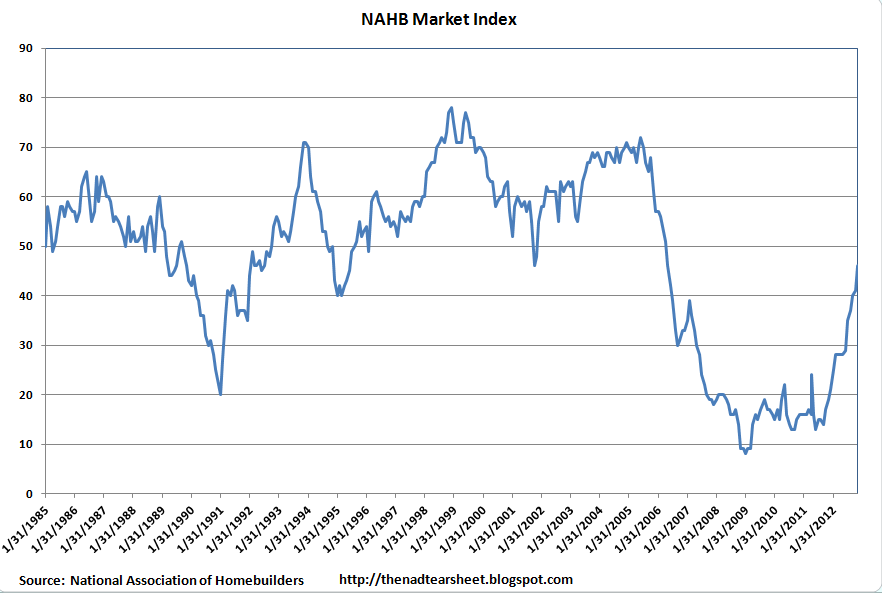
Housing starts rose to an annualized pace of 894k, well ahead of the 840k estimate.  Sep through July numbers were revised downward. While the rest of the economy seems to be turning down, housing is turning into a bright spot. That said, 894k is still far away from “normalcy,” which is 1.5 million units per year. Yesterday’s builder confidence index from the NAHB posted another gain, although it is still reflects “unfavorable” conditions, but just barely.
 
Chart:  Housing Starts


Chart:  NAHB Sentiment Index:


The Bernank is speaking at the Economic Club of NY this afternoon. The market will be looking for clues regarding life after Operation Twist.  Expect Bernake to warn Washington that it won’t be able to offset the damage to the economy if we go over the fiscal cliff. 
 
Hostess and the Baker’s union have been asked to enter mediation.  This is a last-ditch attempt to see if the company can continue as a going concern.  One of the biggest issues is the defined benefit pension plan.  In an environment of zero percent interest rates, most, if not all, pension plans will be insolvent as there is no way to earn enough on the assets of the plan to cover healthcare inflation costs. Of course many companies choose to assume unrealistic rates of return on plan assets or unrealistic cost inflation assumptions to make the plans solvent.  By the way, this phenomenon affects insurance companies as well.  One of the (many) unintended consequences of ZIRP.
 
The recent downturn in the markets has brought out the perma-bears.  Marc Faber and Nouriel Roubini are warning about a tough 2013. Morgan Stanley is also warning of a recession in 2013 if we go over the fiscal cliff.  Even if we don’t they are forecasting flat GDP growth next year. That said, after this sell-off, I would be aware of the potential for a face-melting rally if we get a deal on the fiscal cliff. For those who focus on technicals, the S&P 500 is right at the 200 day moving average.
 
One possible piece of a deal would be a cap on deductions – one current number being bandied about is $35,000.  Needless to say, this will have a negative effect on the high end of the housing market, especially in high cost areas like Coastal California and the NYC area. Moody’s estimates that this could cut national home price growth from 4% to 3.5% from 2015 to 2019.  

Morning Report 11/19/12

Vital Statistics:


Last

Change

Percent

S&P Futures 

1368.0

8.2

0.60%

Eurostoxx Index

2461.2

33.8

1.39%

Oil (WTI)

88

1.1

1.24%

LIBOR

0.312

0.000

0.00%

US Dollar Index (DXY)

81.06

-0.193

-0.24%

10 Year Govt Bond Yield

1.61%

0.03%


RPX Composite Real Estate Index

191.4

-0.4


Stocks are higher this morning on optimism the fiscal cliff can be averted.  The new buzzword in Washington is “constructive” The pattern lately has been a strong opening, and then a late-day sell-off. This is a holiday-shortened week, so you can expect lower volumes and not much activity.  We have a sparse economic calendar as well.  Bonds and MBS are down.

Even if we reach a deal with the fiscal cliff, taxes are going up next year.  Hurricane Sandy has been expected to lop a point or so off of 4Q GDP.  Between the two, we are probably looking at a flat-to slight GDP growth in Q113.  To add insult to injury, businesses are halting capital expenditures. While “constructive” is the operative word for Washington, “Uncertainty’ is the buzzword for business. While it is certainly possible that a deal in Washington will remove the uncertainty, it feels like the business will simply find something else to fret about. The stock market is telling you that as well.  FWIW, Elmer Fudd is sanguine about the whole thing, saying a recession is a small price to pay to get our fiscal house in order.

HUD has announced some changes to help FHA get through its rough patch – the punch line is that FHA loans are about to get more expensive.  Fun fact:  FHA loans were about 2% of the market pre-boom.  Now they are 40%. The biggest changes involving borrowers will be an increase in the insurance premium, and removing the insurance cancellation program.

Redwood sold another $300 million of high quality jumbos last week, their sixth this year.  Two Harbors apparently is close to a securitization as well.  In the past two years, Redwood has securitized $900 million of jumbo mortgages.  To put that in perspective, in 2005 and 2006, private label issuance was $1.2 trillion. That said, the private label securitization market is coming back, slowly but surely.

Leave it to Paul Krugman to link Twinkies and marginal tax rates.

Morning Report 11/15/12

Vital Statistics:

  Last Change Percent
S&P Futures  1352.6 -0.4 -0.03%
Eurostoxx Index 2456.5 -16.3 -0.66%
Oil (WTI) 86.54 0.2 0.25%
LIBOR 0.311 0.001 0.32%
US Dollar Index (DXY) 81.17 0.118 0.15%
10 Year Govt Bond Yield 1.61% 0.02%  
RPX Composite Real Estate Index 192 -0.4  

Markets are flat this morning after yesterday’s bloodbath in the S&P and Wal Mart’s miss, which is a negative sign for the economy. Inflation at the consumer level remained in the Fed’s comfort range, while initial jobless claims jumped to 439k.  This is heavily influenced by Sandy, so don’t read too much into it. The NY Fed’s Empire Manufacturing Survey was negative, but better than expected and higher than the previous month.s  The Eurozone officially entered a recession.  Bonds are down small while MBS are flat.

The Bernank is speaking on Housing and Financial Markets at 1:20 est today.

Freddie Mac discusses housing starts in its November 2012 US Economic and Housing Market Outlook.  

The FOMC minutes released yesterday showed the Fed is moving in the direction of providing explicit economic guideposts for monetary policy.  In other words, once unemployment drops to X%, we end QE. While they also expressed concern that the scheduled completion of Operation Twist may impact the economy, they did not announce a Treasury buying program.  The market does expect one, though. 

A House report on MF Global basically characterizes Jon Corzine as the “de facto chief trader” and blames his trades for the firm’s collapse.  The Democrats on the panel refused to endorse the report, basically proving (yet again) that the financial is political. 

The Washington Post has a good backgrounder on the shale gas revolution.  This has the potential to be a real long-term elixir for the economy.

Morning Report 11/14/12

Vital Statistics:

  Last Change Percent
S&P Futures  1375.3 4.4 0.32%
Eurostoxx Index 2484.9 -8.2 -0.33%
Oil (WTI) 85.16 -0.2 -0.26%
LIBOR 0.31 0.000 0.00%
US Dollar Index (DXY) 81.07 -0.017 -0.02%
10 Year Govt Bond Yield 1.62% 0.02%  
RPX Composite Real Estate Index 192.4 -0.5  

Markets are higher this morning after a good earnings report out of Cisco and a benign reading on wholesale-level inflation.  Shades of the late 90s. Retail sales disappointed, but they were affected by Sandy so the market is dismissing the numbers. Later today, we will get the minutes of the FOMC meeting. 

Speaking of Sandy, she may become the excuse du jour for companies that miss their quarter.  Be advised.

Obama has put out his plan for the fiscal cliff.  It raises double the amount of revenue that was proposed during the deal with Boehner two years ago and involves more than simply letting rates go up for those making over $250k – it includes limitations on deductions and a surtax for incomes over $1 million.  Geithner has dismissed the Republican plan to leave rates the same and cap deductions.  So that is the bid / ask spread at the moment.  

I have heard recent estimates that if we go over the fiscal cliff completely, the economy will contract 1% in Q1.  If we raise taxes on the rich, we will have GDP around 1%, but that number was based on the going back to the old rates, not the additional stuff.  So it would probably be lower. Sounds like flat GDP in early 2013 is a possibility. The FOMC today may provide further guidance re Treasury purchases.  I would not want to be leaning short Treasuries at the moment.

Blackstone sees a two year window to buy foreclosed properties at a discount. They forecast the median existing home price to increase 6% this year, 5% in 2013 and similar gains in 2014.  If homebuilding does not accelerate, they forecast even bigger gains. I keep coming back to the idea that the remaining shadow inventory is largely picked over, and some of it (foreclosures in Harrisburg, Detroit and Stockton) simply aren’t going to sell. Meanwhile, Buffet continues to be positive on housing and has been increasing his exposure. Ara Hovnanian isn’t as sanguine.

Freddie Mac reported that 29% of refis in 3Q involved a term shortening as people refi from a 30 year fixed to a 15 year fixed. During the quarter, the 30 year fixed rate averaged 3.55%, while the 15 year averaged 2.84%.

Will investors do the heavy lifting of ending TBTF? (too big to fail)  Trillium and AFSCME have sent a proposal to Citi encouraging them to split up.  While it is easy to dismiss this as based on politics (Trillium is representing the Benedictine Sisters and has a .01% stake, and AFSCME is a union), it is true that Citi (and others) are trading at a discount to their peers and are exhibiting the classic holding company discount. Could we see Citi spin off Salomon Brothers?  Bank of America spin off Merrill?  JPM spin off Chase? 

Morning Report 11/13/12

Vital Statistics:

  Last Change Percent
S&P Futures  1370.0 -8.2 -0.59%
Eurostoxx Index 2460.4 -13.1 -0.53%
Oil (WTI) 84.97 -0.6 -0.70%
LIBOR 0.31 0.000 0.00%
US Dollar Index (DXY) 81.2 0.166 0.20%
10 Year Govt Bond Yield 1.59% -0.01%  
RPX Composite Real Estate Index 192.8 0.3  

Markets are weaker this morning on Greek worries and a negative earnings report out of Weatherford. Bonds are up 1/2 a point and MBS are flat.

The NFIB Small Business Optimism index gained .3 points.  Uncertainty reached a record high, although this is understandable given it was an October before an election. CAPEX remains in maintenance mode, and hiring is absolutely flat. Generally it was a glum report.

Now that we have the election behind us, we can pretty much safely say that it is safer to be more constructive on Treasuries.  The Fed will continue to do what it does, and taxes are going up at the end of the year.  Combine that with the fact that Obama’s re-election is a negative for energy and the financials, and we could be facing a weak Q113 as well. 

But is there a bright spot?  Ah yes, housing.  Jamie Dimon has some optimistic comments regarding housing in the WSJ.  He basically cites the same things I have been talking about – household formation, affordability and inventory.  He makes the statement that housing isn’t going to recover in the absence of a strong economy, which I am not so sure I agree with.  I think the low household formation numbers of the last 6 years are artificially depressed due to a lousy economy and have created pent-up demand.  Eventually, people get married, move out of Mom and Dad’s place, and boot out the roommates.  In other words, housing can improve in spite of the economy.  

Not only that, but think about this:  As part of obamacare, obama instituted a 3.8% surtax on investment income for people making over $250k.  In a tight rental market, landlords will undoubtedly attempt to pass that cost on to renters, making the rent vs buy decision even more of a no-brainer.  Credit availability remains a problem, though as Dimon notes. 

Wapo notes that the REO discount is starting to disappear.

AIG is looking to expand its balance sheet in the mortgage business.

Morning Report

Vital Statistics 

  Last Change Percent
S&P Futures  1380.2 4.5 0.33%
Eurostoxx Index 2477.4 -2.4 -0.10%
Oil (WTI) 85.55 -0.5 -0.60%
LIBOR 0.31 0.000 0.00%
US Dollar Index (DXY) 80.97 -0.055 -0.07%
10 Year Govt Bond Yield 1.61% 0.00%  
RPX Composite Real Estate Index 192.8 0.3  

Stock markets are higher this morning after last week’s post-election sell-off.  Bonds are closed for Veteran’s Day. The government also has the day off, so there are is no major economic news.

Post election, all eyes turn to the fiscal cliff.  There appears to be a growing consensus that we can leave rates unchanged for the top and limit deductions. Partisan posturing and political jockeying will make the markets a miserable place for the next couple of months.  Capital gains and dividends remain a wild card. The obamacare surtax will happen regardless, so financial income is taking a hit right off the bat.

The Basel III requirements scheduled to take effect on Jan 1 have been pushed back to some time in the future.  SIFMA and the MBA agree with the decision.

So how will the election affect the markets and real estate?  I suspect FHFA Chairman DeMarco will be out of a job, which will pave the way for principal reductions on F&F/Ginnie loans. If they don’t think this through, they could face a deluge of homeowners suddenly finding themselves “unable” to make their mortgage payment.

Geithner is out for obama II, and the favorite for replacement seems to be Jack Lew. Lew is a “middle of the road” candidate that has already been unanimously confirmed by the Senate in 2010 for the OMB job. 

If we go over the fiscal cliff, we will undoubtedly have a 1H recession, which could result in a 1.25% 10-year.  Which means the refi boom will continue to have legs.  If FHFA starts modding underwater loans to LTVs of 1.0, we should see some refi activity, especially in the FHA space.  That said, if CFPB doesn’t come out with a bright line definition of a QM, refinancing these folks may prove to be difficult.

Regarding a 1H recession, earnings this quarter were not great, and Sandy will probably lop 1% to 1.5% of of 4Q GDP.  Taxes are going up, so we should start handicapping a 1H recession. Will it affect housing?  My sense is no, the bottom is in, and the recession will be felt more in cap goods / the energy patch than in housing. JP Morgan downgraded CAT this morning based on the expected negative impact the election will have on energy and mining.