Morning Report – Here’s Janet 2/11/14

Vital Statistics:

Last Change Percent
S&P Futures 1797.6 2.9 0.16%
Eurostoxx Index 3055.4 22.8 0.75%
Oil (WTI) 100.2 0.1 0.15%
LIBOR 0.237 0.003 1.18%
US Dollar Index (DXY) 80.58 -0.067 -0.08%
10 Year Govt Bond Yield 2.70% 0.03%
Current Coupon Ginnie Mae TBA 106.1 -0.2
Current Coupon Fannie Mae TBA 105 -0.2
RPX Composite Real Estate Index 200.7 -0.2
BankRate 30 Year Fixed Rate Mortgage 4.24

Markets are flat on no real news. Bonds and MBS are down.

Janet Yellen will have her first sit-down with Congress today in her new role as Federal Reserve Chairman. The prepared remarks are here. Regarding monetary policy, she will more or less continue on the path that the Bernanke Fed started:

“Turning to monetary policy, let me emphasize that I expect a great deal of continuity in the FOMC’s approach to monetary policy. I served on the Committee as we formulated our current policy strategy and I strongly support that strategy, which is designed to fulfill the Federal Reserve’s statutory mandate of maximum employment and price stability.”

Other than that, the Fed expects the economy to improve moderately. Testimony begins at 10:00 am EST.
Separately, hawkish voting member Charles Plosser is speaking today as well.
The NFIB Small Business Optimism Report is out, and it shows sentiment increased slightly in January, although they note that inventories are too high – remember that the 4.1% Q4 GDP number was driven by inventory build. It looks like the demand for that inventory has yet to materialize. That said, optimism about future sales and hiring jumped, so perhaps businesses are seeing something (foot traffic, inquiries, etc) that has yet to percolate into the data. That said, 94.1 is still a depressed number (100 is more or less average), and government is driving a big part of that, with taxes as the #1 problem and government regulation as #2. Poor sales comes in at a distant third. Bill Dunkelberg is a limited government guy, so take his interpretation of the data with that in mind, but still it does speak to a bifurcation in the market, where the big S&P 500 names are doing fantastic and small businesses are struggling.

Morning Report – Takeaways from Friday’s jobs report 2/10/14

Vital Statistics:

Last Change Percent
S&P Futures 1789.8 -3.7 -0.21%
Eurostoxx Index 3036.5 -2.0 -0.07%
Oil (WTI) 99.6 -0.3 -0.28%
LIBOR 0.234 0.000 0.00%
US Dollar Index (DXY) 80.67 -0.019 -0.02%
10 Year Govt Bond Yield 2.69% 0.01%
Current Coupon Ginnie Mae TBA 106 0.1
Current Coupon Fannie Mae TBA 105 0.0
RPX Composite Real Estate Index 200.7 -0.2
BankRate 30 Year Fixed Rate Mortgage 4.24
Markets are flat without a lot of news out there. Bonds and MBS are flat. The market seems to have been unsurprised by the jobs report on Friday.
The Wall Street Journal did a nice piece on the takeaways from Friday’s jobs report. Punch line: January’s report was almost as disappointing as December, but you can’t blame the weather this time around.
Sometime today, the MBA will release delinquency and foreclosure data.
The CFPB is making data from the Home Mortgage Disclosure Act available on line. It is a way to compare fees and points charged to borrowers. It will also be used by regulators to determine which branches they want to hit. For lenders, it is a good way to gain insight into how you stack up in your geographic area.
Consumer Credit jumped in December, a potentially positive sign for the economy.

Morning Report – meh jobs report 2/7/14

Vital Statistics:

Last Change Percent
S&P Futures 1775.2 8.6 0.49%
Eurostoxx Index 3005.0 -5.8 -0.19%
Oil (WTI) 97.71 -0.1 -0.13%
LIBOR 0.234 -0.003 -1.27%
US Dollar Index (DXY) 80.71 -0.195 -0.24%
10 Year Govt Bond Yield 2.67% -0.03%
Current Coupon Ginnie Mae TBA 105.9 0.0
Current Coupon Fannie Mae TBA 105 0.4
RPX Composite Real Estate Index 200.7 -0.2
BankRate 30 Year Fixed Rate Mortgage 4.29
Markets are higher after a weak jobs report. Bonds and MBS are up.
Jobs report data dump
  • Payrolls + 113k vs +180k expected
  • Prior 2 month revision +34k
  • Unemployment rate 6.6% vs 6.7% expected
  • Hourly earnings + .2%, in line with expectations
  • Labor force participation rate 63%
Retailers cut back jobs after the holidays and government hiring fell. Construction added 48k jobs. Surprising to see weak payrolls in conjunction with a drop in the unemployment rate and a tick up in the participation rate, but it appears to have been driven by annual population adjustments out of Census. It is important to keep in mind that the Employment Situation report is a noisy report that is often very sensitive to modeling adjustments and revisions after the fact. It probably gets more attention than is warranted. This report seems more or less in line with what the Fed has been forecasting, so it shouldn’t have any effect on Fed policy re QE.
Sellers are returning for the Spring Selling season, which should help alleviate the inventory problem. At some point, we should see the pros getting itchy to ring the register as well. What does this mean? Probably (a) more purchase transactions with a mortgage, and (b) a moderation in home price appreciation. Remember, cash sales have been 40% to 50% of all purchase transactions lately, and that number has been historically closer to 20%. Cut the cash transactions in half, and the gettable business increases by 30% to 60%, even if the number of existing home sales doesn’t increase.
Immigration reform appears to be dead for the time being. The reason is that the right believes the WH would only enforce the parts of the law it likes based on the administration’s fast and loose way of handling obamacare.

Morning Report – Awaiting the jobs data 2/6/14

Vital Statistics:

Last Change Percent
S&P Futures 1748.2 4.2 0.24%
Eurostoxx Index 2975.3 12.8 0.43%
Oil (WTI) 98.62 1.2 1.27%
LIBOR 0.237 0.001 0.21%
US Dollar Index (DXY) 80.83 -0.203 -0.25%
10 Year Govt Bond Yield 2.68% 0.01%
Current Coupon Ginnie Mae TBA 105.9 0.0
Current Coupon Fannie Mae TBA 104.7 0.0
RPX Composite Real Estate Index 200.7 -0.2
BankRate 30 Year Fixed Rate Mortgage 4.26
Markets are up small this morning on overseas strength. Market darling TWTR is down 20% this morning after an earnings miss #bloodbath. Initial Jobless Claims came in at 331k, slightly below expectations.
Other economic data this morning – productivity rose 3.2%, while unit labor costs fell. Challenger, Gray, and Christmas reported announced job cuts increased 11.6% in January.
Regarding obamacare, we are now getting earnings announcements from the big health insurers who are considering pulling out of markets – Aetna and Humana both made such announcements.
Tomorrow we will get the January Jobs report and find out how many people are still liberated from working.The partisan spin war on that CBO report continues… One thing to watch for is a sharp sell-off in the bond market. Emerging markets woes have been on the back burner the past couple of days, which means the bond market could be setting up for a sharp sell off on a strong number. I would highly advise against floating right now.

Morning Report – Another Elmendorf special 2/5/14

Vital Statistics:

Last Change Percent
S&P Futures 1742.0 -1.7 -0.10%
Eurostoxx Index 2968.5 6.1 0.20%
Oil (WTI) 97.58 0.4 0.40%
LIBOR 0.236 0.000 -0.04%
US Dollar Index (DXY) 81.15 0.024 0.03%
10 Year Govt Bond Yield 2.64% 0.01%
Current Coupon Ginnie Mae TBA 106.1 0.0
Current Coupon Fannie Mae TBA 104.8 0.0
RPX Composite Real Estate Index 200.7 -0.2
BankRate 30 Year Fixed Rate Mortgage 4.24
Markets are flattish this morning after the ADP Employment Report forecast that 175,000 jobs were created in January. Bonds and MBS are flat. Markets might be a little thin today as the Northeast is snowed in once again.
The ADP report suggests a “meh” number for this Friday’s jobs report, although the ADP report has been a lousy predictor of the BLS numbers lately – last month, ADP forecast 238k jobs and the BLS number came in at 87K. So take this number with a grain of salt. Given what we know about the Fed’s intentions regarding tapering, it would take an extraordinary number on either side to change the Fed’s glidepath.
Mortgage Applications rose .4% last week, which is actually a pretty dismal number when you think about it – mortgage rates fell 7 basis points last week and we had an easy comparison given the MLK holiday the week before. Purchase apps were down 3.8%, while refis were up 2.8%. That said, this is a seasonally weak time, so it is hard to read too much into it, but there it is. FWIW, the homebuilders that have reported fourth quarter earnings so far noted strong traffic in January, which is an encouraging sign.
In the partisan spin wars about obamacare, the CBO launched a new toy to tussle over, with a study showing that obamacare would cost the economy about 2 million jobs. Republicans cited the study, saying that it confirmed what we knew all along, that obamacare would be a job killer. When you look at what CBO actually said, however, it they concluded that the job losses would comhe from people voluntarily leaving the work force, not employers cutting hours / jobs. In fact, CBO said the job losses attributable to employers cutting jobs was so small they didn’t bother to measure it. Obviously Elmendorf (head of the CBO) hasn’t been checking out the reports put out by the regional Federal Reserve banks, or the NFIB small business surveys, which document actual hiring plans from actual businesses and instead is relying on some sort of model to predict what will happen.
Regardless of how their model is specified, the CBO is in effect arguing that the laws of supply and demand are different in the labor market (which is an underlying assumption of most other left-wing labor policy). The normal supply / demand curve looks like this:  As prices increase, more supply comes out (which means if compensation increases, more people want to work) and demand decreases ( which means businesses will want to cut costs / substitute labor for technology, etc) All pretty common-sense stuff. Anyone who has taken Econ 101 will recognize this chart:

However, CBO is making a different argument: Because of obamacare (which raises the price of labor through employer mandates, etc) people will drop out of the labor force more than they would otherwise.  In other words, as price increases, supply will decrease. If people are starting to make more, does anyone really think that would encourage people to quit working? And their second argument makes even less sense – that employers will ignore increased compensation costs and continue to hire as before. Anyone who has used a self-checkout at the supermarket knows that argument is bunk. The CBO is arguing that employer demand for labor is inelastic – meaning that no matter what the price of labor is, they will pay it. In other words, if prices increase, demand stays the same. That may be true of certain items (think life-saving drugs like insulin), but certainly not 99.9% of the goods out there, and certainly not labor. Heck, if that was the case, raise the minimum wage to a million dollars and we’ll all be rich! Essentially, CBO is arguing that the labor market looks like this:

I’ll leave it to the reader to figure out whether this makes sense or not.

This study, along with another Elmendorf special – that mass principal mods would save the government money – makes me wonder how partisan the supposedly non-partisan Elmendorf CBO is.

Morning Report – VIX is spiking again 2/4/14

Vital Statistics:

Last Change Percent
S&P Futures 1744.7 11.9 0.69%
Eurostoxx Index 2964.2 0.3 0.01%
Oil (WTI) 97.18 0.8 0.78%
LIBOR 0.236 0.001 0.36%
US Dollar Index (DXY) 81.11 0.103 0.13%
10 Year Govt Bond Yield 2.61% 0.04%
Current Coupon Ginnie Mae TBA 106.1 -0.3
Current Coupon Fannie Mae TBA 105 -0.1
RPX Composite Real Estate Index 200.7 -0.2
BankRate 30 Year Fixed Rate Mortgage 4.25
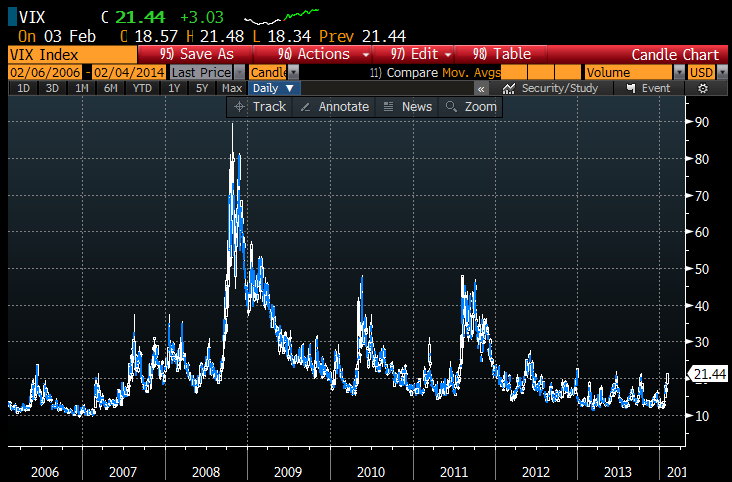
They take ’em away, they give ’em back. Volatility is back. Markets are higher this morning after yesterday’s bloodbath that sent the S&P 500 down 40 points. Overseas markets got slammed, particularly Japan, which is down 14.5% for the year already. Bonds and MBS are lower.
The VIX went out at 21.4. This is an indicator of financial pain and fear – as it rises, it should correlate positively with bonds – meaning if the VIX increases, rates will be falling. We are still nowhere near the spikes we saw in 2011 and 2010, let alone the late 2008 panic, but it is something to watch. The main thing to understand is that there are two forces acting on interest rates right now – 1) the Fed’s ending of QE, which is pushing rates higher, and 2) the sell-off in worldwide markets, which is causing the flight to safety trade which pushes rates lower. I would stress to your borrowers that all bets are off right now with interest rates. You could float and you might get lucky if someone blows up, or this could all blow over and we could be looking at 4.75% mortgage rates before you know it.

Speaking of interest rate bets, the largest mortgage REIT – American Capital Agency reported earnings yesterday. They had been deleveraging since last Spring, when they took their leverage ratio from 10x down to 7.2x. Last quarter they increased their exposure to the MBS market a tad, taking their leverage ratio up to 7.6x. The company had been seeing value in the MBS space. REITs are major players in the space and their activity influences mortgage rates, so their activity is something to watch. Given how much rates have fallen, this looks like a winning trade for them. That said, the sector is very much out of favor as the secular headwinds are going to be tough to manage.
Part of the reason for yesterday’s sell-off was an absolutely dismal ISM report. The ISM manufacturing report came in at 51.3, vs street expectations of 56. This shows a major deceleration in manufacturing in the month of January. Many reports – durable goods, for instance – showed a slowdown in December, which seems to have continued into the new year. Some of this could be weather-related, but investors are bracing for a lousy jobs report this Friday. Separately, construction spending rose .1% in January, which was better than expected.
The fireworks should start tomorrow with the ADP employment report, which is all honesty has been a terrible predictor of the employment report lately. We have another potential winter storm affecting the area as well, so tomorrow could be sloppy in more ways than one.

Morning Report – spring selling season begins early 02/03/14

Vital Statistics:

Last Change Percent
S&P Futures 1776.5 -0.1 -0.01%
Eurostoxx Index 3003.0 -11.0 -0.36%
Oil (WTI) 97.79 0.3 0.31%
LIBOR 0.236 -0.001 -0.42%
US Dollar Index (DXY) 81.22 -0.088 -0.11%
10 Year Govt Bond Yield 2.67% 0.03%
Current Coupon Ginnie Mae TBA 106 -0.1
Current Coupon Fannie Mae TBA 104.7 -0.1
RPX Composite Real Estate Index 200.7 -0.2
BankRate 30 Year Fixed Rate Mortgage 4.26
Markets are flat this morning on no real news. Bonds and MBS are down.
In spite of all the snow falling in the Northeast, the spring selling season more or less begins now. Last week, we heard from PulteGroup and D.R. Horton who both observed that traffic patterns were unusually strong in January, indicating the spring selling season has begun early. Regarding interest rates, both companies said the shock from higher rates appears to have worn off and buyers realize the low rates of a year ago aren’t coming back. Both companies target the first time homebuyer who still remains absent from the market, although the move-up buyer appears to be doing well.
Why is the first time homebuyer struggling? Student loan debt and a lousy job market are considerations. Also they are competing with professional investors for starter homes who are buying them to rent.
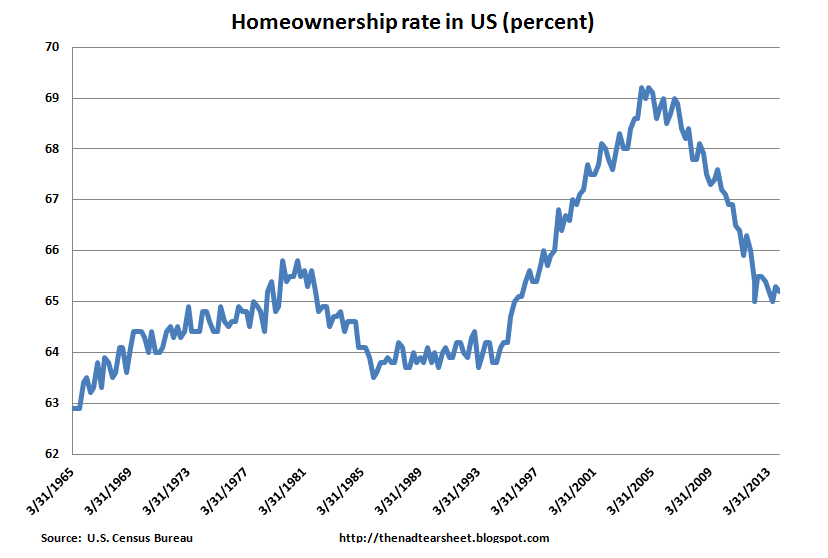
The Census Bureau reported that the homeownership rate fell to 65.2% at the end of the fourth quarter. The big excesses of the bubble years have been worked off.

Nonvoting San Francisco Fed Head John Williams said that the issues in the emerging markets aren’t changing the Fed’s forecast for the U.S. economy and that the FOMC doesn’t “focus too much on the short-term developments in the markets.” Take that to mean that emerging markets sell-offs aren’t going to affect Fed tapering, at least as long as credit availability remains unaffected.

Morning Report – Fannie and Fred will continue for a while 1/31/14

Vital Statistics:

Last Change Percent
S&P Futures 1761.9 -19.3 -1.08%
Eurostoxx Index 2974.7 -52.6 -1.74%
Oil (WTI) 97.39 -0.8 -0.86%
LIBOR 0.237 -0.001 -0.42%
US Dollar Index (DXY) 81.23 0.140 0.17%
10 Year Govt Bond Yield 2.65% -0.04%
Current Coupon Ginnie Mae TBA 106 0.1
Current Coupon Fannie Mae TBA 104.7 0.2
RPX Composite Real Estate Index 200.7 -0.2
BankRate 30 Year Fixed Rate Mortgage 4.31
They’re beating the tape with the ugly stick as emerging markets continue to get clobbered. Bonds and MBS are rallying, with the 10 year trading at 2.65%.
We had some mixed earnings reports, with good news out of Google, a miss out of Mastercard, and a warning from Wal Mart.
Personal income came in flat in December (versus a .2% forecast), while personal spending rose .4%. The savings rate dipped to 3.9%. As I have said before – this is how recessions end. Spending increases and then wages increase. The PCE deflator came in in at 1.1%, showing inflation remains a non-problem.
Squabbling among Senate Democrats probably means that nothing will get done about the GSEs this year. Left wing Democrats like Elizabeth Warren and Sherrod Brown will refuse to back any plan to re-organize the GSEs unless it guarantees affordable loans for most buyers. This means they want whatever entity that replaces Fannie and Fred to be more than simply a re-insurer of privately insured mortgages – they want to continue the social engineering role of the GSEs. Not all Democrats are onboard with this idea, let alone Republicans who rightly view government activism as a contributor to the housing bubble. The left would be more than happy to continue the status quo, with Mel Watt (a CRA guy) running the show.

Morning Report – 4Q GDP comes in at 3.2% 1/30/14

Vital Statistics:

Last Change Percent
S&P Futures 1780.7 9.5 0.54%
Eurostoxx Index 3010.3 -1.2 -0.04%
Oil (WTI) 97.75 0.4 0.40%
LIBOR 0.238 0.002 0.85%
US Dollar Index (DXY) 80.96 0.456 0.57%
10 Year Govt Bond Yield 2.71% 0.04%
Current Coupon Ginnie Mae TBA 105.8 -0.1
Current Coupon Fannie Mae TBA 104.4 -0.2
RPX Composite Real Estate Index 200.7 -0.2
BankRate 30 Year Fixed Rate Mortgage 4.31
Markets are higher this morning after 4Q GDP came in at +3.2%, as forecast by the Street. Facebook is up big on good earnings. Bonds and MBS are still digesting the FOMC meeting and are lower
The advance estimate of fourth quarter GDP came in at +3.2%. Consumption rose 3.3%, which was below the 3.7% estimate. The Commerce Department estimates that the shutdown took .3% off of the number. Finally, the inventory build that drove the large (4.1%) third quarter number wasn’t reversed in this reading.
The FOMC decided to reduce asset purchases by another $10 billion per month yesterday, which markets took in stride. The decision was unanimous, the first one the Bernank has had since 2011. Janet Yellen now takes the reins with more hawkish Committee. The Fed’s balance sheet will continue to grow, just slower than it did last month. The Fed’s balance sheet just passed 4 trillion (it was under 1 pre-crisis)

Pulte reported fourth quarter earnings, which beat expectations. Revenues were in line, but EPS beat by 12 cents. Gross margins expanded as the company raised prices – average selling prices jumped 13% to $325,000, while unit volume dropped by 4%. Orders are down 18%. The stock is up a buck (around 5%) pre-open.
December Pending Home Sales dropped dramatically (down 6.1% year-over-year and 8.7% month-over-month). The Street was forecasting a drop of .3%, so this was a big miss. November was revised down as well. This would comport with the big drop in mortgage applications we have seen.

Morning Report – What to watch for with the FOMC 1/29/14

Vital Statistics:

S&P Futures 1775.5 -18.0 -1.02%
Eurostoxx Index 3010.7 -27.9 -0.92%
Oil (WTI) 96.97 -0.4 -0.45%
LIBOR 0.236 -0.001 -0.21%
US Dollar Index (DXY) 80.71 0.137 0.17%
10 Year Govt Bond Yield 2.72% -0.03%
Current Coupon Ginnie Mae TBA 105.8 0.2
Current Coupon Fannie Mae TBA 104.5 0.3
RPX Composite Real Estate Index 200.7 -0.2
BankRate 30 Year Fixed Rate Mortgage 4.33
Markets are getting slammed this morning on weakness in Europe and emerging markets currencies. Bonds are rallying on the risk-off trade. We should hear from the Fed at 2:00.
The Street is predicting that the Fed will decrease asset purchases by 10 billion a month, equally split between MBS and Treasuries. I would be surprised if they mention the turmoil in emerging markets, and it probably won’t affect their thinking regarding QE unless credit begins to tighten. I don’t think anyone expected the Fed to stick the landing with regard to extricating themselves from the asset markets, so sell-offs like these should be expected.
The WSJ has a good write-up on what to look for in the statement today. It also looks at the new voting members that will accompany Janet Yellen. If anything the Federal Reserve Board will become slightly more hawkish, especially with the addition of Philly Fed President (and my ex faculty adviser) Charles Plosser and Dallas Fed Head Richard Fisher.
I don’t see emerging markets affecting the U.S economy all that much. That said, Canada’s real estate bubble is bigger than ours and is ripe to burst. Most mortgages in Canada are guaranteed by the government or by the Ontario Teachers Fund, so it won’t have the soft of fallout that 2008 had, but there could be still be some issues that could roil credit markets. Luckily for the Canadians, their government doesn’t view housing as an vehicle for social engineering.
Mortgage Applications fell .2% last week, which was a holiday-shortened week. A short week + a 6 basis point drop in rates = a wash. Purchases increased while refis fell.
There were 41,000 completed foreclosures in December, according to CoreLogic. This is a decrease of 4% month-over-month and 14% year-over-year. Approximately 847,000 homes were in some stage of foreclosure as of the end of the year, versus 1.2 million a year ago. The foreclosure inventory remains the highest in the judicial states.