Morning Report: Chances of a rate hike back to pre-Brexit levels 8/17/16

Vital Statistics:

Last Change
S&P Futures 2176.0 0.0
Eurostoxx Index 341.5 -1.9
Oil (WTI) 46.4 -0.2
US dollar index 85.8 0.2
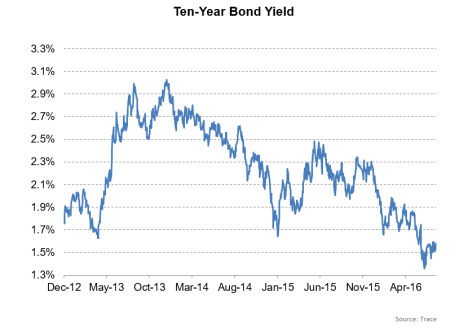
10 Year Govt Bond Yield 1.58%
Current Coupon Fannie Mae TBA 103.3
Current Coupon Ginnie Mae TBA 104.2
30 Year Fixed Rate Mortgage 3.52

Markets are flat this morning on no real news. Bonds and MBS are down small.

The FOMC minutes come out today at 2:00 pm EST. Be careful locking loans around then since we could see some volatility.

Mortgage Applications fell 4% last week as both purchases and refis fell by 4%.

Mohammed El Arian has a good piece on what to look for in the minutes. The main things to look for: labor (and what the Fed considers “full employment), productivity (and why we aren’t seeing it), inflation (and why we don’t see it), external threats (China slowdown, Brexit), and finally why ultra-low interest rates and QE aren’t achieving the desired result (the elephant in the room). Expect the Fed to prod the government to use fiscal policy to help stimulate the economy.

For those complaining that US fiscal policy has been in austerity mode, I would remind them that the biggest post WWII deficits as a percentage of GDP are (in order) 2009, 2010, 2011, 1983, 2012, 1946, 2013.

Yesterday, William Dudley suggested that a September rate hike is still on the table and the markets may be underestimating the chance of one. The Fed Funds futures market have now back to pre-Brexit levels in terms of predicting the probability of a rate hike this year.

The lack of inventory is going to get worse, as we aren’t building enough homes to keep up with population growth, let alone obsolescence. I keep saying this, but we should be hitting 2 million starts a year given the shortage and the need to house Millennials. This is the difference between 2% GDP and 3% GDP. Unfortunately, Washington seems to think the biggest problem is that we aren’t slugging the banks hard enough.

Morning Report: new normal 8/16/16

Vital Statistics:

Last Change
S&P Futures 2182.0 -4.0
Eurostoxx Index 343.7 -2.0
Oil (WTI) 45.9 0.2
US dollar index 85.6 -0.6
10 Year Govt Bond Yield 1.54%
Current Coupon Fannie Mae TBA 103.3
Current Coupon Ginnie Mae TBA 104.2
30 Year Fixed Rate Mortgage 3.45

Stocks are lower this morning on no real news. Bonds and MBS are mixed

Inflation at the consumer level continues to be well-contained. The consumer price index was flat month-over-month and is up 0.8% year-over year. Ex-food and energy it was up 0.1% MOM and 2.2% YOY. The biggest contributors to inflation were health care costs (up 4% YOY) and housing (up 2.4% YOY).

Housing starts were 1.211 million annualized in July, coming in higher than expected. The driver was multi-fam, which can be extremely volatile. Single fam continues to plug along. Building permits were more subdued, coming in at 1.15 million. Same situation in permits: multi-fam permits rose while single fam declined.

Industrial production increased 0.7% in July versus expectations of a 0.3% increase. Manufacturing production increased 0.5%. Capacity utilization increased to 75.9%. So some signs of life in the manufacturing sector after a dismal Spring and early summer.

An idea that is percolating at the Federal Reserve is the idea that this low productivity / low growth economy is a new normal, which implies a lower neutral interest rate. This in part explains why the Fed has been so reluctant to raise rates despite unemployment being at levels historically associated with full employment. One idea is that the Fed should either raise its inflation target or begin targeting nominal GDP. The big question is whether the PhD standard, which has pushed interest rates to the floor, is part of the reason why productivity and growth are so low. By creating a bubble in sovereign debt, you have a misallocation of resources (by definition – that is what bubbles are) and that could account for our disappointing growth and productivity. Certainly business capital expenditures remain low and focused on saving labor costs.

Meanwhile, William Dudley thinks the market may be too complacent about a September rate hike. The market has been calling the Fed’s bluff for over a year now.

Freddie Mac thinks 2016 could be the best year for mortgage origination since 2012, with total origination topping $2 trillion. The unexpected gift of lower rates is the reason why. For 2017, they are forecasting a drop back to $1.7 trillion as home price appreciation falters and interest rates rise, although rising rates shouldn’t be too bad given they are forecasting 2017 GDP growth to be below 2%. They anticipate the mortgage rate to increase 10 basis points to 3.7%.

Morning Report: foreign investors investing in MBS again 8/15/16

Vital Statistics:

Last Change
S&P Futures 2185.0 5.0
Eurostoxx Index 346.5 0.4
Oil (WTI) 44.8 0.3
US dollar index 86.3 -0.2
10 Year Govt Bond Yield 1.54%
Current Coupon Fannie Mae TBA 103.3
Current Coupon Ginnie Mae TBA 104.2
30 Year Fixed Rate Mortgage 3.52

Markets are higher this morning as emerging markets rally. Bonds and MBS are down

We will get a lot of data this week with housing starts and the FOMC minutes on Wednesday. The minutes are probably the most likely event to affect bonds. Earnings season is largely over except for the retailers.

The Empire State Manufacturing Survey fell in August, according to the NY Fed. New orders were flat. Employment contracted.The 6 month outlook dimmed as well.

Foreign investors are beginning to wade into TBAs again as sovereign debt yields continue to offer nothing. Ginnie Mae TBAs stand to benefit the most, which means FHA and VA pricing should improve relative to Fannie Mae pricing. The next event to watch from the Fed will be their own TBA purchasing. The Fed is still re-investing maturing proceeds of their MBS portfolio back into the market. Part of policy normalization will involve ending this practice.

Friday’s weak retail sales data caused some strategists to take down their Q3 GDP numbers from the mid 2% to the low 2% range.

Homebuilder sentiment improved in August to 60 from 58. We are entering the seasonal slowdown for the builders, which coincides with football season.

Morning Report: Delinquencies hit a 10 year low 8/12/16

Vital Statistics:

Last Change
S&P Futures 2180.0 10.0
Eurostoxx Index 346.0 -1.2
Oil (WTI) 43.7 0.1
US dollar index 86.1 -0.2
10 Year Govt Bond Yield 1.49%
Current Coupon Fannie Mae TBA 103.3
Current Coupon Ginnie Mae TBA 104.2
30 Year Fixed Rate Mortgage 3.52


Stocks are higher this morning on strong economic news out of Europe. Bonds and MBS are up.
Retail Sales were flat in July. Ex-autos and gas they were down. Basically autos and ecommerce did okay, and everything else was lousy. Speaking of lousy, we are getting retailer earnings and for the most part they are disappointing.
Inflation at the wholesale level is nowhere to be found, with the producer price index falling .4% in July versus expectations of a .1% increase. The core PPI was up .8% YOY.
Business inventories barely moved in July, increasing by 0.2%.
Consumer sentiment came in lower than expected as well.
The National Association of Federal Credit Unions blames high prices and tight regulation for the lack of housing that people in the middle class can afford.
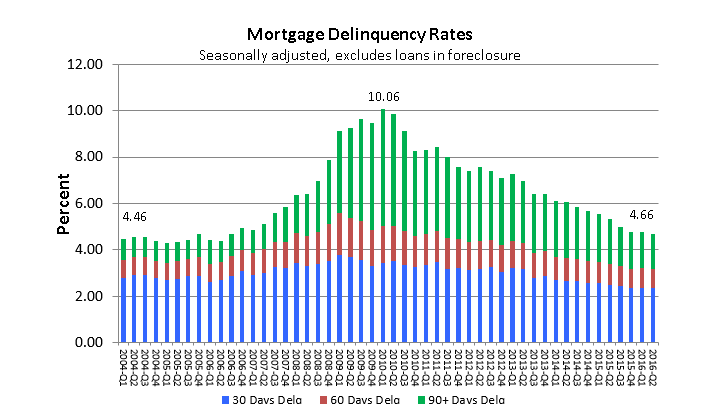
Delinquency rates hit a 10 year low in the second quarter according to the MBA. The number of homes in foreclosure hit 1.64%, down 10 basis points from the first quarter and 40 basis points from a year ago. VA loans are performing the best, while FHA are performing the worst.

Partisan conflict is the highest since 1984, according to the Philly Fed. This conflict supposedly suppresses economic growth.

Morning Report: Bond trading is becoming more like commodity trading 8/11/16

Vital Statistics:

Last Change
S&P Futures 2177.0 58.0
Eurostoxx Index 345.0 4.0
Oil (WTI) 41.6 -0.2
US dollar index 86.0 -0.2
10 Year Govt Bond Yield 1.51%
Current Coupon Fannie Mae TBA 103.8
Current Coupon Ginnie Mae TBA 105.2
30 Year Fixed Rate Mortgage 3.52

Markets are flattish this morning on no real news. Bonds and MBS are flat as well.

Slow news day (again)

Initial Jobless claims dipped ever so slightly to 266k last week.

Import prices rose 0.1% month-over-month, but are down 3.7% on an annual basis. Inflation remains in a deep freeze.

Housing has historically been the vehicle people use to build wealth. For most people, it is their biggest assets. Home prices have been rising since bottoming in 2012, but aspiring homeowners have been shut out as the homeownership rate hits levels not seen since the 1970s. For young Millennials with student loan debt and difficult job prospects, home price increases have made the dream of homeownership further out of reach. Meanwhile, rental inflation (driven by the same scarcity issues that are driving home price appreciation) mean that rent accounts for a bigger and bigger percentage of disposable income.

The homeownership rate fell to 62.9% in the second quarter, which is a 51 year low. You can see the big jump in homeownership that started in the mid 90s has been reversed. That jump in homeownership was a function of Bill Clinton’s social engineering via the housing market and the development of a securitization market. Tight credit post-financial crisis remains an issue as well, as the US taxpayer bears the credit risk for 90% of all origination. If a loan doesn’t fit into the government / conforming box, it likely isn’t getting done.

Homeownership Rate BBG

That said, this does represent pent-up demand that will be unleashed at some point, and with housing starts still well below historical averages, could provide a massive boost to the economy once it turns around. Don’t forget the Millennial generation is bigger than the baby boomers. Amidst the gloom however, is evidence that the Millennials are finally buying.

Interesting observation, and spot-on: Negative interest rates have made bond investing similar to commodity investing. As Warren Buffett would say that with commodities you are simply betting on what someone else might pay for them at some future moment. Commodities cost money to hold (because storage isn’t free) and now bonds with negative yields exhibit the same characteristics. The only way to make money in bonds has been to find a greater fool to sell to. If this causes volatility to spike (which in theory it should), then that will have major effects on mortgage rates and pipeline hedging.

Morning Report: Job openings flat 8/10/16

Vital Statistics:

Last Change
S&P Futures 2180.0 3.0
Eurostoxx Index 344.3 4.0
Oil (WTI) 42.6 -0.2
US dollar index 86.0 -0.2
10 Year Govt Bond Yield 1.51%
Current Coupon Fannie Mae TBA 103.8
Current Coupon Ginnie Mae TBA 105.2
30 Year Fixed Rate Mortgage 3.52

Markets are up this morning on no real news. Bonds and MBS are rallying

Bond markets worldwide are rallying after the Bank of England tried to buy Gilts as part of its QE program and had a tough time finding sellers.

Mortgage applications rose 7% last week as purchases rose 3% and refis rose 10%.

Job openings were unchanged in June, at 5.6 million. The quits rate at 2% was more or less unchanged. This number is the tell for a strengthening labor market.

The bond market has given back the losses from the strong payrolls report last Friday. The Fed Funds futures markets are pricing in a 45% chance of another rate hike this year. Meanwhile, global bond yields continue to fall, with the German Bund at -9 basis points.

Affordable starter homes are becoming scarce in many parts of the country. We are seeing bidding wars in the hotter markets. Low housing starts are playing a factor here, and government regulation is a big driver of that. Mandates that increase the cost of construction make starter homes too expensive for an entry-level income.

Technology is helping drive down realtor commissions, according to Redfin. Of course Redfin is talking its own book, however many sellers are foregoing the use of an agent, especially at the higher price points, which makes sense.

Morning Report: Productivity falls 8/9/16

Vital Statistics:

Last Change
S&P Futures 2177.0 1.0
Eurostoxx Index 342.8 1.0
Oil (WTI) 42.9 -0.2
US dollar index 86.9 -0.2
10 Year Govt Bond Yield 1.58%
Current Coupon Fannie Mae TBA 103.3
Current Coupon Ginnie Mae TBA 104.2
30 Year Fixed Rate Mortgage 3.5

Markets are flattish this morning on no real news. Bonds and MBS are flat

Small Business Optimism ticked up last month according to the NFIB. Sentiment remains well below its historical average. The interesting thing is that the inability to find quality workers rose to the #3 problem facing small business after taxes and government regulation. While small business is interested in hiring, they still have very little appetite for capital expenditures. Inflation at the small business level remains nowhere to be found, as small business cut prices on average last month.

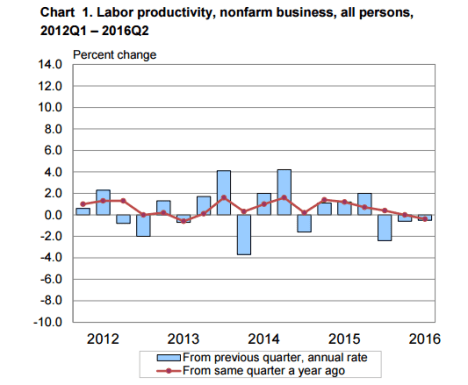
The lack of capital investment ties into another economic number this morning: productivity (or lack thereof). Nonfarm productivity fell .5% in the second quarter, making it the third negative quarter in a row. The Street was looking for a positive .5% reading so the number was a big miss. Productivity is also negative on a year-over-year basis.

Unit Labor costs rose 2% which was a little higher than expected. Comp costs were up 1.5% and productivity losses added another 50 bps.

Productivity growth is what increases standards of living, which is why a lack of it makes people feel like the recovery is so weak. Part of the explanation is found in the NFIB report – no capital expenditures. Productivity is tough to measure these days, with so much free technology. You know GoToMeeting increases productivity, yet it won’t show up in the output numbers because no one pays for it. Same thing with Skype, LinkedIn, etc. While academia suspects there is a problem with the way we measure productivity, no one has found a good way to correct for it.

productivity - bls.PNG

Completed foreclosures came in at 38,000 in June, a 4% increase from May and a 5% drop year over year. The national foreclosures inventory stands at 375k homes, which is down 26% from a year ago. The number of mortgages seriously delinquent fell 21% YOY to 2.8%, or about 1.1 million homes. The big judicial states like New York and New Jersey lead the pack in foreclosure inventory.

FHFA says that Fannie Mae and Freddie Mac could require as much as $126 billion in the next housing crisis. Separately, Fannie’s home purchase sentiment index hit a new high, albeit it is a relatively new index.

Wells is saying that the expiration of HARP at the end of the year. Does this mean a dramatic drop in prepay speeds? Not necessarily, in that HARP will probably be replaced with a high LTV refi program.

Morning Report: DJT lays out his financial vision 8/8/16

Vital Statistics:

Last Change
S&P Futures 2179.0 3.0
Eurostoxx Index 351.5 0.5
Oil (WTI) 42.6 0.8
US dollar index 87.0 -0.2
10 Year Govt Bond Yield 1.60%
Current Coupon Fannie Mae TBA 103.3
Current Coupon Ginnie Mae TBA 104.2
30 Year Fixed Rate Mortgage 3.5

Markets are flattish on no real news. Bonds and MBS are down.

There isn’t much in the way of economic data this week – the week after the jobs report is invariably data-light. There will be no Fed-speak either.

TIAA agreed to buy EverBank Financial for about $2.5 billion.

3 month LIBOR hit 81 basis points this morning, which is the highest since May 2009. This will affect ARM pricing.

While US Treasuries have some of the highest yields in the world, foreign investors who want to hedge their currency risk are buying them for a negative yield. New money market rules will go into effect this fall, which will change the landscape for banks. Expect tightened credit conditions.

Donald Trump will lay out his vision for financial regulation today with a speech in Detroit. He proposes a moratorium on new financial regulations, a repeal of Dodd-Frank, eliminating the estate tax, dropping the corporate income tax to 15%, creating 3 tax brackets for individuals, and making bureaucrats in DC more focused on creating jobs.

The CFPB updated their mortgage servicing regulations.

The July Fed Labor Market Conditions index rose by a point in July.

Morning Report: Strong jobs report 8/5/16

Vital Statistics:

Last Change
S&P Futures 2179.0 14.0
Eurostoxx Index 341.0 3.0
Oil (WTI) 41.3 -0.6
US dollar index 87.0 -0.2
10 Year Govt Bond Yield 1.56%
Current Coupon Fannie Mae TBA 103.3
Current Coupon Ginnie Mae TBA 104.2
30 Year Fixed Rate Mortgage 3.52

Markets are higher after a stronger than expected jobs report. Bonds and MBS are down.

Jobs report data dump:

  • Nonfarm payrolls +255,000
  • Unemployment rate 4.9%
  • Labor Force Participation rate 62.8%
  • Average hourly earnings +0.3% (2.6% YOY)

Overall, a good report. Not sure it moves the needle with the Fed in September, but it looks like May’s super-weak report was an aberration. The underemployment rate increased however, which suggests that the long-term unemployed may be coming back to the market, but they have to settle for part time jobs.

Bonds sold off on the report, with the 10 year yield up about 4 basis points, and the 2 year up 6.

Morning Report: The Bank of England cuts rates, sending Treasuries higher 8/4/16

Vital Statistics:

Last Change
S&P Futures 2160.0 3.0
Eurostoxx Index 336.9 1.0
Oil (WTI) 40.8 0.0
US dollar index 86.5 -0.5
10 Year Govt Bond Yield 1.51%
Current Coupon Fannie Mae TBA 103.3
Current Coupon Ginnie Mae TBA 104.2
30 Year Fixed Rate Mortgage 3.5

Stocks are higher this morning after the Bank of England cut rates and instituted QE. Bonds and MBS are up.

In response to Brexit, the Bank of England cut rates and introduced a bond-buying program for corporate and sovereign debt. This is causing global sovereigns to rally, and the German Bund is now trading at -7 basis points again. The US 10-year seems to correlate the most with the German Bund lately, so if it continues to rally, look for lower rates in the US.

Job cuts increased in July to 45,346, which is up 19% from last month, but is down 57% from a year ago. Military discharges and continued cuts in the energy sector drove the increase. Texas and California bore the brunt of the job cuts.

Initial Jobless Claims ticked up to 269k last week, however we have been below 300k for months, which is a very low level.

The Bloomberg Consumer Comfort index ticked up slightly last week to 43 from 42.9.

Factory Orders fell 1.5% from a downward-revised -1.2% in May. The manufacturing sector continues to exhibit a slowdown.

The ISM Services Index ticked down to 55.5 from 56.5 last month. The ISM Services index has been much stronger than the manufacturing index.

Nationstar reported better than expected earnings in the second quarter, although they took a big hit on their servicing portfolio. That said, while others are running from the servicing business, Nationstar is doubling down, and looks to build their business, with the addition of Seneca and USAA as clients. USAA had used Dovenmuhle in the past. Originations were up 24% QOQ and consumer direct accounted for 60% of the volume. Nationstar was up 12% for the day and is the highest in 9 months.

Mortgage REIT Annaly Capital reported a drop in book value per share as volatility hurt results. Given the widening of MBS spreads at the end of the second quarter, this is to be expected, although peer American Capital Agency did report a small increase. Annaly just completed its acquisition of Hatteras. Aside from the Fed, mortgage REITs are some of the biggest purchasers of mortgage backed securities, and can move around TBAs which influences mortgage rates, so it pays to keep tabs on how they are doing.

Separately, Fannie Mae reported a drop in net income.