Morning Report: Donald Trump makes a subtle but important change to financial regulation 2/9/17

Vital Statistics:

Last Change
S&P Futures 2295.3 2.3
Eurostoxx Index 363.7 0.9
Oil (WTI) 52.8 0.6
US dollar index 90.7 -0.1
10 Year Govt Bond Yield 2.36%
Current Coupon Fannie Mae TBA 102.1
Current Coupon Ginnie Mae TBA 103.2
30 Year Fixed Rate Mortgage 4.13

Stocks are up marginally on no real news. Bonds and MBS are down small.

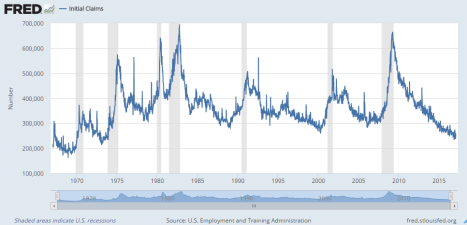
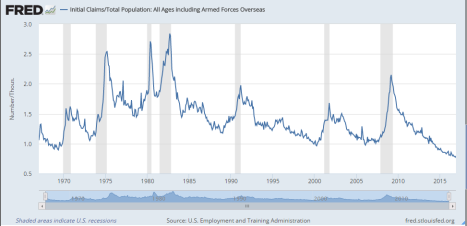
Initial Jobless Claims came in at 234k last week, which is the lowest number since November. Note that the last time initial jobless claims were this low, the Vietnam War was being fought. When you adjust for population growth, we are at record levels. Note that Census has been revising downward its previous estimates for population, as the net immigration numbers have turned out to be lower than initially thought.

Here is the chart for initial jobless claims:

initial-jobless-claims-fred

And now initial jobless claims divided by population (in .000s). Record low.

initial-jobless-claims-divided-by-population

We have some Fed-speak today with James Bullard this morning and Charles Evans in the afternoon. Probably won’t be market moving, but be aware.

The latest trend in banking? People-less branches. You walk in and deal with someone via videoconference. “This is the beginning of the end of the American bank branch,” said Peter Fitzgerald, a former U.S. senator from Illinois, lifelong banker and founder of Chain Bridge Bank in McLean, Va. “Bank branches are dead. They were killed by the iPhone. It’s like the horseshoe when the automobile came along.” Indeed, the iPhone is changing mortgage banking as well, as the Millennial Generation prefers to not interact with humans.

Once of the changes Donald Trump is making to financial regulation is subtle, but important. Typically regulators have to conduct a cost-benefit analysis of new regulations, in order to determine whether the proposed regulations do more harm than good. That requirement was largely ignored by the Obama administration. He is bringing that requirement back, which would require the government to take into account things like restrictions in credit, lost GDP from less lending, and the impact on consumers and financial choice. In fact, a study from Goldman found that low income borrowers and small businesses bore the greatest cost of financial regulation.

While regulation is couched in terms (and intention) to be about public protection, in practice it often acts as a barrier to entry which restricts competition rather than it is something that benefits the public. In fact, restricted credit is only of the big things that is an issue in housing construction. Big publicly-traded homebuilders can borrow all the money they want in the bond market at exceptionally low rates, while smaller builders (who are banked by the smaller guys) cannot borrow because the smaller banks are hamstrung by the regulators. Remember, we haven’t had a 1.5 million year in housing starts (which was normalcy from the sixties until the crisis) since 2006.

Morning Report: Mortgage Credit increases 2/8/17

Vital Statistics:

Last Change
S&P Futures 2285.3 -0.3
Eurostoxx Index 363.7 0.9
Oil (WTI) 51.8 -0.4
US dollar index 90.7 -0.1
10 Year Govt Bond Yield 2.36%
Current Coupon Fannie Mae TBA 102.1
Current Coupon Ginnie Mae TBA 103.2
30 Year Fixed Rate Mortgage 4.13

Stocks are flat this morning while bonds and MBS are up.

Mortgage applications rose 2.3% last week as purchases rose 2% and refis rose 2%. Refi activity slipped to 48% of total applications, the lowest since June 2009.

Jeb Hensarling, the Chairman of the US Financial Services Committee says that reforming Dodd-Frank is a “this year priority.” Congressional Republicans are planning to introduce legislation that will give banks relief from certain Dodd-Frank provisions if they increase their capital. He also called the CFPB a “rogue agency” and called for the President to fire CFPB Director Richard Cordray.

Given the structure of the CFPB, firing Cordray is going to be difficult, however there supposedly is a way. The DC Circuit ruled that the structure of the CFPB was unconstitutional, and that the Director could be fired at will by the President. However, Cordray can stay until the appeals process plays out. Here is the way out: President Trump orders Cordray to drop the appeal, which he has the right to do, since the CFPB must coordinate with the DOJ, and they need the Attorney General’s approval to go to the Supreme Court. So, Trump orders Cordray to drop the appeal, and the court ruling stands. If Cordray refuses then Trump can fire him for insubordination.

In expectation of an easier regulatory environment, we are seeing startup banks after a long dormant period post-crisis. Eight banks filed applications with the FDIC in 2016. This is a far cry from the salad days when you would see 250-300 applications, but it is a step in the right direction towards increasing credit.

Speaking of credit, the MBA Mortgage Credit Availability Index rose in January. The conventional, conforming, government and jumbo indices all rose, although jumbo was really what drove the increase. Since the index was benchmarked at 100 in early 2012 (probably the bottom of the housing market) the increase since then looks pretty dramatic. However, when you compare it to the longer term chart (that includes the bubble years) you can see how much things have changed.

Long-term MCAI chart: Credit probably overshot in the immediate aftermath of the bubble (and credit is probably still too tight), however we are nowhere near returning to the days when ads for “pick a pay” mortgages dominated the Super Bowl.

Will rising rates kill home price appreciation? Probably not, since inventory is so tight. At a minimum, borrowers are looking to get ahead of any increase in mortgage rates, so this could be a lagged effect. Ultimately, mortgage rates will be determined by the 10 year bond, which is influenced by the Fed Funds rate, but doesn’t move in lockstep. In fact, the correlation between the two is quite low: around .12 since 1990. Until we start seeing wage inflation, the yield curve will probably flatten as the fed hikes.

Morning Report: Confidence Up, affordability down 2/7/17

Vital Statistics:

Last Change
S&P Futures 2291.5 5.0
Eurostoxx Index 363.3 1.7
Oil (WTI) 52.7 -0.4
US dollar index 90.9 0.6
10 Year Govt Bond Yield 2.43%
Current Coupon Fannie Mae TBA 102.1
Current Coupon Ginnie Mae TBA 103.2
30 Year Fixed Rate Mortgage 4.13

Stocks are up this morning on no real news. Bonds and MBS are down small.

Job openings were largely unchanged MOM at 5.5 million, according to the BLS’s JOLTS report. On a year-over-year basis, they were up 4.2%. Hires ticked up slightly, while separations fell. The quits rate ticked down to 2.0% from 2.1% in November and 2.2% last year. This will give some comfort to bond investors as well as the Fed, as an increase in the quits rate usually leads an increase in wage growth.

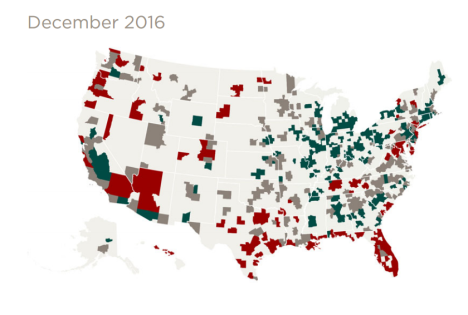
Home prices rose 0.8% MOM and are up 7.2% YOY according to CoreLogic. They foresee a deceleration of home price appreciation in 2017, with a 4.7% increase. The action was in the Pacific Northwest and Mountain states, with Washington, Idaho, Oregon, Colorado, and Utah leading the charge. Here is a map of the overvalued (red) and undervalued (green) MSAs:

corelogic-overvalued

Rising home prices and mortgage rates have hit affordability, which is the lowest in 7 years, when you use the metric of mortgage payment on the median house to median income ratio. Much of the hit took place towards the end of last year as as rates spiked post-election. Tight inventory is driving the price increases, not incomes, which means current prices are vulnerable if wages don’t increase. Eventually builders will start more construction, but as of now they are still holding back.

Economic confidence improved last week according to the Gallup Economic Confidence Index. January was the highest month since 2008. More people are feeling engaged at work, but future expectations drove the index. Despite all the sturm and drang out of Washington, Americans are shrugging it off. Other indices like the VIX, as well as gold prices (despite what the article below says) are confirming this. Separately, Fannie Mae’s Home Purchase Sentiment Index improved two points last month. Most notable in that survey: the net share of people reporting significantly higher household income growth in the past 12 month increased by 5 percentage points. Also, bankruptcy filings are the lowest since 2006.

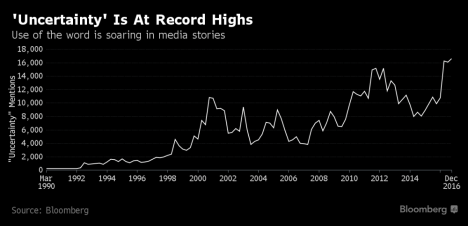
On the other hand, Washington insiders and journalists (especially) are not feeling that way. Donald Trump has upset the traditional way things are done, and that has a lot of pros spooked. That said, I think creating a confidence index based on the use of the word “uncertainty” in business articles speaks more towards the predilections of journalists than it does to the markets as a whole.

uncertainty

Fixing Dodd-Frank will take some time, along with repealing and replacing Obamacare. Democrats are vowing to go to the mattresses on both, although I think Obamacare will be where the war is going to be fought. As I have said before, I suspect there is enough bipartisan agreement to do something on Dodd-Frank, at least with regards to small bank regulation. Reforming the CFPB is expected to cleave down partisan lines, although the Courts may be forcing Congress’s hand there. Much of the change is going to be done non-legislatively, in how the agencies interpret and enforce the law. Democratic Party priorities like disclosing the pay difference between CEOs and the rank and file are simply going to go by the wayside.

Morning Report: Donald Trump “guts” Dodd-Frank!!!! 2/6/17

Vital Statistics:

Last Change
S&P Futures 2286.0 -5.0
Eurostoxx Index 362.3 -1.8
Oil (WTI) 53.7 -0.2
US dollar index 90.6 0.2
10 Year Govt Bond Yield 2.42%
Current Coupon Fannie Mae TBA 102.1
Current Coupon Ginnie Mae TBA 103.2
30 Year Fixed Rate Mortgage 4.19

Stocks are lower this morning as credit spreads widen in Europe. Bonds and MBS are up.

The week after the jobs report is usually data-light and this week is no exception. We have no data this morning, and about the only report of consequence is the JOLTs job opening report tomorrow. All eyes will be on the quits rate, which has been pretty steady. An increase would signal wage inflation ahead.

Goldman strategists are beginning to re-think their initial bullishness on the Trump administration. Instead of tackling things like tax reform, he is spending his energy on immigration and trade. There is a realization that gridlock is going to be the norm for the next two years, and that means no big, sweeping changes. Regulatory relief is still possible, but bureaucrats seem to be preparing to push back against major changes in direction. So the “Trump effect” could end up being a lot smaller than investors (and the Fed) were thinking a month ago. Which means the Fed has more room to be cautious.

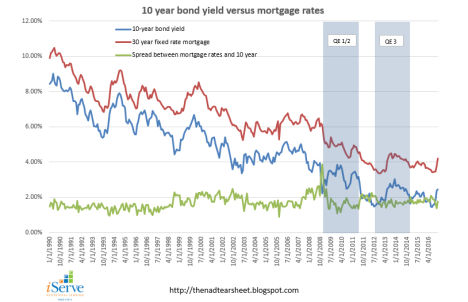
MBS investors are beginning to worry about what happens to MBS when the Fed stops re-investing maturing proceeds from its QE portfolio. After all, the Fed has been the biggest buyer of MBS paper. Will the lower demand for mortgage backed securities translate into higher mortgage rates, even if the 10 year goes nowhere? It is possible, however take a look at the chart below: I plotted the 10 year yield and the 30 year mortgage rate, with the difference between the two (the spread) below. The two blue shaded regions were QE1, 2 and 3. The green line didn’t really move all that much during QE. MBS spreads are about where they were prior to QE. Since the Fed isn’t entertaining selling bonds, just not buying them anymore, the pre-QE level of something like 167 basis points is about right. Right now, the spread is 177 basis points, which probably represents some of the lag you see in mortgage rates versus Treasuries. My point is that MBS spreads vary over time, but they have historically been around these levels. I can’t see MBS spreads making or breaking a homebuying decision. They just aren’t that significant.

10 year vs mortgage rates.PNG

On Friday, Donald Trump signed an executive order which directed a review of Dodd-Frank. There were the expected breathless headlines in the business press (with a stroke of a pen, Donald Trump eliminates Dodd-Frank, he’s “gutting” Dodd-Frank), however this is just a “review and report back to me” order. A full repeal of Dodd-Frank would be impossible, and probably would not be supported by the industry: after all, they have spent the past 6 years getting compliant with D-F and the last thing they want to do is have to adopt some new system. The unintended consequences will be addressed, but the structure will probably remain in place. These will turn out to be addressing the CFPB and small banking regulation in order to get credit flowing for smaller borrowers, addressing the Volcker rule to encourage market making, and the fiduciary rule, which many financial advisors interpret as a gag order and a limitation of the investment options menu. What does this mean for the mortgage business? Probably not much, although the biggest potential is in an easing of CFPB enforcement and an increase in mortgage products as the private label securitization market returns.

Morning Report: Decent Jobs report 2/3/17

Vital Statistics:

Last Change
S&P Futures 2281.3 4.5
Eurostoxx Index 364.1 2.2
Oil (WTI) 53.8 0.2
US dollar index 90.6 0.1
10 Year Govt Bond Yield 2.47%
Current Coupon Fannie Mae TBA 102.1
Current Coupon Ginnie Mae TBA 103.2
30 Year Fixed Rate Mortgage 4.19

Stocks are up after a decent jobs report. Bonds and MBS are up as well.

Jobs report data dump:

  • Nonfarm payrolls up 227,000
  • 2 month prior revision down 39,000
  • Unemployment rate 4.8%
  • Underemployment rate 9.4%
  • Labor force participation rate 62.9%
  • Average hourly earnings up 0.2% MOM / up 2.5% YOY

Overall, a pretty decent report. Payrolls were much better than expectations, although the downward revision of 40,000 to November offset that somewhat. The employment to population ratio ticked up from 59.7 to 59.9, which is something the Fed pays close attention to. The year-over-year increase in wages took a step back, but part of that is due to very strong January 2016 number which fell off the YOY comparison. In terms of industries, we saw big increases in construction and retail. The oil patch is hiring again as well. In some ways this was a Goldilocks type report: strong enough to make the stock market happy, and weak enough in wage growth to keep bonds from selling off.

The ISM non-manufacturing index took a step back in January from December’s strong pace. Factory orders increased 1.3%.

President Trump has ordered a comprehensive review of Dodd-Frank and suspended Obama’s fiduciary rule executive order which was to take effect in April. The goal of the review is to remove regulatory burdens to the financial industry and to increase investor options, according to an administration official. Areas of focus include reforming the CFPB, the Volcker rule, and the fiduciary order. Critics claim that the CFPB is restricting credit, the Volcker rule is restricting liquidity in the markets, and the fiduciary rule amounts to a gag order for retirement advisors.

US CEOs are meeting with Donald Trump today, as the relationship between the two becomes more tenuous. The problems are twofold. First, the left is organizing boycotts on any company associated with the Trump administration, while culminated in Uber’s CEO resigning from Trump’s business panel after the #deleteUber campaign. Second, fears of immigration limits are worrying many, particularly in the tech space. Finally Trump’s naming and shaming of companies via Twitter is causing uncertainty as well.

Interesting article in the Wall Street Journal about the future of the labor market and the business world’s continued move towards outsourcing, even within the US. Companies like Pratt and Whitney are now using UPS to handle parts of the logistics chain that used to be done by Pratt and Whitney employees. This obviously gives the company more flexibility and they don’t have to deal with the HR issues of hiring and firing. Temporary worker agencies continue to grow and allows companies to have “just in time” employee management. Accenture sees a future where the only full time employees at some companies are C-level: the rest will be temps. I wonder if it will work out the way these companies imagine however. Once these agencies control vast parts of the company’s operations, the agency will be able to hold up a company for higher rates the way unions used to hold up companies for higher wages.

Freddie Mac has a somewhat gloomy outlook for origination next year, forecasting a drop of 25% from 2016’s level of $2 trillion in origination. They see the 30 year mortgage rate averaging 4.4% and total home sales falling from 6 million to 5.75 million. House price growth is expected to moderate to 4.7% from 6%. Freddie Mac is baking in some possibility of expansionary fiscal policy coming out of Washington, especially with respect to tax reform, where an increase in the standard deduction will reduce the incentive to itemize and reduce the subsidy from the mortgage interest deduction. They do point out that increases in interest rates have been generally short-lived over the past 8 years as slow global growth and excess savings find their way into the bond market. Freddie Mac caveats this outlook with the fact that the new administration provides a lot of uncertainty. FWIW, it is looking like it will take 60 votes to get anything done in the Senate, which means a fiscal status quo. That will likely mean only 2 hikes in 2017, not 3. Rates may not be going up as much as people think.

You can see the refinanceable population has decreased significantly as rates have risen:

refinanciable population.PNG

The CFPB had another setback in the PHH case.

Morning Report: 2016 had the lowest homeownership rate since 1965 2/2/17

Vital Statistics:

Last Change
S&P Futures 2267.5 -7.0
Eurostoxx Index 362.7 -0.5
Oil (WTI) 54.0 0.2
US dollar index 90.2 -0.4
10 Year Govt Bond Yield 2.44%
Current Coupon Fannie Mae TBA 102.1
Current Coupon Ginnie Mae TBA 103.2
30 Year Fixed Rate Mortgage 4.16

Stocks are lower this morning on overseas weakness. Bonds and MBS are up.

The Fed maintained interest rates at current levels and made no changes to its reinvestment policy. The statement itself was relatively dovish, which caused a small rally in bonds in the afternoon. The money quote: “In light of the current shortfall of inflation from 2 percent, the Committee will carefully monitor actual and expected progress toward its inflation goal. The Committee expects that economic conditions will evolve in a manner that will warrant only gradual increases in the federal funds rate; the federal funds rate is likely to remain, for some time, below levels that are expected to prevail in the longer run.” There was no mention of Washington, and a slight reference to improving sentiment.

Productivity remains a problem as it increased at an anemic 1.3% pace in the fourth quarter. Output increased 2.2% and hours worked increased 0.2%. Unit labor costs increased 1.7% as wages and compensation increased 3% and productivity increased 1.3%. Part of the problem is that business capital expenditures have been in maintenance mode since the financial crisis. Morgan Stanley believes that sentiment is changing, and that means more capital expenditures going forward. Higher productivity means higher non-inflationary wage growth, which translates into higher standards of living. Note the recent divergence between capital expenditure plans and actual spending.

Announced job cuts increased to 45,934 in January, according to outplacement firm Challenger, Gray and Christmas. The holiday season was atrocious for many bricks and mortar retailers, and some are shuttering stores and declaring bankruptcy. Macy’s accounted for almost a quarter of the layoffs. The energy patch is finally on the mend and hiring again.

Initial Jobless Claims fell to 246,000 last week.

The homeownership rate ticked up to 63.7% in the fourth quarter after hitting a 52 year low in the second quarter. Overall, the homeownership rate for 2016 was the lowest since records began in 1965.

NAR took a look at the aspiring homeowner in its latest survey. Affordability was the #1 reason for people not owning a home, followed by flexibility concerns. That said, 88% of non-owners eventually do want to own a home. There still seems to be a disconnect between what people think they need (as far as a downpayment) versus what is actually required. FHA loans remain the best way to get these people their first home.

Morning Report: Blowout ADP number 2/1/17

Vital Statistics:

Last Change
S&P Futures 2281.5 7.0
Eurostoxx Index 364.3 4.0
Oil (WTI) 53.3 0.5
US dollar index 90.7 0.2
10 Year Govt Bond Yield 2.49%
Current Coupon Fannie Mae TBA 102.1
Current Coupon Ginnie Mae TBA 103.2
30 Year Fixed Rate Mortgage 4.16

Stocks are higher this morning after a good ADP number. Bonds and MBS are down.

The private sector added 246,000 jobs in January, according to the ADP Employment Survey. This is the highest number since June 2016. We saw strong growth in construction jobs and manufacturing, while finance was flat and IT fell. The Street is looking for a 175k nonfarm payrolls in Friday’s report. The ADP number hasn’t been a great predictor of the BLS number for a while, so don’t read too much into it. While strong, this number will probably not change anything with respect to this afternoon’s Fed decision, which comes out at 2:00 pm EST.

Mortgage Applications fell 3.2% last week as purchases fell 6% and refis fell 1%, according to the MBA. The average rate for a 30 year fixed rate mortgage rose 4 basis points. Refis fell below 50% for the first time since 2015.

More evidence that the manufacturing sector is turning around: The ISM Manufacturing index hit a 2 year high in December. Input costs rose to a 5.5 year high, which is spooking the bond market a little this morning.

Construction spending fell 0.2% in December, missing expectations. It is up 4.2% YOY. Residential construction rose 0.4% and is up 3,6% YOY.

Donald Trump nominated Colorado federal appeals court judge Neil Gorsuch to the Supreme Court yesterday to replace Anonin Scalia who died last year. Democrats are vowing to filibuster in retaliation for the treatment of Obama’s nominee Merrick Garland.

Distressed sales fell in October, according to CoreLogic and are now at the lowest levels since 2007. Cash sales came in at 32%, which is still elevated compared to pre-crisis levels. Normalcy is around 25% or so.

The REO-to-Rental trade worked out for Blackstone, culminating in the IPO of Invitation Homes, which raised $1.54 billion in an IPO yesterday. The deal was priced at $20 a share, within the $18-$21 range. The stock begins trading today under the symbol INVH.

Should homebuyers wait until spring to purchase a home? It turns out the best months to purchase are January and February. Less competition means bigger discounts to the asking price.

Morning Report: Wages and Salaries increase 2.3% 1/31/17

Vital Statistics:

Last Change
S&P Futures 2270.3 -5.8
Eurostoxx Index 362.9 0.3
Oil (WTI) 53.0 0.3
US dollar index 90.8 -0.3
10 Year Govt Bond Yield 2.48%
Current Coupon Fannie Mae TBA 102.1
Current Coupon Ginnie Mae TBA 103.2
30 Year Fixed Rate Mortgage 4.16

Stocks are lower as earnings come in (and some are bad). Bonds and MBS are up small.

Employment costs increased 0.5% in the fourth quarter as wages and salaries increased 0.5% and benefit costs increased 0.4%. On a year-over-year basis, wages and salaries are up 2.3%, an uptick from the 2.1% pace a year ago. This report is more or less in line with expectations and shouldn’t have much of an effect on the FOMC’s rate decision. The meeting starts today, with an announcement scheduled for 2:00 pm EST tomorrow.  FWIW, the Fed Funds futures are pricing in a 13% chance of a rate hike tomorrow, and a 50% chance of a hike by June.

Home prices increased 5.6% YOY in November, according to the Case-Shiller Home Price Index. This index has recouped all of its losses from the bubble years. The Pacific Northwest led the charge, with prices increasing double digits in Portland and Seattle. Washington DC and NYC were the laggards.

Here is the income required to buy the median home in various locations. It varies from almost $150k in San Francisco to $34k in Cincinnati. As they say, all real estate is local.

Donald Trump promised to “do a big number” on Dodd-Frank yesterday. While the President is limited in what he can do unilaterally, he can ease the burden somewhat without legislation.

One economic historian thinks the current bond market most closely resembles the late 1960s, as we exited a multi-decade period of low inflation. From 1965-1970, inflation rose from 1.6% to 5.9%, and long term Treasuries lost 36% in real terms. The lesson from the 1960s is that inflation can sneak up on you very quickly. Of course there are fundamental structural differences in the economy that make it harder to see inflation creep up the way it did in the 1960s and 1970s, so it is probably unlikely that we will see any sort of 1970s conflagration. First, the US was insulated from globalization in the late 60s and early 70s as postwar Asia and Europe were still rebuilding. Second, union contracts had automatic cost of living increases which caused wage-push inflation. Today, we don’t have that. In fact, technology is replacing labor, which is pushing costs down, not up. Capacity Utilization rates were in the high 80s back then versus mid 70s now. Inflation is a case of too much money chasing too few goods. We might have too much money at the moment, but we don’t have too few goods. If anything, we have too much money chasing too few assets, which is why we have experienced asset bubbles over the past 30 years, not inflation.

Speaking of asset price inflation, the best investment in inflationary times can be real estate, especially when you use a 30 year fixed rate mortgage.

Single women buy houses as twice the rate of single men. Most likely explanation: kids.

Last week, I participated in a webinar for HousingWire where we discussed interest rates, regulation, and MI. The playback is here.

Morning Report: Incomes and spending rises 1/30/17

Vital Statistics:

Last Change
S&P Futures 2281.5 -7.5
Eurostoxx Index 364.2 -2.2
Oil (WTI) 53.1 0.0
US dollar index 91.4 0.0
10 Year Govt Bond Yield 2.48%
Current Coupon Fannie Mae TBA 102.1
Current Coupon Ginnie Mae TBA 103.2
30 Year Fixed Rate Mortgage 4.16

Dow 20,000 hats are off this morning as corporate earnings continue to come in. Bonds and MBS are up.

Donald Trump temporarily restricted immigration from 7 countries over the weekend until new vetting procedures are put in place. This story dominated the news cycle.

Personal Incomes rose in December by 0.3% while spending rose 0.5%. The core PCE index (the Fed’s preferred measure of inflation) is up 1.7% YOY.

Pending Home Sales increased in December, according to NAR. The challenge for 2017 will be increasing inventory enough to offset higher borrowing costs. NAR is forecasting housing starts to increase 8% this year to 1.26 million. Normalcy is closer to 1.5 million, so we have a ways to go there.

We have a big week for data, with the FOMC meeting and the jobs report on Friday. We also get productivity and employment costs, which is another huge number. We are also in the middle of earnings season with several heavyweights reporting this week.

Steve Mnuchin doesn’t appear to be interested in removing the Volcker Rule, which prohibits banks with FDIC backing to conduct proprietary trading. He does believe that it has restricted market liquidity in its implementation however and he is interested in tweaking it. Overall, it looks like Dodd-Frank will be fixed but not repealed.

A war is brewing over the state of the CFPB. Donald Trump has yet to weigh in on the agency or the fate of Richard Cordray. Also, it is looking like the CFPB will be remade into a bipartisan board as well.

80% of all mortgage borrowers are completely honest on their loan applications, according to a study by UBS. The inaccuracies generally fall into four buckets: overstated income, underreported debt, underreported expenses, and overstated assets.

The NAR’s quarterly survey of mortgage lenders is out, and problems with appraisers (or lack thereof) dominate the headaches. Over half of all respondents reported issues in this area, with 11% characterizing them as significant. One problem is the lack of new entrants, however 28% of lenders won’t accept an appraisal done by a trainee, and 44% require direct supervision of all aspects performed by a trainee. Non-QM lending fell slightly during the quarter, however investor demand for the product is rising. Rising rates are expected to have some effect on purchase demand, however there is such tight supply that it shouldn’t affect volumes overall.

Home prices are now within 0.3% of their peaks on a national level according to Black Knight Financial Services.

Morning Report: GDP disappoints 1/27/17

Vital Statistics:

Last Change
S&P Futures 2294.3 0.3
Eurostoxx Index 366.1 -1.4
Oil (WTI) 53.5 -0.3
US dollar index 91.5 0.1
10 Year Govt Bond Yield 2.51%
Current Coupon Fannie Mae TBA 102.1
Current Coupon Ginnie Mae TBA 103.2
30 Year Fixed Rate Mortgage 4.16

Stocks are flattish after GDP comes in weaker than expected. Bonds and MBS are down small.

Fourth quarter GDP growth came in at 1.9%, lower than the 2.2% Street estimate. For the year, GDP came in at 1.6%. Trade was the big drag, along with Federal government spending. This is the advance estimate and will be subject to two more revisions. Disposable personal income rose 3,7% and the PCE deflator (the Fed’s preferred measure of inflation) increased 2%, right in line with the Fed’s inflation target. Ex-food and energy it increased only 1.3%. The savings rate also fell.

The Fed has been consistently high with its estimates for GDP growth. Check out the chart below. It shows the Fed’s forecast for 2016 GDP starting with the June 2014 FOMC meeting. They started out forecasting 2.75% growth, and it actually came in at 1.6%.

fed-2016-gdp-growth-forecast

Durable Goods orders disappointed in December, falling 0.4% versus expectations of a 2.6% increase. Capital Goods orders (a proxy for business capital expenditures) increased .8%, which was below expectations again.

Consumer sentiment improved in January, according to the University of Michigan survey.

I crunched some numbers looking at the last few tightening cycles, and compared the move in the 10 year bond yield to the move in the Fed Funds rate. During the last 3 tightening cycles (1994, 1999, and 2004) the yield curve flattened, meaning that long term rates went up less than short term rates. In fact, for every percentage point increase in the Fed Funds rate, the 10 year increased by about 34 basis points. The 10 year was at 2.2% when the Fed began its latest hike. With the Fed expecting an increase of 50-75 basis points in the Fed Funds rate this year, we should see an end of 2017 Fed Funds rate of about 2.6% or so. With the 10 year already at 2.5% plus, the market is treating these increases as if they have already been made. The 10 year has gotten ahead of itself a little bit, which means we could see the yield stay at these levels during the year while the Fed Funds rate catches up.

I talked about this and other stuff during the HousingWire 2017 Housing Outlook webinar: Trump’s Mortgage Nation. There is a link in the article for a playback if you missed it. We discussed interest rates, regulation and mortgage interest.

Mortgage backed securities got beat up a little yesterday after Brookings released an article by former Fed Chairman Ben Bernanke that discussed ending the practice of re-investing the cash from maturing bonds and MBS back into the market. The Fed’s balance sheet has been stuck at $4.5 trillion since QE ended, and they purchased about 360 billion worth of MBS last year to maintain their exposure. Given that total originations were probably around $2 trillion, that number is not insignificant. Does that mean spreads will widen once the Fed ends this practice of re-investing maturing proceeds? The short answer is “probably not” The spread between the 10 year and the mortgage rate is about 165 basis points or so. Prior to QE, it was around 166, and you didn’t really see any decrease in that spread when QE was active. The end of reinvestment should be a nonevent for the mortgage market.

Blue Horseshoe loves Annacott Steel