Morning Report: Small business optimism remains elevated

Vital Statistics:


Last Change
S&P futures 2667.5 28
Eurostoxx index 345.14 5
Oil (WTI) 51.55 0.25
10 year government bond yield 2.89%
30 year fixed rate mortgage 4.72%


Stocks are higher this morning on hopes of a trade deal. Bonds and MBS are down.


There were 7.1 million job openings as of the end of October, according to the BLS. This was largely unchanged from September. IT and real estate had the biggest increases in open positions. The quits rate fell by 0.1% to 2.3%. The Fed pays close attention to the quits rate as it historically has presaged wage inflation. The JOLTs report does echo what we saw out of last Friday’s employment situation report – the job market is still strong, however it is beginning to cool down a touch.


Small Business optimism slipped ever so slightly in November, however it remains at multi-decade highs. A tight labor market remains one of the biggest issues, with a scarcity of “qualified” – i.e. not just “skilled” labor as a major issue. A net 34% of all small businesses are increasing wages, a historically robust number.  While labor markets are generally tight, there still is a large number of people who are on the older side, who probably do want to work, but are unable to find jobs. Getting them back into the economy is needed in order to raise potential GDP, which acts as a speed limit on the economy.


NFIB


Mel Watt’s term running the FHFA is up in January, and it looks like Mike Pence’s Chief Economist Mark Calabria is the front-runner to replace him. Calabria is a Libertarian, which will be sure to upset affordable housing advocates. Mel Watt was considered to be an ideological kindred spirit of the affordable housing lobby, and he allowed Fannie Mae and Freddie Mac to increase their footprint in the mortgage market. Calabria will probably side with Republicans who want to see the GSEs reduce their influence, and will probably look to tighten requirements, increase guaranty fees, and lower eligible loan sizes. This of course assumes Congress does nothing about GSE reform, which is probably a safe assumption.


Funding for the government expires on Dec 21. Trump and the Democrats are negotiating over funding the wall. Government shutdowns generally do not affect the financial markets – as much as they bother the Washington Post, Wall Street does not care. That said, the last time we had a shutdown, originators were unable to get tax transcripts out of the IRS, so plan ahead.

Morning Report: James Bullard floats idea of skipping Dec. hike

Vital Statistics:


Last Change
S&P futures 2628 -8
Eurostoxx index 343.16 -2.31
Oil (WTI) 51.87 -0.74
10 year government bond yield 2.85%
30 year fixed rate mortgage 4.72%


Stocks are lower this morning on no real news. Bonds and MBS are flat.


St. Louis Fed President James Bullard surprised markets on Friday by suggesting that the Fed could take a break at the December FOMC meeting. He argued that interest rates were already somewhat restrictive (at least that is what the yield curve is telling us), and the neutral Fed Funds rate is around 2%. (the current target rate is between 2% and 2.25%). He also noted that while unemployment is around 3.7%, the relationship between inflation and unemployment (aka the Phillips Curve) has been breaking down for decades, to where the statistical relationship is close to zero. The Fed Funds futures are handicapping an 80% chance of a hike, but the reaction from the market if they don’t hike may end up being worse than the reaction if they do.


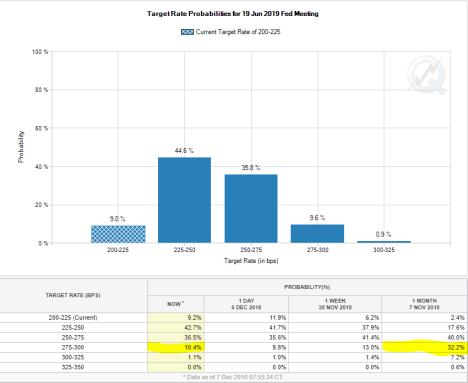
The Fed Funds futures have been forecasting a hike in December, and then one more in 2019. So regardless of the timing, this tightening cycle is pretty much over.


The Fannie Mae Home Purchase Sentiment Index rose slightly in November, driven by increasing incomes. There has been a push-pull effect happening in the index, as increasing personal financials are being offset by deteriorating housing affordability. “The HPSI has moved within a tight range over the past five months, as positive sentiment regarding the overall economy continued to offset cooling housing sentiment,” said Doug Duncan, senior vice president and chief economist at Fannie Mae. “Consumers’ perceptions of growth in their household income reached a survey high this month, helping to absorb some of the impact of increasing mortgage rates on housing market activity. Meanwhile, the net share of consumers expecting home prices to increase over the next 12 months continues to moderate, dropping by 13 percentage points since this time last year.”


Roughly 46,000 homes were flipped in the third quarter, which is the lowest number in 3 1/2 years. The number of sub-3 year mortgages (used for the fix and flip crowd) dropped 11% last quarter. A combination of rich home prices and higher financing costs have made it tougher to earn a decent return in the business. At some point, the investors who did well in the REO-to-rental trade will probably look to ring the register and move on to better opportunities.

Morning Report: Jobs and the Fed Funds futures

Vital Statistics:


Last Change
S&P futures 2675 -16
Eurostoxx index 374 3.73
Oil (WTI) 51.4 -0.09
10 year government bond yield 2.89%
30 year fixed rate mortgage 4.66%


Stocks are lower this morning after yesterday’s wild ride in the stock and bond markets. Bonds and MBS are flat.


Jobs report data dump:

  • Nonfarm payrolls + 155,000
  • Unemployment rate 3.7%
  • Labor force participation rate 62.9%
  • Average hourly earnings up 0.2% / 3.1%

This was generally a weaker-than-expected jobs report, with payrolls coming in below the 190,000k estimate and average hourly earnings about 1/10% below estimates. It probably won’t make that much of a difference to the Fed, but it does show the economy is moderating a bit from the torrid pace of mid-year.


The Fed Funds futures are beginning to cheat to the side of less movement from the Fed. While the December futures are still predicting a hike, the June futures are now predicting that the Fed might hike only one more time.


fed funds futures


Nonfarm productivity rose 2.3% last quarter, while employment costs rose 0.9%. Real compensation grew at 1.1%, which is disappointing, but overall the report is decent. This report does demonstrate the issue that has been bedeviling the Fed: if we are at full employment, wages should be heading higher and the central bank should get ahead of that. However, wages are behaving as if we are not at full employment. So which numbers are telling the truth? IMO, we are not at full employment yet. While there are worker shortages in some areas, there is a glut in other areas. Also the financial crisis kicked out a lot of workers who were in their prime earnings years, and that is depressing the numbers.


Kathy Kraninger has been confirmed by the Senate to be the next head of the CFPB. She will serve a 5 year term. The vote fell along party lines, with Republicans looking for her to reform the agency’s anti-business tilt, while Democrats ululated that she won’t be tough enough on the industry. While nobody knows exactly what she has in mind, the CFPB has been going in the direction of more transparency about what the rules of the road are.


Loan Depot CEO Anthony Hsieh sent an email to his loan officers to stop whining. “I am honored to be your CEO and happy to work very hard for you. But the 42% that are unhappy being here, I do not want to work this hard for those that don’t want to be here. Adjust your attitude, be ALL-IN,” the alleged email states.  “Stop acting entitled and understand this industry has ups and downs, but all will average out great. Be confident and stop whining” Definitely a different approach to motivating people.

Morning Report: The government targets VA lending

Vital Statistics:


Last Change
S&P futures 2657 -42
Eurostoxx index 346.51 -7.2
Oil (WTI) 51.46 -1.45
10 year government bond yield 2.90%
30 year fixed rate mortgage 4.83%


Stocks are lower this morning as the global sell-off continues. Bonds and MBS are up.


While stocks are moving lower, the big news these days is the bond market rally. What appeared to be window-dressing last Friday (a sub 3% yield on the 10-year) has just kept going. A lot of market commentators have been scrambling to come up for a reason. Trade tensions make a convenient, if unsatisfying explanation. China and the US have reached an agreement to cool things off for 90 days, which should be good news. Economic data has been strong, and while we have had some slightly dovish comments out of the Fed, it is nothing dramatic. It feels like a major asset allocation trade out of equities into fixed income, but who or why is anyone’s guess. In other words, this could be just random noise, and therefore temporary. Note that 2s/10s (the difference in yield between the 10 year and the 2 year) got to single digits. Historically such behavior would signal a slowdown, but the Fed’s footprint in the Treasury market wasn’t so large before.


The business press is pushing out all sorts of “recession imminent?” articles, but if you read the ISM report on manufacturing, you will see nothing of the sort. New orders, production, and employment are all at historically very strong levels. The business press mirrors the mainstream media, and they are talking their ideological book a little.


In terms of MBS trading, they lagged the move big-time. On Tuesday, where yields touched 2.88% we saw only a couple of investors re-price for the better. So, all of those LOs who were running scenarios hoping to see an improvement were disappointed. TBAs did increase by 6 or 7 ticks, but the aggregators largely ignored it.


Construction spending fell 0.1% MOM in September, but was up almost 5% YOY. Residential construction fell 0.5% MOM and rose about 1.7% YOY. Lodging and office construction were up high / mid teens YOY, but resi (42% of total construction spending) continues to lag.


Speaking of resi construction, Toll Brothers reported a big drop in orders (down 13% in units / 15% in dollars). The cancellation rate jumped from 7.9% to 9.3%. Toll was one of the first builders to recover from the slowdown, making big bets on luxury urban apartments along with their traditional McMansion fare. California is the problem area, which  is being hit by higher prices, higher rates, diminished foreign demand and new tax treatment. The whole sector was smacked, with the homebuilder ETF down about 5%. The XHB is down about 25% from its mid January levels.


XHB chart


Mortgage applications rose 2% last week as purchase activity rose 1% and refis rose 6%. Mortgage rates dropped about 4 basis points.


The VA is taking a closer look at predatory behavior in VA lending. From the Federal Register on November 30:

“VA is concerned that certain lenders are exploiting cash-out refinancing as a loophole to the responsible refinancing Congress envisioned when enacting section 309 of the Act. VA recognizes there are certain advantages to a veteran who wants to obtain a cash-out refinance, and VA has no intention of unduly curtailing veterans’ access to the equity they have earned in their homes. Nevertheless, some lenders are pressuring veterans to increase artificially their home loan amounts when refinancing, without regard to the long-term costs to the veteran and without adequately advising the veteran of the veteran’s loss of home equity. In doing so, veterans are placed at a higher financial risk, and the lender avoids compliance with the more stringent requirements Congress mandated for less risky refinance loans. Essentially, the lender revives the period of subprime lending under a new name.”

The government has already dealt with the serial refinancings by adding new seasoning requirements for loans to be eligible for standard Ginnie MBS, but that was about protecting MBS investors. This is different. For many veterans, it may sound like a great deal to be able to lop 50 bucks off your monthly payment and maybe get to skip a month or two, but that 3.3% funding fee is expensive, even though you get to finance it. If you are doing a VA cash-out to refinance credit card debt, it amounts to an expensive debt consolidation loan, though the drop in your rate and the tax treatment does offset that a bit.


Morning Report: Markets closed on Wednesday

Vital Statistics:


Last Change
S&P futures 2798 40
Eurostoxx index 362.59 5.1
Oil (WTI) 52.94 2.02
10 year government bond yield 3.03%
30 year fixed rate mortgage 4.83%


Stocks are higher this morning after the US and China agreed to a 90 day trade truce. Bonds and MBS are down.


China and the US agreed to halt further tariffs against each other, and agreed to fresh talks to try and end the trade war. This has sent stocks up sharply in Europe and Asia, and emerging markets are especially strong. Whether this actually turns out to be the end is anyone’s guess, but at least dire trade warnings will be off the headlines for a while.


The stock markets will be closed in observance of a day of mourning for George H.W. Bush, who passed away over the weekend. SIFMA has recommended that the bond markets close on Wednesday as well.


We have a lot of data this week, which will probably be dominated by the Employment Situation Report on Friday. Jerome Powell will be speaking on Wednesday and we will get productivity as well as the ISM reports.


The typical mortgage originator made $480 on each loan (all-in) in the third quarter, a drop from $580 in the second quarter. Declining volumes are driving the drop, which is being offset somewhat from servicing income gains. “These are very challenging times for independent mortgage bankers, with the average pre-tax net production income per loan reaching its lowest level for any third quarter since inception of our report in 2008,” said Marina Walsh, MBA’s Vice President of Industry Analysis. “Profitability continues to be hindered by high costs and low productivity. We expect fixed costs to remain elevated, and competitive pressures will continue to hamper production revenues in the winter months. Therefore, mortgage banker profitability will likely remain challenged.” It won’t get any better as we enter the seasonally slow period.


Morning Report: Looks like the Fed tightening cycle is winding down.

Vital Statistics:


Last Change
S&P futures 2730.25 -14
Eurostoxx index 356.36 -1.74
Oil (WTI) 50.5 -0.96
10 year government bond yield 3.01%
30 year fixed rate mortgage 3.85%


Stocks are lower this morning on no major news. Bonds and MBS are up small.


The minutes from the November FOMC meeting were released yesterday, and they said nothing all that interesting. Bonds, which had been supported by Powell’s comments on Wednesday ticked up slightly. The media seemed to take the minutes as dovish, but there really wasn’t any sort of statement that jumped out.


Initial Jobless Claims increased by 10k to 234,000.


Personal incomes rose by 0.5% in October, and consumption rose by 0.6%. Those were extremely strong numbers, and support the idea that Q4 is going to be strong as well. It was also a bit of a Goldilocks report, with the personal consumption expenditures inflation reading sitting right at the Fed’s target rate, with the core rate (ex-food and energy) rising 1.8%.


The Fed Funds futures are pricing in a December hike as a pretty much a sure thing, and then have coalesced around the forecast that we get one more hike in 2019. In other words, we are in the late stages of this hiking cycle. Note that monetary policy acts with about a year’s lag, so we haven’t really begun to feel the hikes from this year. Below is the implied probability chart for the December 2019 Fed Funds futures.


fed funds futures


Pending Home Sales fell 2.6% in October, according to NAR. For those keeping score at home, this is the 10th straight drop, and demonstrates the issues of higher home prices and mortgage rates. All regions experienced declines, and the West was hit particularly hard as home prices have experienced double-digit increases for years. Something has to give in the real estate market – either prices have to stabilize, interest rates have to fall, or incomes have to rise. Given the personal income numbers and other anecdotal data, rising wages will probably end up squaring the circle.


Morning Report: New Home Sales drop

Vital Statistics:


Last Change
S&P futures 2932.25 -9
Eurostoxx index 357.94 0.56
Oil (WTI) 50.06 -0.15
10 year government bond yield 3.02%
30 year fixed rate mortgage 3.85%


Stocks are lower this morning on no real news. Bonds and MBS are up.


Jerome Powell spoke yesterday and said that rates are “just below” the neutral range. These comments pushed up bond prices (rates fell) and contributed to a rally in the stock market. He may have been walking back an earlier unscripted statement which said that the Fed had a “ways to go” before hitting neutral. He also said that there were no financial bubbles in the US and that the stock market was near its long term valuation average. This put a bid under stocks and other risk assets.


The Fed Funds futures didn’t really react all that much, however a consensus seems to be building that we are looking at a hike in December, and probably one more in 2019.


TBAs have spent the last couple of days catching up with the move lower in the bond market. MBS were up a good 6 ticks or so in a flat Treasury market. Note we will get the minutes from the November FOMC meeting at 2:00 pm EST. It probably should be a nonevent, but just be aware.


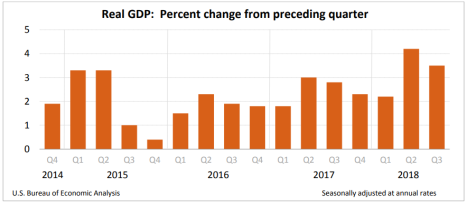
GDP came in at 3.5% for the third quarter. This was the second revision out of BEA and there were few changes. This is a deceleration from Q2’s torrid 4.2% growth rate. The PCE price index rose 1.5%, which is slower than the second quarter’s 2.0% pace, and below the Fed’s target or 2%.


GDP


Mortgage applications increased 5.5% last week as purchases rose 9% and refis rose 1%. Last week contained the Thanksgiving day holiday, so there were all sorts of adjustments to these numbers. Still it is encouraging.


New Home sales came in much weaker than expected, and we saw major, major declines in the Midwest and Northeast (which dropped around 20%). New Home Sales is a notoriously volatile number, and is often subject to major revisions. That said, there is no way to put a positive spin on that number – it was simply lousy.


new home sales


Morning Report: Dallas home prices and the lagging Northeast

Vital Statistics:


Last Change
S&P futures 2692.5 6
Eurostoxx index 358.13 0.76
Oil (WTI) 51.75 0.19
10 year government bond yield 3.06%
30 year fixed rate mortgage 4.89%


Stocks are higher this morning on as we await a speech from Jerome Powell. Bonds and MBS are flat.


Same store sales increased 7.7% last week according to Redbook. This would indicate that Black Friday was strong.


Consumer confidence from its multi-decade peak in October, driven by fears of of an economic slowdown. It is funny – the index asks people about their current state and then asks about their expectations for the future. The current state is at almost record highs while the future state is lower. This was the opposite for most of the Obama administration – the current state numbers were lousy, but people were optimistic for the future. Historically, consumer confidence was kind of an inverse gasoline price index, but the media is so heavily invested in talking down the “Orange Man Bad” economy that CNN damn near has an “impending recession” countdown monitor ticking in the lower right hand corner of the screen.


House prices rose 6.3% in the third quarter, according to the FHFA index. Prices were strongest in the Pacific Northwest / Mountain states. Prices were weakest in the Dakotas, Alaska, Louisiana, and Connecticut.


The Case-Shiller Home Price Index was flat MOM, and up 5.1% YOY. “Home prices plus data on house sales and construction confirm the slowdown in housing,” says David
M. Blitzer, Managing Director and Chairman of the Index Committee at S&P Dow Jones Indices.  “Sales of both new and existing single family homes peaked one year ago in November 2017. Sales of existing homes are down 9.3% from that peak. Housing starts are down 8.7% from November of last year. The National Association of Home Builders sentiment index dropped seven points to 60, its lowest level in two years. One factor contributing to the weaker housing market is the recent increase in mortgage rates. Currently the national average for a 30-year fixed rate loan is 4.9%, a full percentage
point higher than a year ago.”


Freddie Mac is out with their housing forecast for the next couple of years. Their view is that the market will adjust to the big slowdown we saw in 2018 and resume modest growth. That said, they see originations down slightly in 2019 and 2020, largely driven by a continued uptick in interest rates, but the worst of the decline is behind us. Purchases activity will increase, however the refi business will continue to decline. Interestingly, they see housing starts continue to lag historical levels despite the pent-up demand.


freddie outlook


The new 2019 conforming limits are out, and the new limit for SFR is 484,350, a 6.9% increase from 2018. Hi bal limits for SFR is 726,525. The multi-unit limits also increased by the same percentage.


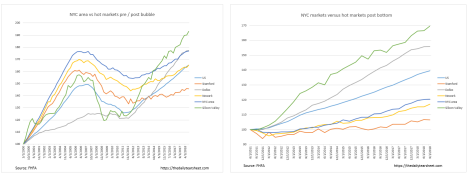
Yesterday, I mentioned an article in the Wall Street Journal about the Dallas home market and how it is the “canary in the coal mine” for the US real estate market. Builders are beginning to have to offer discounts / amenities in order to attract buyers, who are becoming more cautious following a rise in real estate markets. The Dallas market is interesting because Texas is more restrictive in terms of cash-out refinances. Take a look at the charts below. Dallas is the grey line. You can see they largely missed out a lot of the torrid growth during the bust years, but prices held up during the bust (they barely fell). However, take a look at the chart on the right, which shows the relative performance of several MSAs following the quarter when the US in general bottomed (late 2011). Dallas has well outperformed the US, and their appreciation is comparable to Silicon Valley. The Dallas market does indeed look toppy, and probably has more in common with the high flyers than the rest of the US. The median house price to income ratio is Dallas is 6, versus 4.4 for the rest of the US. Note as well how poorly the NYC metro area is doing. Fairfield County, CT (Stamford / Bridgeport), North Jersey (Newark) and Westchester (NYC area) are all just barely off the bottom. They have barely participated in the rebound seen in the rest of the country.

NYC MSAs

Morning Report: Home sizes fall

Vital Statistics:


Last Change
S&P futures 2664 -6
Eurostoxx index 357.22 -1.11
Oil (WTI) 51.69 0.06
10 year government bond yield 3.06%
30 year fixed rate mortgage 4.89%


Stocks are lower this morning on no real news. Bonds and MBS are flat.


We have a lot of Fed-speak today, with 4 different speeches. As we approach the December Fed meeting, the markets will hang on every word, looking for clues about 2019. The Fed funds futures are increasing their probability of a December hike, which is up to 80% compared to 66% a month ago.


Economic growth accelerated a touch in October, according to the Chicago Fed National Activity Index. The CFNAI is a meta-index of some 85 different statistics, and in October employment-related numbers (things like unemployment and initial jobless claims) were the drivers. Production-related statistics slowed a touch, but overall the economy is growing above trend.


Median home sizes are falling, as more and more builders focus on building starter homes. Home sizes rose during the housing bust as the luxury end of the market was about the only segment that was working. This trend was exacerbated by debt levels and employment uncertainty for the first time homebuyer. In addition, the Millennial generation tended to favor urban areas, and builders focused on apartment building. Now, we are seeing a glut of properties at the high end, and strong demand for starter homes as the first time homebuyer moves to the suburbs. Note that the latest existing home sales data had the first time homebuyer share at 31%. Historically, that number has been closer to 40%.


home sizes


Signs of things to come? The Dallas home market is cooling off, as affordability issues bite. The Dallas market is a little different than the typical US housing market – Texas has some limitations on cash-out refinances that meant it largely avoided the big boom / bust of the real estate bubble. Prices are 50% higher than they were in 2007, which is similar to MSAs like San Francisco. On the other hand, Dallas homebuyers are more likely to finance their purchases than the typical foreign cash buyer on the West Coast. Builders have a glut of inventory and are cutting prices / adding features to move properties.

Morning Report: Existing home sales rise

Vital Statistics:


Last Change
S&P futures 2660 31.25
Eurostoxx index 357.65 3.68
Oil (WTI) 50.97 0.55
10 year government bond yield 3.06%
30 year fixed rate mortgage 4.89%


Stocks are higher as investors return from the Thanksgiving holiday. Bonds and MBS are down.


Oil continues to plunge, falling 8% on Friday. Saudi Arabia continues to pump over 11MM barrels a day and there are worries of a supply glut. Oil has fallen about 33% since early October. Natural gas has given back some of its gains, but is still elevated on concerns of a cold winter in the South.


Existing home sales broke its six month losing streak, rising 1.4% in October, according to NAR. Sales rose 1.4% MOM to an annualized pace of 5.22 million. This is down over 5% YOY. The median home price was $255,100, up 3.8% YOY. The inventory situation continues to improve, but remains tight. There were 1.88 million homes for sale at the end of the month, which represents a 4.3 month supply.  There were only 3.9 month’s worth of homes a year ago.


The median home price to median income ratio now stands at 4.15x, an improvement from 4.4x, where it ended 2017. It is still above the historical range of 3.1 – 3.5 times, but below the peak levels of 4.8x. Note this ratio ignores the effect of interest rates, which affects affordability, but it does give a quick synopsis of home pricing.


Median House Price to Median Income Ratio


In other economic news, Mortgage applications were flat two weeks ago, with purchases rising 3% and refis falling 5%. Durable Goods orders fell 4.4% on weaker aircraft orders, and the Index of Leading Economic Indicators slowed in October. It is looking like the economy is moderating from its torrid mid-year pace.


Rising home prices means rising home equity, and over 80% of the refis last year were cash-outs. This is back towards bubble levels. This makes sense, because rate / term refis generally don’t make sense with rates at these levels. Cash-out refis are especially attractive if the borrower has credit card debt with rates in the teens.


cash out