Morning Report: New home sales rise

ital Statistics:

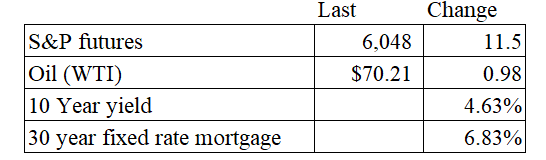
Stocks are up this morning on no real news. Bonds and MBS are down.

The markets close early today in observance of Christmas Eve. Should be a quiet day.

New home sales rose 5.9% to a seasonally adjusted annual rate of 664,000 in November. This was up 8.7% compared to a year ago. The median sales price of new houses sold in November 2024 was $402,600. The average sales price was $484,800. The median price fell 6.3%, while the average price was down about 80 basis points.

Consumer confidence pulled back in December, according to the Conference Board. “The recent rebound in consumer confidence was not sustained in December as the Index dropped back to the middle of the range that has prevailed over the past two years,” said Dana M. Peterson, Chief Economist at The Conference Board. “While weaker consumer assessments of the present situation and expectations contributed to the decline, the expectations component saw the sharpest drop. Consumer views of current labor market conditions continued to improve, consistent with recent jobs and unemployment data, but their assessment of business conditions weakened. Compared to last month, consumers in December were substantially less optimistic about future business conditions and incomes. Moreover, pessimism about future employment prospects returned after cautious optimism prevailed in October and November.”

The CPFB is accusing Rocket Mortgage of illegal kickbacks. “Rocket engaged in a kickback scheme that discouraged home-buyers from comparison shopping and getting the best deal,” CFPB Director Rohit Chopra said in a statement. “At a time when homeownership feels out of reach for so many, companies should not illegally block competition in ways that drive up the cost of housing.”

Rocket responded by saying that one-third of the borrowers with an application in progress chose to go to a different lender: “The facts are clear – data shows one-third of consumers with a loan application already in progress with Rocket Mortgage, before contacting Rocket Homes, chose to close with a different lender,” the company said in a statement. “This proves Rocket Homes is committed to empowering home-buyers to make the best decisions for their unique needs.”

Morning Report: Manufacturing continues to deteriorate

Vital Statistics:

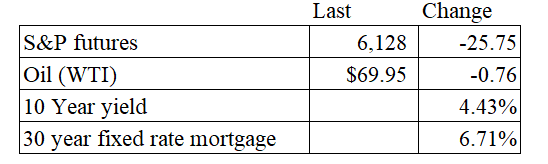
Stocks are lower as the Fed begins its FOMC meeting. Bonds and MBS are up.

Retail sales rose 0.7% MOM in November, which was above expectations. On a year-over-year basis, they rose 3.8%. Motor Vehicles and parts were the big driver of the increase. Excluding vehicles and gas, sales rose 0.2% MOM, which was below expectations. October’s sales numbers were revised upward.

The S&P Flash PMI hit a 33 month high in December. Output rose at the steepest rate in 33 months, and much of the increase was attributed to the incoming administration. That said, the growth was concentrated in the service sector, as manufacturing conditions continued to deteriorate.

“Business is booming in the US services economy, where output is growing at the sharpest rate since the reopening of the economy from COVID lockdowns in 2021. The service sector expansion is helping drive overall growth in the economy to its fastest for nearly three years, consistent with GDP rising at an annualized rate of just over 3% in December.

“It’s a different picture in manufacturing, however, where output is falling sharply and at an increased rate, in part due to weak export demand. Encouragingly, confidence in the 12-month outlook has lifted to a two-and-a-half year high, suggesting the robust economic upturn will persist into the new year and could also become more broad-based by sector. However, some of the high spirits seen after the election in the manufacturing sector have been checked over concerns surrounding tariffs and the potential impact on inflation resulting from the higher cost of imported materials. December saw raw material prices spike sharply higher amid supplier-led price rises and higher shipping costs, in a reflection of busier supply chains in advance of threatened protectionism in the new year.”

Notably, the PMI and the CPI are diverging, and since the PMI generally leads the CPI, we should see further downward pressure on inflation, which is good for the Fed as it fights the last mile of inflation.

Industrial production fell 0.1% MOM in November, according to the Federal Reserve. Manufacturing production rose 0.2%. Capacity Utilization slipped to 76.8%. Note that October’s numbers were revised downward.

Morning Report: Optimism improves

Vital Statistics:

Stocks are flattish this morning on no real news. Bonds and MBS are down small.

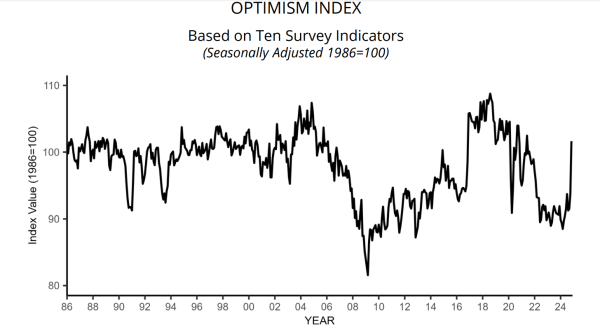
Small business optimism improved markedly in November, according to the NFIB Small Business Optimism Report. The index rose by 8 points to hit the highest level since June 2021, and breaking through the 50 year average for the first time in 34 months.

All components of the index improved as uncertainty over the election faded. The labor market remains tight, with 36% of small businesses reporting they had jobs they were unable to fill. Labor costs remain the biggest concern for small businesses.

Sales remain challenged, however optimism for the future improved. The net number of firms reporting higher sales was negative 13, however a net 18% think things are about to get better.

“After a year of readings at 94 or lower (98 is the 50-year average), the Index of Small Business Optimism rose to 101.7 in November, clearly a response to the presidential election. The election results signal a major shift in economic policy, particularly for tax and regulation policies, that favor economic growth. Economic and employment growth have been dominated by government spending, financed with massive deficits, crowding out private spending with higher prices and interest rates. Average small firm loan costs rose from 4 percent to over 9 percent over the past four years. Government (federal, state, and local) employment (direct and indirect) surged, competing with private firms for employees, mainly those businesses that did not benefit from government spending. Trump’s first term as president produced inflation rates that averaged well under the Fed’s 2 percent target and very strong economic growth. Owners hope for a repeat performance.”

The national delinquency rate improved to 3.45% in October, according to the latest ICE Mortgage Monitor. The 90 day rate continues to tick up, however. Foreclosure activity remains muted, rising 12% MOM, but still down about 12% on a YOY basis.

We saw a spike in rate / term refis in October, which is something that has been non-existent for the past few years. Rate / term refis actually exceeded cash-out refis. Much of the activity came from loans originated in 2023, when mortgage rates were closer to 8%.

Productivity increased 2.2% in the third quarter, according to BLS. Unit labor costs were revised downward from 1.9% to 0.8%. A downward revision to compensation accounted for the change.

People’s household finance outlook improved dramatically, according to the latest data from the New York Fed. The outlook has returned to February 2020 levels (i.e. pre-pandemic) levels.

Morning Report: Manufacturing activity improves

Vital Statistics:

Stocks are flattish this morning on no real news. Bonds and MBS are flat.

Manufacturing activity contracted for the 8th consecutive month, according to the ISM Report. That said, conditions improved compared to last month. The internals of the report are mainly good news: new orders and production increased, while the prices index fell markedly to near-neutral levels.

 “U.S. manufacturing activity contracted again in November, but at a slower rate compared to last month. Demand continues to be weak but may be moderating, output declined again, and inputs stayed accommodative. Positive signs for demand include the (1) New Orders Index returning to expansion territory, (2) New Export Orders Index increasing moderately (up 3.2 percentage points but still in contraction territory), (3) Backlog of Orders Index dipping further into strong contraction territory, and (4) Customers’ Inventories Index indicating levels were only marginally above ‘too low.’ Output continued in contraction: Employment shrunk, but at a much slower rate, and production took a small step in the right direction. Demand remains weak, as companies prepare plans for 2025 with the benefit of the election cycle ending. Production execution eased in November, consistent with demand sluggishness and weak backlogs. Suppliers continue to have capacity, with lead times improving but some product shortages reappearing.”

The issue of potential tariffs barely came up; and its impact will probably be positive in the short term, as companies accelerate spending plans to beat the increases. So, all the sturm and drang in the media over the issue seems to be partisan posturing.

Fed Governor Waller supports a rate cut at the upcoming December FOMC meeting. “At present, I lean towards supporting a cut in the policy rate at our December meeting … Overall, I feel like an MMA fighter who keeps getting inflation in a chokehold, waiting for it to tap out, yet it keeps slipping out of my grasp at the last minute.” Waller emphasized that monetary policy is still restrictive, and cutting rates in December means that the Fed will still have its foot on the brakes, just not as hard.

The odds of a December rate cut have increased from 60% to 72%.