Morning Report: Inflation comes in as expected

Vital Statistics:

Stocks are higher this morning after another benign inflation report. Bonds and MBS are down small.

Personal incomes rose 0.3% MOM in July, according to the Bureau of Economic Analysis. This was 0.1% above expectations. Consumption rose 0.5% MOM, which was in line with expectations.

The PCE Price Index rose 0.2%, in line with expectations, but was above May and June. The core rate, which excludes food and energy rose 0.2%, which was flat with June and in line with expectations. On an annual basis, the headline number rose 2.5% and the core rate rose 2.6%.

Bonds sold off slightly, and the Fed Funds futures now handicapping a 70% chance of a 25 basis point cut and a 30% chance of a 50 basis point cut. The strong spending number probably means the Fed will choose the less aggressive option.

Pending Home Sales fell 5.5% in July, according to NAR. The index fell to the lowest level on record, which goes back to 2001 when the index first started. “A sales recovery did not occur in midsummer,” said NAR Chief Economist Lawrence Yun. “The positive impact of job growth and higher inventory could not overcome affordability challenges and some degree of wait-and-see related to the upcoming U.S. presidential election. In terms of home sales and prices, the New England region has performed relatively better than other regions in recent months,” added Yun. “Current lower, falling mortgage rates will no doubt bring buyers into market.”

Affordability did improve somewhat in July, according to the MBA. The national median payment for purchase applicants fell from $2,167 to $2,140. “Homebuyer affordability conditions improved for the third consecutive month as rates below 7 percent and rising housing inventory continue to bode well for prospective homebuyers,”,” said Edward Seiler, MBA’s Associate Vice President, Housing Economics, and Executive Director, Research Institute for Housing America. “MBA is expecting that slower home-price appreciation, coupled with lower rates, will ease affordability constraints and lead to increased activity in the housing market.”

Morning Report: New Home Sales rise

Vital Statistics:

Stocks are higher this morning as we await Jerome Powell’s speech at Jackson Hole. Bonds and MBS are down.

Powell is set to speak at 10:00 am this morning. The FOMC minutes indicated that unless something dramatic happens, the Fed is set to cut interest rates at their September meeting. Powell will probably reiterate the Fed’s data-dependent mindset and confirm that a September rate cut is probably in the cards. Note that Kansas City Fed President Tom Harker said the Fed is ready to start cutting on CNBC yesterday. “I think it means this September we need to start a process of moving rates down,” Harker told CNBC’s Steve Liesman during a “Squawk on the Street” interview. Harker said the Fed should ease “methodically and signal well in advance….Right now, I’m not in the camp of 25 or 50. I need to see a couple more weeks of data,” he said.

Existing home sales rose 1.3% in July to a seasonally adjusted annual pace of 3.95 million, according to the National Association of Realtors. This snaps a 4 month losing streak which started in March. On a year-over-year basis, sales fell 2.5%. “Despite the modest gain, home sales are still sluggish,” said NAR Chief Economist Lawrence Yun. “But consumers are definitely seeing more choices, and affordability is improving due to lower interest rates.”

Total housing inventory rose 0.8% to 1.33 million units, which is up 19.8% compared to a year ago. The median home price rose to $422,600, up 4.2% compared to a year ago.

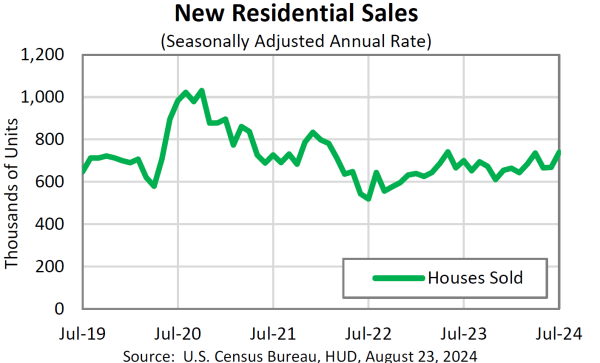
New Home sales rose by more than expected in July, increasing 10.6% to a seasonally adjusted annual rate of 739,000. This is still down about 5.8% compared to last year.

The Chicago Fed National Activity Index declined in July. Consumption and housing indicators improved, while production / income, employment, and sales indicators all fell.

The CFNAI is sort of a meta-index which gives a high-level view of the state of the economy. While the numbers don’t indicate recessionary territory, it does show a softening economy.

Morning Report: Housing starts fall

Vital Statistics:

Stocks are lower this morning on no real news. Bonds and MBS are up.

Housing starts declined to a seasonally-adjusted annual rate of 1.238 million. This is a 7% decline from a downwardly-revised June rate of 1.329 million, and down 16% compared to a year ago. Building permits fell 4% MOM and 7% YOY. Starts are at the lowest levels since May of 2020.

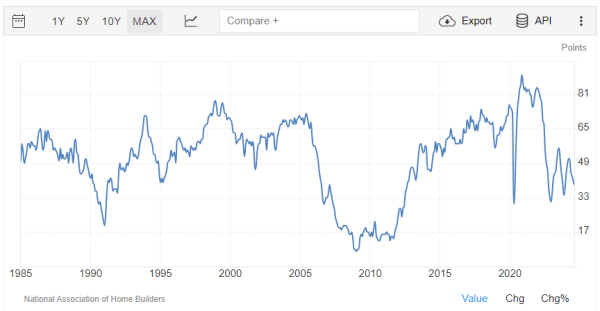
Homebuilder confidence declined in August as we await interest rate cuts. This is a decline from July and the lowest level since December last year. “Challenging housing affordability conditions remain the top concern for prospective home buyers in the current reading of the HMI, as both present sales and traffic readings showed weakness,” said NAHB Chairman Carl Harris, a custom home builder from Wichita, Kan. “The only sustainable way to effectively tame high housing costs is to implement policies that allow builders to construct more attainable, affordable housing.”

Homebuilder confidence is still stuck at the levels we saw during the post-bubble housing bust.

Mortgage delinquencies ticked up in the second quarter, according to the MBA. The delinquency rate rose 3 basis points QOQ to 3.97%. This is up 60 basis points compared to a year ago. “Mortgage delinquencies increased across all product types compared to this time last year,” said Marina Walsh, CMB, MBA’s Vice President of Industry Analysis. “While delinquencies are still low by historical standards, the recent increase corresponds with a rising unemployment rate, which has historically been closely correlated with mortgage performance.”

Industrial production fell 0.6% in July, according to the Federal Reserve. This was well below Street expectations. Manufacturing production fell 0.3%, which was in line with expectations. Capacity utilization fell to 77.8%. We have known the manufacturing economy is struggling, and this report shows no indication of a turnaround.

Morning Report: Housing inventory builds as affordability remains a concern.

Vital Statistics:

Stocks are lower as we finish up a turbulent week for markets. Bonds and MBS are up.

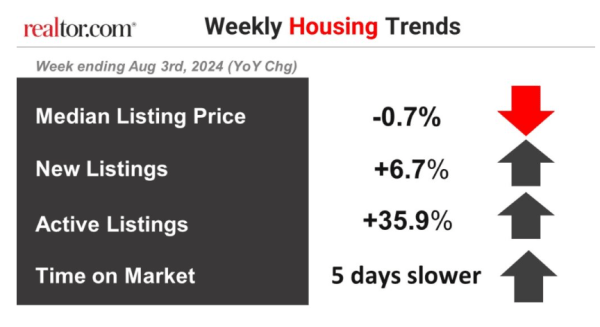
Active for-sale inventory rose 36% YOY, according to Realtor.com. The median listing price is down 0.7% YOY, while year-to-date listing prices are flat. Overall, we are getting to a more balanced home market.

The total value of US residential real estate rose to $49.6 trillion, according to research from Redfin. “The value of America’s housing market will likely cross the $50 trillion threshold in the next 12 months as there are not enough homes being listed to push prices down,” said Redfin Economics Research Lead Chen Zhao. “Mortgage rates have started falling, but many potential sellers and buyers are waiting to make a move, meaning we are likely to continue seeing a pattern where prices slowly tick up. That’s great news for the millions of American homeowners who see their equity rising, but first-time buyers are going to keep finding it tough to find an affordable home.”

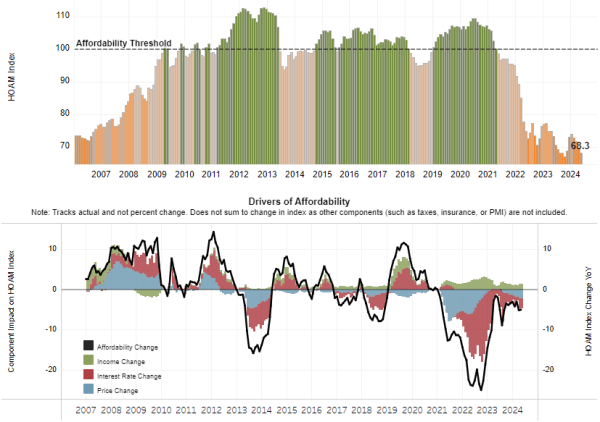
Affordability continues to be terrible however, according to the Atlanta Fed:

Morning Report: Weak employment data supports a September rate cut

Vital Statistics:

Stocks are lower this morning as tech continues to sell off. Bonds and MBS are up big on the disappointing jobs report.

The Bank of England cut rates this morning, which is also helping put global sovereign yields lower.

The economy added 114,000 jobs in July, which was below the Street estimate of 180,000. June was revised downward from 206,000 jobs to 179,000. The unemployment rate ticked up from 4.1% to 4.3%. The number of unemployed people ticked up to 352,000.

Average hourly earnings rose 3.6% YOY, and June’s 3.9% number was revised downward to 3.8%.

Overall, this was a disappointing jobs report, and strengthens the case for a September rate cut. The 10 year bond yield moved decisively lower, falling 14 basis points in the immediate aftermath of the report.

The manufacturing economy continues to deteriorate, according to the ISM Manufacturing Index. The index contracted for the fourth month in a row, and 20 out of the last 21 months. Employment contracted by quite a bit, however prices are still rising. “Demand remains subdued, as companies show an unwillingness to invest in capital and inventory due to current federal monetary policy and other conditions. Production execution was down compared to June, likely adding to revenue declines, putting additional pressure on profitability. Suppliers continue to have capacity, with lead times improving and shortages not as severe. Eighty-six percent of manufacturing gross domestic product (GDP) contracted in July, up from 62 percent in June. More concerning: The share of sector GDP registering a composite PMI® calculation at or below 45 percent (a good barometer of overall manufacturing weakness) was 53 percent in July, 39 percentage points higher than the 14 percent reported in June. Notably, all six of the largest manufacturing industries — Machinery; Transportation Equipment; Fabricated Metal Products; Food, Beverage & Tobacco Products; Chemical Products; and Computer & Electronic Products — contracted in July,” says Fiore.

Private residential construction spending fell for the second straight month in June, largely driven by a decline in single family building. We had been seeing a shift in building from multi-family to single family for the past 18 months or so, but now both are declining.