Morning Report: Home Prices continue their march upward

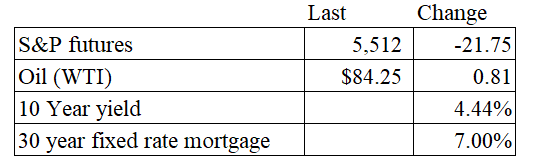
Vital Statistics:

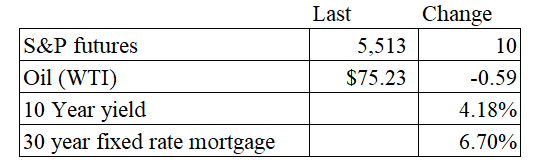
Stocks are higher this morning as earnings continue to come in. Bonds and MBS are down small.

The US Treasury expects to borrow $740 billion in the third quarter, which is down about $106 billion from the April estimate. It expects to borrow $565 billion in Q4.

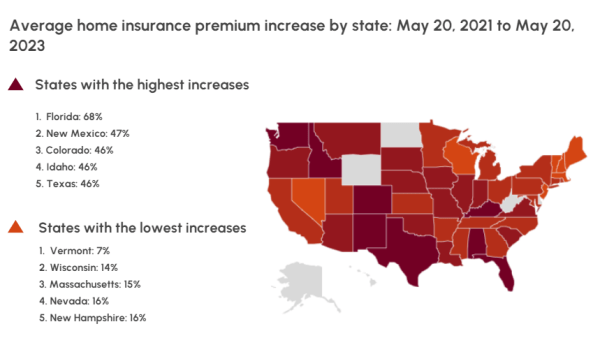
Home insurance premiums rose 21% last year. “The levels of risk and the kinds of hazards that a property can be exposed to are massively changing,” said Carlos Martín, director of the Remodeling Futures program at the Joint Center for Housing Studies of Harvard University.

“And right now there’s a lot of confusion, not just among the homeowners, but also among the insurers about how they should be pricing this actuarially,” he said.
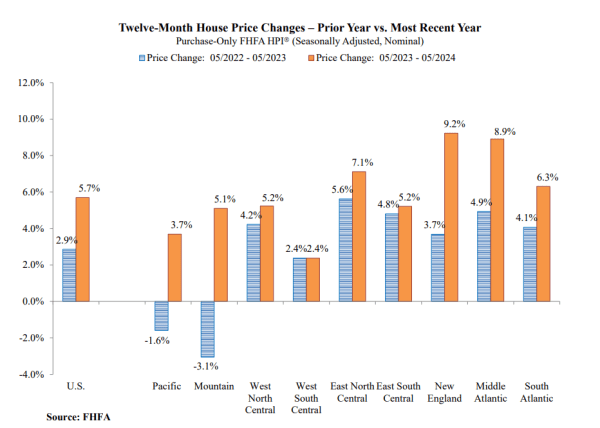
Home price appreciation was flat in May, according to the FHFA House Price Index. Over the past year, home prices rose 5.7%. “U.S. house price movement was flat in May,” said Dr. Anju Vajja, Deputy Director for FHFA’s Division of Research and Statistics. “The slowdown in U.S. house price appreciation continued in May amid a slight rise in both mortgage rates and housing inventory.”

The hot markets of the pandemic era are fading, while the post-2008 laggards are showing the most growth.
The Case-Shiller index showed a 5.9% annual gain in May. “While annual gains have decelerated recently, this may have more to do with 2023 than 2024, as recent performance remains encouraging,” says Brian D. Luke, Head of Commodities, Real & Digital Assets. “Our home price index has appreciated 4.1% year-to-date, the fastest start in two years. Covering the six-month period dating to when mortgage rates peaked, our national index has risen the past four months, erasing the stall experienced late last year. Collectively, all 20 markets covered continue to trade in a homogeneous pattern. Coming into the 2024 presidential election, traditional red states are in a dead heat with blue states, both averaging 5.9% gains annually.

“The Big Apple returned to the top of the leader boards, toppling San Diego from its six-month perch. New York’s 9.4% annual return outpaced San Diego and Las Vegas, by 0.3% and 0.7%, respectively. All 20 markets observed annual gains for the last six months. The last time we saw that long a streak was when all markets rose for three years consecutively during the COVID housing boom. This rally pales in comparison in both duration and annual gains, with above trend growth of 6.2%. The waiting game for the possibility of favorable changes in lending rates continues to be costly for potential buyers\ as home prices march forward.”

Morning Report: Existing Home Sales Fall

Vital Statistics:

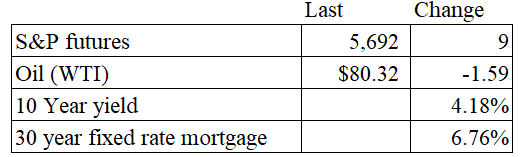
Stocks are lower this morning after lackluster earnings from Tesla. Bonds and MBS are flat.

Existing home sales fell 5.4% last month to a seasonally-adjusted annual rate of 3.89 million. “We’re seeing a slow shift from a seller’s market to a buyer’s market,” said NAR Chief Economist Lawrence Yun. “Homes are sitting on the market a bit longer, and sellers are receiving fewer offers. More buyers are insisting on home inspections and appraisals, and inventory is definitively rising on a national basis. Even as the median home price reached a new record high, further large accelerations are unlikely,” Yun added. “Supply and demand dynamics are nearing a balanced market condition. The months supply of inventory reached its highest level in more than four years.”

The median home price rose to 426,900, which was a 4.1% increase from a year ago. The first time homebuyer share fell from 31% to 29%, while investor purchases fell from 18% to 16%. The 3.9 million pace of existing home sales is pretty consistent for a housing recession. To put that number into perspective, we did something like 5.3 million in 2019.

Fannie Mae’s latest housing forecast is out. They see the 30 year fixed rate mortgage ending the year at 6.7%, and gradually falling to 6.2% by the end of 2025. Home price appreciation is expected to remain in the 6% range before falling into the 3% range in 2025. They expect to see 25 basis points in rate cuts this year and another 75 bp in 2025. The core PCE inflation rate is expected to fall to 2.7% this year and 2.3% next year.

PennyMac reported earnings that disappointed the Street. The company acquired $22.5 billion in loans in Q2, which was up 6% on a year-over-year basis. On the earnings conference call, CEO David Spector was asked about when we will start seeing more refi activity:

“Look, I think it’s a gradual decline down. I think if you look at originations post COVID, we kind of jumped and kind of ran through loans with 5% handle. And I think it’s really in the 6% to 7% range where you see a lot — and even north of 7%, where you see a lot of opportunity. It’s going to be — the way I think about it is it’s going to be the slow grind down. I think when rates get to 6.5%, that’s where it really picks up steam.

And I think at 6%, you’re in what I would deem a really robust refi market because it’s not just the existing first that are in the money. You could have loans that are 4% and 5%, taking out debt consolidation, cash refinance to either pay off existing HELOCs or closed-end seconds or other forms of debt. And so it’s really a function of what’s behind the first lien that helps drive the refinanceability. But I continue to believe that it’s 10-year around 3.75%, mortgage is down 50 basis points, that it really is to me, that’s the signal of a true new market or new phase of the refinanceability.”

Mortgage applications fell 2.2% last week as purchases fell 4% and refis rose 0.3%. “Mortgage rates continued to ease, with the 30-year fixed rate dipping to 6.82 percent, the lowest level since February 2024,” said Joel Kan, MBA’s Vice President and Deputy Chief Economist. “Refinance applications were up, driven by conventional and FHA application activity, as some borrowers took the opportunity to act. Furthermore, the conventional refi index was at its highest level since September 2022. Purchase applications decreased as ongoing affordability challenges persist with rates at their current levels and with home-price appreciation still strong in many markets.”

Morning Report: Jerome Powell acknowledges progress on inflation.

Vital Statistics:

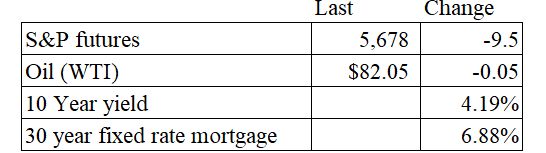
Stocks are higher this morning as earnings continue to come in. Bonds and MBS are up.

Jerome Powell spoke yesterday, and said that the Fed isn’t going to wait until inflation hits its 2% target before easing. “The implication of that is that if you wait until inflation gets all the way down to 2%, you’ve probably waited too long, because the tightening that you’re doing, or the level of tightness that you have, is still having effects which will probably drive inflation below 2%,” Powell said.

He also acknowledged the recent good inflation reports: “What increases that confidence in that is more good inflation data, and lately here we have been getting some of that,” he said.

The September Fed Funds futures now see a rate cut as a certainty.

Retail Sales were flat month-over-month in June, according to the Census Bureau. They rose 2.3% on a year-over-year basis. Since these numbers are not adjusted for inflation, real retail sales fell.

Non-store retailers (i.e. online shopping) and restaurants saw big increases. If you strip out motor vehicles, sales rose 0.4% MOM and if you exclude vehicles and gasoline, they rose 0.8%.

May’s retail sales numbers were revised upward.

When inflation rises, politicians invariably return to one of the dumbest ideas ever put forward – price caps. The idea is that we beat inflation by simply putting a ceiling on prices. Of course this has unintended consequences – the most common is that price controls create shortages – but those effects take time to play out, so it can often give a politician the veneer of “doing something” long enough to get through the election cycle before the unintended effects are visible.

I mention this because the Biden Administration wants to impose rent control nationwide, capping annual price increases at 5%. Of course since this doesn’t affect the costs that landlords bear, it will act to lower cap rates for multi-family developments, which will discourage investment.

Needless to say, industry groups oppose this. The MBA said “There are endless examples in localities in America and around the world that prove that rent control is a counter-productive policy idea that ultimately harms renters by distorting market pricing, discouraging new construction, and degrading the quality of rental housing. While the odds are stacked against this proposal ever passing Congress, a federal rent control law would be catastrophic to renters and our nation’s rental housing market. 

The measure requires Congressional approval, so has little-to-no chance of getting passed, let alone in an election year, but it does demonstrate yet again that bad ideas are like Freddy Kreuger – they keep coming back

Morning Report: Good surprise on inflation

Vital Statistics:

Stocks are lower despite a good CPI print. Bonds and MBS are up.

Inflation fell 0.1% MOM and 3.0% year-over-year. The Street was expecting an increase of 0.1%, so this was a good surprise for the bond market. Energy prices fell overall, which was offset by increases in shelter. Used Car prices were down 10% on a year-over-year basis.

If you strip out food and energy, prices rose 0.1% month-over-month and 3.1% year-over-year. This was again below expectations. The bond market reacted positively to the report, with the 10 year yield falling over 10 basis points to below 4.2%.

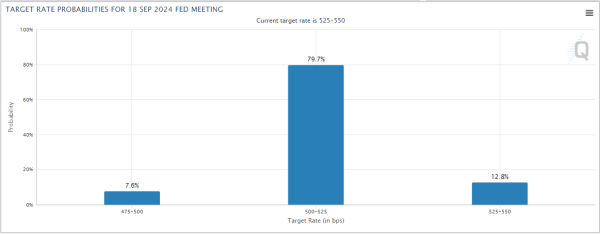
The September Fed Funds futures now see a 80% chance of a rate cut at the September meeting.

Over the past year, we have seen a lot of eye-popping payroll gains, which get revised downward in later months. The average downward revision this year has been 50,000 per month. The typical headline number has been around 275k, so this is a pretty big downward revision. What is going on?

The explanation may be that the numbers are less reliable due to lower response rates. The government estimates payroll growth by sending out questionnaires to businesses who report how many people they hired during the month. It goes out to some 600,000 businesses nationwide.

The response rate fell to a 21 year low in 2023, and has fallen even more this year. If less businesses respond to the survey, the less accurate it is. And with the big downward revisions, the labor market might be worse off than it initially appears.

One recent phenomenon has been the posting of “ghost jobs” which are job listings where the company really doesn’t intend to hire any one. They are there for HR window dressing and resume collection, but they don’t represent real hiring needs. If this behavior is affecting the JOLTs job openings number, then that is another employment statistic that is hiding a broader deterioration in the labor market.

Morning Report: Big week of data ahead

Vital Statistics:

Stocks are flattish as we head into earnings season. Bonds and MBS are up small.

The week ahead will have some important events, with Jerome Powell heading to the Hill on Tuesday and Wednesday for his semi-annual Humphrey-Hawkins testimony. We will get the consumer price index on Thursday, and earnings season kicks off with the big banks reporting on Friday.

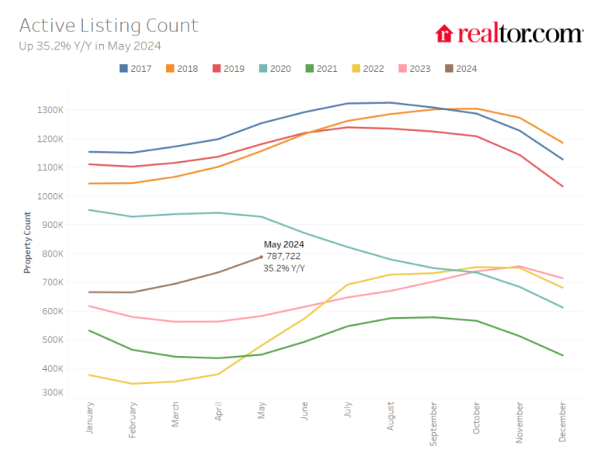
We are seeing for-sale inventory build, however we are still below pre-pandemic levels, according to research from Realtor.com. For-sale inventory rose 35% on a year-over-year basis, however median prices were flat. This might represent a mix shift, as prices rose on price per square foot basis.

While inventory is up 35% YOY, it is still about 35% below 2019 levels. Inventory is getting closer to balance in the South and West, where we saw a building boom over the past few years. Regions which saw muted growth post-2008 (lots of the Northeast and Midwest) are now catching up to the rest of the country.

Mark Zandi has come out in favor of rate cuts.

While the Fed Funds futures are seeing no move at the July 31 meeting, they are handicapping a 74% chance of a rate cut

Morning Report: Manufacturing continues to struggle

Vital Statistics:

Stocks are lower this morning on no real news. Bonds and MBS are up small.

Jerome Powell is speaking at 9:30 this morning.

The manufacturing economy contracted again in June, according to the ISM Manufacturing Report. “Demand remains subdued, as companies demonstrate an unwillingness to invest in capital and inventory due to current monetary policy and other conditions. Production execution was down compared to the previous month, likely causing revenue declines, putting pressure on profitability. Suppliers continue to have capacity, with lead times improving and shortages not as severe. Sixty-two percent of manufacturing gross domestic product (GDP) contracted in June, up from 55 percent in May. More concerning is the share of sector GDP registering a composite PMI® calculation at or below 45 percent — a good barometer of overall manufacturing weakness — was 14 percent in June, 10 percentage points higher than the 4 percent reported in May.”

Importantly, the prices index fell pretty dramatically, which helps support falling inflation.

The manufacturing economy expanded slightly in June, according to the S&P US Manufacturing PMI. New orders appear to be increasing, and input costs remain an issue. That said, business confidence hit a 19 month low. “Factories have been hit over the past two years by demand switching post-pandemic from goods to services, while at the same time household and business spending power has been diminished by higher prices and concerns over higher-for-longer interest rates. These headwinds persisted into June, accompanied by heightened uncertainty about the economic outlook as the presidential election draws closer. Business confidence has consequently fallen to the lowest for 19 months, suggesting the manufacturing sector is bracing
itself for further tough times in the coming months.”