Morning Report: Existing Home Sales fall

Vital Statistics:

Stocks are higher this morning on no real news. Bonds and MBS are down.

The week ahead will have a lot of real estate data, with home prices and pending home sales. We will get the third revision to Q1 GDP and get personal incomes / outlays on Friday which will give us the all-important PCE Price Index.

Existing home sales fell 0.7% MOM in May, according to NAR. This is a decline of 2.8% compared to a year ago. The median home price rose 5.8% on a YOY basis to $419,300. There are about 1.28 million units for sale, which represents a 3.7 month supply at the current sales pace. A balanced market is 6 – 7 months’ worth of supply.

“Eventually, more inventory will help boost home sales and tame home price gains in the upcoming months,” said NAR Chief Economist Lawrence Yun. “Increased housing supply spells good news for consumers who want to see more properties before making purchasing decisions.” “Home prices reaching new highs are creating a wider divide between those owning properties and those who wish to be first-time buyers,” Yun added. “The mortgage payment for a typical home today is more than double that of homes purchased before 2020. Still, first-time buyers in the market understand the long-term benefits of owning.”

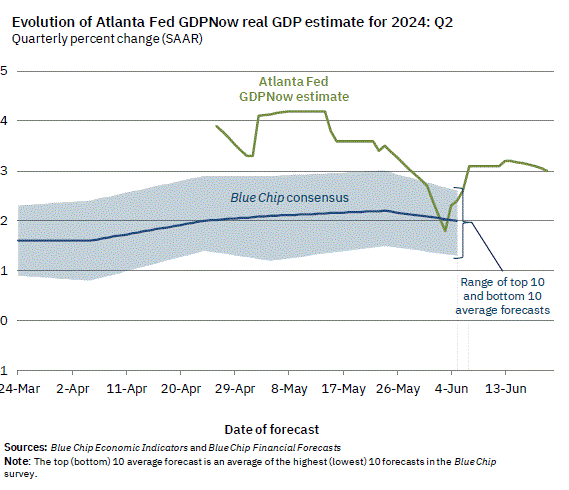
Q2 GDP is tracking around 3%, according to the Atlanta Fed GDP Now model.
Morning Report: The Fed sees one rate cut this year

Vital Statistics:

Stocks are higher as markets digest the Fed decision. Bonds and MBS are down small.

As expected, the Fed maintained the Fed Funds rate at current levels. “Recent indicators suggest that economic activity has continued to expand at a solid pace. Job gains have remained strong, and the unemployment rate has remained low. Inflation has eased over the past year but remains elevated. In recent months, there has been modest further progress toward the Committee’s 2 percent inflation objective.” In the May statement, the Fed said that “In recent months, there has been a lack of further progress toward the Committee’s 2 percent inflation objective.” So there is a bit of an improvement in the language.

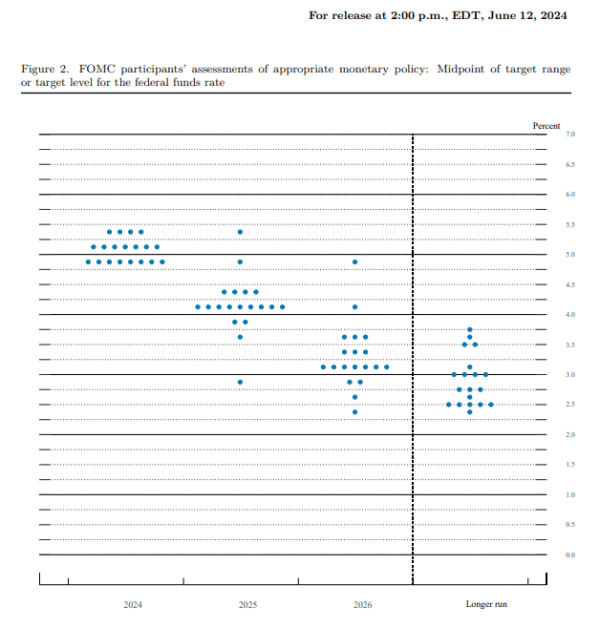
The dot plot showed the Committee expects to cut rates once this year. The economic forecasts didn’t move much, however they did bump up their inflation forecasts a tad, with the headline PCE forecast increasing from 2.4% to 2.6% and the core rate increasing from 2.6% to 2.8%.

We have another benign inflation report, with the producer price index actually falling 0.2% on a month-over-month basis and 2.2% on a year-over-year basis. About 60% of the decline was due to falling gas prices. Ex-food and energy, the index was flat and rose 2.3% on a YOY basis. Both numbers were below expectations.

More evidence of a weakening job market: Initial Jobless Claims rose to 242k last week. This is the highest level since August of last year.

The median home sale price in the US hit a record last week, according to Redfin. The median sale price hit $394,000 which is up 4.4% on a year-over-year basis. Asking prices appear to be leveling off however. The median mortgage payment fell to $2,829 due to falling mortgage rates. “The latest inflation report is good for homebuyers because it has already sent mortgage rates down, though this week’s Fed meeting will temper mortgage-rate declines,” said Chen Zhao, Redfin’s economic research lead. “But on the other side of the coin, if lower mortgage rates bring back more demand than supply, that could erase the possibility that home-price growth softens, and push prices up even further. Lower rates and higher prices may ultimately cancel each other out when it comes to homebuyers’ monthly paym

Morning Report: Weak ISM pushes down bond yields

Vital Statisics:

Stocks are lower this morning on no real news. Bonds and MBS are up.

Bond yields got pushed down on the softer-than-expected ISM survey yesterday. The market narrative seems to be shifting from persistent inflation to a slowdown.

The manufacturing economy deteriorated in May, according to the ISM report.  “U.S. manufacturing activity continued in contraction after growing in March, the first expansion for the sector since September 2022. Demand was soft again, output was stable, and inputs stayed accommodative. Demand remains elusive as companies demonstrate an unwillingness to invest due to current monetary policy and other conditions. These investments include supplier order commitments, inventory building and capital expenditures. Production execution continued to expand but was essentially flat compared to the previous month. Suppliers continue to have capacity, with lead times improving and shortages not as severe. Fifty-five percent of manufacturing gross domestic product (GDP) contracted in May, up from 34 percent in April.

The prices measure improved from April, but is still above February and March.

Construction spending fell 0.1% MOM and rose 10% YOY. Residential construction rose 8.1% on a year over year basis. There is a massive bifurcation in the resi market, with single-family construction up 20.4% YOY and multi-family up 2.3%.

We are seeing signs that multi-family has reached saturation and projects that penciled out in the 0% free-money era of COVID no longer make sense. “We certainly are seeing a decline in construction,” said Robert Dietz, chief economist at the National Association of Home Builders. “Deals and financing have dried up.”

The boom in multi-family building was the biggest since the early 1970s.

The inventory issue is most acute in the markets which boomed during the pandemic years – Boise, Phoenix, Austin, etc.

For-sale inventory is becoming more aligned with demand, according to the ICE Mortgage Monitor. “With 30-year rates easing and affordability improving entering the year, unadjusted monthly price gains had been running above their same-month 25-year average since the start of 2024,” said Walden. “However, softening price growth in April has dropped us below that long-run average. We’ve seen the rate of appreciation slow on an adjusted level as well, with April’s +0.28% increase in home prices a marked downshift from +0.45% in March.