Morning Report: Housing starts disappoint

Vital Statistics:

 LastChange
S&P futures4,2372.8
Oil (WTI)72.320.24
10 year government bond yield 1.49%
30 year fixed rate mortgage 3.14%

Stocks are flat as we await the FOMC decision. Bonds and MBS are flat.

The FOMC decision will be released at noon today. The markets will be listening for language pointing towards an end of MBS and Treasury purchases as well as the dot plot. I also think markets will be sensitive to how the Fed describes the state of the economy. Finally, I hope they discuss what is driving the current labor shortage and offer up a reasonable explanation for it.

Speaking of disappointing economic data, housing starts came in below expectations. Starts came in at 1.57 million, while permits came in at 1.68 million. Starts were more or less flat with April, while permits showed a small uptick. Labor and materials shortages are probably behind the disappointing numbers. That said, homebuilder sentiment remains elevated, despite challenges with input costs and labor.

Mortgage applications rose 4.2% last week as purchases increased 2% and refis rose 6%. Rates have been coming back down, which is increasing refi opportunities. “U.S. Treasury yields have slid because of the uncertainty in the financial markets regarding inflation and how the Federal Reserve may act over the next few months,” said Joel Kan, MBA Associate Vice President of Economic and Industry Forecasting. “Purchase activity also rebounded, even as supply constraints continue to slow the housing market. An almost 5 percent increase in government purchase applications drove most of last week’s gain while also tempering the recent growth in loan sizes. Purchase applications were still down 17 percent from a year ago, which was when the mortgage market started seeing large post-shutdown increases in activity.”

Note that NAR believes we have a 5.5 million unit gap in housing demand versus supply.

Mortgage credit availability rose in May, according to the MBA. “Mortgage credit availability in May increased to its highest level since near the start of the pandemic, but still remained at 2014 levels. The increase was driven by a 3 percent gain in the conventional segment of the market, with a rise in the supply of ARMs and cash-out refinances. This is consistent with the uptick in mortgage rates and a slowing refinance market, as well as MBA’s Weekly Applications Survey data showing increased interest in ARMs,” said Joel Kan, MBA’s Associate Vice President of Economic and Industry Forecasting. “The jumbo index jumped 5 percent last month, but even with increases over the past two months, the index is still around half of where it was in February 2020. A rapidly improving economy and job market has freed up jumbo credit, as banks have deposits to utilize. However, there is still plenty of restraint, as many sectors have not fully returned to pre-pandemic capacity, and there are around 2 million borrowers still in forbearance.” 

Morning Report: Retail Sales disappoint

Vital Statistics:

 LastChange
S&P futures4,2472.8
Oil (WTI)71.620.74
10 year government bond yield 1.50%
30 year fixed rate mortgage 3.14%

Stocks are flattish after a disappointing retail sales number. Bonds and MBS are down small.

The Fed starts its two-day meeting today. The announcement will be tomorrow at 2:00 PM. Bond yields have been slowly declining over the past week or two ahead of the meeting.

Retail Sales fell 1.3% in May. Ex-autos and gas, they fell 0.8%. These numbers were well below Street expectations. On a year-over-year basis, they are up smartly, but this is due to comparisons versus lockdowns. Since consumption is something like 70% of GDP, I find it strange to see the high GDP estimates given this backdrop.

As an aside, regarding retail sales etc, I was at the New England Mortgage Expo which was held at Mohegan Sun, a massive casino complex in Connecticut. The Expo usually has something like 2,000 people attending. If I had to venture a guess, I would say a few hundred attended. The other thing I noticed was the casinos were deserted. The vast majority of the blackjack tables were empty, with no dealers and no gamblers. Very few people playing slots. I heard that the casinos were having a horrible time finding workers as well.

Delinquencies fell to the lowest rate in a year, according to CoreLogic. 4.9% of mortgages were 30 days down. The foreclosure inventory rate was 0.3%, but that number is being held down artificially by the foreclosure moratorium. The eviction moratorium expires at the end of June. The CFPB supposedly plans to extend the foreclosure moratorium until the end of the year.

Inflation at the wholesale level rose 0.8% month-over-month and 6.6% year-over-year. Ex-food, energy, and trade services prices rose 0.7%. Raw material prices are behind the increases. That said, additional supply is coming on line, which should ease the pressure. Note that lumber is down about 40% from its peak a month ago.

The Fannie Mae Mortgage Lender Sentiment Survey shows that lenders expect profit margins to contract. “Despite elevated optimism toward the U.S. economy, lenders show a cautious outlook for their mortgage business,” said Doug Duncan, Fannie Mae Senior Vice President and Chief Economist. “This quarter, the largest net percentage of lenders in the survey’s seven-year history are expecting a decrease in their profit margin outlook. This is the third quarterly decline from the lender profitability highs of 2020. Those who expected a lower profit margin continued to cite competition from other lenders and market trend changes as the primary reasons. Lenders reported a significant refinance demand decline over the past three months and expect the decline to continue, with their refinance demand growth expectations reaching the lowest level seen since Q4 2018. With the shift from refinance to purchase business, some lenders commented that purchase transactions are harder to complete and have lower margin.”

Industrial production rose 0.8% in May, while manufacturing production rose 0.9%. Capacity Utilization rose to 75.2%.

Morning Report: The Atlanta Fed sees second quarter GDP rising 9.3%

Vital Statistics:

 LastChange
S&P futures4,2370.8
Oil (WTI)71.570.64
10 year government bond yield 1.47%
30 year fixed rate mortgage 3.12%

Stocks are flat as we head into Fed week. Bonds and MBS are up.

Aside from the FOMC meeting (which will also include a fresh set of projections), we will also get some important economic data with retail sales, the producer price index, and housing starts.

The Street is looking for the Fed’s dot plot to show rates increasing in 2023, and to start discussing tapering of MBS purchases later this year.

The MBA sent a letter to the Biden Administration calling for an end to the nationwide eviction moratorium when it expires on June 30. “As the pandemic comes under better control, we look forward to working with the Administration to end unsustainable nationwide federal restrictions on property operations, implement workable solutions for renters facing housing instability and help the country recover,” the coalition said.

The Atlanta Fed’s GDP Now forecast sees 9.3% GDP growth for the second quarter. Note that this forecast excludes some of the COVID-19 related effects and assumptions.

Pending home sales are slowing, according to Redfin. “While the market has not come to a full stop, we are seeing signs of yielding,” said Westchester County, NY Redfin real estate agent Candice Smith. “Buyers are winning bidding wars with offers that are $60,000 or less over asking prices; just a month ago in similar situations they had to go $100,000 or more over asking. Bidding wars are still the norm, but the number of competing offers have been cut in half from around 17 to about eight. Homebuyers still need to be strategically creative when submitting their highest and best offer, which involves methods like offering to cover an appraisal gap upfront, dropping the appraisal or mortgage contingency altogether or adding escalation clauses.”

You can see several indicators of demand cooling off in the chart below.

Mortgage REIT AGNC Investment reported a 6.5% drop in book value in the month of May. I don’t think MBS pricing got hit that hard, but that is a surprising report.

Morning Report: Inflation comes in hotter than expected

Vital Statistics:

 LastChange
S&P futures4,2232.8
Oil (WTI)70.370.34
10 year government bond yield 1.52%
30 year fixed rate mortgage 3.14%

Stocks are flattish this morning after inflation came in higher than expected. Bonds and MBS are down.

Inflation at the consumer level rose 0.6% MOM and 5% YOY. Given the lockdowns of a year ago, the annual numbers will have a lot of noise in them. Used vehicles accounted for a third of the increase. Ex-food and energy, the index rose 0.7% MOM and 3.8% YOY.

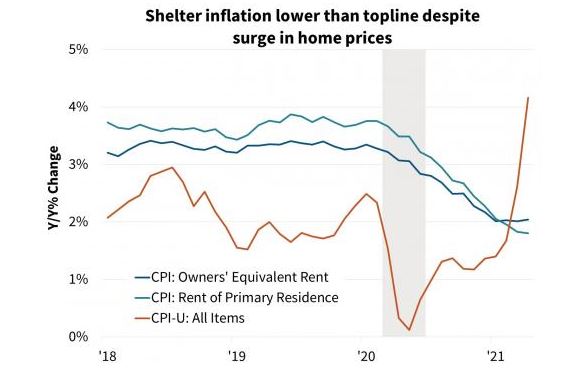
Housing is poised to push up the inflation numbers going forward, according to research from Fannie Mae. The inflation metrices attempt to capture home price appreciation via a concept called owners equivalent rent. Owners equivalent rent is a pretty lagged variable, which means that it probably won’t filter into the inflation numbers until 2022.

Initial Jobless Claims rose to 376,000 last week. Given the tightness of the labor market, it is surprising to see initial claims so elevated. Pre-COVID, they were in the low 200ks on average.

Home equity rose 19%, or about $1.9 trillion in the first quarter, according to CoreLogic. Negative equity fell about 24% to 1.8 million homes. This rise in equity will make cash-out refis a much bigger chunk of business going forward. “Homeowner equity has more than doubled over the past decade and become a crucial buffer for many weathering the challenges of the pandemic,” said Frank Martell, president and CEO of CoreLogic. “These gains have become an important financial tool and boosted consumer confidence in the U.S. housing market, especially for older homeowners and baby boomers who’ve experienced years of price appreciation.”

A bipartisan group of Senators are trying to craft an infrastructure plan that avoids tax hikes. This will be a tug-of-war between the left which wants to hike taxes and Republicans who are dead-set against raising them. While the Democrats nominally control the Senate, they will need 10 Republicans to go along to get a plan through.

Morning Report: The quits rate might be signaling future wage growth.

Vital Statistics:

 LastChange
S&P futures4,2339.8
Oil (WTI)70.340.33
10 year government bond yield 1.49%
30 year fixed rate mortgage 3.14%

Stocks are flattish this morning as oil rises above $70 per barrel. Bonds and MBS are up again.

The 10 year bond yield has started falling again, and this seems to be a global trade. The German Bund is back to negative 25 basis points, and just about every other sovereign bond yield is dropping. Some of this is a reversal of early-taper bets. Mortgage rates have been lagging the move as usual. Note the World Bank is forecasting that global growth will hit 5.6% this year, which would be the fastest growth since 1940. This would be incongruous with current bond yields, but with global central banks intervening so much in the market it might be useless as an economic signal.

Mortgage Applications fell 3.1% last week as purchases increased 0.3% and refis fell 13%. “Most of the decline in mortgage rates came late last week, with the 30-year fixed-rate mortgage declining to 3.15 percent. This likely impacted refinance applications,” said Joel Kan, MBA Associate Vice President of Economic and Industry Forecasting. “With fewer homeowners able to take advantage of lower rates, the refinance share dipped to the lowest level since April. Purchase applications were up slightly last week, and the large annual decline was the result of Memorial Day 2021 being compared to a non-holiday week, as well as the big upswing in applications seen last May once pandemic-induced lockdowns started to lift.”

Job openings hit a record high of 9.3 million at the end of April, according to the JOLTS job openings report. The biggest increase in openings came in food services. The quits rate hit 2.7%, and 4 million employees, both series records. Increases in the quits rate generally precedes increases in wages, and if the relationship holds, we should expect to see wage inflation into the second half of the year.

The increase in wages will undoubtedly contribute to further home price appreciation. I would expect to see this filter down into more esoteric mortgage products, as home price appreciation makes taking credit risk more appealing.

Morning Report: Small Business is getting more pessimistic on the economy

Vital Statistics:

 LastChange
S&P futures4,2359.8
Oil (WTI)69.340.11
10 year government bond yield 1.53%
30 year fixed rate mortgage 3.17%

Stocks are higher this morning on no major news. Bonds and MBS are up.

Almost half of small businesses report being unable to fill job openings, according to the NFIB Small Business Optimism Survey. “Small business owners are struggling at record levels trying to get workers back in open positions,” said NFIB Chief Economist Bill Dunkelberg. “Owners are offering higher wages to try to remedy the labor shortage problem. Ultimately, higher labor costs are being passed on to customers in higher selling prices.”

I found one particular aspect of the report interesting:

While the consensus from the Fed and most economists is that the economy is poised to accelerate into the second half of the year, this survey sees increased pessimism. Expected earnings trends are down as well. That said, the survey also showed increasing numbers for the “good time to expand” issue, so maybe it is just some weirdness in the data. A tight labor market and a weakening economy don’t generally go together.

If NFIB is correct and earnings trends are heading downward, that is a canary in the coal mine. Stocks gotta be vulnerable here. I wonder if that report explains some of the move in the 10-year this morning.

Freddie Mac lowered the limit of NOO / Second homes it will buy from 7% to 6% yesterday.

To complement those efforts, we have updated our requirements for Investment Property and second home Mortgages as follows: for the month of July 2021, if the Seller sells more than five Mortgages secured by second homes and/or Investment Properties, the Seller’s deliveries of such Mortgages may not, by measure of aggregate UPB, exceed 6.5% of the total UPB for all Mortgages sold during that month. After July, on a monthly basis, if the Seller delivers more than five Mortgages secured by second homes and/or Investment Properties, deliveries of such Mortgages may not exceed 6% of the total UPB of all Mortgages sold.

There seems to be an appetite for these loans from investors, so this probably won’t be that big of an issue. NOO pricing seems to have found a level here. This makes sense – these loans are generally <75 LTV, and with home price appreciation in the double digits, the collateral means these loans are going to be money good.

TIAA’s correspondent lending division is being acquired by Pen Fed.

The number of loans in forbearance fell slightly to 4.16% last week, according to the MBA. “The share of loans in forbearance declined for the 14th straight week, with small drops across most investor types and all servicer types,” said Mike Fratantoni, MBA Senior Vice President and Chief Economist. “Forbearance exits dropped to 6 basis points, the lowest weekly level since mid-February, but new forbearance requests, at 4 basis points, matched the recent weekly low from early May.”

Morning Report: Home prices rise 15% in April

Vital Statistics:

 LastChange
S&P futures4,2313.8
Oil (WTI)69.43-0.17
10 year government bond yield 1.57%
30 year fixed rate mortgage 3.17%

Stocks are flattish this morning on no real news. Bonds and MBS are up.

The upcoming week will be relatively data-light, however we will get some inflation data with the consumer price index. Year-over-year comparisons will be noisy given the lockdown of a year ago.

Home prices rose 14.8% in April, according to Black Knight Financial Services. There is just two months of inventory available for sale, which is the lowest since Black Knight started keeping records. Higher prices are driving down affordability, and the company estimates that it costs 20.5% of median income to make monthly payments on the median home price. This is high compare to the past decade, but below the historical average of 23.6%. The number of listings in April was down 60% compared to the 2017-2019 average. Note that Redfin says that asking prices are beginning to fall.

Lumber was limit down on Friday, as supply is finally catching up with demand.

The Fed is thinking about talking about considering the concept of reducing bond purchases, according to the Wall Street Journal. It wants to avoid the “taper tantrum” of 2013. “We’re going to have discussions about our stance of policy overall, including our asset-purchase programs, and including our interest rates,” Cleveland Fed President Loretta Mester said Friday on CNBC shortly after the Labor Department released what she described as “a solid employment report.” Note the Fed is planning on selling its holdings of corporate bonds and ETFs which it purchased last year to stabilize the credit markets.

June might be the pivot point for the economy’s second-half acceleration. Baseball stadiums will be back to full capacity, and the rest of California’s draconian COVID restrictions will end on June 15. The expanded COVID-19 unemployment benefits will lapse in September, which should be a catalyst for people to get back to work.

Morning Report: Jobs data disappoint.

Vital Statistics:

 LastChange
S&P futures4,20918.8
Oil (WTI)69.510.07
10 year government bond yield 1.61%
30 year fixed rate mortgage 3.16%

Stocks are higher this morning despite a disappointing jobs report. Bonds and MBS are flat.

The economy added 559,000 jobs in May, according to BLS. This number was below Street expectations. Leisure and hospitality accounted for about half of the new jobs created. The April number was revised upward to 278,000 so that report remains surprisingly weak.

The unemployment rate fell from 6.1% to 5.8%, however the labor force participation rate fell from 61.7% to 61.6%. The employment-population ratio did rise however to 58%

Average hourly earnings rose 0.5% MOM and 2% YOY. The big increase in lower-paid leisure / hospitality jobs is pulling down average hourly earnings, and is a reversal of what we saw a year ago.

Note that the ADP report showed that close to a million jobs were added in May, so there is a good chance this payroll number gets revised upward in the next couple of reports. One other point to keep in mind is that the seasonal adjustments have probably been introducing noise into the series as last year’s payroll volatility was a huge shock. The non-seasonally-adjusted payroll number was close to ADP’s estimate.

Independent mortgage bankers made $3,361 on each loan in the first quarter of 2021, which was the best first quarter on record. It was a decline from the fourth quarter, however that reflects the normal seasonality of the business. “Despite dropping slightly from the fourth quarter of 2020, net production profits reached their highest level for any first quarter since the inception of MBA’s report in 2008,” said Marina Walsh, CMB, MBA Vice President of Industry Analysis. “Triple-digit basis-point profitability was seen for the fourth consecutive quarter – another record that surpasses the 2012 boom generated from Home Affordable Refinance Program.”

Average volume fell slightly to $1.44 billion in the first quarter, and production revenue came in at 408 basis points. Net secondary marketing revenue decreased to 331 basis points from 346 in the fourth quarter. Purchase percentage fell to 39% from 43%.

Productivity fell to 3.6 loans per production employee from 4.2 in the fourth quarter. Since volumes were pretty much the same, it shows that mortgage banks added a lot of people in the first quarter.

Morning Report: The economy added a million jobs last month

Vital Statistics:

 LastChange
S&P futures4,183-22.8
Oil (WTI)68.910.07
10 year government bond yield 1.59%
30 year fixed rate mortgage 3.16%

Stocks are lower this morning on overseas weakness. Bonds and MBS are flat.

The economy added 978,000 jobs last month, according to ADP. Leisure / hospitality added 440k of these jobs. Education and health were the next biggest category at 139k. Note that the Street is looking for about 650k jobs in tomorrow’s employment situation report.

Nonfarm productivity increased 5.4% in the first quarter as output increased 8.6% and hours worked increased 3%. Unit labor costs rose 1.7% as compensation increased 7.2% and productivity rose 5.4%. The increase in productivity should be considered bond-bullish because it will counteract inflationary pressures. Productivity issues were a big driver of 1970s inflation as US plants were aged and becoming inefficient, while union contracts had big automatic escalators.

Initial Jobless Claims fell to 385,000 last week. We are still pretty elevated relative to historical norms, but nowhere near where we were a few months ago. Outplacement firm Challenger and Gray reported companies announced 24,586 job cuts last month.

A DC Appeals Court rejected an appeal by landlords to resume evictions. The moratorium is supposed to expire at the end of June. Sure would be nice to see property rights again in the US.

The Biden Budget is out, and like most of these documents is an aspirational document not meant to be taken seriously. Of note however is their interest rate assumptions: that negative real interest rates will continue for the next 10 years. In other words, the budget envisions the 90-day T-bill rate to be below inflation through 2031. GDP is expected to stabilize around 1.8% per year and unemployment is going to find a level around 3.8%. The 10 year bond yield is expected to gradually rise to 2.8%.

I don’t know what the assumptions are behind that projection, however it definitely assumes that the sovereign debt bubble that global central banks have inflated will not burst. Bubbles generally do not work that way, and we have never seen a sovereign debt bubble before, at least none that I am aware of.

China has followed the model of rapidly-growing states (the US in the early 1900s, Japan in the mid-1900s) where rapid growth creates credit and real estate bubbles. These bubbles inevitably burst, and the country goes through a multi-decade deflationary episode. The US deflation episode lasted from the mid 1920s through the early 1950s. Japan is still in its episode which started in the 1990s. If China does see the same thing, it will try and export its way out of it, which will mean inflation will remain low as it floods world markets with cheap goods.

In the past, investors would judge the sentiment of global government debt using gold. The barbarous relic is no longer considered much of an indicator, however cryptocurrencies will be the new barometer. I suspect more and more money will own crypto as a hedge against government profligacy. Which is why the government wants to ban it under the guise of preventing criminality.

Morning Report: High end home prices soar

Vital Statistics:

 LastChange
S&P futures4,2078.8
Oil (WTI)68.410.67
10 year government bond yield 1.60%
30 year fixed rate mortgage 3.15%

Stocks are flattish this morning on no real news. Bonds and MBS are up small.

Mortgage applications fell 4% last week as purchases fell 3% and refis fell 5%. “Tight housing inventory, obstacles to a faster rate of new construction and rapidly rising home prices continue to hold back purchase activity,” said Joel Kan, MBA Associate Vice President of Economic and Industry Forecasting. “ The government purchase index declined to its lowest level in over a year and has now decreased year-over-year for five straight weeks. Purchase applications were down almost 2 percent from a year ago, but that was compared to the week of Memorial Day 2020.”

Loans in forbearance fell 1% last week to 4.18%, according to the MBA. “The share of loans in forbearance slightly declined, dropping by only 1 basis point, due to a slower pace of forbearance exits,” said Mike Fratantoni, MBA Senior Vice President and Chief Economist. “Forbearance re-entries increased to almost 5.6 percent, as more homeowners who had canceled forbearance needed assistance again. There was also an increase in the share of PLS and portfolio loans in forbearance, while the share for Fannie Mae, Freddie Mac and Ginnie Mae loans decreased.”

In a bit of a post-bubble reversal, the highest-priced homes are seeing the biggest price appreciation. Up until very recently, high priced homes languished on the market, as there was little demand for anything over $1.5 million except for a few metros on the West Coast. Now, luxury properties in places like Austin, San Diego, and Phoenix are are seeing price appreciation approaching 20%.

“In the high-end market, we’re not only seeing multiple offers—we’re seeing buyers waiving appraisal and inspection contingencies, which doesn’t normally happen,” said Vincent Shook, a Redfin real estate agent in Phoenix. “The biggest driver is the influx of people from California. Still, competition remains toughest for buyers of affordable and mid-priced homes.”

Shook continued: “Some buyers with more modest budgets are coming to me and saying, ‘I want a four-bedroom home and here’s my maximum price.’ I’ve had conversations where I’ve had to be brutally honest and tell them that home literally does not exist anymore. It existed eight months ago when they started looking, but they wanted to wait in hopes that prices would come down. Prices didn’t come down, and now they’re priced out of the market.”

The Biden Administration has unveiled a home rehab tax credit, which is targeted towards low-and-median income borrowers. The idea is to encourage rehabbing of older homes. The buyer must make no more than 140% of the area median income, and will apply to only 1 in 4 census tracts, and the final sale price of the home cannot exceed four times the area median income.