Morning Report: Bonds down on trade progress with China

Vital Statistics:


Last Change
S&P futures 3017.5 5.25
Oil (WTI) 55.37 0.44
10 year government bond yield 1.83%
30 year fixed rate mortgage 3.90%


Stocks are higher this morning after further progress on trade talks with China. Bonds and MBS are down.


China walked back some proposed tariffs on US agricultural products after Trump agreed to delay some additional tariffs. Commodities in general are up on the news.


Retail Sales rose 0.4% MOM in August, according to Census. July was revised upward to an increase of 0.8% from an increase of 0.7%. This was the back-to-school shopping season, so it gives a good indication that this year’s holiday shopping season will be strong as well. Given that consumption accounts for 70% of GDP, we might see some upward revisions in Q3 and Q4 estimates.


Mortgage credit availability declined in August, according to the MBA. “Credit supply declined across the board in August, even as mortgage rates fell and application activity picked up, particularly for refinances,” said Joel Kan, MBA’s associate vice president of economic and industry forecasting. “Last month’s decrease was the largest since December 2018, and also the first tightening we have seen for conventional loans all year. We anticipate some weakening of the job market in the year ahead as economic growth cools. It’s possible some lenders may be tightening credit in expectation of a slowdown.” Some contraction was expected for VA due to the new rules, but it is surprising to see it in the other buckets.
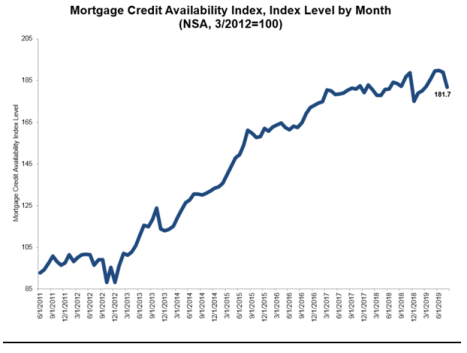
 

MCAI


The Trump Admin is working to end Fannie and Freddie’s net profits sweep in September. “We expect a deal prior to Sept. 30 in which Fannie and Freddie will stop paying a quarterly dividend to Treasury,” Cowen Managing Director Jaret Seiberg wrote in the note. “Instead, they will pay a commitment fee for the outstanding preferred capital line. This means they can retain the rest of their profits in order to rebuild capital.”

Morning Report: ECB cuts rates and bonds rally.

Vital Statistics:


Last Change
S&P futures 3009.5 5.25
Oil (WTI) 54.37 -1.44
10 year government bond yield 1.68%
30 year fixed rate mortgage 3.89%


Stocks are higher this morning after the European Central Bank cut rates and announced new stimulus measures. Bonds and MBS are up.


The European Central Bank cut its deposit rate to -50 basis points from -40 bps and re-instated bond purchases of 20 billion euros a month. This is sending down yields, with the German Bund now trading at -62 basis points. Separately, the Bank of Japan is also looking at measures to push their negative interest rates even lower.


Inflation remained under control with the consumer price index up 0.1% MOM / 1.7% YOY. The core rate, which strips out food and energy rose 0.3% MOM / 2.4% YOY. Medical care and shelter drove the increase in the index, while lower energy costs pushed it down.


Initial Jobless Claims fell to 204,000 in the holiday shortened week.


Treasury Secretary Steve Mnuchin said that the US is “seriously considering” issuing a 50 year bond. “We would do this in a way that if there is demand it’s something that we would meet. I personally think it would be a good thing to expand the U.S.′ borrowing capabilities,” Mnuchin said. “I would say it’s obviously quite attractive for us to extend and derisk the U.S. Treasury borrowing. So we’re also looking at extending the weighted average maturity of the Treasury borrowing to derisk this for the U.S. people.” Mnuchin also pushed back against Trump’s view that we need negative interest rates in the US, as negative interest rates wreak havoc on bank earnings, and a weak banking sector does not make a foundation for a strong economy.


Separately, Mnuchin said that the Trump Administration has approved the plan to reorganize the GSEs. “We are actively negotiating an amendment try to get it done by the end of the month” What “actively negotiating an amendment” means is unclear, but it probably refers to the net worth sweep of Fannie and Freddie’s profits to Treasury. Since that was done via executive order during the Obama administration, it should be able to be undone the same way. Full legislation is probably going to be impossible heading into an election year, judging by the way testimony went in the Senate.

Morning Report: Trump calls for negative interest rates

Vital Statistics:


Last Change
S&P futures 2983.5 5.25
Oil (WTI) 57.96 0.44
10 year government bond yield 1.73%
30 year fixed rate mortgage 3.85%


Stocks are up this morning on no real news. Bonds and MBS are flat.


We saw a big uptick in rates yesterday, with not much of a catalyst. It could just be position-squaring ahead of the expected stimulus announcements tomorrow from the ECB, although some pointed to the government bond auction. Regardless, these things happen. While the path of least resistance for interest rates clearly seems to be down, there will be inevitable retracements along the way – markets don’t go straight up or straight down.


Mortgage applications increased 2% last week as purchases rose 5% and refis increased about half a percent. “Mortgages rates continued to decline over the holiday-shortened week, with the 30-year fixed rate decreasing five basis points and remaining near three-year lows,” said Joel Kan, MBA Associate Vice President of Economic and Industry Forecasting. “Refinances were essentially unchanged, up just 0.4 percent, but August overall was the strongest month of activity so far in 2019.”


Steve Mnuchin, Mark Calabria, and Ben Carson appeared before the Senate yesterday to discuss GSE reform. The discussion fell predictably along partisan lines, with the left fretting about affordable housing while the right wanted to reduce the government’s footprint and risk in the system.


Meanwhile, Trump called on the “boneheads” at the Fed to cut interest rates, even below 0% if necessary. Trump is arguing that we should lower rates considerably in order to refinance our government debt into longer term loans, say 50 or 100 years. Note that cutting interest rates to 0% will wreak havoc on the banking system, as Europe is finding out. Check out the chart of Deutsche Bank, which has been annihilated by negative interest rates.


Deutsche Bank


Mortgage fraud decreased in the second quarter, according to CoreLogic.

Morning Report: Fannie Mae surges on reform optimism

Vital Statistics:


Last Change
S&P futures 2973.5 -5.25
Oil (WTI) 58.46 0.44
10 year government bond yield 1.64
30 year fixed rate mortgage 3.77%


Stocks are lower this morning on no real news. Bonds and MBS are flat.


Steve Mnuchin is scheduled to testify before the Senate Banking Committee this morning regarding housing reform and the role of Fannie and Freddie. Mark Calabria, who runs the FHFA and Ben Carson who runs HUD will also join him. Note that Fannie and Freddie surged 35% yesterday on a Compass Point piece that expressed optimism for a shareholder suit and Mnuchin said that they were closer to retaining their earnings. You might want to keep an eye on the screen this morning if you hold these stocks.


Fannie mae stock


Small Business Optimism fell in August as respondents tempered their optimism about the future. Much of this was due to the about-face at the Fed, and fears that they might know something everyone else does not. Despite the drop in expectations, the small business labor market improved, with firms hiring .19 workers on average, and many finding it difficult to hire qualified workers. Small business also increased capital spending, which indicates optimism about the future. So, despite the dip in optimism, firms are still spending like the expansion will continue. One other data point: credit availability remains a non-problem. Only 4% of small businesses reported that their borrowing needs were not met, which is more or less a historical record. So, don’t expect much additional juice from rate cuts, as there is already more than enough credit.


The Chinese government removed the foreign cap on investments, although this is largely a symbolic move, as the current limit presents no constraint. That said, it is hard to avoid the thought that the Chinese government is looking for some greater fools out there for their banking system to sell assets to. Despite the talk about the yuan becoming a reserve currency, the Chinese government probably won’t want to give up the amount of control required.


Delinquency rates continue to fall, according to CoreLogic. The 30 day delinquency rate fell 30 basis points to 4% in June. The foreclosure rate fell 10 bps to 0.4%. We did see an uptick in a few states that wasn’t natural disaster related: VT, NH, MN, and ND.


Corelogic delinquencies.


Morning Report: More GSE reform.

Vital Statistics:


Last Change
S&P futures 2990.5 9.25
Oil (WTI) 56.96 0.44
10 year government bond yield 1.59
30 year fixed rate mortgage 3.72%


Stocks are higher this morning on no real news. Bonds and MBS are down small.


No economic data today, and this week should be relatively data-light, with retail sales on Friday the only potential market-moving number. No Fed-speak as we are in the quiet period ahead of next week’s meeting.


Jerome Powell vowed to act “as appropriate” to maintain the current US expansion, which was largely taken as an admission the Fed will cut rates another quarter point at next week’s meeting. The Fed funds futures are pricing this in as a certainty, although there is disagreement within the Fed over whether it is necessary to cut rates given the strong consumer spending. He also threw cold water on political considerations affecting monetary policy. “Political factors play absolutely no role in our process, and my colleagues and I would not tolerate any attempt to include them in our decision-making or our discussions,” he said. “We are going to act as appropriate to sustain the expansion.” This was presumably in response to comments from ex-NY Fed president William Dudley to  “consider how their decisions will affect the political outcome in 2020.”


Interesting data point: Compass Point Analytics upped their price target for Fannie Mae stock to $7.75. which is almost 3x the current trading price of $2.71. Fannie Mae stock got hit last week on disappointment with the lack of specifics in the government’s housing reform plan.


Despite the disappointment from Fannie Mae stockholders and pref holders, the housing industry generally likes what the saw in the plan. “The reports recognize the need to better coordinate the roles of FHA and the GSEs,” Mortgage Bankers Association CEO Robert Broeksmit said. “Such coordination must preserve affordable financing options for a wide range of borrowers and reflect the vital role FHA plays in the larger housing finance system.” Talks about getting rid of the GSEs altogether seem to be over: “Both in the Obama administration and during periods of bipartisan negotiations the focus was on whiteboarding a totally new system,” said David M. Dworkin, who was a senior adviser in the Treasury Department on housing finance during the Obama and Trump administrations. “It is too hard. The current system is too embedded and the unintended consequences are too unpredictable.” The GSE affordable housing goals would also go away, to be replaced by a fee paid to HUD, who would then distribute the funds themselves. This is likely to be a non-starter with Democrats.


Mortgage interest deductions fell 62% last year as tax reform encouraged most people to take the standard deduction instead of itemizing.


Morning Report: GSE reform

Vital Statistics:


Last Change
S&P futures 2981 9.25
Oil (WTI) 55.12 -1.14
10 year government bond yield 1.57
30 year fixed rate mortgage 3.74%


Stocks are higher this morning after the jobs report. Bonds and MBS are flat.


Jobs report data dump:

  • Nonfarm payrolls up 130,000, lower than expectations, and the ADP report
  • Unemployment rate 3.7%, unchanged
  • Labor force participation rate 63.2%, unchanged
  • Employment-population ratio 60.9%
  • Average hourly earnings up 0.4% MOM / 3.2% YOY, above expectations

Overall, a disappointing report given the big ADP number, but the ADP generally predicts the final numbers, which means this data probably gets revised upwards. The employment-population ratio continued to edge up, which is good, although we still are nowhere near pre-crisis levels. This indicates that wage growth will remain in a Goldilocks range: enough to beat inflation, but not too hot to worry the Fed.


employment population ratio


The Trump Administration released its GSE reform plan. The plan states that ” the existing Government support of the secondary market should be explicitly defined, tailored, and paid-for, and the GSEs’ conservatorships should come to an end, subject to the preconditions set forth in this plan.” The government’s guarantee should “stand behind significant first-loss private capital and would be triggered only in exigent circumstances.” “Single-family guarantors should be required to maintain a nationwide cash window through which small lenders can sell loans for cash, and also should be prohibited from offering volume-based pricing discounts or other incentives to their lender clients.” The government support for the GSEs under the preferred stock purchase agreement would be replaced with an explicit, paid for guarantee backed by the US government for paying principal and interest on MBS. The plan would end (or at least modify) the “net worth sweep” which would allow the GSEs to rebuild capital. The GSEs would still have a role to promote affordable housing. FNMA stock is looking down about 6% on the open.


Michael Burry, of The Big Short fame, sees a bubble in indexing and passive investment ETFs. Passive investments now account for half of the stock market as more investors pile into these low-fee investment vehicles. “Trillions of dollars in assets globally are indexed to these stocks,” Burry said. “The theater keeps getting more crowded, but the exit door is the same as it always was. All this gets worse as you get into even less liquid equity and bond markets globally.” Certainly the leveraged ETFs – the triple long and triple short types – will become hopelessly illiquid in a market distortion. Burry runs a hedge fund, so he is talking his book a little but like all investment crazes, the more money that goes into the asset class, the more marginal each incremental trade becomes. Eventually, you might see a return to active stock management as they begin to outperform, especially small caps.

Morning Report: Strong ADP jobs report

Vital Statistics:


Last Change
S&P futures 2963 25.25
Oil (WTI) 56.12 0.14
10 year government bond yield 1.53%
30 year fixed rate mortgage 3.7%


Stocks are up this morning after China and the US supposedly have scheduled an October meeting. Bonds and MBS are down on the risk-on trade.


We have quite a bit of strong data this morning, starting with the ADP jobs report, which came in at 195,000. This was much higher than the 149k the Street was looking for, and the 158k expected for tomorrow’s jobs report. This was the highest number in 4 months. Manufacturing added 8,000 jobs, so we aren’t seeing any sort of trade-driven pull-back in that sector. Construction added 6,000 jobs. Where are jobs shrinking? tech and mining.


ADP report


Challenger and Gray released their layoffs report, which backed up the ADP report of job cuts in tech. The layoff report is based on press releases, not actual job cuts. US employers announced 53,480 job cuts last month, of which 10,000 were due to trade war issues. That said, most of the job cuts were in retail. “Employers are beginning to feel the effects of the trade war and imposed tariffs by the U.S. and China. In fact, trade difficulties were cited as the reason for over 10,000 job cuts in August,” said Andrew Challenger, Vice President of Challenger, Gray & Christmas, Inc. “We are continuing to see investor concerns shaking confidence in the market, and employers appear to be cutting workers in response to a slowdown in demand for their products and services,” he added.


In other economic data, productivity in the second quarter was unchanged at 2.3% and unit labor costs were revised upward to 2.6%. The Street was expecting a downward revision in productivity. Hourly compensation was revised upward to a 4.9% increase. Initial jobless claims came in at 216k.


We had a slew of Fed-speak yesterday, with a wide range of opinions, from John Williams of the NY Fed avoiding the dovish bent versus St. Louis President James Bullard advocating for 50 basis points. FWIW, the market is virtually unanimous in its forecast of a 25 basis point cut at the September 17-18 meeting.


Despite falling rates and rising home prices, bidding wars for properties hit an 8 year low in August, according to Redfin. “Despite remaining near three-year lows, mortgage rates have failed to bring enough buyers to the market to rev up competition for homes this summer,” said Redfin chief economist Daryl Fairweather. “Recession fears have been enough to spook some would-be buyers from making the big financial commitment of a home purchase. But assuming a recession doesn’t arrive this fall or winter, consumers will likely adjust to the new ‘normal’ of continued volatility in the stock and global markets, and the people who need and want to make a move will take advantage of low mortgage rates. As a result, I still expect homebuying competition to pick back up in the new year.”

Morning Report: High Frequency Traders and Mortgage Rates

Vital Statistics:


Last Change
S&P futures 2907 -16.5
Oil (WTI) 53.33 -1.74
10 year government bond yield 1.50%
30 year fixed rate mortgage 3.78%


Stocks are lower this morning on trade issues. Bonds and MBS are flat.


The holiday-shortened week ahead looks to be relatively quiet, with the exception of a spate of Fed-speak on Wednesday and the jobs report on Friday. The September Fed Funds futures are pricing in a 100% chance of another 25 basis point cut, and the Fed seems to be in market-following mode, so the data should take a backseat.


Manufacturing activity slipped in August, according to the ISM Manufacturing Survey, which came in at 49.1, well below expectations. This was the first contraction in the manufacturing sector since mid-2016. The level for the ISM typically corresponds with 1.8% GDP growth.


Separately, construction spending rose 0.1%, which was lower as well, however the previous month’s drop was revised upward from -1.3% to -.7%.


Home prices rose .5% MOM / 3.6% YOY in July, according to CoreLogic. Home price appreciation slowed in 2018 as rates rose. That effect will reverse over the next year, and Corelogic expects annual home price appreciation rates to settle in around 5%. Tight supply, especially amongst starter homes will support prices, as well as a robust labor market and a move out of urban areas to the suburbs. About 37% of the US housing stock in the top 100 MSAs is overvalued. This metric is based on wage growth and housing supply.


Hurricane Dorian is expected to miss direct landfall, however it is slow-moving and dumping a lot of rain. Coastal areas will be at risk of flooding as the storm parallels the Eastern Seaboard this week.


The WSJ has an interesting article this morning about thinning liquidity in the markets. Late summer is often characterized by thinning liquidity, which means fewer active investors are trading, which causes exaggerated market movements when a big buyer or seller wants to execute an order. They mention what has been going on in the Treasury market:

Some analysts point to high-frequency traders. They have dominated the government-bond market, making up a big chunk of trading activity compared with slower counterparts, according to JPMorgan analysts. These traders withdrew last month, the firm said, suggesting that they amplified turbulence. Investors said liquidity worries are even more pronounced in riskier corporate bonds.

“As you go further down the credit spectrum, it starts to get a bit more volatile,” said Gautam Khanna, a fixed-income portfolio manager at Insight Investment. “Liquidity is definitely thinner in this market than it has been.”

This might help explain why mortgage rates have lagged the move in Treasuries. In essence, high frequency traders help establish a liquid market, where it is easier for large investors such as banks, sovereign wealth funds, pension funds, etc to trade large positions. When these high frequency traders withdraw, bid / ask spreads widen, and volatility increases. Here is the issue: MBS investors hate volatility because it makes their portfolios hard to hedge, and adds uncertainty about prepayment speeds. This causes them to be more conservative with respect to the prices they are willing to pay for mortgage backed securities, which flows through to mortgage rates falling less than the move in Treasuries would predict. Below is a chart of 10 year Treasury futures volatility. You can see the spike in the index beginning in August, which corresponds with the dramatic drop in rates, and the exit of high frequency traders from the market.


treasury futures volatility