Morning Report: Why we aren’t headed for a recession

Vital Statistics:


Last Change
S&P futures 2874 24.5
Oil (WTI) 54.62 -0.14
10 year government bond yield 1.55%
30 year fixed rate mortgage 3.78%


Stocks are higher on no real news this morning. There is a risk-on feel to the tape after a tumultuous week. Bonds and MBS are down.


Housing starts disappointed (again!) coming in at 1.19 million, lower than the 1.26MM street estimate. This is down 4% on a MOM basis, and up about 0.6% on a YOY basis. On the bright side, building permits surprised to the upside, coming in at 1.34 million versus the 1.27 million street estimate. Still, new home construction remains depressed due to labor shortages and lack of buildable lots.


Despite these issues, homebuilders remain optimistic. The NAHB / Wells Fargo Builder Sentiment Index rose in August to 66. Current sales conditions improved, while expectations for the next six months moderated. “While 30-year mortgage rates have dropped from 4.1 percent down to 3.6 percent during the past four months, we have not seen an equivalent higher pace of building activity because the rate declines occurred due to economic uncertainty stemming largely from growing trade concerns,” said NAHB Chief Economist Robert Dietz. “Although affordability headwinds remain a challenge, demand is good and growing at lower price points and for smaller homes.” Interesting about the tariff issue – building materials prices are down quite substantially. If tariffs were really that big of a deal, you would expect to see shortages and increases. We aren’t.


Given all the chatter about the yield curve and a possible recession, it is worthwhile to step back and take a look at the facts on the ground. The business press is awash with stories about the yield curve and how it is possibly signalling a recession. The yield curve shows interest rates along the spread of maturities, and short term rates are usually lower than long term rates. However, we are flirting with a situation where long term rates are lower than short term rates. That is a yield curve inversion, and historically a yield curve inversion has been a decent (but not perfect) predictor of an imminent recession. The reason for this is that it implies that businesses are taking less risk, which means they must see something wrong in the economy.


The problem with the inverted yield curve model is that it gives off a lot of false positives – an old market saw is that an inverted yield curve has predicted “15 of the last 10 recessions.” Many times an inverted yield curve is the result of technical issues in the bond markets, which are temporary and don’t really spill through to the overall economy. This current period is probably one of those cases, and the technical issue is central bank behavior. The Fed, ECB, Bank of Japan have been pushing down long term rates in order to stimulate the economy for years, and now we have negative interest rates in much of the world. Negative interest rates in Germany and Japan (two huge bond markets) is drawing down US bond yields as overseas investors sell things that pay less than nothing (German Bunds and Japanese Government bonds) to buy things that pay something (US Treasuries).


The business press is emphasizing the recession angle here because (1) it is a much simpler story to tell, (2) the partisans can blame it on Trump, and (3) many strategists are too reluctant to stick their necks out and discuss the implications of negative rates worldwide – this is a completely new phenomenon and quite simply people don’t know.  We have a bubble in sovereign debt that has been engineered by global central banks – unlike stock and real estate bubbles, and we don’t have any historical analogy. We know that bubbles end eventually, and how this resolves is anyone’s guess.


That said, what is the current economic state of play? Europe is doing its same-old Euro-sclerosis thing, which it has been doing for decades. Germany had a flat GDP quarter and most of the Eurozone is slowing down in sympathy. Japan has been in the throes of a sclerotic economy since the New Kids on the Block ruled the charts. China is also tempering its growth. On the other side of the coin, the US has the lowest unemployment rate in 50 years, initial jobless claims are the lowest since we had a military draft, wages are rising, inflation is under control, and the consumer is increasing spending. This simply is not a recipe for a recession. And to take this a step further, tariff income has been about $60 billion since they have been implemented. In the context of a $21 trillion economy, this is insignificant – about 1/3 of 1%. It is a humorous state of affairs with partisan talking heads accusing Trump of destroying the economy over small-beer tariffs, while Trump accuses partisan journalists of sabotaging the economy with negative stories – as if the press had the power to do that.


Here is the big picture: The US economy has been strong enough to withstand a tightening cycle from the Fed, and has had 2.6% GDP growth in the immediate aftermath of a tightening cycle. Inflation is low, and is probably going to go lower as Europe and China begin exporting deflation to the US. Oh, and by the way the Fed is now cutting interest rates, which is the equivalent of giving a can of Red Bull to your kid at 9:00 pm on Halloween night. Don’t buy the recession narrative. None of the required pieces are in place.

Morning Report: Strong retail sales

Vital Statistics:


Last Change
S&P futures 2857 14.5
Oil (WTI) 54.92 -0.64
10 year government bond yield 1.59%
30 year fixed rate mortgage 3.84%


Stocks are up after strong retail sales numbers. Bonds and MBS are flat. The German Bund hit a new low this morning, trading at negative 66 basis points.


Strong retail sales numbers out this morning. The headline number was up 0.7%, well above the Street expectations of 0.4%. The control group, which strips out volatile gas and autos, was up 1.0% MOM, exceeding the Street estimate by 0.7%. Note that Trump’s delay of Chinese tariffs means they won’t hit until mid-December, or after the holiday shopping season. These numbers bode well for the back-to-school shopping season, which is the second most important of the year. Note that Walmart also reported strong numbers this morning, another bellwether for the retail sector. Expect strategists to take up their GDP estimates on these figures.


In other economic news, initial jobless claims rose to 220,000 last week, while industrial production fell 0.2% MOM and rose half a percent YOY. Capacity Utilization fell to 77.5%. The industrial and manufacturing numbers are probably influenced by trade.


Productivity rose 2.3% in the second quarter, way more than expectations as output rose 1.9%, hours worked fell 0.4% and compensation rose 4.8%. The biggest surprise however came in the revisions, where compensation in the first quarter was revised upward from -1.5% to +5.5%! These are inflation-adjusted numbers, so we had real compensation growth of 5.2% in the first half of the year. Where was the growth strongest? Manufacturing.


With the inversion of the yield curve, the business press is chattering about an imminent recession. Don’t buy it. Most of them are talking their partisan book and are sticking with their preferred narrative: (Trump’s trade war is causing a recession!). It helps that it is the most convenient and easy to explain scenario, and let’s face it: it is hard to talk about overseas interest rates when most journalists wouldn’t know a Bund if it bit them in the begonias. Reality check: you generally don’t get recessions with a dovish Fed, unemployment at 50 year lows, strong consumer spending and accelerating wage growth. In fact, the bullish case is that with strong wage growth, overseas deflation keeping inflation in check, and a dovish Fed, you could see a scenario similar to the mid / late 90s. Food for thought.


The new FHA guidance for condos is available in its unpublished form here. The new rule will become effective 60 days after publication in the Federal Register (which should be any day now) and will make more condos eligible for FHA insurance.


Home prices rose 3% in July, according to Redfin. “July home prices and sales were weaker than I had expected, especially given that falling mortgage rates have been luring homebuyers back to the market since early spring,” said Redfin chief economist Daryl Fairweather. “Even though we’ve seen increased interest from homebuyers—especially compared to a year ago when mortgage rates were climbing—uncertainties in the overall economy and talk of a looming recession have people feeling jittery about making a huge purchase and investment. But I think the odds are that we won’t see a recession within the next year. If rates stay low and the economy continues to grow, we’ll see more homebuyers come back in a serious way in 2020, and the market will be much more competitive.” Home sales were down 3.4%, while supply fell by the same amount. In terms of price, the previously hot markets of San Jose and Seattle fell, while many of the laggards (like Cleveland and Rochester) rose.


Redfin price chart

Morning Report: The US yield curve inverts

Vital Statistics:


Last Change
S&P futures 2890 -41.5
Oil (WTI) 55.49 -1.64
10 year government bond yield 1.61%
30 year fixed rate mortgage 3.88%


Stocks are lower after disappointing overseas economic data. Bonds and MBS are up on the flight to safety.


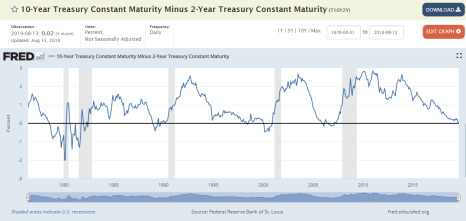
Overnight, the US yield curve officially inverted with 2s/10s trading at negative 1.7 basis points.  This has historically been considered a recession indicator. You can see the chart below, which plots the difference between the 10 year bond yield and the 2 year bond yield, and not that the shaded grey bars (which represent recessions) have historically followed after the line goes to zero. One caveat to keep in mind however: In the past, we didn’t have the sort of activism out of central banks that we have now. Quantitative easing (where the central bank tries to directly influence long term rates) are a new phenomenon, and therefore investors should take that signal with a grain of salt. Still, it does speak to a global slowdown, and that will inevitably pass through to the US.


2s10s


The German Bund yields negative 64 basis points, which is a record low. Their economy contracted by 0.1% last quarter. This is what is driving stocks lower and bonds higher. The trade war is being blamed on their economic weakness. China reported the slowest industrial growth since 2002.


The FHA announced they will widen the credit box for condos, in an attempt to revive the entry-level condo market and help the first time homebuyer. “This is set to really expand homeownership,” said Ben Carson, secretary of the Department of Housing and Urban Development, which oversees the FHA. FHA will now begin insuring loans in unapproved buildings, provided no more than 10% of the units have a FHA loan.


Mortgage applications increased 21.7% last week as purchases increased 2% and refis increased 37%. The average contract interest rate fell from 4.01% to 3.93%, and has dropped about 80 basis points this year. The government refi index is at the highest level since 2013, driven by VA refis.

Morning Report: 30 year bond yield near record lows

Vital Statistics:


Last Change
S&P futures 2871 -14.5
Oil (WTI) 54.49 -0.44
10 year government bond yield 1.69%
30 year fixed rate mortgage 3.85%


Stocks are lower this morning after the Argentinian markets blew up overnight and the Hong Kong airport remains occupied by protesters. Bonds and MBS reversed their rally and are down after the Trump Administration announced they would delay the tariff increases on Chinese goods until mid-December. They were scheduled to take effect September 1.


The German Bund yield has hit a record low at negative 61 basis points. While the 10 year bond yield is still some 30 basis points from a record, the 30 year bond is getting close at a yield of 2.13%. Note that with the 10 year yield of 1.63% is lower than the dividend yield of the S&P 500.


30 year bond yield


Some economic data this morning: the consumer price index rose 0.2% MOM / 1.8% YOY, which was a touch higher than the Street forecast. Ex-food and energy, it rose 0.3% / 2.2%. The CPI remains pretty much where the Fed wants it, and is not going to be the driver of Fed policy, at least in the near term. Like it or not, the Fed is watching the markets and following them even if the signal-to-noise ratio is heavily distorted.


Small Business Optimism continued to increase as the index improved in July. Despite all of the handwringing in the business press over growth small business continues to grow and invest. Biggest headwind? Labor. The top concern of business was finding quality labor at 26%, which is a record. 57% reported capital expenditures, which means they have enough confidence to invest in infrastructure to grow their businesses. Only 3% of businesses reported not having their credit needs met, which is close to historical lows and kind of begs the question of what the Fed hopes to accomplish with lowering rates.


Mortgage delinquency rates continued to fall, hitting 20 year lows for most of the country. 30 day DQs fell to 3.6% and the foreclosure rate fell to 0.4%. The only areas with elevated DQ rates are in the Midwest and Southeast and are the result of flooding.


delinquencies


Fitch is out saying that GSE reform will probably not result in near-term downgrades.

Morning Report: Trump talks down the dollar

Vital Statistics:


Last Change
S&P futures 2905 -14.5
Oil (WTI) 54.68 0.64
10 year government bond yield 1.69%
30 year fixed rate mortgage 3.86%


Stocks are lower after a bunch of non-US political headlines over the weekend. Bonds and MBS are up.


Overseas, currencies and bond yields are focusing on elections in Italy and Argentina, as well as protests in Hong Kong. Protestors shut down the Hong Kong airport over the weekend.


The week ahead will have a few important data points, but nothing likely to be market-moving. We will get inflation at the consumer level tomorrow, retail sales / productivity / industrial production on Thursday, and housing starts on Friday. There doesn’t appear to be any Fed-speak this week, so things should be quiet absent overseas political developments. Congress is on vacation until Labor Day, so things should be quiet in DC as well.


Building materials prices rose 0.7% (NSA) in July, but are down overall year-over-year. Despite tariffs, softwood lumber prices are down 20% over the past year, while other products like gypsum are down less. Roofing materials (tar / asphalt) were flattish-to-down as well. Rising home costs are due more to labor, land, and regulatory costs than they are due to sticks and bricks.


After rising for a decade, average new home sizes are falling as builders pivot away from luxury buyers to first time homebuyers. In 2018, the average size of a single family dwelling was 2,588 square feet, down from 2,631 the year before. Builders had largely decided to relegate the first time homebuyer to the resale market and focused on McMansions and luxury urban apartments during the immediate aftermath of the housing crash. Townhomes are also increasing in popularity, with 69,000 sales last year, the most since 2007. This is the sector growing the fastest.


Prepay speeds were released on Friday, and we saw some eye-popping CPRs on the government side: 2018 FHA had a CPR of 30.7%, while VA was almost 50%. People who loaded up the boat on MSRs in 2017 and 2018 have been killed.


The Fed is looking at the idea of a countercyclical capital buffer as a way to mitigate the credit cycle. The idea would be to have the banks hold more capital (i.e. lend less) when the economy shows signs of overheating and then allow them to hold less (i.e. lend more) when the economy goes into a down cycle. This would only apply to the Citis and JP Morgans of the world – banks with more than 250 billion in assets. “The idea of putting it in place so you can cut it, that’s something some other jurisdictions have done, and it’s worth considering,” Fed Chairman Jerome Powell said at a late July press conference. It is an interesting idea, although reserves are typically sovereign debt, and this sounds a bit like adding buying pressure to a market that certainly does not need it.


Trump tweeted about the dollar, arguing that it should be weaker. Note this is a yuge departure from the strong dollar policy that every other president has supported. “As your President, one would think that I would be thrilled with our very strong dollar,” he tweeted. “I am not! The Fed’s high interest rate level, in comparison to other countries, is keeping the dollar high, making it more difficult for our great manufacturers like Caterpillar, Boeing, John Deere, our car companies, & others, to compete on a level playing field. With substantial Fed Cuts (there is no inflation) and no quantitative tightening, the dollar will make it possible for our companies to win against any competition. We have the greatest companies in the world, there is nobody even close, but unfortunately the same cannot be said about our Federal Reserve. They have called it wrong at every step of the way, and we are still winning. Can you imagine what would happen if they actually called it right?”


The strength in the dollar is more due to the relative strength of the US economy versus its trading partners, along with various carry trades. A carry trade is where you borrow money in a low yielding currency like the Japanese yen and invest the proceeds in a high-yielding government bond like the US Treasury. The net effect of a strong dollar is to make our exports more expensive to foreign buyers, make imports cheaper for US consumers and to lower interest rates in the US. The problem is that the ones who benefits from a weaker dollar (exporters) are loud and visible, while the beneficiaries (everyone else) aren’t even aware they are benefiting from it. Note that as the US has pivoted from a manufacturing-based economy to a service / IP based economy, the currency has a smaller and smaller impact on things.


Chart US dollar index (1989 – Present):


dollar

Morning Report: Inflation comes in lower than expected

Vital Statistics:


Last Change
S&P futures 2025 -14.5
Oil (WTI) 53.14 0.64
10 year government bond yield 1.70%
30 year fixed rate mortgage 3.83%


Slow news day.


Stocks are lower this morning as we round out a volatile week. Bonds and MBS are up with global sovereign yields lower across the board. The Japanese Government Bond is flirting with a record low yield at -22 basis points. Japan has about $12 trillion in government debt outstanding, which isn’t chump change – it is about 75% of the Treasuries held by the public.


Chaos in the Italian government pushed their yields up 26 basis points, and they now yield more than US Treasuries. Also, China reported a year on year decline in producer prices, as the country is in a bind between slowing growth and a real estate bubble.


Inflation at the wholesale level came in lower than expected, with the producer price index up 0.2% MOM / 1.7% YOY. Ex-food and energy, it fell 0.1% MOM and was up 2.1% YOY. Now that the Fed is in easing mode, the inflation numbers will fade in importance.

Morning Report: Reprieve from volatility

Vital Statistics:


Last Change
S&P futures 2891 10.5
Oil (WTI) 52.40 1.34
10 year government bond yield 1.75%
30 year fixed rate mortgage 3.83%


Markets are stronger this morning after China fixed the yuan stronger than expected. Bonds and MBS are down.


Mortgage credit availability decreased in July, according to the MBA’s Mortgage Credit Availability Index. Conventional credit increased by 0.1%, while government credit decreased. Credit increased primarily in the jumbo space. The drop in government credit availability was seen primarily in the high balance and streamline buckets.


Foreclosures filings are down 18% in the first six months of the year, according to ATTOM. Most MSAs fell, and it looks like any increases were concentrated in Florida. 177k properties entered the foreclosures process in the first 6 months of the year, down from 1.07 million in the first 6 months of 2009, which was the peak.


One strategist is out with a call for a “Lehman-like” sell off in the stock market, beginning as early as this month. Note this is a call based on market technicals, not fundamentals, which means it is looking at sentiment indicators and volatility. Note that the crash of 1987 happened in a similar environment, with trade and currency tensions between the US and Japan. Note another technical analyst is out with a call saying the US 10 year yield will eclipse the prior low of 1.36%. It is important to keep in mind that the US economy is not driving the action right now, nor is trade. This is being driven by overseas bond markets, and the actions of foreign central banks. The Fed is following the markets, not driving them.


Initial Jobless Claims fell to 209k last week, while consumer credit fell in June.


Morning Report: Surprise refi boom

Vital Statistics:


Last Change
S&P futures 2850 -24.5
Oil (WTI) 52.746 -.94
10 year government bond yield 1.63%
30 year fixed rate mortgage 3.86%


Stocks are lower this morning on continued trade fears. Bonds and MBS are up.


New Zealand cut its short term interest rate more than expected, which sent sovereign yields lower overnight. The German Bund is approaching negative 60 basis points, and UK Gilts just dropped below a 50 basis point yield. All of this pushed US Treasury yields down to 1.62% overnight and we are now sitting at 1.63%. 2s-10s are at 10 basis points, and the September Fed Funds futures are now pricing in a 100% chance of a cut, with a 1/3 chance of 50 bps and a 2/3 chance of 25 bps.


fed funds futures


Mortgage rates have been falling along with the drop in yields, but they have been lagging the move. We are seeing compression high up in the rate stack, which means that the higher note rates are not improving by much. Why is that? Prepayment fears. Given the drop in rates, it is a risky bet to pay 105 for for a Fannie 4.5% coupon bond when the 2.5% are trading at par.  Those 4.5% MBS might prepay so quickly you won’t make up for that extra premium you paid. Hedging issues are also coming into play here, as MBS investors generally abhor rate volatility and we have been getting a lot of it. Bottom line, this is good news for mortgage bankers, but prepare to be disappointed when you run new scenarios. Rates are better, but not by as much as you would expect.


Mortgage applications increased 5.3% last week as purchases decreased 2% and refis increased 12%. On a YOY basis, refis are up 116%. Take a look at the chart of the MBA refi index below. Houston, we have a refi boom. Now if we could only do something about housing starts….


refi index


Lost in the noise about interest rates was another strong job openings report. The JOLTs job openings came in better than expected at 7.35 million and the prior month was revised upward to 7.38 million. The quits rate was flat at 2.3%.

Morning Report: Trump labels China a currency manipulator

Vital Statistics:


Last Change
S&P futures 2853 24.5
Oil (WTI) 54.76 -.04
10 year government bond yield 1.75%
30 year fixed rate mortgage 3.92%


Stocks are higher after China stopped the devaluation of the yuan and fixed it at a higher than expected rate. Bonds and MBS are flat.


Treasury officially called China a “currency manipulator” yesterday for the first time since 1994. This is a specific term used when the country in question intervenes in the currency markets and has a large trade surpluses. That said, it is also largely symbolic in that it doesn’t have any real consequences. It brings the IMF into the loop and that is about it. In essence it is a political move.


The 10 year bond was up something like 24 ticks yesterday, but we did not see much movement in MBS, particularly up in the rate stack. If you were looking for big improvements in the 4%+ note rate range, you were disappointed. As a general rule, MBS will lag the moves in Treasuries, especially large ones. If the 10 year seems to find a level around these prices, then eventually mortgage rates will follow. But it generally seems like mortgage rates take a “wait and see” posture after big moves. If we get some sort of trade detente with China, it is likely we will give back a big chunk of this rally and mortgages seem to be wary of this.


Home prices rose 0.4% MOM and 3.4% YOY according to CoreLogic. This is despite lower rates from a year ago. Prices are rising at the lower price points and languishing at the higher price points. That said, incomes are rising and that should push prices higher, especially combined with lower rates.


Grandpa, tell me again about when people paid to lend money? We know all about negative yields in the sovereign debt markets, with investors paying over 50 basis points per year for the privilege of lending to the German government. We have seen some corporate bonds trade at negative yields, so why not mortgages, too? Jyske Bank in Denmark is offering 10 year mortgage bonds with a negative coupon. Nordea Bank may be following suit as well, by offering 30 year mortgage bonds with negative coupons. Denmark’s government bond yields -50 basis points already, and some banks in Denmark are offering 30 year mortgages with rates as low as 50 basis points. Home prices are up 24% over the past 2 years in Denmark.


You have to wonder what the Fed is thinking here – no matter what they do, it seems long term rates globally are being drawn into a vortex of negative rates. Mohammed-El Arian talked about this at the MBA secondary conference in May – the 10 year yield is going to be pulled down by global rates no matter what the Fed does. The US has to feel like the Rodney Dangerfield of government bonds: of the major players, only Greece, Russia, Mexico, Brazil, Indonesia, China, and India have higher yields.


The service economy cooled in July, according to the ISM non-manufacturing PMI. It fell from 55.1 to 53.7, which means the sector grew, just at a slower rate than June. That said, this is the lowest reading since August of 2016, which is a concern. The report usually has some anecdotes and I thought this was interesting: “Tariffs continue to push costs higher, and customers are looking for more discounts due to mortgage-rate fluctuations.” (Construction). We have a housing shortage and builders are experiencing softening prices?


Black Knight Financial Services said that July home affordability is at an 18 month high. Falling interest rates have translated into a 15% increase in buying power. The share of median income needed to make principal and interest payments on the average home fell from 23.3% to 21.3% in November 2018. In the early 80s, when mortgage rates were double digit, this percentage was closer to 40%.

Morning Report: 10 year bond yield hits a 3 year low

Vital Statistics:


Last Change
S&P futures 2886 -44.5
Oil (WTI) 54.43 -.84
10 year government bond yield 1.77%
30 year fixed rate mortgage 3.91%


Stocks are lower this morning on more trade war fears. Bonds and MBS are up.


Bond yields worldwide are down this morning, and many traders are watching the yuan / dollar exchange rate. Weakening the yuan is one of the arrows in China’s quiver to combat tariffs. A weaker yuan will make Chinese imports cheaper, which can offset the effect of tariffs. Globally, we see the German Bund with a negative 50 basis point handle, and the Japanese government bond pushing negative 20 basis points. If this continues, I think we are looking at another 25 basis point cut in September.


Trump tweeted about the yuan exchange rate this morning and called it “currency manipulation.” This is not an idle term – Treasury Secretary Steve Mnuchin has resisted calling China a currency manipulator, because it is a weighty accusation. Trump also asked if the Fed was “listening.” The Fed is not in the currency business – that is Treasury’s job – but he is putting additional pressure on the Fed to cut rates. If there is a silver lining in all this, it is that it means lower rates and that is good for the mortgage market. It also looks like some of the more expensive real estate markets on the West Coast are re-thinking their zoning laws, which could add some much-needed supply.


The week after the jobs report is invariably data-light, and this week is no exception. The biggest reports will be job openings on Tuesday and producer prices on Friday. Since we are no longer in a tightening cycle, the inflation data will not be a market mover. Note that the disappointing construction spending number is pulling down Q3 GDP estimates to the 1.6% – 1.9% range.