Morning Report: CFPB will no longer “push the envelope” 2/13/18

Vital Statistics:

Last Change
S&P Futures 2643.5 -11.8
Eurostoxx Index 372.7 -0.2
Oil (WTI) 58.8 -0.5
US dollar index 83.8 -0.3
10 Year Govt Bond Yield 2.54%
Current Coupon Fannie Mae TBA 103.591
Current Coupon Ginnie Mae TBA 103.688
30 Year Fixed Rate Mortgage 4.37

Stocks are lower this morning on no real news. Bonds and MBS are up small.

Small Business Optimism rebounded in January as expansion plans hit a record high. The net percentage of businesses saying “now is a good time to expand” was the highest since 1973, when the survey began. A more benign regulatory and tax environment is helping drive sentiment. In fact, “finding quality workers” is a bigger concern now than “taxes and regulations.” Small businesses added .23 workers last month on average.

The CFPB released its strategic plan for the next 5 years, and it marks a departure from the Cordray CFPB. CFPB Acting Director lays out his strategic vision in the opening statement: “This Strategic Plan presents an opportunity to explain to the public how the Bureau intends to fulfill its statutory duties consistent with the strategic vision of its new leadership. In reviewing the draft Strategic Plan released by the Bureau in October 2017, it became clear to me that the Bureau needed a more coherent strategic direction. If there is one way to summarize the strategic changes occurring at the Bureau, it is this: we have committed to fulfill the Bureau’s statutory responsibilities, but go no further. Indeed, this should be an ironclad promise for any federal agency; pushing the envelope in pursuit of other objectives ignores the will of the American people, as established in law by their representatives in Congress and the White House. Pushing the envelope also risks trampling upon the liberties of our citizens, or interfering with the sovereignty or autonomy of the states or Indian tribes. I have resolved that this will not happen at the Bureau. The rest of the document reiterates the role of the CFPB and Mulvaney’s commitment to those duties.

Donald Trump laid out his priorities in a budget document yesterday. These sorts of things are never intended to become law (Obama had one that garnered exactly zero votes), but are more to lay out philosophies and priorities. The document did contemplate an increase in the guaranty fee that Fannie Mae charges borrowers by 10 basis points. At the margin, this would make Fannie loans somewhat less attractive relative to FHA / VA however it probably won’t matter all that much. The amount of money involved ($26 billion over 10 years) is not major. Separately, shareholders of Fannie Mae and Freddie Mac stock had hoped the document would discuss the GSEs retaining their profits. That didn’t happen.

Hurricane-related delinquencies rose in November, but fell everywhere else, according to CoreLogic. 30 year DQs fell overall from 5.2% a year ago to 5.1%. The foreclosure rate fell from 0.8% to 0.6%.

Morning Report: Bond Vigilantes returning? 2/12/18

Vital Statistics:

Last Change
S&P Futures 2648.5 29.8
Eurostoxx Index 373.8 5.1
Oil (WTI) 60.3 1.1
US dollar index 84.2 0.0
10 Year Govt Bond Yield 2.87%
Current Coupon Fannie Mae TBA 103.591
Current Coupon Ginnie Mae TBA 103.688
30 Year Fixed Rate Mortgage 4.37

Stocks are soaring this morning on overseas strength. Bonds and MBS are down.

No economic news today. The only market moving data this week should be the Consumer Price Index on Wednesday and the Producer Price Index on Thursday. We will get some housing data, with starts and the FHFA House Price Index, although those should not matter to the markets. Bonds are probably going to be an inverse stock ETF for a while – meaning that when stocks are down, they will be up and vice versa.

Old timers may remember the term “bond vigilantes” from the early days of the Clinton Administration. Early on in Bill’s term he wanted to do a fiscal stimulus package which would have increased government spending. As he talked about increasing spending to goose the economy, the bond market would sell off in response, raising interest rates. In other words, the government’s plan to increase economic growth via government spending was being offset by the market (increasing rates are generally bad for the economy). At one point, Bill Clinton was so exasperated, he exclaimed: “You mean to tell me that the success of the economic program and my re-election hinges on the Federal Reserve and a bunch of f****** bond traders?” James Carville, Bill’s strategist once said ““I used to think that if there was reincarnation, I wanted to come back as the president or the pope or as a .400 baseball hitter. But now I would like to come back as the bond market. You can intimidate everybody.”

Fast forward to today. With the spending deal in place, along with a possible infrastructure plan, the economy will be getting plenty of stimulus and government spending. The bond market has been artificially supported by the Fed and global central banks, and that is unwinding. The bond vigilantes may be coming back, which is ironic since probably 3/4 of the bond traders on the street are experiencing their first tightening cycle. But, the trader in me sees the path of least resistance in the bond market as down, which means that rates are generally heading up. In practical terms, this means floating is a lot riskier than it used to be. During the last 30 years, rates generally moved down over time, so if you floated you often did well on that trade – you weren’t paying for a lock, and your rate at closing was probably better than it was when you opened the file. Given the change in market direction, the risk of floating is that the rate will increase over time, and in that circumstance it might make better sense to lock. Note that this isn’t a forecast of the bond market over the next 45 or 60 days, but an observation that the market “feels” like it wants to go down. It is something to keep in the back of your mind when discussing a lock with a borrower.

The House tweaked some of the “points and fees” language in Reg Z last week. Democrats have been universally opposed to the Financial CHOICE act, which makes some changes to Dodd-Frank. This may have a chance in the Senate, or at least a better chance than CHOICE would.

Best headline from last week: Low volatility ETN dies of irony. This was in reference to the XIV inverse VIX ETN which blew up early last week.

Morning Report: Fannie Mae will now allow AirB&B income on refi applications 2/9/18

Vital Statistics:

Last Change
S&P Futures 2593.0 0.0
Eurostoxx Index 368.2 -5.9
Oil (WTI) 60.4 -0.8
US dollar index 84.2 0.0
10 Year Govt Bond Yield 2.83%
Current Coupon Fannie Mae TBA 102.688
Current Coupon Ginnie Mae TBA 102.938
30 Year Fixed Rate Mortgage 4.33

Stock index futures are flat this morning after yesterday’s closing sell-off. Bonds and MBS are up.

There wasn’t any real catalyst for yesterday’s sell-off, aside from the natural phenomenon of volatility begets volatility. At the margin, stock market volatility is good for interest rates, but it does have negative consequences on your blood pressure.

So far the sell-off has yet to be reflected much in credit spreads. The biggest high yield ETF has dropped a few points over the past week, but nothing major. It did hit a low of 66 during the financial crisis and also a low in the 70s during early 2016. When high yield debt begins to seriously drop, you tend to see big drops in interest rates overall. Treat this ETF like the proverbial canary in the coal mine. High yield spreads overall are still below the 5 year average, which means investors are not even close to panicking.

You might not have been aware, but the government shut down for a few hours last night. Democrats in the House (and a few Republicans) balked at the Senate bipartisan plan that adds about $300 billion in spending over the next two years and kicks the debt ceiling can down the road until 2019. This takes continuing resolutions / debt ceiling grandstanding off the table for the 2018 midterms.

Homeowners will soon be allowed to include Air B&B income on their applications for refinancings. This is a new Fannie Mae program that will initially only be offered by a few lenders.

Fannie Mae’s Home Purchase Sentiment Index hit an all-time high last month on the back of a strong economy and rising house prices. The index increase was driven by expectations of increased home price appreciation. Personal economic expectations (things like concern over losing a job / household incomes) have been in a tight range over the past year.

Morning Report: Govt cracking down VA loan churning 2/8/18

Vital Statistics:

Last Change
S&P Futures 2681.3 13.3
Eurostoxx Index 380.1 7.3
Oil (WTI) 61.3 -0.6
US dollar index 84.2 0.0
10 Year Govt Bond Yield 2.86%
Current Coupon Fannie Mae TBA 102.688
Current Coupon Ginnie Mae TBA 102.938
30 Year Fixed Rate Mortgage 4.33

Stocks are higher as Monday’s sell-off gets smaller in the rear view mirror. Bonds and MBS are down.

The Senate reached a 2 year budget deal to fund the government which bumps up spending by $300 billion. It suspends the debt ceiling for a year, bumps up defense and social spending and provides additional relief to Puerto Rico. We’ll see if this can get through the House: the left is mad there is no immigration deal, while the right objects to the increase in spending.

Initial Jobless Claims hit a 45 year low last week, falling to 221,000.

The government is cracking down on VA IRRRL abuses and has told 9 lenders that they will remove them from the VA program if they don’t find a way to curtail refinance abuses. “We are targeting our actions at outliers, not at lenders who are genuinely helping to support responsible lending,” Ginnie Mae Chief Operating Officer Michael Bright wrote in a statement through a spokesman. These abuses are bad for the affected veterans who borrow the funding fee, but they also affect others, particularly other borrowers in FHA / VA loans. Part of the reason why it has been so difficult to get any fee pickup as you move up in rate has been due to serial refinancings. Investors are reticent to purchase high coupon TBAs.

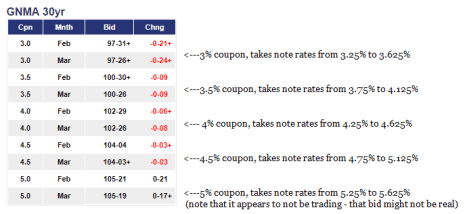
I’ll try and explain what is going on, but first a little background on how government loans are priced. Suppose a borrower wants to get a lender credit and is willing to pay a higher rate to do it. The TBA rate stock is used to determine the rate / fee that goes to the borrower. If a borrower wants a note rate between 4.25% and 4.625%, their loan will be sold into a 4% TBA, which is trading at 102.8125. The difference between par and 102.8125 +/- any lender credits is what pays LO comp, covers the cost of doing the loan, overhead, etc. The higher up you go in the rate stack, the more profit margin you have to play with, and therefore the bigger credit you can offer. If the borrower is willing to take a note rate of 4.75% to 5.125%, the baseline TBA price is 104.125 and that differential between the TBAs represents the increased lender credit the borrower can receive. Here is the problem: What happens if a borrower wants to go even higher and get a bigger credit? If there is no demand for the next TBA coupon (say 5%), then the increase might not be a point – it might only be half a point.  Note today that all the TBAs are down for the day except for the 5% note rates. That means those prices are stale and probably not real.

Ginnie rate stack

Why would investors not be interested in buying the 5% Ginnie note rates? It has to do with prepayment speeds. If you are an investor, you are paying well over par (in this case, maybe 4 or 5 points over par) in order to get something that will give you par back at some point. In other words, you are paying 104 and once the loan pays off you are getting 100, which is a loss of 4 points. You are betting that you will get back that 4 points over time because the note rate is higher than what you could typically get for an instrument with similar credit risk. So, if you buy a bond over par it might take a few years to recoup that premium you paid. If the borrower refis in 6 months, you lose. Ginnie Mae investors have been burned over the past several years paying 105 – 106 for a security that pays them par in a few months when the borrower gets a VA IRRRL. Investors have become gun-shy at buying the higher coupon TBAs, and that affects everybody, not just the veteran who rolled a 1.5% funding fee into a new mortgage for a smaller monthly payment of a couple bucks and the right to skip a payment or two.

The Elizabeth Warrens of the world will focus on the veteran who is paying a big fee for a refi that will take several years to break even, but Ginnie will be focused on some of the unintended consequences of this, and it really becomes evident when you look at how it affects the more marginal borrower. Ginnie Mae was created to finance the tougher credits – the first time homebuyer, the cash-strapped buyer, manufactured homes, lower income / credit buyers. These homebuyers usually have risk factors that will translate into bigger loan level pricing adjustments, and will often require a higher note rate to make the math work. If those higher note rates are not available, then it becomes tough to finance those people, and Ginnie Mae’s mission is to help get these people loans. Which is why Ginnie is very sensitive to the actual investors of Ginnie Mae MBS as well as the veteran. The behavior of a few rogue lenders really does impact the whole market and pretty much everyone who takes out a government loans.

Morning Report: More on volatility 2/7/18

Vital Statistics:

Last Change
S&P Futures 2700 5.0
Eurostoxx Index 376.7 -8.8
Oil (WTI) 63.2 -0.8
US dollar index 83.9 0.0
10 Year Govt Bond Yield 2.78%
Current Coupon Fannie Mae TBA 103.591
Current Coupon Ginnie Mae TBA 103.688
30 Year Fixed Rate Mortgage 4.33

Stocks are flat this morning after recovering about half of Monday’s losses. Bonds and MBS are up.

Mortgage applications were up 0.7% last week as purchases were flat and refis rose 1%. This is despite an increase in rates. Spring Selling season is more or less upon us. Inventory will continue to be an issue, especially if wage growth continues.

Here is a Bloomberg story discussing the volatility we saw on Monday. Much of it traces back to an ETF – the inverse VIX or XIV. This was the easiest way for retail investors to play the volatility in the market. The XIV had been rising all through last year and the beginning of this one as volatility compressed in the equity markets. This shows the possible unintended consequences of some of these products. The XIV is basically a proxy of a proxy of a proxy. In other words, it is an easily-tradeable proxy for the VIX, which is a proxy for how index options are trading. Hedging activity ultimately drove the volatility of the underlying index and arbitrage activity caused the movement in the underlying stocks. Bottom line, the catalyst for the sell-off is probably over.

XIV

Note the price action in the XIV. Some investment activities are like picking up nickels in front of a steamroller. It works until it doesn’t, and when it no longer works, it can wipe you out. $145 to $7 – worse than Bitcoin.  Note Goldman thinks most cryptocurrencies are doughnuts.

Remember when the story was that Millennials wanted to be urban dwellers? Well, now they want the suburbs. The article includes some of the most desirable suburbs based on income growth, affordability, etc.

Dallas Fed Chairman Robert Kaplan said yesterday that he doesn’t think the nascent upward wage pressure is going to translate into higher inflation. He believes that businesses simply don’t have the market power to increase prices (in other words, the environment is too competitive). Interesting theory, and certainly supports the prevailing view of the Fed that there is no inflation problem on the horizon. The lack of pricing power is more or less borne out in the various business sentiment surveys. This in turn will cause central banks worldwide to continue to “feed the beast” according to Yale economist Stephen Roach.

Morning Report: Sell-off is “technical fear,” not “real fear” 2/6/18

Vital Statistics:

Last Change
S&P Futures 2593.8 -14.0
Eurostoxx Index 373.2 -8.8
Oil (WTI) 63.4 -0.8
US dollar index 84.0 0.0
10 Year Govt Bond Yield 2.74%
Current Coupon Fannie Mae TBA 103.591
Current Coupon Ginnie Mae TBA 103.688
30 Year Fixed Rate Mortgage 4.33

Stocks are lower after yesterday’s bloodbath. Bonds and MBS are down.

There was no real catalyst for yesterday’s sell-off. The economic data has been great, earnings have been good, and nothing has really changed fundamentally. The canary in the coal mine economically is credit spread behavior, and we have not seen any major movement there. To put things in perspective: We are 8.5% off the record highs set last week. That doesn’t even meet the threshold for a correction, which is defined as a 10% drop. Don’t forget that a lot of money has been hiding in the stock market because bonds have paid nothing for so long. As the Fed hikes rates, short-term money instruments begin to come back on the radar screen for many investors. Investors have been spoiled over the past few years. Low volatility made people a lot of money in some trades, and it also made investors complacent.

In fact, THE trade of 2017 was short volatility, and it blew up yesterday. Retail investors can trade volatility via VIX futures, and there are exchange traded funds that mimic movements in the volatility indices. VIX is a “fear index” and it is generally associated with major downward moves in stocks. The “short vol” trade made something like 100% last year, and the mechanics of exiting it can cause all sorts of technical trading issues that can affect stocks. If all the speculators are short volatility, then their exit from the market can add to the destabilization. It is tough to explain, but think of a marble in a bowl. That is “normalcy.” If the marble is off-center, it is attracted to the center. That is what typical buy low / sell-high stock market behavior is like. Too many sellers come in, and the buyers emerge which stabilizes things. But, when the crowd is generally short volatility, it is like the bowl is flipped over and the marble is on top. So when the marble is off-center, it is more likely to move away from equilibrium, and the further away it gets, the more the momentum builds. That is what a short squeeze in volatility feels like, and that is what happened yesterday. I am hearing that the mechanical covering in the exchange traded notes is largely done. However, the real money resides in the over-the-counter market and there is simply no visibility there.

You can see the correlation between high VIX and market-moving events below. There is an old market saw: “VIX is high, time to buy. VIX is low, time to go.” You can see the volatility spikes which generally correspond with major events, like the end of the dot-com bubble or the financial crisis. There is no catalyst to speak of here, so I have to imagine this will be short. Yesterday was technically-driven “fear” not “real fear.”

VIX

By the way, whenever you hear the term “convexity-related buying or selling” that describes sort of the same phenomenon in bonds, although the magnitude is much less than it is with stocks and VIX. Convexity buying and selling generally refers to the behavior of mortgage backed securities and interest rate hedging. We did not see much activity in credit spreads yesterday, and that is a good sign. If credit spreads are increasing, that means investors are becoming worried about the economy going forward. While spreads moved a little, it wasn’t much.

Bonds rallied hard on the flight-to-quality trade, which gives LOs a chance to retrieve some loans that may have gotten away from them last week. Take advantage of the drop in rates to review your pipelines and see if any borrowers might want to lock and / or consider a refi. Given the massive home price appreciation we have seen lately, the switch out of a FHA into a conforming loan with no MI still makes a lot of sense. You might only have a short window here.

As an aside, Jerome Powell took over as Fed Chairman yesterday as Janet Yellen heads to Brookings. Welcome to the party, Jerome!

Interestingly, the move in markets yesterday caused the Fed Funds futures to take down their estimate of a March hike from 78% to 69%. While it is a low-probability event, the Fed could ease up on rate hikes if the sell-off continues, provided that inflation remains below target. If inflation passes the target and hits the upper 2% range, then they will probably stick to script regardless of what happens in the markets, barring a crash of some sort.

Home prices rose 0.5% MOM and 6.6% YOY in December, according to CoreLogic.

As an aside, I will be on a panel at IMN’s MSR conference in NYC March 26 and 27. Should be a good event.

Morning Report: Friday’s jobs report and the FOMC 2/5/18

Vital Statistics:

Last Change
S&P Futures 2848.0 -9.0
Eurostoxx Index 382.4 -5.7
Oil (WTI) 65.0 -0.4
US dollar index 83.6 0.0
10 Year Govt Bond Yield 2.83%
Current Coupon Fannie Mae TBA 103.591
Current Coupon Ginnie Mae TBA 103.688
30 Year Fixed Rate Mortgage 4.26

Markets are lower this morning as last week’s weakness continues. Bonds and MBS are flat.

Not a lot of data this week (typical in the week after the jobs report), but we will have plenty of Fed-Speak all week.

The services economy continues to hum, as the ISM non-manufacturing PMI hit 59.9.

Bonds rolled over Friday on the jobs report, which showed stronger-than-expected wage growth. The 10 year bond yield has increased dramatically since last fall, and it certainly looks like bond yields want to test that 3% level.

Despite the big sell off in the bond market on the jobs report, the Fed Funds futures didn’t really do much – they are predicting a 78% chance of a 25 basis point hike in March, which is where it was mid week. Janet Yellen has previously said she wanted to “let the labor market run hot” and Jerome Powell is considered to be more or less the same philosophically as Yellen was on the issue of monetary policy. I suspect the Fed is comfortable to maintain the current pace of rate hikes, to get off the zero bound and allow the economy to digest the new levels. They don’t need to be aggressive quite yet, and IMO they are looking at the employment – population ratio as much as the increase in average hourly earnings. If you look at it from their standpoint, they have a duty to maximize employment as well as control inflation. Even though the unemployment rate says “full employment” the employment to population ratio and the labor force participation rate do not. Some of the drop is demographic, but not all of it. Here is a way to put the drop in the labor force participation rate into perspective: The big increase in the labor force participation rate started in the 1960s and was driven by women entering the workforce. Half those gains were given back during the recession. Until that number moves up, the Fed is going to stay dovish unless we get a massive upward surprise on inflation.

Won’t all of these raises were are seeing force the Fed’s hand? More and more companies are increasing compensation and capital expenditures. Keep this in mind: one-time bonuses are probably not going to do much for inflation, especially if they are saved / used to pay down debt. That said, the increase in paychecks from tax reform starts this month.

The Atlanta Fed raised its Q1 GDP estimate to 5.4% on Friday. They have been a bit of an outlier in terms of growth predictions, but still – 5% plus is an eye-popping number.

Forbes has a list of the best housing markets for 2018… Lots of Midwestern and Southern cities, and none of the usual suspects like SF, Seattle, etc.

Acting CFPB Director Mick Mulvaney has taken the office of Fair Lending and Equal Opportunity and moved it under his direct control. Consumer advocates are unhappy, but this looks mainly like a shuffling of the organizational chart. The big change – Mulvaney will be in charge of enforcement, which is in keeping with the philosophy he outlined in his memo to the CFPB.

Morning Report: FOMC statement 2/1/18

Vital Statistics:

Last Change
S&P Futures 282.0 -2.8
Eurostoxx Index 395.1 -0.4
Oil (WTI) 65.4 0.7
US dollar index 83.3 0.0
10 Year Govt Bond Yield 2.74%
Current Coupon Fannie Mae TBA 103.591
Current Coupon Ginnie Mae TBA 103.688
30 Year Fixed Rate Mortgage 4.19

Stocks are down small on earnings. Bonds and MBS are down small as well.

The Fed left interest rates unchanged, and released a somewhat hawkish statement. The changes weren’t really all that major, and they confirmed what we pretty much already know: the economy continues to strengthen, the labor markets remain tight, and inflation remains below target. The Fed Funds futures pushed up their probability estimate for a March hike by a few percentage points and the market is now handicapping a 77% chance of a 25 basis point hike in March. Bonds sold off a couple of basis points on the statement.

Initial Jobless Claims came in at 230,000 last week, a drop from the downward-revised 231,000 the week prior. Meanwhile, the Challenger Job cuts report increased to 44,500 as retailers shed jobs after the holidays.

Nonfarm productivity declined 0.1% last quarter as output increased 3.2% and hours worked increased 3.3%. Unit labor costs increased 2.0%, with compensation increasing 1.8%. Manufacturing productivity really took off, as output increased over over 7% while hours worked increased 1.5%. Productivity is incredibly hard to actually measure, but it is the secret to increasing living standards. A lack of productivity growth since the late 90s has acted to depress wage growth.

Some loan officers have noticed that FHA and VA pricing has been lousy lately higher up in the rate stack. This is an industry-wide phenomenon. For some reason, there is not much demand for the higher coupon Ginnie Mae TBAs, which means borrowers aren’t seeing the pickup in lender credit they would expect as they go up in rate. It has been so bad, that we are seeing state downpayment assistance programs suspend pricing until things work themselves out. I am not sure what is driving this – the knock on Ginnie mortgage backed securities has always been prepayment speeds. Between FHA streamlines and VA IRRRLs, the prepay speeds have been much higher than trading desks have been modeling. Ginnie has issued new guidance and regulations in order to prevent serial refinancings. So far, that hasn’t translated into demand for the higher note rate TBAs. Loan officers, don’t be afraid to contact us with pricing issues – we will do what we can to try and help.

The DC appeals court yesterday affirmed the CFPB’s structure, largely along partisan lines. The Court also lowered the penalty to PHH, so it isn’t necessarily a given that this will go to SCOTUS.

Construction spending increased 0.7% MOM and is up 2.6% YOY. Residential construction was up 0.4% MOM and 6.2% YOY.

D.R. Horton’s affordable home program targeted to the first time homebuyer is growing, and it seems like this segment is becoming the focus of the homebuilding industry, especially since demand in general (and tax law changes) are affecting the luxury end of the market. D.R. Horton started the unit in 2014, and was bucking the trend in building of buying up urban land and focusing on renters. Instead, they bought land in the less-fashionable suburbs and focused on entry-level homes. You are starting to see other builders attack this segment as well.