Morning Report: Bank earnings 4/14/16

Stocks are up this morning as commodities rally. Bonds and MBS are down.

Initial Jobless Claims fell to 253k from 266k the week before. This is the lowest reading since 1973. When you take into account population growth, the number is even more dramatic. Employers are hanging onto their workers, but they aren’t necessarily paying them more.

Inflation remains muted at the consumer level, with the Consumer Price Index rising 0.1% month over month. Ex-food and energy, it is up 0.9%. The core index, which excludes food and energy was up 0.1% MOM and 2.2% YOY. Real average weekly earnings were up 1.1%.

Consumer comfort increased slightly last week to 43.6 from 42.6 the week before.

Wells reported numbers this morning, with a decrease in profit on loan loss provisions. Mortgage loan origination volume and margins both fell on a QOQ and YOY basis. Originations fell 6% from Q4 and 10% YOY. Margins fell 15 bps QOQ and 25 bps YOY. Non-conforming mortgage growth was up 8% YOY. The stock is down a couple percent pre-open. Overall, lower net interest margins are hurting the banking business in general. Separately, the US government increased Well’s “systemically important” rating, which means they could be subject to higher capital requirements. JP Morgan, Citi, Morgan Stanley and Goldman are also in that club.

Bank of America also reported weaker-than expected earnings this morning. Losses in the energy patch are hurting them. The stock is down about a percent. The big legal fees and settlements should be in the rear view mirror now.

Hillary Clinton and Bernie Sanders are debating in New York over whether the financial industry should be drowned in boiling oil or just put before a firing squad.

Morning Report: Banks fail the living will test 4/13/16

Markets are higher this morning after equities rallied overnight. Bonds and MBS are down on the “risk-on” trade.

Mortgage applications increased 10% last week as purchases rose 8.4% and refis rose 11.3%. The average 30 year fixed rate mortgage rate fell from 3.86% to 3.82%. Refis dipped to 54.9% of all loans.

Retail Sales fell 0.3% in March which was lower than expected. The control group, which excludes autos, gas and building products rose 0.1%, which again was lower than expected. January and February were revised higher, however.

Inflation remains muted at the wholesale level, with the Producer Price Index falling 0.1% in March, again below estimates. On a year over year basis, the core rate is up 0.9%, well below the Fed’s inflation target of 2%.

Business inventories fell 0.1% in February, in line with expectations. January was revised downward as well.

JP Morgan reported better than expected earnings this morning. Mortgage Banking revenues increased 7.3% YOY, and charge-offs fell. It appears that units fell while average loan sizes increased.

Regulators have rejected the living wills submitted by 5 of the largest banks, which could ultimately force them to raise more capital and could subject them to being broken up. In spite of all of these TBTF banks, we do have the least concentrated banking system in the world. Most countries are dominated by 3 or 4 massive banks.

Confirming everyone’s suspicions, the government knew that Fannie and Fred were about to become profitable when they changed the rules and began to take everything the GSEs made. The government’s cover story was that the two GSEs were too weak and therefore all profits needed to be swept to protect taxpayers. Fannie stock rallied from 1.33 to 2.05 on the news.

Morning Report: Small Business and Consumers are more negative on the economy 4/12/16

Markets are higher despite a lousy start to the earnings season. Bonds and MBS are down.

Earnings season kicked off last night with Alcoa missing on revenues and revising down their forecast for aluminum demand. As if on cue, the IMF took down their global growth forecast for 2016 from 3.4% to 3.2%. Fastenal also missed this morning.

Import prices rose for the first time since June of last year. Energy prices increased and food prices decreased. On a year-over-year basis, import prices are down over 6.2%. We will get two more inflation indicators this week, with the Consumer Price Index and the Producer Price Index.

The NFIB Small Business Optimism index fell again to a two year low. The bright spot? Businesses are still adding employees, although there is a mismatch between the skills they want and the available labor pool. A net 22% of employers reported increasing wages. Capital expenditures are rising slightly, although it is tough to tell if that is merely maintenance capex or growth capex.

Consumers are getting more pessimistic about the economy as well, according to Gallup. Voters are mad as hell, and they aren’t going to take it anymore.

Completed foreclosures fell to 34k in February, according to Corelogic. This is a decline of 10% YOY. There are 434k homes in foreclosure, down 24% from a year ago. This is roughly where foreclosures were in late 2007. 1.25 million mortgages are seriously delinquent, which is down 20% from a year ago. Foreclosures remain an issue in the judicial states (especially in the Northeast) but aren’t an issue anywhere else. We are seeing delinquencies creep up in the energy states.

Another day, another settlement with the DOJ. Goldman settled with the DOJ for $5.1 billion.  I wonder how the fines stack up compared to the bailout money received.

Morning Report: Sentiment lowest in 18 months 4/11/16

Markets are higher this morning on no real news. Bonds and MBS are lower

No economic data today – in fact this week looks pretty data-light. We will get retail sales, inflation and industrial production data this week, but none of these should be market moving, unless inflation comes in way higher than expected. The Fed doesn’t really pay too much attention to the CPI and PPI numbers.

Earnings season kicks off this week in the traditional way, with Alcoa reporting after the close. The first week is usually pretty slow, and dominated by the banks. JP Morgan and Citi report Wednesday and Friday, respectively. The banks are being squeezed by a flattening yield curve as the Fed is tightening while long-term rates are falling. This compresses net interest margins and cuts profits. The stock market has been hitting the financials lately, which you can see below with a relative performance graph of the S&P SPDRs versus the XLF financials ETF

Consumer home purchase sentiment is the lowest in 18 months, according to Fannie Mae. Pessimism over the economy is spilling over into the real estate market. They haven’t been this pessimistic about the economy since March of 2014.

Want to hear something depressing? Check this out: Hillary’s take on the banking industry…(feel free to ignore the commentator) She thinks lending discrimination is rampant in our industry, which is a preposterous assertion in the age of automated underwriting systems. The ironic thing is that if the government was on a mission to restrict credit to poor people, push mortgage origination to the biggest TBTF banks, and depress the economy, they would be doing exactly what they are doing. Worse, they don’t even realize it.

Following on that theme, Wells just settled with the DOJ for $1.2 billion over errors in its FHA loans from 2001 to 2008. According to the settlement, Wells Fargo “admits, acknowledges, and accepts responsibility” for having from 2001 to 2008 falsely certified that many of its home loans qualified for Federal Housing Administration insurance. Wonder if Wells is going to follow JP Morgan in de-emphasizing FHA loans.

Morning Report: Dovish FOMC minutes 4/7/16

Stocks are lower this morning on no real news. Bonds and MBS are up and the 10 year is flirting with a 1.6 handle

Initial Jobless Claims fell to 267k last week, while consumer comfort dipped slightly.

The Fed re-affirmed their dovish bent in the March FOMC minutes, which were released yesterday afternoon. In discussing the global financial situation, the money quote was: “Nonetheless, many participants indicated that the heightened global risks and the asymmetric ability of monetary policy to respond to them warranted caution in making adjustments to the stance of U.S. monetary policy.” The markets have been saying that via the Fed Funds futures for a while now. An April hike is off the table. With the US economy improving, while the rest of the world deteriorates, the Fed doesn’t have to be aggressive in hiking rates. We are in uncharted territory here with zero and negative interest rates. They are going to be cautious raising rates when the rest of the world is cutting rates. 2016 could be shaping up to be a great year for mortgage bankers.

The German Bund yield is now a single-digit midget, trading at a 9 basis point yield. The Japanese 10 year yield has been negative since February.

Hedge fund giant Apollo is into the “seller financed” market for low income / bad credit borrowers. It is a hybrid purchase / rental model, where the seller keeps the title and the borrower is responsible for upkeep. Some have called this a predatory model. “Whether the process is called a land sale, contract-for-deed, bond-for-title or something else, the idea is the same: While it gives some low-income Americans a path, though long and winding, to homeownership, it can also be a way for investors to profit from borrowers who don’t qualify for mortgages.”

Morning Report: US corporations are re-leveraging 4/6/16

Stocks are higher this morning on no real news. Bonds and MBS are down

Mortgage Applications rose 2.7% last week as purchases fell 2.4% and refis rose 6.8%.

We will get the FOMC minutes later today at 2:00 pm EST. Given the big move downward in rates over the past couple of weeks, look for a rebound in rates if the minutes aren’t sufficiently dovish.

Pessimism in the stock market is one of the reasons why it is levitating. Short interest is at an 8 month high. This represents future demand for stocks.

Another negative consequence of ZIRP: companies are more leveraged today than they were during the financial crisis. Many companies have used debt to buy back stock, which doesn’t improve asset quality. That said, the rates on this debt are much lower than they were 10 years ago, which will ease the pain somewhat.

Global bond yields continue to fall. The yield on the Bank of America Global Bond index is 1.3%.

Morning Report: Bond yields approach their 2013 lows 4/5/16

Markets are lower for the second day in a row on global growth concerns. Bonds and MBS are up.

With the latest bond market rally, the 10 year bond yield is a stone’s throw away from the 2013 “taper tantrum” when the Fed began its withdrawal of QE. Part of the reason for the bond rally is the flight to safety in Europe. The German Bund now yields under 10 basis points. Talk about a all-risk/no reward trade. Falling global bond yields are pulling US Treasury yields lower as investors sell European and Japanese bonds to buy US Treasuries. For the mortgage industry, it should mean more refi volume. Since the Fed hiked rates in December, the 10 year yield has fallen 58 basis points. Who’d a thunk?


The ISM non-manufacturing index improved in March, after decelerating for most of last year and this year. Employment continues to be neutral.

Job openings fell in February to 5.445 million from 5.6 million the month before. These are still boom-time levels, which begs the question as to why the labor market continues to have such a low labor force participation rate. Many would argue it is a skills gap – the labor people need isn’t what is out there there right now.

Good article on how hard it can be for Millennials to get a mortgage these days if you have bad credit, given the regulatory shelling that has been going on for the past 8 years. There is definitely a cognitive dissonance in DC over the competing goals of increasing access to credit and slugging “unregulated” financial system even harder.

Ever wonder why a government guaranteed mortgage backed security trades for a much higher yield than the corresponding Treasury? The credit risk is the same – i.e. zero – so what is the reason for the difference. I discuss the reason in Rob Chrisman’s blog. Note there is some bond geek math going on in the explanation.

Former Fed Head Narayana Kochlerakota discusses the way we use the financial system for social engineering, and suggests if the government thinks college and housing needs to be subsidized, the answer is to subsidize it directly instead of subsidizing borrowing. FWIW, I have always thought the issue with college tuition inflation is that college is a good with inelastic demand. Colleges don’t compete on price and parents will pretty much pay whatever is asked. When the government subsidizes an inelastic good, the subsidies accrue to the producer, not the consumer. Which means the net effect is that the more the government subsidizes college education, the more colleges raise tuition.

Just in Case Brent Doesn’t do his Thing 4/4/16

This group actually survives because of Morning Report.  Here is an Open Thread, just in case Brent doesn’t make it in to work for us this morning.


Propulsion at significant fractions of the speed of light:

http://www.gizmag.com/laser-light-propulsion/41980/?utm_source=Gizmag+Subscribers&utm_campaign=3fcf87e838-UA-2235360-4&utm_medium=email&utm_term=0_65b67362bd-3fcf87e838-90358962


Supremes uphold one-man one-vote based on population.

http://www.texastribune.org/2016/04/04/texas-case-supreme-court-upholds-one-person-one-vo/


The Economist weighs in against a merger of the German and London Exchanges.

http://www.economist.com/news/finance-and-economics/21695928-bigger-may-not-be-better-when-it-comes-clearing-houses-double-crossed


A good compilation of links on the Kurds.

http://www.fpa.org/great_decisions/index.cfm?act=topic_detail&topic_id=52

The Kurds still revere GWB for liberating them, but it seems we are back into the morass of petty local reasons why other groups want them marginalized.  Meanwhile, they are the only dependable force against ISIS on the ground.  There’s a lot of stuff there a new Administration might want to consider.


Morning Report: Decent jobs report 4/1/16

Stocks are lower after the jobs report. Bonds and MBS are flat.

  • Payrolls up 215k vs 205k expected
  • Unemployment rate 5% up .1%
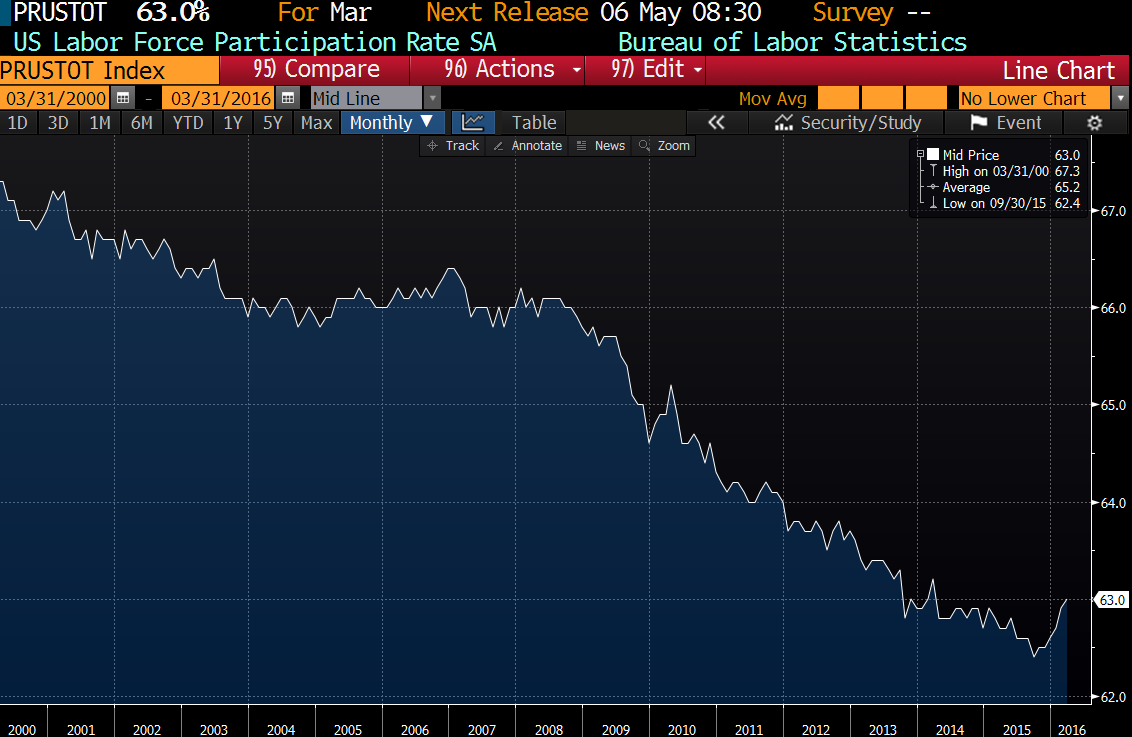
  • Labor Force Participation rate 63%
  • Average hourly earnings up 2.3% YOY
  • Average hourly earnings flat at 34.4

Manufacturing employment fell 29k, while restaurant increased 25k, retail, up 48k and construction up 37k. This is the fifth straight increase in the labor force participation rate, which bottomed out (hopefully) in September. The lower the labor force participation rate, the lower the speed limit for the economy. The improvement in the participation rate drove an increase in the unemployment rate, and this is one of those times where an increase in the unemployment rate is actually a good thing because it means that discouraged workers are now beginning to see enough opportunity out there to look for a job. Remember, if you are unemployed and not actively looking for a job, you are not considered to be part of the labor force, and therefore you aren’t officially “unemployed” according to the government. Wages rebounded from a negative February. Overall, a decent report – the wage growth will certainly push the Fed to take another step towards normalization of interest rates, and a June hike is looking more certain.

Despite the drop in manufacturing employment, the ISM Manufacturing Index increased smartly in March, New Orders and production drove the increase, while employment fell. Prices rose as commodity and raw material prices increased. This level of manufacturing would be consistent with 2% GDP growth. A shortage of skilled labor continues to be a problem.

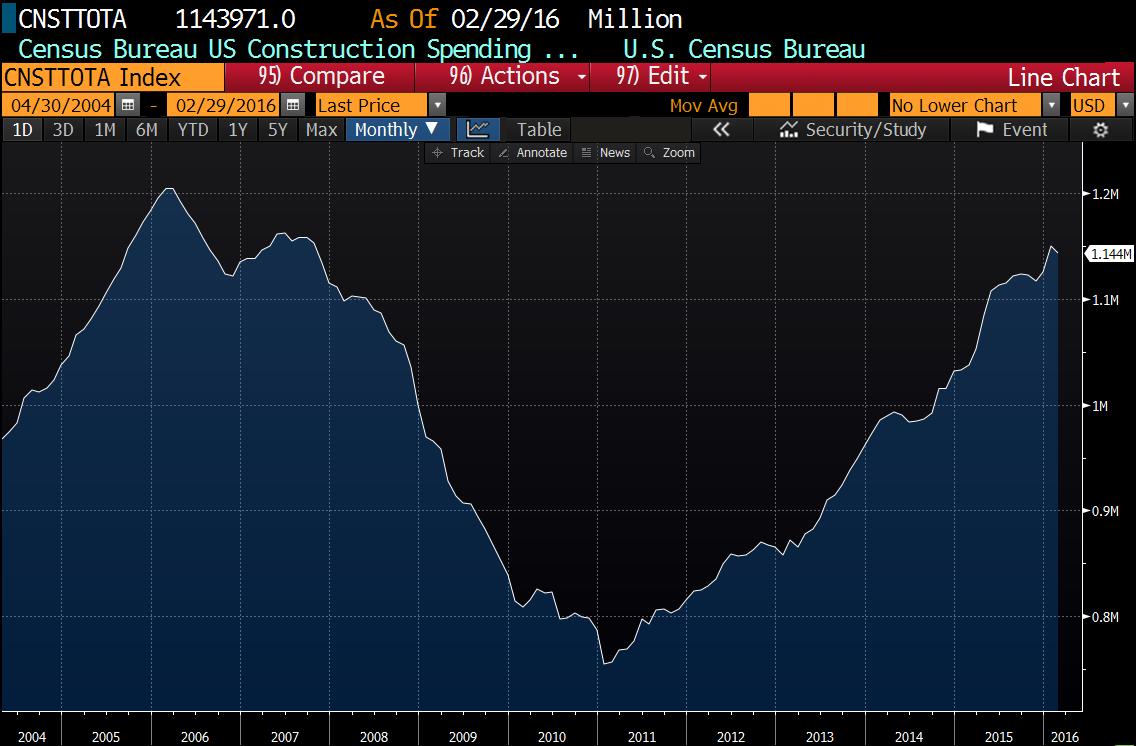
Construction spending fell 0.5% in February, while January was revised upward to an increase of 2.1%. Residential construction rose 0.9% and is up 10.5% YOY. We are almost back to the pre-bubble highs.

Consumer Sentiment ticked up in March, according to the University of Michigan to 91.