Morning Report: Lots of economic data this morning 3/3/16

Stocks are slightly lower as a slew of economic data comes in this morning. Bonds and MBS are flattish.

Outplacement firm Challenger, Gray and Christmas reported that announced job cuts rose 21.8% in February to 61.6k. The energy sector accounted for 25k of the losses, followed by chemicals, computer, and industrial goods. The West and the Midwest bore the brunt of the cuts. Remember these are announced job cuts and often never actually happen. Overall, the employment picture is looking decent, however we’ll get a better look tomorrow.

Here is a table of the industries hit. Note that aside from energy, job cuts are pretty low. Note that these are not net numbers either – they don’t take into account any sort of hiring.

Initial Jobless Claims rose to 278k last week. Anything below 300k is a good number.

The ISM Non-manufacturing composite fell slightly to 53.4 in February from 53.5 in January. Business continues to be decent in the services sector.

Factory Orders fell 1.6% in January, while durable goods orders rose 4.7%. Capital Goods Orders rose 3.4%.

Why is wage growth so difficult to find? Productivity growth has been weak since peaking around 1999 – 2000. This was the tail end of the big boost from the Internet and the decade-long transformation of the PC into a tool on everyone’s desk. Last quarter it came in at -2.2%. Productivity has been negative for 3 out of the past 4 years, and that is not a recipe for wage inflation.

Unit Labor costs rose 3.3% in the fourth quarter, which drove the drop in productivity as output only increased 1%.

The Markit US Services PMI fell slightly in February to 49.7 while the composite PMI was flat at 50.

The Bloomberg Consumer Comfort Index fell to 43.6 from 44.2 last week. Falling perceptions of the economy drove the decline.

2012 Presidential Nominee Mitt Romney is going to try and push back the Trumpmentum with a speech tonight.

Nothing too earth-shattering in the Fed’s Beige Book which was released yesterday. Overall, manufacturing is flattish compared to last month, however labor markets improved overall, and “wage growth varied considerably, from flat to strong, across all districts.”

Morning Report: Global yields continue to fall 3/2/16

Stocks are lower this morning after yesterday’s strong rally. Bonds and MBS are down.

Mortgage Applications fell 4.8% last week as purchases fell 0.6% and refis fell 7.2%.

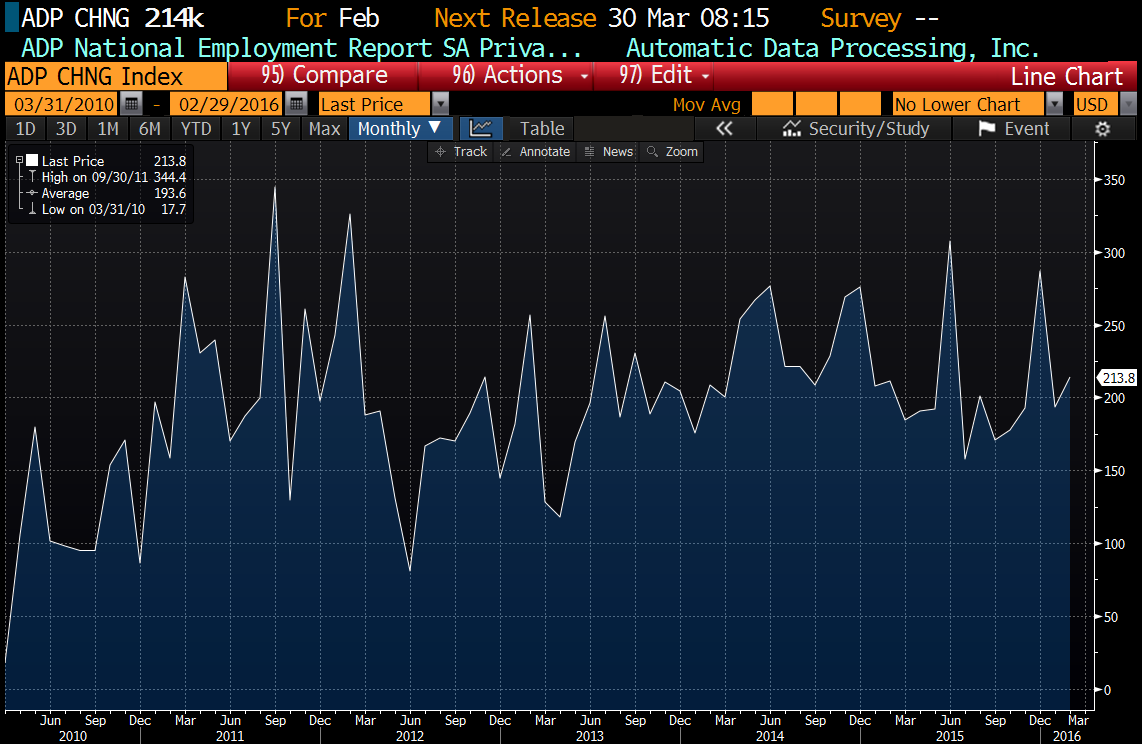
The ADP Employment change came in stronger than expected at 214k jobs. The Street is forecasting an increase of 195k payrolls for Friday’s jobs report. All of the activity was in the services sector, as the manufacturing sector lost about 9,000 jobs and the financial sector added only 8,000.

Chart: ADP jobs

The ISM New York Index fell slightly to 53.6

Donald Trump and Hillary Clinton were the big winners on Super Tuesday. You can probably stick a fork in Sanders at this point. For the GOP, the question is whether Donald Trump is a plurality winner or a majority winner. The establishment is hoping that once they coalesce around a single candidate, the numbers will swing to that candidate. If they go the brokered convention route, Trump will almost certainly run as an independent, which guarantees a Clinton landslide.

Yesterday was a bloodbath in Treasuries, with the 10 year yield increasing about 9 basis points to 1.82%. The 2 year yield increased 7 basis points. If we see strong wage growth on Friday’s jobs report, we could see further weakness in Treasuries.

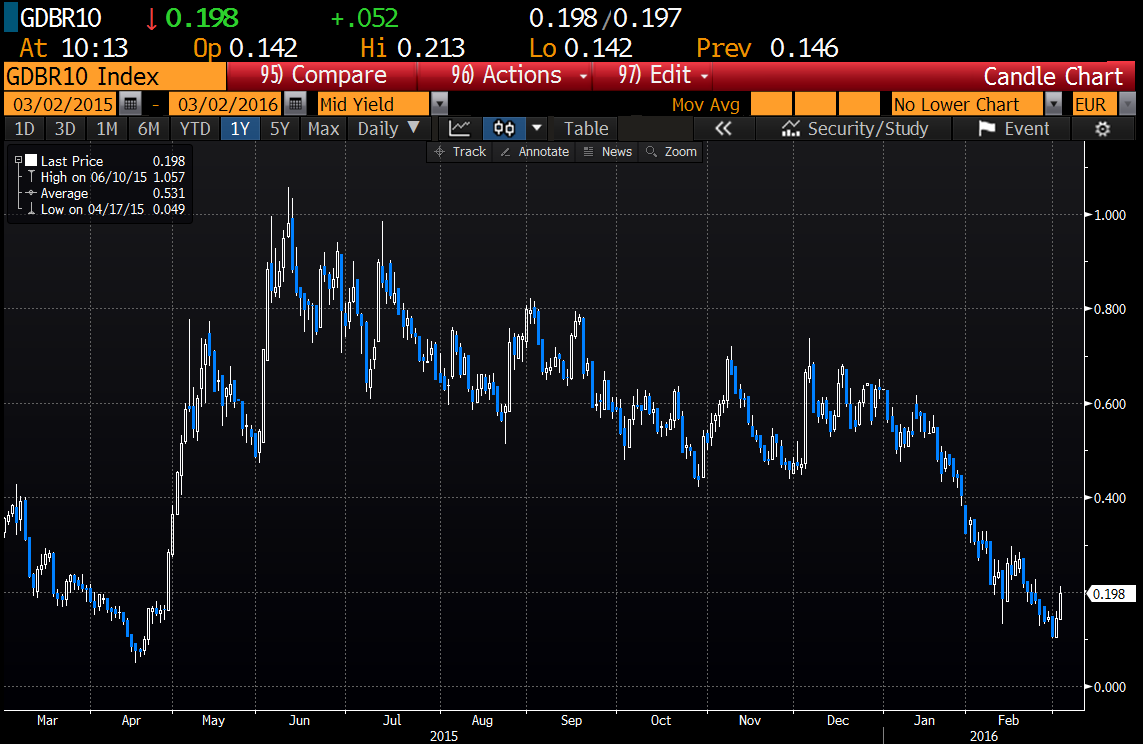
To put the current 1.85% 10 year yield in perspective: when the Fed hiked rates last December, the yield was 2.3%. That said, the fact that interest rates are falling globally will prevent Treasuries from falling too much. Note the German 10 year Bund is close to the sub 10 basis point lows of last spring, and currently yields 18 basis points. The Japanese Government 10 year bond yield is negative 5 basis points. Global investors look at Treasuries yielding more than Italian, Spanish, and Irish bonds and see relative attractiveness, especially since the US is about the only country not trying to devalue its currency. That should help keep a lid on rates.

Chart: German Bund Yield

The collapse in global bond yields is sending a signal that the Fed isn’t going to ignore – that deflation remains a threat. Janet Yellen has pledged to let the labor market “run hot” for a while and that means letting wage growth run. The big question is what happens to the labor force participation rate. If these workers come back, that will prevent too much wage inflation and will be ultimately better for the economy in the longer term. If they don’t, then look for wage inflation to begin and the Fed to move earlier.

Morning Report: Markets at odds with Fed forecasts 3/1/16

Green on the screen this morning as oil and emerging markets rally and the Chinese act to boost lending. Bondsd and MBS are flat.

The ISM manufacturing Index improved to 49.5 from 48.2 last month. Still below 50, which indicates a slowdown, but better than expected. The Markit US Manufacturing PMI came in at 51.3, better than expected.

Construction Spending rose 1.5% in January, much higher than the 0.3% forecast. Public construction drove the increase. Private residential construction was flat for the month.

The turmoil in the financial markets and the global economy have cooled the market’s forecast for further rate hikes. The Fed Funds futures contracts are now forecasting only a 10% chance of a rate hike at the upcoming March meeting and a coin toss for one by December. This is at odds with the last dot graph from the December FOMC meeting, where the median forecast was 1.25% by the end of 2016.

Vehicle sales are coming in strong this morning. Ford Feb sales were up 20%, while Fiat Chrysler sales were up 12% on strong Jeep sales. SUVs were the big gainer overall, as lower gasoline prices entice drivers to switch to bigger cars. Much of this growth is being fueled by cheap credit, however there is so much pent-up demand for new cars (the average age of a car in the US is 11.4 years) that this growth is probably sustainable for the near term and isn’t just a cheap credit story.

Today is Super Tuesday, where 12 states are holding primaries. So far, it looks like Hillary Clinton and Donald Trump will emerge as the winners.

Elmer Fudd warns of “distortions to savings and investment” due to negative interest rates. As the primary architect of the Great United States Housing Bubble, it would have been nice if he had worried about monetary policy-driven distortions to savings and investment say, 15 year ago.

Home prices continue to rise according to CoreLogic. Prices rose 1.3% MOM and are up 6.9% YOY. According to Corelogic, prices remain about 7% below their April 2006 peak. Overvalued markets include many in Texas, Washington DC, and Florida. You can see in the map below, which areas are cheap and expensive (green=cheap, red=expensive).

NAR is predicting existing home sales of 5.38 million in 2016, with average home price appreciation of 4% to 5%. It looks like the Northeast is finally starting to pick up a bit, with contracts up 11% in January.