

 Brent Nyitray
 Fairlington Blade
 Let the mutherfuker burn!
 jnc4p
jnc4p Kevin S. Willis
 Michigoose
 lmsinca
 markinaustin
 Arcanaut
 novahockey
 quarterback
 ScottC
 yellojkt
Markets are higher this morning on overseas strength. Bonds and MBS are down.
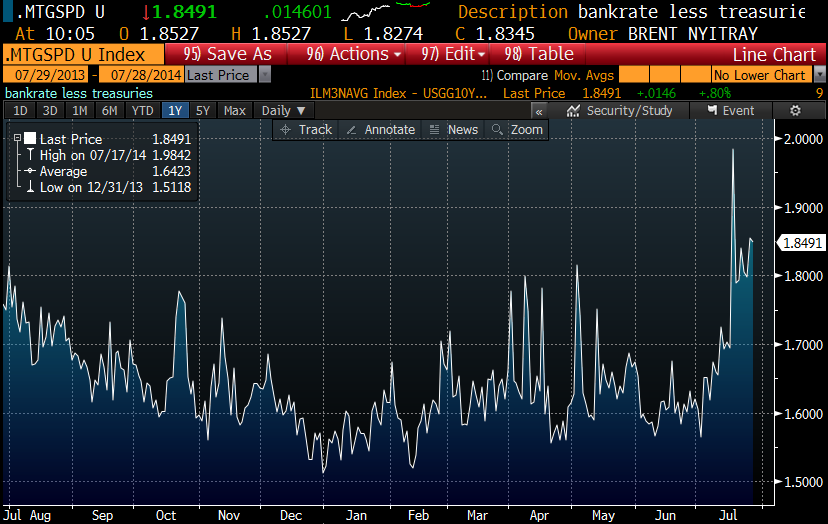
Pending Home Sales fell 1.1% month over month in June, a sign that the real estate market continues to struggle to get up off the mat in many areas of the country. Limited credit and wage growth continue to be issues. That said, mortgage rates continue to increase even in the face of a flat bond market, which could signal credit is easing. Here is a chart of the Bankrate average 30 year fixed rate mortgage minus the 10 year bond yield:
In other economic data, the Markit Composite PMI came in at 60.9, a very strong number. The services PMI came in at 61. The Street forecast for the ISM PMI is 56 (for both services and manufacturing), so there is another possibility of an upside surprise there. The economy is getting better.
Big week coming up with economic data. On Wednesday, we will get the advance estimate for second quarter GDP and the results from the FOMC meeting. Friday is a big day – we will get the jobs report, ISM, and personal spending / personal income. This is a lot of data in one day, and markets will be thin as many desks will be half-staffed. This is a recipe for volatility. The lack of action in the bond market has bred complacency – don’t get caught napping – I wouldn’t be floating ahead of this Friday.
I don’t expect any fireworks with the FOMC meeting – there will be no economic revisions until September, and the meaningful stuff (how to conduct policy after QE, how to prep the markets for rate hikes) won’t make it into the FOMC statement. Separately, Dallas Fed Head Richard Fisher wrote an opinion piece in the Wall Street Journal pressing the Fed to not only end QE but to also start shrinking its balance sheet by not re-investing maturing bonds back into the market. Even that might not be enough. FWIW, he is skeptical of the Yellen framework for bubbles which is that “low interest rates don’t cause speculative bubbles, and we can deal with bubbles through banking regulation.” People have gotten used to the hawks being ignored. As the economy recovers, that will change.
It is official: Zillow is buying Trulia. It would be the marriage of the #1 and #2 online real estate listing sites, so it will attract antitrust scrutiny. Trulia will remain an independent brand and Zillow is following a similar strategy to Barry Diller’s IAC/Interactive corp, where competing brands co-exist as some appeal to different market segments than the other.
Guess the marching orders went out over the weekend: The Administration want to end these inversion transactions, and everyone from Jack Lew to Dr. Cowbell are singing from the same sheet of music. The message: Take away this loophole now, and then let’s focus on corporate tax reform later. It is clear what is going on: The Administration fears a Republican Senate will mean vastly different negotiations regarding corporate tax reform. Republicans are going to want to trade closing loopholes for lowering rates, so Obama wants to get a few “free” tax hikes in (which is what “closing loopholes” really means). Of course Republicans are in no mood to throw Obama a freebie and he knows it, so this is just a means to create some talking points ahead of the midterm elections.
Check out our iServe app for iPhone and Android.
Filed under: Morning Report |
 All Things in Moderation
Frist.
LikeLike
& the NY Times doesn’t bother to fact check Krugman’s column:
That’s totally false. Inversion only impacts US taxes on overseas profits, as the NYT DealBook notes:
Wonder if a correction can be forced on this one.
LikeLike
JNC, there has been a bipartisan bill around since 9-11 [I think] to make inversion dependent on 50%+1 foreign ownership of stock. IIRC, it is now a 20% threshhold.
Brent – taking a stroll though the Major Leagues – congratulations!
LikeLike
Yeah, the 50% threshold actually makes sense to me for defining “ownership”. I just dislike the entire premise that the US is entitled to tax foreign profits made by foreign subsidiaries selling products to foreigners in foreign countries.
And of course Krugman flat out lying that inversion reduces US taxes on US profits of US operations.
LikeLike
Michi – you see that the US is looking to replace the M9 with a new standard sidearm and may be shifting from 9mm?
http://www.foxnews.com/politics/2014/07/12/army-to-replace-mm-pistol-with-more-reliable-gun-packing-better-knock-down/
LikeLike
Thanks, Mark. If there is one thing the financial crisis has taught me it is that the financial industry can go on a hiring freeze for a long time, so you better have a back up plan. I guess writing is mine.
LikeLike
what’s wrong with the 1911?
LikeLike
Lack of capacity. If they had the money, they could go with the SIG 227 in .45 ACP
“SIG’s new service pistol offers up to 15 rounds of .45 ACP power in an accurate and reliable design.”
http://www.policemag.com/channel/weapons/articles/2013/12/sig-sauer-p227-pistol.aspx
Edit, actually that’s apparently with the extended clip. Standard is 10 rounds.
Looks like the Glock 21 is 13 round magazine capacity.
http://us.glock.com/products/model/g21
LikeLike
i wonder if they’ll go with a .40 instead.
LikeLike
Is it not obvious now that us Baggers are good for the Republican Party?
http://mobile.nytimes.com/2014/07/26/opinion/joe-nocera-chamber-of-commerce-lost-its-way-in-right-turn.html?referrer=
LikeLike
Joe is just whining that the Chamber of Commerce doesn’t support democrats anymore.
LikeLike
Michi – you see that the US is looking to replace the M9 with a new standard sidearm and may be shifting from 9mm?
I hadn’t–interesting! I was never a fan of the M9; it’s too big for my hand. I’m a horrible shot with a handgun, anyway, and when I can’t really control the grip. . . let’s just say it can lead to very dispersed shot groups.
LikeLike