Morning Report – Jobs report in line with expectations 6/7/13

Vital Statistics:

  Last Change Percent
S&P Futures  1631.1 8.4 0.52%
Eurostoxx Index 2695.6 19.4 0.72%
Oil (WTI) 94.28 -0.5 -0.51%
LIBOR 0.275 0.001 0.33%
US Dollar Index (DXY) 81.47 -0.067 -0.08%
10 Year Govt Bond Yield 2.11% 0.03%  
Current Coupon Ginnie Mae TBA 102.2 0.1  
Current Coupon Fannie Mae TBA 100.6 -0.1  
RPX Composite Real Estate Index 202.2 0.3  
BankRate 30 Year Fixed Rate Mortgage 3.98    


Markets are higher after the jobs report came in pretty much in line. Bonds and MBS are flat / down small.
 
The jobs report showed that nonfarm payrolls increased by 175,000 in the month of May, slightly higher than Street estimates (which were lowered after the ADP report). April was revised downward from 165k to 149k. The unemployment rate ticked up from 7.5% to 7.6% as the labor force participation rate ticked up from 63.3% to 63.4%. Earnings and workweek were flat. Since the report was pretty much in line with expectations,we aren’t seeing any big reaction in the markets.
 
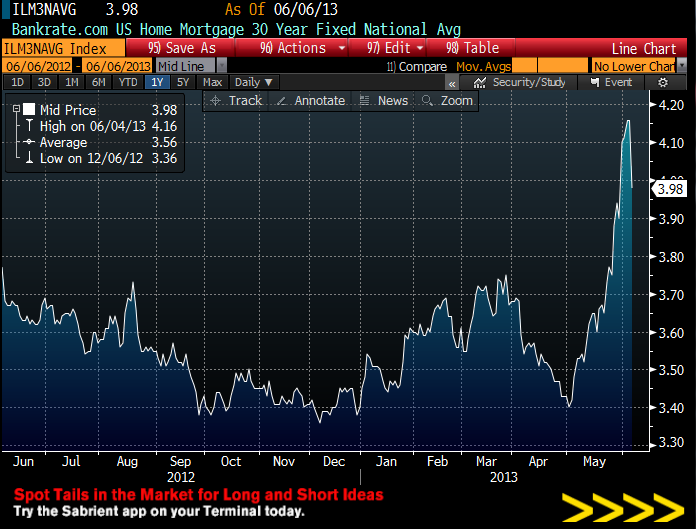
Remember my question about mortgage rates on Wednesday? Basically how did the Bankrate average 30 year mortgage rate jump from 3.9% to 4.1% when the bond market was flat and we had a weak day in Fannie TBAs? Well, whatever it was, it has been reversed, as the Bankrate average 30 year mortgage rate fell 18 bps back to 3.98%. Strange.


Morning Report – Modest, Moderate, and Measured 6/6/13

Vital Statistics:

  Last Change Percent
S&P Futures  1611.6 3.6 0.22%
Eurostoxx Index 2725.5 16.2 0.60%
Oil (WTI) 94.24 0.5 0.53%
LIBOR 0.274 0.000 -0.07%
US Dollar Index (DXY) 82.35 -0.248 -0.30%
10 Year Govt Bond Yield 2.11% 0.03%  
Current Coupon Ginnie Mae TBA 101.8 -0.2  
Current Coupon Fannie Mae TBA 100.2 -0.2  
RPX Composite Real Estate Index 201.9 0.1  
BankRate 30 Year Fixed Rate Mortgage 4.16    
Markets are flattish after initial jobless claims came in as expected. Challenger and Gray reported that announced layoffs are 41% below last year’s pace.  Bonds and MBS are flat.
 
Moderate. Modest. Measured. That is the summary of the Fed’s Beige Book Survey of economic growth. The bright spot of the report was residential real estate construction. The Dallas District noted the strongest growth, while growth elsewhere was modest to moderate. Since this report is basically as amalgam of the various Federal Reserve District reports which have been previously released, it isn’t a market-mover. 
 
The Senate plan to wind down the GSE’s (Corker / Warner) would liquidate Fannie and Fred, transfer all of their liabilities to Treasury. The liquidation preference would be to the US Government first, then the junior prefs, and then the common shares. Note that Fannie Mae and Freddie Mac’s recent record profits have not gone to paying down their debt to the government – those funds have been simply revenues to the government. A new entity – The Federal Mortgage Insurance Commission would have a re-insurance role and backstop private insurance. Ginnie Mae would not be affected.

Morning Report – What is going on with mortgage rates? 6/5/13

Vital Statistics:

  Last Change Percent
S&P Futures  1625.1 -6.1 -0.37%
Eurostoxx Index 2723.4 -32.3 -1.17%
Oil (WTI) 93.76 0.5 0.48%
LIBOR 0.274 0.001 0.18%
US Dollar Index (DXY) 82.58 -0.192 -0.23%
10 Year Govt Bond Yield 2.12% -0.02%  
Current Coupon Ginnie Mae TBA 101.8 0.0  
Current Coupon Fannie Mae TBA 100.3 -0.8  
RPX Composite Real Estate Index 201.8 0.4  
BankRate 30 Year Fixed Rate Mortgage 4.16    


Markets are weaker after a disappointing ADP report. Nonfarm productivity was revised downward to .5% while unit labor costs fell. The Fed will release its Beige Book later on this afternoon. Mortgage applications fell 11.5% last week. Bonds and MBS are up small on the data.
 
The ADP report is supposed to foreshadow Friday’s all-important jobs report, albeit only the private sector portion. Basically take the jobs report, subtract out public sector workers, and you have ADP. The ADP employment change report came in at 135,000 vs expectations of 165,000. Friday’s payroll report is expected to be 178,000, with an unchanged unemployment rate of 7.5%. Bonds spiked on the ADP number and have pretty much given it all back. I am struggling to come up with a scenario where bonds rally big on Friday. My guess is that it will take an increase in the unemployment rate (like 7.7%) and a lousy payroll number, like 50k. The bond market increases so grudgingly, it feels like it won’t take much of an upside surprise to send it lower.
 
I first thought it was a data error, or a misprint. On Friday, the Bankrate US Home Mortgage 30 year Fixed National Average spiked from 3.9% to 4.1%. But it increased again on Monday and Tuesday and now is sitting at 4.16%. Over that period, the 10 year is unchanged, but the FNCL 3.5 TBA is down a point, which corresponds to a 22 bp increase in yield. The GNSF 3.5 is down 14 ticks, which corresponds to a 10 basis point increase in yield. So how do we get a 26 basis point increase in mortgage rates when Fannies are up 22bps and Ginnies are up 10?  And no, its not jumbos, which only increased 4 basis points. Strange things are afoot at the Circle K. 


Morning Report – Progress on the GSEs 6/4/13

Vital Statistics:


Last

Change

Percent

S&P Futures 

1638.5

2.3

0.14%

Eurostoxx Index

2765.3

17.5

0.64%

Oil (WTI)

93.19

-0.3

-0.28%

LIBOR

0.274

0.001

0.26%

US Dollar Index (DXY)

82.81

0.149

0.18%

10 Year Govt Bond Yield

2.13%

0.01%


Current Coupon Ginnie Mae TBA

101.9

-0.2


Current Coupon Fannie Mae TBA

100.4

-0.1


RPX Composite Real Estate Index

201.5

0.6


BankRate 30 Year Fixed Rate Mortgage

4.11


Markets are up small after a 2% rally in Japan’s Nikkei 225 index last night. Bonds and MBS are down small.

Yesterday’s ISM report showed the manufacturing sector contracted slightly in May. New Orders and Production fell, while inventories rose. Employment was flat. The index level of 49 corresponds to a GDP growth rate of just about 2%.

The Senate is close to establishing a plan to abolish Fannie Mae and Freddie Mac and replace them with a government re-insurer that would backstop private mortgage insurance. F&F would be wound down and the US Treasury would assume responsibility for existing conforming loans. A new entity – the Federal Mortgage Insurance Corporation (FMIC) would provide re-insurance, which means they would only step in if the private mortgage insurer was unable to cover the losses. For holders of the junior preferreds, which includes a lot of big hedge funds, this doesn’t look like anything good for them.

And for those keeping track at home, here is Fannie Mae’s recent chart:

Image

In the News Now

Grand Old Party for a Brand New Generation

There was a lot of internet chatter about the above “GOP for a New Generation” report today.  Out of curiosity I decided to read it.  It was really interesting and while it doesn’t have much to do with our recent discussion of whether the Republican Party has moved right or not, I think it’s indicative of where they could use some improvement.

I happen to be the mother of young voters just outside of this under 30 age group, and because I’ve enjoyed watching their political views form so much, I thought this was a great study.

To be clear, in addition to the parts I’ve excerpted, they also polled economic matters, the size of government (interesting results there), the environment, and also discussed the use of social media and other sources of political news.

The following report assesses the findings from a variety of studies on young voters, including a new March 2013 survey conducted for the College Republican National Committee (CRNC), and makes recommendations about how Republicans can begin this work today.

We believe that Republicans can win young voters but that it will require a significantly different approach than has been used in recent elections.

Health Care

Health care remains a second-tier issue behind the economy and the national debt. In the August 2012 XG survey, only 8% of young voters said it was their top issue, and just 27% named “lowering health care costs and improving care” as one of their top two or three priorities in the March 2013 CRNC survey.

Nonetheless, the issue is at the top of the second tier in both surveys and came up frequently in our focus group research. In the August XG survey, young voters handed Democrats a heavy advantage on the issue, preferring their handling of health care to Republicans by a 63-37 margin. Some 41% thought things overall would be better as a result of Obama’s health care reform plan (versus to 32% who said things would be worse).

Many of the young people in our focus groups noted that they thought everyone in America should have access to health coverage. In the Spring 2012Harvard Institute of Politics survey of young voters, 44% said that “basic health insurance is a right for all people, and if someone has no means of paying for it, the government should provide it”; 23% disagreed.

Admittedly, there were concerns about the cost and quality of health care under the ACA but in general the young people gave Obama credit for trying.

Immigration

While immigration wasn’t a major issue it appeared it might be an issue that could turn a voter against a conservative candidate who they agreed with on taxes or other economic issues but disagreed with on immigration reform.

The position taken most frequently by young voters was that “illegal immigrants should have a path to earn citizenship,” chosen by35% of respondents. Closely behind this were the 30% who preferred the “enforcement first” strategy of securing the border and enforcing existing immigration laws. Some 19% chose “illegal immigrants should be deported or put in jail for breaking the law,” while another 17% took the position that “illegal immigrants should have a path to legal status but not citizenship.”On the issue of laws that “would allow illegal immigrants brought to the U.S. as children to gain legal resident status if they join the military or go to college,” three out of four (75.3%) young adults agreed in an October 2012 poll conducted by CIRCLE. And young voters for the most part knew how the candidates in the election stood on that issue; in that same survey, 63% of respondents said that Barack Obama was the candidate who supported “allowing many illegal or undocumented immigrants who were brought to the United States as children to remain in the country,” while only 3% said that was Mitt Romney’s position.

Abortion

This really surprised me; I knew it was pretty close but not quite this close.  In this case I wish Dems would alter their position a little to make room for a more tolerant culture of life position, but I repeat myself.

The results debunk the conventional wisdom on the issue and establish that not all “social issues” are viewed the same. Indeed, only 16% of young voters preferred that abortion be legal in all cases, while 32% said abortion should be legal “up to a certain point.” Combined, that comprises 48% who take a position leaning toward legality. On the other side, 37% felt abortion should be illegal with exceptions, and 14% thought abortion should always be illegal, making a combined 51% who lean toward prohibiting abortion. On this issue, there is small gender divide, with men in the survey actually tending to lean more pro-choice than women.

Where the Republican Party runs into trouble with young voters on the abortion issue is not necessarily in being pro-life. On the contrary, the Democratic Party’s position of pushing for abortion to be legal in all cases and at all times, including some recent laws around how to handle medical care for babies born alive during abortion procedures, is what is outside the norm of where young voters stand. Unfortunately for the GOP, the Republican Party has been painted – both by Democrats and by unhelpful voices in our own ranks – as holding the most extreme anti-abortion position (that it should be prohibited in all cases). Furthermore, the issue of protecting life has been conflated with issues around the definition of rape, funding for Planned Parenthood, and even contraception.

In the words of one pro-life respondent, “The Planned Parenthood thing for me is not so much about abortion; it’s about counseling before you can get to that point, and I feel that that’s a big part of what they do, is contraception counseling and about being safe.”

Bingo

Gay Marriage

Perhaps no topic has gotten more attention with regards to the youth vote than the issue of gay marriage. And on this issue, the conventional wisdom is right: young people are unlikely to view homosexuality as morally wrong, and they lean toward legal recognition of same-sex relationships. Only 21% of young voters in the Spring 2012 Harvard Institute of Politics survey felt that religious values should play a more important role in government, and only 25% felt homosexual relationships were wrong. Young people nowadays are more likely than ever to know someone who is openly gay or lesbian, and that factor is correlated with attitudes supporting same-sex marriage.

Surveys have consistently shown that gay marriage is not as important an issue as jobs and the economy to young voters. Yet it was unmistakable in the focus groups that gay marriage was a reason many of these young voters disliked the GOP.

The conclusion of the report discusses five areas where they think the GOP can improve their chances to win over a larger percentage of the youth vote and they explain their methodology and whatnot.

I’m still working on an immigration post, just thought this was interesting and current considering all the references I read about it today on both sides of the political divide.

Morning Report – John Williams confirms QE could end this year 6/3/13

Vital Statistics:

  Last Change Percent
S&P Futures  1634.2 5.2 0.32%
Eurostoxx Index 2772.8 3.1 0.11%
Oil (WTI) 92.68 0.7 0.77%
LIBOR 0.273 -0.002 -0.73%
US Dollar Index (DXY) 83.15 -0.228 -0.27%
10 Year Govt Bond Yield 2.16% 0.03%  
Current Coupon Ginnie Mae TBA 101.8 -0.1  
Current Coupon Fannie Mae TBA 100.4 -0.3  
RPX Composite Real Estate Index 200.8 0.3  
BankRate 30 Year Fixed Rate Mortgage 4.1    


Markets are higher on no real news. We will get an important manufacturing report at 10:00 am est with the ISM Manufacturing Report. Bonds and MBS are down small.
 
Lots of data this week, with the ISM Manufacturing Survey later this morning, Unit labor costs and productivity on Wed and the jobs report on Friday. The jobs report will obviously be the biggest report of the week. The Street is expecting an increase of 177 jobs and a 7.5% unemployment rate. 177,000 jobs is on the low side of recent history. 
 
Federal Reserve Bank of San Francisco President John Williams confirmed the conventional wisdom in the bond market – that the Fed may start reducing asset purchases with an eye towards ending QE by year end. “With continued good signs on jobs and confidence in a substantial improvement, I could see as early as this summer, some adjustment, maybe modest adjustment downward in our bond purchase program.” The program is doing this great job of helping the economy gain momentum and I would want to see that continue well into the second half of the year, but if things, again iff they go well, you could imagine ending the program by the end of the year.”
 
The sell-off in bonds has been painful for PIMCO: Bill Gross’s Total Return Fund lost 2.2% last month.
 
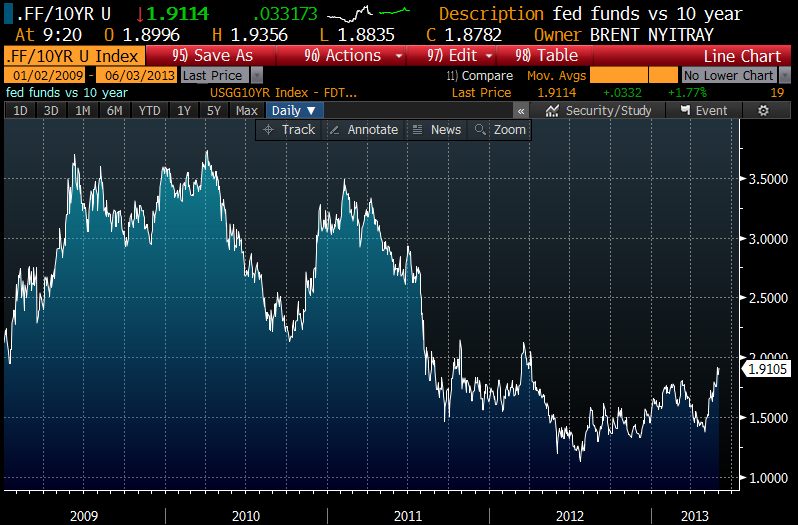
If the Fed ends QE, how high can we expect 10 year yields to go? Actually, a lot higher. The following chart shows the difference between the 10 year bond and the Fed Funds rate since it was set at 25 basis points in early 2009. Since we know the Fed is probably going to wait until unemployment gets closer to 6% before making any moves with the Fed Funds rate, we can assume that stays constant for the near term. But this chart shows we have gotten used to a flat yield curve over the past year. And that may be about to change.
 
Chart: 10 year bond yield minus the Fed Funds Rate
 

Not Your Ordinary Marketplace

http://tinyurl.com/m4qjapm

Some takeaways:

Whether directly from their wallets or through insurance policies, Americans pay much more for almost every interaction with the medical system.

High prices mostly result not from top-notch patient care, but from business plans seeking to maximize revenue; haggling between hospitals and insurers that have no relation to the actual costs of performing the procedure; and lobbying, marketing and turf battles among specialists that increase patient fees.

The United States spends about 18 percent of its gross domestic product on health care, nearly twice as much as most other developed countries. The Congressional Budget Office has said that if medical costs continue to grow unabated, “total spending on health care would eventually account for all of the country’s economic output.”

Consumers, the patients, do not see prices until after a service is provided, if they see them at all.

Patients with insurance pay a tiny fraction of the bill, providing scant disincentive for spending (NoVA has told us this, of course).

Even doctors often do not know the costs of the tests and procedures they prescribe.

Insurers have limited incentive to bargain forcefully, since they can raise premiums to cover costs.

The article focuses on colonoscopies as a case study of an ordinary procedure run amok. If the American health care system were a true market, the increased volume of colonoscopies — numbers rose 50 percent from 2003 to 2009 for those with commercial insurance — might have brought down the costs because of economies of scale and more competition. Instead, it became a new business opportunity, and moved out of the office and into the hospital.

The cost of a colonoscopy in the United States varies staggeringly, from place to place, and even within a city. Austin averages four times Baltimore, for example. New York is even higher, of course.

It is the pricing of these ordinary medical procedures that surprises me as a major contributor to our inflated health care costs.

I recommend the linked article.

Bites & Pieces…Weekend Edition

I learned something this week; Brent enjoys the Bites & Pieces posts.  Well, in that case here we go.

Oooops, he and I don’t have much in common except that he’s a Democrat when it comes to social issues, and I’m pretty sure our food tastes will be as out of sync as our belief in the free market.

I’ve described myself as a grazer and I wasn’t kidding.  I offered up my kale and pine nut salad and he didn’t jump at the offer so I think I’ll offer up my prime rib, Yorkshire pudding and spinach soufflé instead.  I’d throw in my blueberry cheese cake but he’d probably have a heart attack and you guys would blame me for the loss of our Morning Report.

I only serve this meal once a year……… maybe, and I generally make a big salad to go with it so I can keep from starving to death while I watch everyone else inhale their dinner.

Prime Rib

Minimum 3 rib standing roast of quality, we buy prime.  The weight doesn’t matter and I’ve actually purchased a roast of only 2 ribs before and the recipe works.  You can have the butcher cut the bones away and reattach with string if you want.

Generously season the entire surface of roast.  We like a Monterey seasoning but you can use anything you want as long as it includes some salt.  Be creative.

Bring roast to room temperature and pre-heat oven to 375.  Place roast in roasting pan with a rack under it.  Put roast in oven, uncovered, and roast for 1 hour.  Turn oven off.

Leave roast in oven, with door closed until guests arrive or about 45 minutes before you want to serve dinner.  Do Not Open Oven Door and the roast must be in the oven for at least 2 hours after first roasting before you turn the oven on to finish.  It can stay in longer though.

Turn oven on to 375 and continue roasting; 35 minutes for rare, 45 minutes for medium or 55 minutes for well done.

I leave it in for 45 minutes and the outside pieces are medium and inside is medium rare.  Everyone around here says that’s perfect.

Serve with creamed horse radish sauce.  I used packaged au jus mix or brown/onion gravy for the meat and the Yorkshire pudding.  There won’t be enough drippings in the pan to make au jus or gravy generally.

Yorkshire Pudding (makes 12 muffins)

Ingredients:

1 cup milk

1 cup flour

6 eggs

1 tsp salt

Vegetable shortening

Directions:

Mix milk, flour, eggs and salt until well blended.  Refrigerate for at least two hours.

Spray muffin pan with Pam and put ¼ tsp of Crisco into each muffin tin.  Place pan in oven and heat in oven at 400 until Crisco is melted and quite hot.  Ladle cold liquid evenly between 12 muffins, quickly while pan is hot.  Bake at 400 for about 25-30 minutes until the Yorkshire is puffed up and brown.

Let muffins sit in the pan for about 5 minutes before removing as it’s easier to get them out.  Don’t skip the Crisco or spraying the pan.  They will fall as they cool but that’s normal.  There will still be little hollow places inside.

Spinach Souffle

Ingredients:

1 cube butter or margarine

6 eggs

6 tbs flour

2 boxes chopped frozen spinach (defrosted and drained well)

2 lbs. cottage cheese

½ lb. American cheese (cubed)

Combine all ingredients in a round and deep baking dish and bake for one hour at 350.

If you only have one oven (I actually have two) you can cook the spinach with the roast at 375 for a little less time.  While the roast and spinach sit put the Yorkshire in.

As I mentioned, this is not a light or diet friendly dinner so be warned, but our family and friends look forward to it every time I say “that’s what’s for dinner”.  It’s generally a holiday or special occasion meal.  If you want to cut back on the fat content, save the spinach for another meal and have green beans instead….hahaha