

 Brent Nyitray
 Fairlington Blade
 Let the mutherfuker burn!
 jnc4p
jnc4p Kevin S. Willis
 Michigoose
 lmsinca
 markinaustin
 Arcanaut
 novahockey
 quarterback
 ScottC
 yellojkt
Vital Statistics:
|
Last |
Change |
Percent |
|
|
S&P Futures |
1576.3 |
10.1 |
0.64% |
|
Eurostoxx Index |
2546.0 |
34.2 |
1.36% |
|
Oil (WTI) |
95.53 |
0.3 |
0.37% |
|
LIBOR |
0.276 |
-0.001 |
-0.23% |
|
US Dollar Index (DXY) |
82.29 |
-0.137 |
-0.17% |
|
10 Year Govt Bond Yield |
2.51% |
-0.02% |
|
|
Current Coupon Ginnie Mae TBA |
100.2 |
-0.5 |
|
|
Current Coupon Fannie Mae TBA |
100.7 |
0.4 |
|
|
RPX Composite Real Estate Index |
205.3 |
0.3 |
|
|
BankRate 30 Year Fixed Rate Mortgage |
4.51 |
Green on the screen after the 10 year bond recouped all of its early losses and ended up positive on the day. The Chinese central bank agreed to keep money-market rates at a “reasonable” level. Durable Goods orders came in at 3.6%, above the 3% estimate. Ex transportation, they were up .7%, above the consensus estimate. April numbers were revised up. Bonds and MBS are up.
Homebuilder Lennar reported 2Q earnings per share of $.61, ahead of the $.33 estimate. The numbers included a tax benefit, but even without the one-time item, earnings still beat estimates by ten cents. Deliveries were up 39%, new orders were up 27% and backlog was up 55%. Stuart Miller, the CEO addressed the recent increase in rates directly: “Against the backdrop of recent investor concerns over recent mortgage rate increases, we believe our second quarter results together with real-time feedback from our field associates continue to point towards a solid housing recovery….Demand in all of our markets continues to outpace supply…affordability remains high and despite recent interest rate increases, we have seen very little impact on sales or pricing.” The stock is up 4.5% pre-open.
Senators Corker and Warner plan to introduce their bill today to euthanize Fan and Fred. They will be replaced by the Federal Mortgage Insurance Corporation which will act as a re-insurer and not a primary insurer. How this will actually play out is anyone’s guess – right now there are no mortgage insurance entities big enough to replace F&F. Perhaps the answer will be to over-collateralize MBS backed by QM mortgages by 10% and then apply the FMIC insurance. Obviously Dodd-Frank will have to weigh in on that one, and they are still figuring that part out.
Lender Processing Services reported that April home prices were up 1.5% from March and 8.1% year-over-year. We are starting to see the Midwestern states start to show up in the top 10. California and Nevada are still #1 and #2 as usual. The LPS HPI is a little different than the other indices like Case-Shiller in that it applies a normalization process to REO and short sales in order to come up with a non-distressed index.
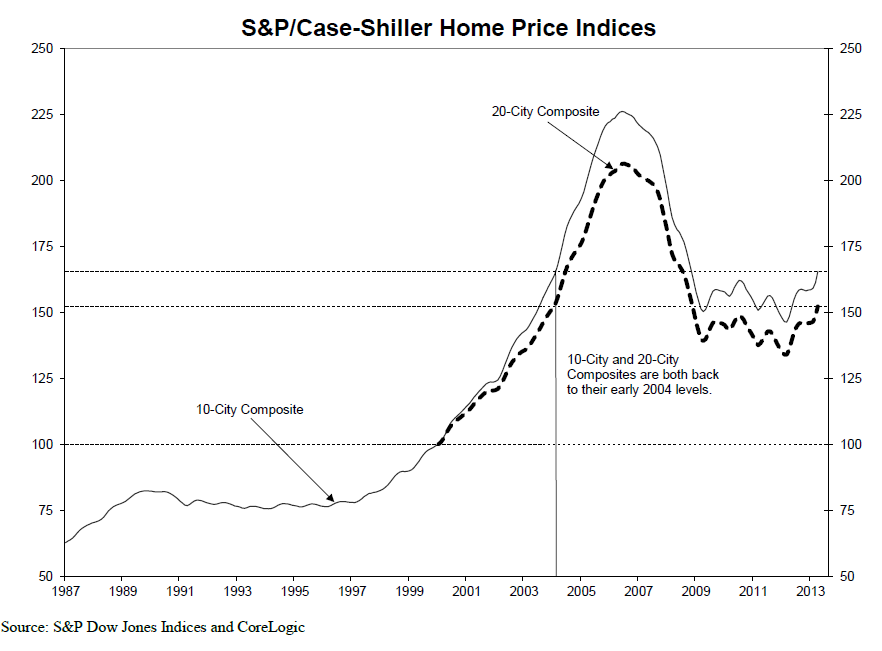
Case-Shiller reported home prices increased 1.72% month-over-month and 12.05% year-over year. This was the highest gain in the history of the Case-Shiller indices. David Blitzer of Case-Shiller addressed the recent increase in rates: “Last week’s comments from the Fed and the resulting sharp increase in Treasury yields sparked fears that rising mortgage rates will damage the housing rebound. Home buyers have survived rising mortgage rates in the past, often by shifting from fixed rate to adjustable rate loans. In the housing boom, bust, and recovery, banks’ credit quality standards were more important than the level of mortgage rates. The most recent Fed Senior Loan Officer Opinion Survey shows that some banks are easing credit restrictions. Given this, the recovery should continue.”
The FHFA Home price Index reported an increase of .7% month-over-month and 7.4% year-over year. Remember, each of these indices (LPS, Case-Shiller, and FHFA) have different methodologies and samples. FHFA looks only at properties with a conforming mortgage, which eliminates jumbos, distressed, cash-only, etc. This index is more of a “central tendency” index than Case-Shiller or LPS.
Filed under: Morning Report |
 All Things in Moderation
I’m busy still this morning and don’t have time to look a bunch of stuff up but I’ve been thinking and reading about Snowden and the NSA quite a bit. I thought at first that what he did was a valuable whistle blower civil disobedience type service, but now I’m not so sure. I even thought the media and the government placing the focus on him was an intentional distraction from the meat of what he was leaking.
Then I read this:
Edward Snowden appeared to first admit to the South China Morning Post today that he took classified documents from the NSA, without regard to whether the content would be so damaging to the United States that it should not be released publicly. Then he appears to suggest something far worse.
This is an important and nuanced point, as Snowden appears at first to be claiming that in fact he’s showing due diligence to concerns for American national security by screening classified NSA documents before he releases them to the media.
But Snowden also seems to be admitting that he did not make that determination, that it was safe to remove these documents from the NSA, before he removed those documents from the NSA.
Regarding the classified documents showing that the US had spied on China, here’s what Snowden had to say today:
“I did not release them earlier because I don’t want to simply dump huge amounts of documents without regard to their content,” he said.
“I have to screen everything before releasing it to journalists.”
Why does he have to screen it? At first, I thought it was to make sure the secrets weren’t too dangerous to be released publicly. But then Snowden continues:
“If I have time to go through this information, I would like to make it available to journalists in each country to make their own assessment, independent of my bias, as to whether or not the knowledge of US network operations against their people should be published.”
Note that Snowden is now admitting a few things. First, that that he plans on releasing the details of US intelligence efforts against far more countries. Who’s next? Exposing US efforts against Iran, against Cuba, against North Korea? Against Syria?
Seriously, exposing our spy network used on foreign governments doesn’t seem like a great way to support the American people. Transparency run amok. Everything he’s done now is suspect to me at least.
http://americablog.com/2013/06/edward-snowden-nsa-prism-russia-china-leak.html
Some of this can be found here as well.
http://www.businessinsider.com/snowden-gives-us-secrets-to-chinese-2013-6
I’m sure there are better places to go for some of this info but I just don’t have time this morning to do the research. Just wanted to get it out there.
LikeLike
I don’t really care about Snowden. He seems like a narcissist to me. If he took classified stuff he should prosecuted. I don’t trust “whistleblowers” who seek refuge in totalitarian regimes.
That being said, I think there is almost nothing that is truly secret from our enemies for more than six months. Considering the sheer size of the security bureaucracy, and considering human nature, it’s impossible for me to believe stuff doesn’t leak out quite quickly. The more explosive the info. the quicker it becomes known to those you are trying to keep it from. Your using that information against them and it doesn’t take much to figure out why your enemy thinks it has leverage over you.
As I’ve said before, there really are no secrets in the world.
LikeLike
Chris Hayes love letter to “Ends justify means” lefty politics is hilarious. He has a sad but no condemnation. Go figure.
http://chrishayes.org/articles/keeping-america-empty/
Is there any evidence to support overpopulation? What resources have been found to be too limited?
Who’s the real rubes here?
It’s also funny to see Haye’s unquestioned acceptance of immigration control advocates (the rubes, not the “good” people) inveterate racism. “Of course the only reason to control immigration is racism. Unless you’re enlightened, then you’re not racist just a nature lover. “
LikeLike
Re: The Voting Rights Act. I actually disagree with the Courts ruling. The 15th Amendment pretty much gives Congress carte blanche to legislate in this area, and more specifically, the idea that changes in “data” somehow renders a piece of legislation unconstitutional is bogus.
Or to put it more precisely, there’s no coherent reason why the same legislation that was passed in 2006 can be upheld as constitutional in 2009 under Northwest Austin Municipal Utility District No. 1 v. Holder and then somehow in the intervening years become unconstitutional.
It’s straight legislating from the bench.
LikeLike
jnc:
the idea that changes in “data” somehow renders a piece of legislation unconstitutional is bogus.
Does the data itself render it the legislation constitutional?
For instance, would it be constitutional for Congress to simply select, say, 10 states at random and pass laws that apply only to those 10 states? Or does the discrimination against certain states that is obviously being implemented become constitutional only if it is applied in a certain manner related to objective “data”?
(BTW, I have not read the ruling yet.)
LikeLike
JNC, I agree, even though I would have voted in Congress to repeal Section 4 and apply Section 5 preclearance as a remedy under Section 2.
Section 2 is Congress exercising its authority specifically granted under the 15th A. The statute allows the AG to intervene and sue jurisdictions that deny voting rights.
Section 4 singled out southern states and some other areas outside the south for “preclearance”, the remedy under Section 5 that does not require the AG to file a lawsuit. Instead, the burden is on the suspect jurisdiction to show it is not in violation of the law. Under Section 2 the burden of proof is on the AG.
It is a pain in the ass for southern states to be treated differently than other states that actually have had more violations under the VRA. So if I were a TX Congresscritter I would have voted to expand Sec. 4 to the nation or repeal it and allow Sec. 5 to apply to Sec. 2.
But JNC is right. This was awful judicial activism – typically, it wouldn’t even be enough to find that Congress didn’t have a legislative history if the law was enacted under the 15thA, but here there was an extensive history, and the Court just blew right by it.
Scott, the view in this case on state overeignty ought to interest you. It is written as if the 15th Amendment never happened.
LikeLike
About Fisher:
It’s true that the university, for whatever reason, offered provisional admission to some students with lower test scores and grades than Fisher. Five of those students were black or Latino. Forty-two were white.
Neither Fisher nor Blum mentioned those 42 applicants in interviews. Nor did they acknowledge the 168 black and Latino students with grades as good as or better than Fisher’s who were also denied entry into the university that year. Also left unsaid is the fact that Fisher turned down a standard UT offer under which she could have gone to the university her sophomore year if she earned a 3.2 GPA at another Texas university school in her freshman year.
Court blew right by those facts, too. Bullshit.
LikeLike
Mark:
Court blew right by those facts, too. Bullshit.
Why would those facts be relevant? The claim is not that there are no factors other than grades that can be constitutionally used to determine admission. And so there is no reason to be interested in whites who had worse grades but got in anyway, or blacks who had better grades but didn’t get in. Those instances can be accounted for (indeed must be accounted for) due to factors other than race the constitutionality of which is not in question.
The simple fact is that as long as race is in fact used as a contributing factor, which as far as I know is not in dispute, then there will of necessity be people who were denied admission because of their race who would not otherwise have been denied if they were of a different race. So the only real questions are 1) was the applicant one of those people and 2) is the use of race against the applicant in this manner constitutional. The facts you cite do not speak to either of those questions as far as I can tell.
LikeLike
Scott, she was passed over by UT because she had less than a 1200 SAT score. Her grades were good enough that she could transfer to UT if she went somewhere else for a year and proved herself. She simply was not a proper Plaintiff to raise the issue. She should have been denied standing.
FWIW, I like the top % rule because it is actually race neutral, despite Ginsburg’s claim. It guarantees geographical diversity; ranch kids, inner city kids, suburban kids, kids who live closer to Mexico City than to Austin. It also works. Top 8% kids from little rural white schools with no French teacher and top 8% kids from inner city black schools with no calculus teacher make better than average students at UT because they care about learning and about getting out and ahead. But the top 8% who can qualify for UT [and in CA, the top 4% who can qualify for UCLA] will not bring the schools sufficient blacks from their viewpoints because more blacks go to integrated schools in CA and TX than not. It has helped chicanos in both states, because both states have a lot of predominantly chicano schools. It has helped poor kids in both states who really want it. So CA wisely did nothing but its top % rule while TX screwed around with giving some black kids points for being black. I prefer the color blind top % test although it makes UT over 20% Asian American and UCLA over 40% Asian American. I prefer color blind top % tests for state universities because they have to serve the entire state, because without it poor kids in bad schools could never get in even if they were potentially good enough because the best HSs are a year or more advanced over the poor HSs when the kid is a senior. Not the kid’s fault, give the kid a break because he proved he wanted to compete and had something on the ball and he catches up real quick.
So I am not disturbed by the ruling. Just by the phony Plaintiff.
LikeLike
Mark:
Scott, she was passed over by UT because she had less than a 1200 SAT score.
So UT didn’t admit anyone with an SAT score less than 1200?
LikeLike
I read somewhere that Alito was making faces while Ginsburg read her dissent.
In a 5-4 ruling with the court’s conservatives in the majority, the justices ruled that Congress had used obsolete reasoning in continuing to force nine states, mainly in the South, to get federal approval for voting rule changes affecting blacks and other minorities.
The court ruled in favor of officials from Shelby County, Alabama, by declaring invalid a section of the law that set a formula that determines which states need federal approval to change voting laws.
http://www.reuters.com/article/2013/06/25/us-usa-court-voting-idUSBRE95O0TU20130625
LikeLike
Troll: “Is there any evidence to support overpopulation? What resources have been found to be too limited?”
Like many bugaboos of the doom-and-gloom/Day After Tomorrow left, there’s plenty of evidence that overpopulation can be a problem in certain geographic regions or locales (until the population is naturally controlled). There’s also evidence that unprecedented population growth can result in overpopulation and scarcity of resources if infrastructure isn’t scalable—but in most western nations, scalability is not an issue. Plus, the greatest form of population control is material wealth and technological growth. Western secular nations end up with underpopulation becoming an issue.
From the article: ” Perhaps Ehrlich’s predictions weren’t wrong, just premature.”
If I had a nickel for every time I heard that in reference to The Population Bomb. He predicted people resorting to cannibalism. By the 1980s. All first world nations have an obesity problem, easily exported to any nation that embraces democracy and a quasi-free market.
Ehrlich was unambiguously wrong in his predictions. And one only has to look to Ray Kurzweil’s prediction of the technological singularity around 2045 for predictions of technological plenty that are diametrically opposed to Ehrlich’s pessimism, and one could reasonably conclude that the truth is somewhere in the middle. In any case, we didn’t have outbreaks of famine-induced cannibalism in the 1980s and I don’t think we’ll have them in the 2080s.
Ehrlich’s also the one who equate giving humanity a cheap and inexhaustible source of energy would be like giving a mentally disabled child a machine gun, so his predictions are borne out of an ideological orientation rather than logical progression (which might help explain why they’re wrong).
Pertaining to immigration, the resources that will found to be too limited with huge immigration (or amnesty) will tend to be public benefits. California has certainly experienced some of that, where the cost of new immigrants outweigh their economic contribution. However, even that won’t lead to cannibalism.
LikeLike
OMFG!
Time to hit the panic button!
http://thinkprogress.org/economy/2013/06/25/2205061/college-grads-take-jobs-they-dont-want-every-5-minutes/
LikeLike
McWing:
Time to hit the panic button!
For chrissakes, even I have a job I don’t want!
LikeLike
@lmsinca: “The Shelby County challengers said the kind of systematic obstruction that once warranted treating the South differently is over and the screening provision should be struck down.”
I’m not sure of all the details, but I tend to agree with the thrust of the decision, even if I might not agree with all the reasoning, if I understood it.
“The Shelby County challengers said the kind of systematic obstruction that once warranted treating the South differently is over and the screening provision should be struck down.”
I think this is true. Certainly, such systematic obstruction would not apply statewide, but, more to the point, if the law places additional burdens on certain states but not others, such uneven application seems unjust.
Or, at least, the nature of the law should be honestly discussed: that is, it is about protecting democratic voting blocs, as most of the voting changes being proffered are not about favoring a specific race, but a specific (Republican) party.
“Section 5 of the law required certain states, mainly in the South, to show that any proposed election-law change does not discriminate against black, Latino or other minority voters.”
Why don’t other states have to demonstrate that, that’s what I am curious about. Given that it only effects 9 states, I just don’t see the justification for it.
Of course, I also think this is nonsense: “Just last week, the Supreme Court struck down an Arizona state law that required people registering to vote in federal elections to show proof of citizenship, a victory for activists who said it discouraged Native Americans and Latinos from voting.”
The idea that showing proof of citizenship, in an of itself, is a “voter suppression” tactic is just absurd. What are the requirements to demonstrate citizenship?
LikeLike
Kevin
The idea that showing proof of citizenship, in an of itself, is a “voter suppression” tactic is just absurd. What are the requirements to demonstrate citizenship?
For now just this. It’s what the SC upheld in the AZ decision.
The law, the National Voter Registration Act of 1993, allows voters to register using a federal form that asks, “Are you a citizen of the United States?” Prospective voters must check a box for yes or no, and they must sign the form, swearing under the penalty of perjury that they are citizens.
As for the rest, I think you could agree that possibly changes could be made but my understanding is that Congress has the power to do that and the SC just over rode that power…………….I could be wrong though. I don’t always take the time with legal decisions to get all the way to clarity……..haha
Update…………see marks comments, he’s the lawyer. I should have waited to hit “post a comment”
LikeLike
Kev, some justices suggested that the states ought to use their political clout to push Congress to making a higher standard under NVRA. However, the Court recognized that federal elections are uniquely under federal supervision.
LikeLike
“lmsinca, on June 25, 2013 at 12:20 pm said:
I read somewhere that Alito was making faces while Ginsburg read her dissent.”
That was the affirmative action case that was decided earlier.
http://www.washingtonpost.com/opinions/dana-milbank-justice-samuel-alitos-middle-school-antics/2013/06/24/534888f8-dd0d-11e2-9218-bc2ac7cd44e2_story.html
I know someone who was recently sworn in to the SCOTUS bar. He reported that the only two Justices who comported themselves with any decorum were Roberts and Ginsburg.
LikeLike
Scott
even I have a job I don’t want!
Really? I guess I’m surprised for some reason. I figured I was the only one here who hated their job. I’m not surprised so many grads are taking jobs they don’t want, it’s an employers market but I do wish more of us could enjoy our work…………don’t you? I do think it’s kind of silly to make a big deal out of recent college grads being disappointed or whatever……………sort of “woeismeismish”. 😉
LikeLike
lms:
Really?
Oh yes, really.
I’m not surprised so many grads are taking jobs they don’t want, it’s an employers market but I do wish more of us could enjoy our work…………don’t you?
Sure. I wish for a lot of things, though, and most of them have no chance of ever happening.
LikeLike
“ScottC, on June 25, 2013 at 12:59 pm said:
jnc:
the idea that changes in “data” somehow renders a piece of legislation unconstitutional is bogus.
Does the data itself render it the legislation constitutional?
For instance, would it be constitutional for Congress to simply select, say, 10 states at random and pass laws that apply only to those 10 states? Or does the discrimination against certain states that is obviously being implemented become constitutional only if it is applied in a certain manner related to objective “data”?”
Yes. Given how broad the 15th Amendment is, they could have applied it to just states that started with the letter “T”.
More fundamentally, there were no constitutional amendments passed between 2009 and 2013 so how a law passed in 2006 suddenly became unconstitutional in that time period escapes me.
LikeLike
On the chance someone besides JNC will find this interesting, I link to
http://www.volokh.com/2013/04/12/new-scholarship-on-originalism-and-discrimination/
LikeLike
jnc:
Given how broad the 15th Amendment is, they could have applied it to just states that started with the letter “T”.
The 15th amendment relates to a citizen’s right to vote, so I don’t see how the 15th amendment speaks to whether or not congress can discriminate against particular states (ie apply a law to one state but not another). But if such discrimination is constitutional even if applied on a totally arbitrary and capricious basis, then I agree that a change in “data” could not render such a discriminatory law unconstitutional.
I still wonder, though, whether arbitrary discrimination by congress against particular states is constitutional.
LikeLike
This is a great line:
“Yesterday, the Senate immigration bill received its Congressional Budget Office budget score, which is kind of like a bar mitzvah for major legislation. ”
http://nymag.com/daily/intelligencer/2013/06/obamas-secret-growth-strategy.html
LikeLike
I can write better articles than this:
“Gold Was a Horrible Investment from 1500 to 1965”
http://www.theatlantic.com/business/archive/2013/06/gold-was-a-horrible-investment-from-1500-to-1965/277186/
Well, yes, hence the term “Gold Standard”. The entire modern argument for buying gold is based on the idea that after leaving the gold standard countries would be unconstrained in inflating and thus devaluing their currencies. By making the contra argument based on data prior to Nixon’s final move to floating exchange rates in 1971, this article actually reinforces their entire world view.
LikeLike
jnc:
By making the contra argument based on data prior to Nixon’s final move to floating exchange rates in 1971, this article actually reinforces their entire world view.
Hilarious.
LikeLike
@ScottC: “For chrissakes, even I have a job I don’t want!”
I didn’t get my preferred job as a lottery winner, or trust fund baby, so I, too, have always worked at jobs I didn’t want. It’s a national tragedy.
LikeLike
@lmsinca: ” it’s an employers market but I do wish more of us could enjoy our work…………don’t you? ”
Yes! I encourage people to quit gigs, if at all possible, that are truly unpleasant, because there’s usually something better out there. But it is an employers market, and some employers get kind of ugly when you try to negotiate for a better deal, or quit because they are horrible people to work for. 😉
It’s better that the workplace be pleasant, but it’s important for recent grads to remember that (a) schooling doesn’t guarantee you get any kind of job, much less one in your preferred field and (b) it’s called “work” for a reason.
LikeLike
@markinaustin: “However, the Court recognized that federal elections are uniquely under federal supervision.”
Which makes sense. Do you think that would mean that the federal government could treat states differently or hold them to different standards (in some way) from other states, as regards federal elections? I find the question of treating certain states differently interesting.
LikeLike
Is tomorrow the last day the SC can issue rulings on DOMA and CA’s Prop 8?
LikeLike
The 15th amendment relates to a citizen’s right to vote, so I don’t see how the 15th amendment speaks to whether or not congress can discriminate against particular states (ie apply a law to one state but not another).
The problem originating with how egregious the voter suppression was in those regions. We really shouldn’t forget that people were being killed over the right to vote. There is a certain element of guilty until proven innocent but I don’t see the need to punish the whole class just because a few students were acting up.
LikeLike
yello:
The problem originating with how egregious the voter suppression was in those regions. We really shouldn’t forget that people were being killed over the right to vote. There is a certain element of guilty until proven innocent but I don’t see the need to punish the whole class just because a few students were acting up.
The point I was originally getting at was not that is was necessarily unconstitutional to discriminate against certain states (although it may well be), but that if it was made constitutional because of the method by which the states to be discriminated against were selected, then I think jnc is wrong about a change in “data” being irrelevant to the question of constitutionality.
BTW…I don’t see the need to punish today’s Texans just because other Texans 50 years ago were “acting up”.
LikeLike
Scott and Kevin
Every day that I wake up dreading another boring day of work I just remember I don’t have to get dressed until I feel like it and I can hang out at ATiM as much as I want and not actually get yelled at. I might get the pursed lip look now and again, but no yelling. And the money, I like having a little money. Oh and I always have my latest book minimized so I can pop it open and read when the coast is clear. I figure if he can take a siesta after lunch I can read right?
LikeLike
lms:
I figure if he can take a siesta after lunch I can read right?
Only if ATiM is having a slow day.
LikeLike
“ScottC, on June 25, 2013 at 2:14 pm said:
I still wonder, though, whether arbitrary discrimination by congress against particular states is constitutional.”
Well, it certainly didn’t suddenly change this year if it was Constitutional previously. The same justices who upheld it in 2009 suddenly found a different result this time. The arbitrariness didn’t change.
“but that if it was made constitutional because of the method by which the states to be discriminated against were selected, then I think jnc is wrong about a change in “data” being irrelevant to the question of constitutionality.”
The data has been frozen since the 1970’s and it didn’t impact the previous rulings.
LikeLike
jnc:
The data has been frozen since the 1970’s and it didn’t impact the previous rulings.
I understand, and again I haven’t read the opinion so I am not defending the reasoning of the majority. I am just saying that I think the grounds on which the discriminatory law was deemed constitutional in the first place matters to whether or not time and changing circumstances could cause it to later become unconstitutional.
If it would be perfectly constitutional for Congress, under its power to regulate interstate commerce, to pass regulations that apply only to states beginning with the letter “M”, which is to say that the constitutionality of discrimination against a state is totally unrelated to the reason for the discrimination, then I agree with you that nothing could have changed bewteen the 1970s and today to cause such a law to become unconstitutional. However, if it would not be constitutional for Congress to pass such a law, and Congress actually needs a “reasonable” basis on which to discriminate in order for such discrimination to be constitutional, then time and circumstances most definitely could turn a reasonable basis into an unreasonable basis. And it would be up to the Justices to determine what is and is not reasonable at any given time.
Unfortunately, I don’t know whether section 4 was originally upheld on the grounds that Congress can legitimately discriminate against a state for any reason it wants to, or if it was upheld on the grounds that the reason for the discrimination was, at the time, reasonable.
LikeLike
jnc:
The same justices who upheld it in 2009 suddenly found a different result this time.
I finally read the opinion. It seems to me that Roberts directly addresses your contention (emphasis added).
In other words, contrary to what you have suggested, the ruling in 2009 did not address the constitutionality of section 4. According to Roberts the Court deliberately avoided that question, making its ruling instead on statutory grounds. And to the extent that the 2009 opinion did touch on the constitutionality issue, it actually expressed doubt about it, saying that “the coverage formula raise[s] serious constitutional questions.” So if Roberts is correct, it seems to me that the disconnect that you assert between the 2009 ruling and the most recent one does not exist.
Also worth noting is that according to Roberts’ opinion the Constitution does, as I suspected, require equal treatment of the states, but that a departure from the principle could be justified under “exceptional conditions”. Since it was the existence of such conditions that led the court to rule in its original 1966 ruling that the disparate treatment called for in Section 4 was indeed constitutional, then it makes perfect sense to me that a change in those conditions would lead to the conclusion that what was once constitutional no longer is. I don’t see this reversal as indicative of “judicial activism” at all. If anything is judicial activism, it would have to be the original departure from the principle of equal treatment, not the tentative step back towards the principle that the Court now seems to have taken.
Finally, and apropos of nothing that you have said at all, I can’t help but to note again the Court’s obvious recognition of and repeated references to state sovereignty, the constitutional existence of which has been much discussed and disputed here at ATiM in the past.
LikeLike
I’m an open borders/instant citizenship guy but this is funny.
http://m.weeklystandard.com/blogs/senators-dont-know-if-bill-encourages-hiring-amnestied-immigrants-instead-us-citizens_737897.html
LikeLike
Love this girl and other Texas women putting up a stink on the last minute abortion bill the R’s are trying to get through. From CBS news.
AUSTIN, Texas Wearing pink tennis shoes to prepare for nearly 13 consecutive hours of standing, a Democratic Texas state senator on Tuesday began a one-woman filibuster to block a GOP-led effort that would impose stringent new abortion restrictions across the nation’s second-most populous state.
Sen. Wendy Davis of Fort Worth began the filibuster at 11:18 a.m. CDT Tuesday. To derail a vote in the GOP-dominated Senate, she must keep speaking on the bill until midnight — the deadline for the end of the 30-day special session.
Before Davis began speaking, her chair was removed. CBSDFW.com reports that Davis must speak continuously — and stay on topic — the entire time. She is not allowed to lean against something for support. And she will not be able to stop or take a break, not even for meals or the restroom, during the entire 13-hour ordeal.
LikeLike
lms….the link is missing.
LikeLike
This is part of the reason why I’m in Baltimore looking for a job.
Several of you keep protesting that budget cuts and sequestration aren’t really hurting anyone in the “real world”, but that’s just not true.
LikeLike
Oooops,
http://www.cbsnews.com/8301-201_162-57590966/texas-senator-wendy-davis-filibusters-against-abortion-bill/
LikeLike
Seems like a whacky filibuster rule that she is not allowed to lean against the podium.
BTW, just for the record, it appears that the sponsor of the bill is a woman.
LikeLike
it appears that the sponsor of the bill is a woman
That’s true; she’s also the one that thinks that rape kits used in ER’s are to “clean the woman out” so that she won’t get pregnant.
LikeLike
Scott, I saw that. I’m not sure she knows what she’s talking about though, to be honest.
As reported by Chris Tomlinson at the Associated Press, one such amendment would have called for an exemption to the ban in cases of rape and incest; state Rep. Jodie Laubenberg, R-Parker, felt such an exception was unnecessary because “in the emergency room they have what’s called rape kits where a woman can get cleaned out,” she said, incorrectly comparing the procedure to collect physical evidence after a sexual assault to an abortion.
http://www.salon.com/2013/06/24/texas_abortion_bill_sponsor_doesnt_know_what_a_rape_kit_is/
Corked
LikeLike
I got double corked. From lms’s link:
Sensitivity does not seem to be her strong suit.
LikeLike
lms:
I’m not sure she knows what she’s talking about though, to be honest.
Well, apparently not about what a rape kit does, anyway. But what relevance that has to her opinion on abortion, apart from its obvious usefulness as an ad hominem talking point (3 times in 8 minutes!), I don’t know.
In any event, I mentioned it only because I think it is useful to point out as often as possible that the issue is not, as is far too often portrayed (both subtly and not so subtly, consciously and unconsciously), a women vs men issue.
LikeLike
But what relevance that has to her opinion on abortion
She was explaining why there did not need to be a rape exception to the abortion restrictions. It’s totally relevant.
LikeLike
yello:
It’s totally relevant.
My understanding was that, under the proposed law, abortion would still be allowed at any time up to 20 weeks, including for rape victims. Are you saying rape victims need more than 20 weeks to decide to get an abortion because rape kits don’t terminate pregnancies? If not, then, again, the whole rape kit issue seems entirely irrelevant to me, except, again, as an ad hominem.
LikeLike
What’s even more interesting about her comment than it’s ignorance is if it were true, the “pro life” crowd wouldn’t approve of that kind of rape kit.
LikeLike
Scott
Yello’s right I think. Her comment was in debate regarding allowing an amendment for a rape exception. It shows a complete lack of understanding of both rape and abortion IMO. She may be a woman but she appears to be somewhat clueless on at least a couple of the issues.
3 times in 8 minutes!
Great minds?
a women vs men issue
I don’t believe it’s always a women vs men issue as I think we’ve proven here at ATiM. Most of the men here seem to believe women should have the right to terminate a pregnancy up until some point of viability. I believe most of you are actually pro-choice. I do however believe there are some men who are terminally unprepared to discuss the issue in terms that don’t demean women or even really understand the consequences of their legislative proposals.
The fact that this was proposed by a woman doesn’t exactly impress me, but I understand she’s not the only female in the pro-life movement obviously. She doesn’t appear to be one of the brightest though considering it’s her legislation and she doesn’t even know what a rape kit does or doesn’t do and believes it can terminate a pregnancy. I don’t think she’ll live that one down for a long time.
I wonder what y’all think about the part of her bill that will apparently close all but possibly 5 remaining abortion clinics in all of Texas.
LikeLike
LMS, the bill sucks. Viability = 24 weeks. 20 weeks will be struck down by the USDC in Austin.
Wendy Davis is a star and will probably be one of the first Ds elected to statewide office if/ when TX turns purple.
http://en.wikipedia.org/wiki/Wendy_Davis_%28politician%29
You will find her life story interesting, Lulu.
LikeLike
And just to be clear, I don’t really think there should be a rape exception past viability. I do think 20 weeks is limiting choice and not only rape victims’ decisions but other women as well. I believe there are exceptions that can be made past viability regarding the health of either the woman or the condition of the fetus and should be made at the medical level and in a hospital setting, not legislated.
My comment was directed at Laubenberg’s lack of understanding of both a rape kit and terminating a pregnancy via the rape kit, not the amendment per se. What normally educated woman would refer to a rape kit as cleaning a woman out? Sheesh
LikeLike
he issue is not, as is far too often portrayed (both subtly and not so subtly, consciously and unconsciously), a women vs men issue.
Here you’re ignoring the point that it is most often male politicians (and, particularly most often, Republicans) that are proposing these laws and restrictions. I’ve never thought that it was universally a men vs women issue.
LikeLike
Mark, I’ve heard a lot about her already. I like how she’s making a name for herself by joining all the other women protesting this bill. I’ve been watching since last week and through the weekend the goings on in TX.
20 weeks seems to be the new R standard unless you’re in a state that thinks it should be 6 or 8 weeks. We need people to fight back who believe in choice because if they get away with this then next year or the year after it will be 16 weeks and on and on. Their goal is limiting choice and challenging Roe which I totally understand from their perspective but I’m happy to see people fighting back. I don’t think we should just give it to them on a silver platter.
LikeLike
lms:
It shows a complete lack of understanding of both rape and abortion IMO.
I think that, at worst, it shows a lack of understanding of what a rape kit does.
Great minds?
Maybe. Or you all get your info from the same lefty sources.
I believe most of you are actually pro-choice.
I definitely would not characterize myself as pro-choice given the radicalism it has come to indicate. If pro-choice means thinking that limits on abortions after 5 months of pregnancy are an outrageous offense against women to be condemned at every turn…and it seems to these days…then I am definitely out.
I do however believe there are some men who are terminally unprepared to discuss the issue in terms that don’t demean women or even really understand the consequences of their legislative proposals.
This is an example of one of those subtle/unconscious things i was talking about. Why do you focus on the arguments and legislative proposals of “some men” as demeaning women when “some” wome..indeed lots of women…make the exact same arguments and support the exact same proposals? Because, I think, it is much harder to dismiss the arguments/proposals as demeaning of women rather than points to be addressed seriously if we admit that plenty of women themselves actually agree with them.
I wonder what y’all think about the part of her bill that will apparently close all but possibly 5 remaining abortion clinics in all of Texas.
She’s not really trying?
LikeLike
Mark:
LMS, the bill sucks. Viability = 24 weeks. 20 weeks will be struck down by the USDC in Austin.
So the difference between a good bill and a sucky bill is 4 weeks?
LikeLike
So the difference between a good bill and a sucky bill is 4 weeks?
Are you having fun yet?
LikeLike
Honestly Scott, I think Laubenburg just demeaned women herself by being such an embarrassment to herself and other women.
The committee in the HoR who designed the 20 week abortion ban was just another all male decision making group passing down judgement as far as I’m concerned. If there were more women influencing these new rules maybe I wouldn’t have to be talking about men and abortion all the time. I’d prefer that actually. Unfortunately, while Laubenburg may be passionate about being pro-life she doesn’t seem to know much about being a woman, at least not one that’s been raped.
I do know there are intelligent and passionate pro-life women out there btw and I even respect some of them. There’s a woman who counsels raped women against abortion that I’ve read about who makes a lot of sense to me, but not the way you might imagine. She believes that carrying a rapist’s baby to term empowers women in a world that wants to shame them. It’s an interesting position.
Sorry about calling you “pro-choice”…………….hah
LikeLike
lms:
I do think 20 weeks is limiting choice
Of course it is limiting “choice”. 24 weeks would be limiting “choice” as well. So would 30 weeks. If you favor any restriction on abortion whatsoever (and I think you do) then the question isn’t whether you favor limiting “choice”, but rather what limitations on “choice” you favor.
What I definitely do not understand is thinking that 24 weeks is the ideal point for placing limitations, but also thinking no limitations at all are far more preferable to 20 weeks, which not even 1 full month different than the ideal.
LikeLike
So the difference between a good bill and a sucky bill is 4 weeks?
When you’re talking fetal development, certainly. And 24 weeks is only barely, barely viable; lungs have the architecture to perform gas exchange, but the surfactant that the baby needs to breath independently and achieve full oxygenation doesn’t develop until 36 weeks.
not even 1 full month different than the ideal
Again, 24 weeks is barely viable, so hardly the ideal.
LikeLike
Mark
Are you having fun yet?
I think he’s indulging his Manichean streak.
LikeLike
Btw Scott, my comment was neither subtle nor unconscious (should that read subconscious?), I meant it exactly the way I wrote it. There are predominantly male legislative bodies across the country making decisions for women without consulting us first. The fact that some women accept those decisions might actually be a different kind of interesting discussion.
LikeLike
Mark:
Are you having fun yet?
I am genuinely curious. To me the difference between 20 weeks and 24 weeks is pretty much insignificant relative to the difference between 24 weeks and 39 or 40 weeks. So I simply do not understand people who say that viability is the proper point for limitations, but will accept virtually no limitations at all with complete ambivalence while finding the less than one month difference between 20 weeks and 24 weeks to be utterly condemnable. I just don’t get such a mindset.
LikeLike
Scott:
To me the difference between 20 weeks and 24 weeks is pretty much insignificant.
(1) Have you read my explanation of fetal lung development?
(2) Or do you just dismiss my information?
LikeLike
Scott, if viability is the determining factor, then 20 weeks is limiting both time and choice.
LikeLike
Lulu, 20 weeks isn’t even viable. Development is development, and until we can grow babies in fake uteri there’s just an actual, real time that is too early.
LikeLike
That was my point Michi. 20 weeks takes away choice because it has nothing to do with viability which is the standard.
LikeLike
My point being, that Scott trying to back you into a corner about why four weeks should make a difference to you is not an argument based in reality.
LikeLike
Corked by you!
LikeLike
lms:
Scott, if viability is the determining factor, then 20 weeks is limiting both time and choice.
I agree, but I would go even further. 20 weeks is limiting “choice” regardless of whether one accepts viability as the determining factor. As I said, any restriction limits “choice”, and that includes a restriction determined by viability. Again, if you would find a “viability” restriction to be acceptable, then you are already admitting that you find a restriction of “choice” to be acceptable, and then the issue just becomes one not of whether to limit “choice”, but simply how much to limit it.
You may say that 24 weeks, ie viability, is the ideal point at which to limit “choice”, and that is fine. But when faced with the political reality of having to compromise on your ideal, and having to choose between no restrictions whatsoever all the way through birth, and restrictions beginning in the 20th week rather than the 24th, you seem to prefer no restrictions whatsoever. And that I do not understand.
LikeLike
Mich:
Or do you just dismiss my information?
Rest assured i read and think about everything you write. But I prefer not to waste my time trying to thoughfully address points only to have them dismissed for being “insulting” or offensive. I admit defeat…I have no idea how to engage you without you ending up offended and pissed off somehow for some reason, especially on , although certainly not limited to, this topic, and so I have regretfully chosen the path of not even trying to engage you anymore.
LikeLike
Lulu, the gavel [rather obviously] incorrectly ruled that Wendy Davis had violated the filibuster rule about an hour before midnight. The furor over parliamentary procedure that followed was intense, and the parliamentary points and points of orders and motions and appeals carried on long enough that the vote count on the question was completed after midnight and the session closed with the bill having failed.
http://www.texastribune.org/2013/06/26/led-davis-democrats-defeat-abortion-legislation/
I watched ’til midnight. My next door neighbor, Mike the software guy, was in the gallery.
What was interesting to me was that after obviously screwing the ruling on Davis the R gavel allowed all the parliamentary procedure to play out as he did. He did try to control the timing to the advantage of passing the bill, but he just missed.
Was he tanking the bill? I don’t think so. In the bad old days, the sergeant-at-arms would be ordered to physically stop the clock in the chamber to delay the deadline. The difference here was that this was on TV statewide and on live feed internet to the world. I think that forced some semblance of fairness.
Perry will probably call another special session.
LikeLike
Scott
But when faced with the political reality of having to compromise on your ideal, and having to choose between no restrictions whatsoever all the way through birth, and restrictions beginning in the 20th week rather than the 24th, you seem to prefer no restrictions whatsoever
But that’s not true because there is a status quo in Texas already which I do support, more or less. It’s my understanding that their legal abortion framework ends at third trimester lmp (last menstrual period) which is right around 25 weeks. What I’m objecting to is their use of a non-scientifically supported 20 week limit based on fetal pain. This appears to be the new conservative standard in rolling back choice.
And where women object I support their efforts.
LikeLike
lms:
And where women object I support their efforts.
What about where men object?
LikeLike
Mark, what a dramatic finish to a special session. Wendy Davis just became not only a Texas hero but a national one. Good for her.
I don’t doubt they’ll try again but in much the same way that VA turned a lot of women into activists last year Texas just did the same.
LikeLike
And in a special note to ATiMers, I tried avoiding the abortion issue, then gave up on ATiM because I believed there were issues, such as this one, that I couldn’t discuss because of the passion and sometimes anger and animosity they evoked.
And then after taking time off and visiting other comment boards and a lot of reflection I realized that ATiM was still the best board for actually discussing the issue with people I disagreed with and just tried to change my approach. It’s working for me now. In simple terms, I count to five first………………. 😉
It isn’t all of the reason I came back but it’s definitely a big part of it.
LikeLike
Sorry Scott, men as well. The people protesting the 20 week ban in Texas wore orange shirts and there were men in the group. It was primarily women but you’re right, I shouldn’t negate the fact that men object to these new laws as well. Bravo guys. Don’t you wonder though how many of their girlfriends or wives dragged them there? 😉
LikeLike
Don’t you wonder though how many of their girlfriends of wives dragged them there? 😉
There’s an episode of It’s Always Sunny In Philadelphia where Charlie fakes being pro-life to seduce an abortion clinic protester. She fakes a pregnancy to test him and confronts him during a rally in front of pro-choice counter-protesters. Hilarity ensues.
LikeLike
lms:
Don’t you wonder though how many of their girlfriends of wives dragged them there?
I actually wonder more about how many girlfriends and wives didn’t go at all because they actually approve of the 20 week limit.
LikeLike
I actually wonder more about how many girlfriends and wives didn’t go at all because they actually approve of the 20 week limit.
You keep harping on the existence of anti-abortion women as if it somehow negates the existence of pro-choice women.
LikeLike
yello:
You keep harping on the existence of anti-abortion women as if it somehow negates the existence of pro-choice women.
Quite the contrary…I think the pro-abortion side routinely acts as though it speaks for “women” as a group. I keep “harping” on the existence of pro-life women because it negates that pretense. It also negates the pretense, very common as well especially among radical feminists, that pro-life sentiments are somehow misogynistic or patriarchical.
LikeLike
Completely OT: I’m in Baltimore to do some house-hunting for the next couple of days. Think good thoughts for me!
LikeLike
One last word [from me] on the VRA case: great news for lawyers. The remaining tool is litigation, nation wide. When a jurisdiction loses a case and then tries to get around the ruling again there will be more litigation. This is predictable from past behavior.
Again, were I in Congress I would have fought to include everyone under Sec. 4, or at least make Sec. 5 effective nationally. On the Supreme Court, I would not have ruled that Congress did not have power to enforce the 15th A. in the way it chose to do, unless the arbitrariness was evident. Despite J. Roberts’ protestation, the legislative history belies a finding of arbitrary and capricious. Arbitrary and capricious would require that there was no substantial evidence to support the legislation.
The Roberts ruling would require Congress to change its statute on an unknown schedule – when does a history of good behavior become long enough to assure good behavior going forward? Under Section 4 as it was written, jurisdictions could apply to opt out based on good behavior for ten years.
Many had opted out successfully over time. Travis County could have, would have been successful if it had applied. Never did because the County has never had any problem under preclearance and thus it was cheaper than inviting litigation. So substituting the unwritten requirement that Congress update its jurisdiction list on its own rather than let the opt out be the self correcting mechanism was legislating from the bench – tweaking, if you will.
LikeLike
Mark;
The Roberts ruling would require Congress to change its statute on an unknown schedule – when does a history of good behavior become long enough to assure good behavior going forward?
Actually it seems to me it was the original ruling in 1966, not Roberts’ in 2013, that poses this question. By ruling that disparate, otherwise unconstitutional, treatment of states becomes constitutional as a result of “exceptional conditions”, it necessarily implied that such treatment would become unconstitutional on some unknown schedule, specifically whenever those “exceptional conditions” were no longer present.
Also, Congress hasn’t exactly helped itself by routinely extending the period between its own reviews of whether such exceptional conditions still prevail to longer and longer time frames (oringally 5 years, then 7, now 25) while at the same time routinely expanding the number of indicators that supposedly show the continued existence of these exceptional circumstances. The fact that the feds have to keep coming up with new indicators in order to keep those selected states under its thumb is a strong indication that the original “exceptional conditions” no longer exist.
LikeLike
FWIW, I don’t get the rape exception. it is either a life worthy of state protection … or it is not.
Regarding the kids hating their jobs …I personally don’t put a lot of weight into job satisfaction. I’m here to get paid. whether I like it or not is irrelevant. ,
LikeLike
nova:
FWIW, I don’t get the rape exception. it is either a life worthy of state protection … or it is not.
The only reason the rape exception argument is so routinely introduced is as a rhetorical gambit. Try to make pro-lifers, or really anyone looking for more restrictive regulations, appear not to care about rape victims.
LikeLike
“peaks for “women” as a group”
totally shifting gears, but the VRA ruling and a recent gerson column had me thinking …. I really don’t like measuring things by groups.
LikeLike
http://www.volokh.com/2013/06/26/making-sense-of-shelby-county/
pretty good read on shelby. i liked the bit about the varying starting points on federal authority.
LikeLike
Nova
I really don’t like measuring things by groups
I think I probably agree with you for the most part. There really is no conformity of thought by group and generalizations in that regard normally get us, or me, into trouble. 🙂
I agree with you on the rape exception, I don’t really think there should be one, as I’ve said numerous times, and I actually don’t know why pro-choice advocates insist on it when they are threatened by rolling back abortion rights. It’s probably a tactic to preserve the status quo for some women at least, and rape victims are generally a sympathy inducing group. I just wish conservatives, including the woman from TX who authored the Texas bill, wouldn’t then resort to such idiotic comments because then I can’t actually agree with them can I, especially when I don’t agree with the original bill either.
And I don’t really think it matters that much whether there is a ban at 20 or 24 weeks if the goal is really to make abortion impossible by closing clinics. Considering only 1.5% of abortions occur after 21 weeks we’re not actually talking about a very large percentage of abortions. 0.8% occur after 24 weeks so we’re looking at a difference of less than 1% of abortions occurring between 21 and 24 weeks. If the clinics are all closed though the real goal of eliminating legal abortions will have been met.
LikeLike
“In other words, contrary to what you have suggested, the ruling in 2009 did not address the constitutionality of section 4.”
I never suggested that. I argued that the ruling is pure bullshit because the Constitution didn’t change between 2009 and 2013. The fact that Roberts is trying to finesse the issue by saying that he put Congress on notice is purely self serving. If it was unconstitutional in 2009 or before then it should have been struck down then, not sent back to Congress with a “Needs Improvement” Post-it note.
To do this while also attempting to maintain some pretense of judicial restraint and/or adhering to originalism is just laughable. Between this and Roberts tortured and politically transparent reasoning on the ACA challenge, I don’t consider him much of a jurist.
Thomas doesn’t have this issue, he’s been consistent from the beginning.
“Also worth noting is that according to Roberts’ opinion the Constitution does, as I suspected, require equal treatment of the states, but that a departure from the principle could be justified under “exceptional conditions”.”
Please cite the portion of the Constitution that references and defines “exceptional conditions”. It’s pure “Living Constitution” made up BS.
LikeLike
” lmsinca, on June 26, 2013 at 6:27 am said:
…
I realized that ATiM was still the best board for actually discussing the issue with people I disagreed with ”
Yep. It also helps to realize that you don’t always have to come to a consensus.
LikeLike
Considering only 1.5% of abortions occur after 21 weeks we’re not actually talking about a very large percentage of abortions. 0.8% occur after 24 weeks so we’re looking at a difference of less than 1% of abortions occurring between 21 and 24 weeks.
Considering how busy Kermit Gosnell seemed to be and how many referral’s from other OB/GYN’s he got, I wonder if those numbers are correct. People lie on surveys all the time. Well, at least I do.
LikeLike
Scott, to further clarify, my issue with Roberts and the rest who flipped their votes is that they are trying to argue that the 2013 ruling is somehow consistent with the previous rulings.
If they straight up admitted that they were reversing themselves and the previous rulings were in fact wrongly decided I’d have much less of an issue with this.
From the piece you quoted:
“Its failure to act leaves us today with no choice but to declare §4(b) unconstitutional.”
Of course they had a choice, they could have punted again just like 2009. They had the exact same choices they had then.
LikeLike
jnc:
Scott, to further clarify, my issue with Roberts and the rest who flipped their votes is that they are trying to argue that the 2013 ruling is somehow consistent with the previous rulings.
I guess I don’t understand how it can be said that they have “flipped” their votes. If in 2009 they explicitly did not rule on the constitutionality of section 4, how is it that a ruling on that issue (either way, actually) in 2013 constitutes a “flip”? Especially in light of the fact that the 2009 ruling, like the 2013 ruling, actually held in favor of the plaintiff, only on statutory rather than constitutional grounds.
If they straight up admitted that they were reversing themselves and the previous rulings were in fact wrongly decided I’d have much less of an issue with this.
Again, it seems to me that once one accepts the original, 1966 reasoning, then there is no need to declare subsequent rulings in error in order to now declare the law unconstitutional. If it’s constitutionality is a function of prevailing circumstances at the time of the ruling, as was the case in 1966, then a change in circumstances can logically be said to have changed the constitutionality of the law.
If you are suggesting that the 1966 ruling itself is not really defensible, and so subsequent decisions based upon its reasoning are therefore not defensible, then I can see the logic behind that argument. But if one accepts the 1966 reasoning as legitimate, then by necessity the soundness/consistency of each subsequent ruling depends on the conditions prevailing at the time of each ruling, not the substance of previous decisions.
Of course they had a choice, they could have punted again just like 2009.
I admit that I am not well enough versed to know whether a statutory rather than a constitutional decision was available in 2013, as it appears to have been in 2009. But I don’t think that having avoided a constitutional question in one instance requires the court to avoid that question in perpetuity in order to be consistent.
LikeLike
” People lie on surveys all the time. Well, at least I do.”
it’s fun, it’s it.
LikeLike
McWing, the numbers have been recognized just about everywhere as being legitimate and they’re not from surveys, they’re from actual abortion clinics and medical records. Bringing Gosnell up is not that helpful to the discussion considering that he was actually an unlicensed OB/GYN with an unlicensed staff performing what ended up being illegal procedures.
I do believe though that the more legal clinics with restrictions and rules to follow are closed, the more unsavory the abortion procedure will likely become.
LikeLike
jnc
Yep. It also helps to realize that you don’t always have to come to a consensus.
Considering the fact that Scott and I have been debating each other for five years now and are still speaking to each other, I think I already knew that……haha
I only single him out because other than qb, I’ve know him longer than anyone else.
LikeLike
Lms, I agree that Gosnell is anecdotal but disagree that it is irrelevant. If abortion after x weeks is illegal in a state a clinic would be unwise to report it. Does that mean they’re lying? Not necessarily. What I’m saying is that perhaps Gosnell represents a higher demand and hence a higher level of late term abortion. While he was an “outlaw” he didn’t seem to behave as if he were afraid of the authorities. That speaks volumes , no?
LikeLike
I don’t know any way in the world to track illegal abortions, unless like Gosnell they’re caught committing crimes. I have no idea how many states have clinics like his operating under the radar, I hope not many.
I just think that we can draw some conclusions based on the laws the way they exist now and the legal clinics doing the reporting. I think it’s pretty clear, IMO, that most abortions occur earlier than many people believe and that conservatives goal of closing legal clinics and other restrictions on legal and early abortions will quite possibly change this dynamic.
LikeLike
Actually, I just realized I added a year to my time with Scott either here or at the PL………it’s been that much fun I guess…………hahaha
LikeLike
lms:
Actually, I just realized I added a year to my time with Scott either here or at the PL………it’s been that much fun I guess…………hahaha
Time flies when you’re…oh, wait.
LikeLike
Lms,
I wonder if Gosnell’s unfettered lawlessness represents a need for a lossening of abortion restrictions.
LikeLike
McWing, my guess is it’s not the restrictions, it’s the cost and who pays for it or the availability of cost sharing clinics such as planned parenthood.
LikeLike
Scott:
I admit defeat…I have no idea how to engage you without you ending up offended and pissed off somehow for some reason, especially on , although certainly not limited to, this topic, and so I have regretfully chosen the path of not even trying to engage you anymore.
I actually doubt that you offend/piss me off any more than you do Lulu or anyone else, I just probably express myself more forcefully when you do.
LikeLike