

 Brent Nyitray
 Fairlington Blade
 Let the mutherfuker burn!
 jnc4p
jnc4p Kevin S. Willis
 Michigoose
 lmsinca
 markinaustin
 Arcanaut
 novahockey
 quarterback
 ScottC
 yellojkt
Vital Statistics:
| Last | Change | Percent | |
| S&P Futures | 1591.2 | -1.0 | -0.06% |
| Eurostoxx Index | 2712.0 | 0.0 | 0.00% |
| Oil (WTI) | 91.87 | -1.6 | -1.70% |
| LIBOR | 0.273 | 0.000 | 0.00% |
| US Dollar Index (DXY) | 81.38 | -0.367 | -0.45% |
| 10 Year Govt Bond Yield | 1.65% | -0.02% | |
| Current Coupon Ginnie Mae TBA | 106.5 | 0.0 | |
| Current Coupon Fannie Mae TBA | 104.7 | 0.1 | |
| RPX Composite Real Estate Index | 192.5 | 0.4 | |
| BankRate 30 Year Fixed Rate Mortgage | 3.43 |
Markets are slightly weaker ahead of the FOMC announcement later today. MBA mortgage applications increased 1.8% last week. The Markit Flash Manufacturing Purchasing Managers Index came in at 52.1, indicating that business conditions for manufacturers are more or less in line with historical trends. Bonds and MBS are up.
The ADP employment change (which is a forecast for Friday’s jobs report) came in lower than expected at 119,000. March was revised downward as well. Lately the ADP employment change has not been all that great or a predictor of the official jobs report, but we’ll see.
The FOMC’s rate decision is expected to be released at 2:00 pm EST. Nobody expects any change in interest rates – the big question will be regarding asset purchases or QE. Late last year, there appeared to be a consensus that QE would end sometime this year. Subsequent comments from Federal Reserve governors however seemed to contradict that view. Now, we have some that have mentioned the possibility of additional measures. If anything that probably points to a “steady as she goes” type of statement, but we’ll see.
Looks like Ed DeMarco is out at FHFA and Mel Watt is in. This probably means principal mods for conforming mortgages are on the way. Interestingly, Watt represented the Charlotte district, the same district as Bank of America. Principal mods are not a slam dunk however – the biggest MBS holders are pension funds and they are struggling to meet their obligations in this low interest rate environment. Watt’s confirmation will not be a slam dunk by any means.
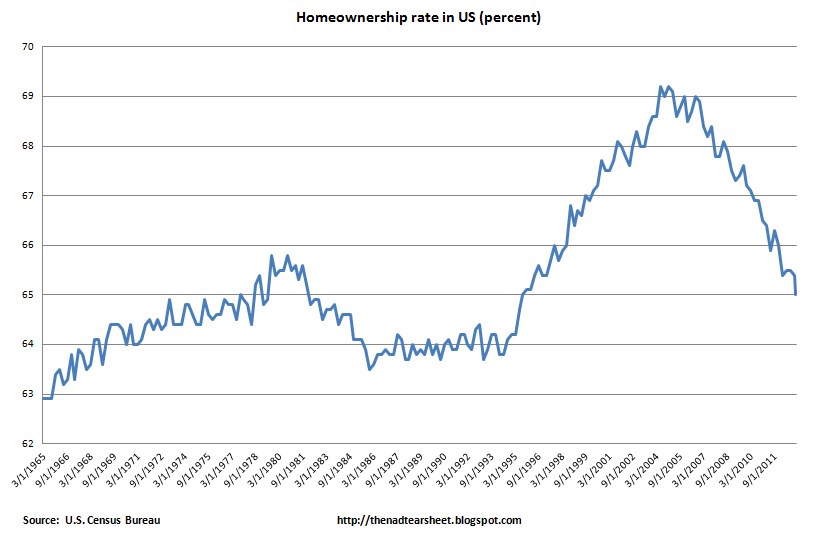
The homeownership rate declined to 65% in Q1, the lowest level since 1995. This speaks to the absolute dearth of household formation numbers in the last 5 years. While the number has dropped significantly from its peak in 2005, it is still more or less at historical averages.
Chart: Homeownership rate
Filed under: Morning Report |
 All Things in Moderation
OT: What if tattoos for employees were mandatory?
http://gawker.com/employees-promised-raises-in-exchange-for-tattoo-of-com-486202564
LikeLike
Warning! Counter-Narrative!!
VDR answers Teh Krugman.
http://www.nationalreview.com/node/346921
LikeLike
VDR conflates austerity and supply side marginal rate tax theory. They are not the same things.
LikeLike
jnc:
VDR conflates austerity and supply side marginal rate tax theory.
I don’t understand this comment. VDR says: 1) “austerity, as defined by economists, represents the measures implemented by a government in order to reduce the debt-to-GDP ratio”, 2) “I would prefer the word “austerity” to describe the measures implemented to skrink the size and scope of government, rather than improve a government’s fiscal situation”, 3) under the standard definition, austerity measures can mean different things, ie “cutting spending, raising taxes, or a mix of both”, and that effects vary depending upon which measures one is talking about.
I don’t see how any of this is a conflation with supply side marginal tax rate theory.
LikeLike
I guess I don’t understand. She is defining austerity as: “It is a sad fact that austerity, as defined by economists, represents the measures implemented by a government in order to reduce the debt-to-GDP ratio. “
Is that not the case?
LikeLike
Here’s what I don’t understand, whenever assholes like me whine about liberal media bias I get the standard bs response that all the corporate owners of the media are conservative. I think that’s idiotic, in that I don’t think corporations are conservative, I think they’re predominantly cronyest, statist and all to often willing to use the power of government to enrich and empower themselves. But let’s say the liberal belief about corporations is true, why would an LA Times reporter quit because the Kochtapus buys them when they’re already owned by another Kochtapus?
http://hotair.com/archives/2013/05/01/newspaper-guild-the-la-times-must-not-be-sold-to-the-koch-brothers-and-their-harsh-right-wing-positions/
LikeLike
George, I don’t understand why anyone cares who owns a newspaper, before the fact. I did think the WSJ was a better paper under DJ than under Murdoch, but I had no reason at all to assume it would go downhill before NewsCorp bought it. Really. Some actually pretty liberal folks bought Newsweek and ran it into the ground very quickly. I had no reason to assume they would do that before the fact.
Everyone is always afraid of the next William Rndolph Hearst, I think.
If most major media were thought of as too liberal by conservatives than conservatives would buy their own, and vice versa. Works for me.
I still think the WSJ is a high quality newspaper, btw.
When the WaPo goes behind a paywall, along with the Austin A-S and the Houston Chronicle, I will only be reading The Economist, which I pay for.
LikeLike
http://www.popehat.com/tag/shut-up/
LikeLike
Just because she would prefer austerity to mean what she wants, doesn’t mean that it does.
LikeLike
jnc:
Just because she would prefer austerity to mean what she wants, doesn’t mean that it does.
I agree, but I still don’t see the conflation. Her desire for austerity to mean something other than what economists generally mean when they use the term is pretty much just an aside. When she discusses the proposition that austerity has failed, she does so under the conventional definition, which she explicitly states, and points out that it can be achieved in different ways which, her argument claims, matters. Where is the problem?
LikeLike
She’s too hung up on redefining the word in her argument:
“But that’s because austerity measures implemented in Europe are not the kind of austerity we actually need.”
LikeLike
jnc:
“But that’s because austerity measures implemented in Europe are not the kind of austerity we actually need.”
That is not a redefinition. If austerity is taken, as it traditionally is, to mean reducing debt/deficits, it can be achieved by different measures. And her whole point seems to be that it matters which measures you adopt. There is no re-defining going on at all.
LikeLike
Knock me over with a feather.
http://mobile.slate.com/articles/health_and_science/the_dismal_science/2013/05/will_obamacare_work_a_new_study_out_of_oregon_challenges_shows_universal.html?original_referrer=http%3A%2F%2Ft.co%2Fy8PCwMPPDZ
LikeLike
McWing:
It’s interesting how that Oregon story gets spun in headlines.
New York Times: Medicaid Access Increases Use of Care, Study Finds
WaPo: Study: Depression rates for uninsured dropped with Medicaid coverage
The NYT headline is particularly laughable. Who needs a study to know that if the government pays for something, people will consume more of it? All the news that’s fit to print!
LikeLike
What is interesting to me is the thought that health would improve with increased access. Why would it when those with insurance are incredibly unhealthy? Poor eating habits and obesity are epidemic throughout the population.
LikeLike
The great hope of Medicaid is patient control. it’s always about control.
LikeLike
For what it’s worth this morning I was curious about the OR study after reading about the “failure” of medicaid, virtually everywhere, and found these two Kevin Drum pieces. I think he paints a more realistic picture of the actual outcomes. Whether these small improvements are worth it to taxpayers of course is another story.
http://www.motherjones.com/kevin-drum/2013/05/so-healthcare-worthwhile-or-not
http://www.motherjones.com/kevin-drum/2013/05/followup-medicaid-probably-does-improve-health-outcomes-after-all
LikeLike
LMS, I saw enough to make me decide it was premature to decide. All the commentators saw what they wanted to see. My only contribution is that it would take more than two years to see the long term results of controlling for diabetes.
FWIW, Medicaid is expensive. One question is – once you have forced hospitals to treat indigents – what is the cheapest most efficient way to do this? Another is – once you have forced hospitals to treat indigents – which taxpayers get hit for the bill?
We have talked about these issues a lot and some suggested not forcing hospitals to treat indigents while others suggested some sort of single payer – Medicaid – for all.
I go to the extremes of the discussion because I think it points up how little we can learn from the OR Medicaid experience.
I am now of the view that classic Smithian market analysis has limited application to health care costs and health care decision making. That doesn’t lead me anywhere in particular, as I still think we will move toward a private, regulated, insurance model that looks like Germany’s or Switzerland’s, not to a national insurance model like Canada’s. Costs will be shared more widely, but they will inevitably go up until we address the shortage of providers.
LikeLike
mark:
I am now of the view that classic Smithian market analysis has limited application to health care costs and health care decision making.
Why do you think so?
LikeLike