

 Brent Nyitray
 Fairlington Blade
 Let the mutherfuker burn!
 jnc4p
jnc4p Kevin S. Willis
 Michigoose
 lmsinca
 markinaustin
 Arcanaut
 novahockey
 quarterback
 ScottC
 yellojkt
Vital Statistics:
|
Last |
Change |
Percent |
|
|
S&P Futures |
1550.7 |
2.2 |
0.14% |
|
Eurostoxx Index |
2661.8 |
22.8 |
0.86% |
|
Oil (WTI) |
93.96 |
-0.5 |
-0.52% |
|
LIBOR |
0.28 |
-0.001 |
-0.25% |
|
US Dollar Index (DXY) |
83.19 |
0.469 |
0.57% |
|
10 Year Govt Bond Yield |
1.77% |
-0.04% |
|
|
Current Coupon Ginnie Mae TBA |
104.9 |
0.1 |
|
|
Current Coupon Fannie Mae TBA |
103.7 |
0.2 |
|
|
RPX Composite Real Estate Index |
189.4 |
0.1 |
|
|
BankRate 30 Year Fixed Rate Mortgage |
3.68 |
Markets are giving back some Japan-led gains after Initial Jobless Claims spiked to 385k from 357k. This was the holiday-shortened Easter week, so there is a seasonality adjustment there. On a non-seasonally adjusted basis, they fell. Bonds and MBS are rallying, with the 10 year yield down to 1.77%.
The Bank of Japan outlined more aggressive monetary actions last night with their own version of quantitative easing. This pushed the Nikkei 225 stock market index up 2%, and caused a sizeable drop in the yen. This explains the rally in US bonds as Japanese investors flee for the “high yielding” US treasury market. Don’t laugh – the Japanese 40 year bond (the 2’s of 52) yields 1.34%. The US 10-year at 1.77%, in the context of a depreciating yen, is reviving the yen carry trade. The Yen Carry Trade is when Japanese investors borrow funds at yen rates and invest in high-yielding sovereign debt. They benefit from the pickup in yield and any favorable currency movements. With the high quality Euro sovereigns yielding even lower than the US, we are the only game in town. Punch line – this will put downward pressure on mortgage rates in the US, at least at the margin.
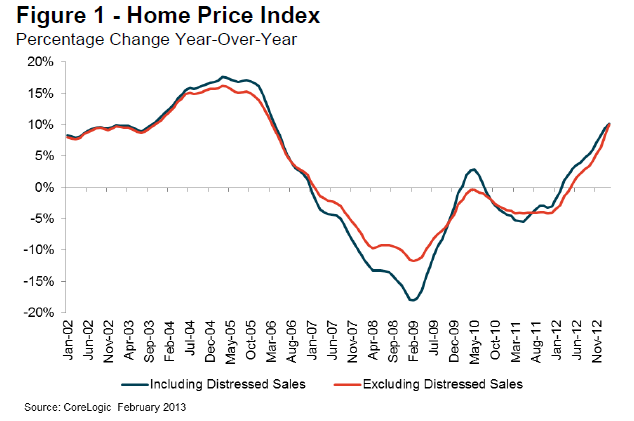
The CoreLogic Home Price Index increased 10.2% on a year-over-year basis in February, the highest increase since March of 2006. It is the 12th consecutive monthly increase. The gains were broad based, with 96% of their MSAs reporting gains. California, Arizona, and Nevada all showed gains in the high teens. They are forecasting a 2% month over month increase in March, or 12% year over year.
Chart: CoreLogic Home Price Index
Hank Paulson, George Bush’s Secretary of Treasury, says that Fannie Mae’s new profitability shouldn’t deter the government from establishing a new platform for mortgage finance. He mentioned the Washington Post article that says the Administration is pushing banks to make home loans to people with weaker credit. Nominated to take over as Treasury Secretary just as the housing bubble was peaking, he can be forgiven for being a little gun-shy on re-inflating the bubble.
San Francisco Fed President John Williams said he is hopeful that “the economy has shifted into high gear” and that the Fed could begin slowing the purchases of Treasuries and MBS this summer, with a full exit by the end of the year.
Finally, you can hear my latest interview on Capital Markets Today, where I discuss real estate pricing, politics, and the economy.
Filed under: Morning Report |
 All Things in Moderation
I’m move this from yesterday’s MR to today’s as I assume this will become the open thread now.
Unintended consequences?
“If we treated the patients receiving the most expensive drugs, we’d be out of business in six months to a year,” said Jeff Vacirca, chief executive of North Shore Hematology Oncology Associates in New York. “The drugs we’re going to lose money on we’re not going to administer right now.”
After an emergency meeting Tuesday, Vacirca’s clinics decided that they would no longer see one-third of their 16,000 Medicare patients.
“A lot of us are in disbelief that this is happening,” he said. “It’s a choice between seeing these patients and staying in business.”
Some who have been pushing the federal government to spend less on health care say this is not the right approach.
“I don’t think there was an intention to disrupt care or move it into a more expensive setting,” said Cathy Schoen, senior vice president of the Commonwealth Fund, which recently released a plan for cutting $2 trillion in health spending. “If that’s the case, we’re being penny-wise and a pound-foolish with these cuts.”
Legislators meant to partially shield Medicare from the automatic budget cuts triggered by the sequester, limiting the program to a 2 percent reduction — a fraction of the cuts seen by other federal programs.
But oncologists say the cut is unexpectedly damaging for cancer patients because of the way those treatments are covered.
Medications for seniors are usually covered under the optional Medicare Part D, which includes private insurance. But because cancer drugs must be administered by a physician, they are among a handful of pharmaceuticals paid for by Part B, which covers doctor visits and is subject to the sequester cut.
http://www.washingtonpost.com/blogs/wonkblog/wp/2013/04/03/cancer-clinics-are-turning-away-thousands-of-medicare-patients-blame-the-sequester/
LikeLike
I can’t think of a compelling reason to watch CNN any longer.
CNN brought retired General James Marks into their studio on Wednesday afternoon to explain the military strategies North Korea and the United States would likely employ in a conflict.
Assuming North Korea struck first, the country would begin firing artillery into South Korea while deploying special operation forces along the coast of the peninsula. Marks also warned North Korea had sleeper agents in South Korea who would spot targets.
The United States would respond by destroying North Korea’s artillery with its overwhelming naval and aerial power. The U.S. military would then destroy North Korea’s aerial defenses, communication lines, and transportation routes. Marks predicted the “instantaneous” response from the U.S. and South Korea would paralyze the North within days.
http://www.rawstory.com/rs/2013/04/03/cnn-previews-how-war-with-north-korea-would-play-out/
LikeLike
And this, putting “The David Stockman FArmageddon” predictions in perspective. (FArmageddon=financial Armageddon)
These oscillations themselves obscure the simple truth that our views about the future usually says less about what will happen then than about how we feel now. As the saying goes, predictions are tricky, especially about the future. None of us know what will unfold, and the human legacy of accurately gauging what will happen is poor at best.
Of course, Stockman might be right, and the jeremiads can be useful if they force us to focus on issues we are otherwise ignoring. Surely, political and economic policy can use constant improvement. But as for the odds of him being right, the past is suggestive if not predictive: The end of the world, the collapse of an old regime, the implosion of order ‑ those are rare, rare, rare. Even the crisis of 2008, as damaging as it was, did not fundamentally change the world as we know it, however much it raised the fear of the end. Current warnings of the end need to be placed in the context of a remarkably stable time, if not an easy one. Stockman and the rest of the doomsday chorus have not revealed any hidden truths; they simply loudly voice concerns widely shared. As such, they are a voice of collective angst, just as surely as the utopians of years past were beacons of collective hope. We should listen to the warnings, but given how paralyzing fear can be, let’s not invest them with crystal-ball clarity and so make them more real than they are.
http://blogs.reuters.com/edgy-optimist/2013/04/03/david-stockman-and-the-cult-of-gloom/
LikeLike
@lmsinca: “(FArmageddon=financial Armageddon)”
And here I thought Stockman was going to start arguing the plight of American’s family farmer. 😉
LikeLike
@lmsinca: “I can’t think of a compelling reason to watch CNN any longer.”
I’d appreciate more details on your thoughts here. Because CNN is fantasizing about war with North Korea? Because they are pining for the ratings of a hot war news cycle?
LikeLike
If the part b issue wasn’t intended I don’t know what to say. We’ve been screaming about that for months. I’m in meetings all day but part b drugs have been a target for a long time. But I think the refrain that provider cuts wouldn’t harm benes was ridiculous. Fwiw I’ve got guys ready to exit the program.
LikeLike
@lmsinca: “Unintended consequences?”
I don’t know the details, but I know a general principle of budget cuts: when you cut an agency or department’s money, they are going to cut where it hurts the most, or folks with yell the loudest, most of the time. This is very difficult to prevent, as it’s often the only form of retaliation they have in response to the cuts. So, they will cut where the folks responsible for the cutting, be it politicians or the public, will feel the most pain. This is often in opposition to cutting where there might be more long term damage (but no directly identifiable connection to the cuts) or where there might be similar damage, but not nearly so much noise.
Generally, when you start cutting government programs or budgets, those in charge will, if they can, try and make folks regret the money is being cut. Recipients of said largesse being cut off will do the same. That’s why cutting budgets is so hard.
LikeLike
Both Kevin. Also, when someone tells me now that an engagement would paralyze the North within days I no longer believe it.
LikeLike
Also, I should add, my experience is that people making budgets in hard times, where they have to cut things, often have no on the ground experience, and no real sense of what they are cutting or where, or why what they are cutting might or might not be important or problematic. They’re just cutting things at a very high, abstract level, and can be genuinely surprised to find they’ve taken out an important piece of the puzzle and that everything is suddenly collapsing. If they ever associate all the problems with the “excess” they cut, which they often do not.
LikeLike
You may be right Kevin, but they did actually address that issue in the piece. I know I’ve been receiving calls from hospice to please come back. The 2% cut they’re taking is on top of other cuts at the state level (Medical) already, that cut them to the quick. Regarding the medicare cuts, they were more specific than I think most of us realized. But you’re right, it’s difficult to tell sometimes if there’s an agenda lying underneath the way the cuts are made. It does seem as though using cancer patients would be somewhat beneath contempt so I hope you’re wrong.
LikeLike
@lmsinca: “Both Kevin. Also, when someone tells me now that an engagement would paralyze the North within days I no longer believe it.”
Well, they need to change “would” to “could”, and then it would be 100% accurate. We could paralyze the North within days. With carpet bombing. We’ve got the capacity to quarter their population in days without nukes; Katy bar the door if we decide to dust off some ICBMs. That’s a guarantee. We aren’t likely to do that unless they’ve nuked us, however. So saying “would” is inaccurate, as it is much more likely that we’d blanche at the body count required to truly paralyze and overwhelmingly defeat any nation.
LikeLike
@lmsinca: “It does seem as though using cancer patients would be somewhat beneath contempt so I hope you’re wrong.”
Rather than cut money from other important things that nobody, except those being deprived, would notice? I don’t imagine many folks are maintaining their office remodeling budgets while cutting care to cancer patients (alas, someone is, if I know humanity) . . . If they believe they need 100% of their budget, and it’s a choice between hurting people with no voice where only those people will feel the pain, or hurting people who will raise a ruckus an illustrate a broader point . . . I suspect some would consider it better to target cancer patients and build public opposition to cuts so that many more people could benefit, in the long run, from a robustly funded program.
LikeLike
Thanks Nova, I’ll look forward to hearing more. Are you saying the cuts were intended to hit part d cancer drugs and patients? The piece quoted says these people can receive the same drugs in a hospital setting at more cost to all.
LikeLike
Regarding the piece on the sequester and the Medicare cuts, I would note that if a cut of 2% results in 1/3 of the patients being denied treatment, then there’s no hope at all for the cost controls in the enhanced Medicare Payment Advisory Board in the PPACA.
This is what “cuts to Medicare Providers” and “squeezing providers” looks like and also what it looks like when those providers push back.
LikeLike
“lmsinca, on April 4, 2013 at 8:14 am said:
Both Kevin. Also, when someone tells me now that an engagement would paralyze the North within days I no longer believe it.”
We can destroy the North’s offensive capabilities pretty quickly, if the gloves come off. The Korean peninsula is the closest thing to a pre-planned war if ever there was one since the Fulda gap back in the 1970’s & 1980’s.
http://en.wikipedia.org/wiki/Fulda_Gap
LikeLike
It also shows that the cuts in the sequester did include cuts to medicare that affected patients and benefits. If these people show up at hospitals for chemo isn’t that just going to add more to health care costs? Or are we expecting 80 year old cancer patients to pick up the difference?
LikeLike
jnc and kevin, I’m not saying we couldn’t whip NK’s ass if we wanted to, what I’m saying is I don’t really need CNN to begin beating the war drums and telling me what the war would look like and probably how little it would cost. That almost treats is as a foregone conclusion.
This also coincides with the point I was making the other day, who do we, as average non-military citizens, trust when it comes to the run-up to war? CNN is off the list early.
LikeLike
“It also shows that the cuts in the sequester did include cuts to medicare that affected patients and benefits. ”
Only if you discount the administration’s position that you can cut payments to providers without affecting beneficiaries.
My own expectation is that this is the clinic’s way of playing hardball to get the funding restored.
LikeLike
“I’m saying is I don’t really need CNN to begin beating the war drums and telling me what the war would look like and probably how little it would cost.”
CNN and the administration aren’t beating the war drums, it’s North Korea. It’s worth doing some reporting on what the consequences will be if the North Koreans really are serious this time.
I could do with out the excessive graphics though.
All in all I think the administration has handled the situation about as well as it can be. Nothing overly provocative in response, but they haven’t caved either.
However, if the North Koreans shell South Korea again or attempt to sink another ship, it’s time for a military response.
LikeLike
As someone who has been involved with hospice for almost 25 years I’m all in favor of knowing when it’s time to settle in and die in as much comfort as it’s humanly possible to provide. I’m not a life prolonging at all cost advocate in any shape or form. I just don’t know how we can humanely lower costs on the backs of patients who are still legitimately seeking a cure and have the least amount of resources to pay for it. If someone can explain how to do that to me I’ll listen.
LikeLike
On my phone but I think this summarizes the issue. Medicare pricing for physician admonistered drugs isn’t like part D. It’s part of the part b program and Medicare spot does not cover costs. It is cheaper and saves b/c it simply under pays providers and dares them to not participate. People are starting to call that bluff. http://mobile.journals.lww.com/oncology-times/_layouts/oaks.journals.mobile/articleviewer.aspx?year=2011&issue=11100&article=00001
LikeLike
jnc
I could do with out the excessive graphics though
Yeah me too. As a “peacnik” (I’ve been told I am), these kinds of scenario experiments and conclusions tend to unnerve me.
I obviously agree we need to present a firm resolve in the face of NK’s threats, I’m just not ready to go down the “what if” path yet. I’m not sure that it doesn’t even give NK more legitimacy than they deserve.
LikeLike
Don’t pay for routine care and divert those funds to actual sick people. Pay premiums and pay out of pocket for physicals and prevention. Then have all the cancer drugs we need. Put old people in the same risk pool with young. Aca doesn’t do that.
LikeLike
Put old people in the same risk pool with young. Aca doesn’t do that.
Because old people are in Medicare?
So are you suggesting something like Wyden-Ryan? Or single payer?
I get that the silos are inefficient. I read what other countries do and I see room for private carriers as opposed to gummint and think that will work here, with regulation. I did think that TIME article was compelling.
—
Think of family in two ways. One is as an economic unit. This is usually H+W (+minor Cs, if any). Insulating this unit against the estate tax makes sense, because the loss of a member is not a windfall to the rest of the unit, it is a detriment.
Inheritance outside that economic unit – say by adult children – is a windfall to them.
I am only suggesting how the Code came to be what it is, not what I think it should be, necessarily.
LikeLike
Mark:
As always, you revert to what the law says while I am talking about what it should say.
Scott, as is often the case, we are talking past each other. I directly replied to your statement about what you think are the implications of equal rights under law. Then you suggested that equal rights under law should be something other than what they are, in America, in actual practice.
That is certainly what the proponents of SSM are trying to do when they argue that sexual orientation should be a suspect classification.
You can do it too. But if you have some hypothesis about what equal rights under the law should mean, and can state it succinctly enough for a discussion, please do so.
LikeLike
Mark:
I directly replied to your statement about what you think are the implications of equal rights under law.
Except that what I said was “equality before the law”, not “equal rights under the law”. And I was addressing the arguments of SSM advocates regarding justice, not constitutional law. SSM advocates are arguing that, as a matter of cosmological justice, SSM should be allowed. And one of their arguments about justice is the notion that, in the absence of SSM, same-sex couples do not receive equal treatment under the law.
That is certainly what the proponents of SSM are trying to do when they argue that sexual orientation should be a suspect classification.
I don’t think I have heard anyone else here besides you use the term “suspect classification”. I think virtually every proponent of SSM here at ATiM is making an argument about justice, not the meaning of the constitution. You and I can certainly discuss whether SSM is mandated by the constitution, but I think we have both already agreed that it is not, so that is not particularly interesting to me. I am far more interested in the notion that justice requires the changing of our laws, and the implications of accepting that claim as true.
LikeLike
It took us three fucking years and 40000 American dead and 90000 more wounded to fight the Korean War to a stalemate and an Armistice. Where the fuck was this three day war general then?
LikeLike
Mark:
It took us three fucking years and 40000 American dead and 90000 more wounded to fight the Korean War to a stalemate and an Armistice. Where the fuck was this three day war general then?
I don’t think the situations are comparable. The length and outcome of the Korean War was dictated largely, if not exclusively, by the participation of the Chinese on the North Korean side. In the current situation, if North Korea launches missiles to which we respond militarily, I very much doubt the Chinese will step in to protect them. But of course I presume the Chinese posture over this will factor heavily into whatever it is that we do, and how it plays out (and for how long).
LikeLike
“lmsinca, on April 4, 2013 at 9:14 am said:
jnc
I could do with out the excessive graphics though
Yeah me too. As a “peacnik” (I’ve been told I am), these kinds of scenario experiments and conclusions tend to unnerve me. ”
I believe the best way to put it is that the graphics and presentation tend to trivialize and desensitize one to the actual reality of war.
However, North Korea is a current event and I don’t think coverage of what the military options are and the various scenarios could be should be automatically out of bounds or viewed as beating the drum for war.
I do believe that the PBS NewsHour would do a better job with less sensationalism than CNN, but that applies to all topics, not just war.
LikeLike
jnc:
I do believe that the PBS NewsHour would do a better job with less sensationalism than CNN,…
Interesting to see Taibbi fans worrying about sensationalism.:)
LikeLike
Sounds good to me Nova. They need to lower my soon to be $1000/mo premium then. That already includes a $45 deductible and $5000 for hospital plus cost sharing on ER etc. I have absolutely no idea how much blood work or MRI’s, mammograms, colonoscopies, etc. cost though. I wish I did.
Put old people in the same risk pool with young
Medicare for all from cradle to grave? With supplemental insurance as people desire in various forms?
LikeLike
I do believe that the PBS NewsHour would do a better job with less sensationalism than CNN
Agree
LikeLike
Touche. Sensationalism does have it’s place though. I read Taibbi half for the entertainment value.
LikeLike
With regards to the sequester in general, I’m waiting for this next:
“Child’s homework not turned in. Blames the sequester.”
LikeLike
I had no idea Taibbi was considered a news source. I’ll have to re-evaluate.
LikeLike
I actually just think jnc and I are as effed up as Taibbi, that’s why we like him.
LikeLike
Amen Mark.
LikeLike
Mark, the post WWII drawdown. Went to far if we needed a ready army to deploy and fight a war, hence the post Korea build-up we have today. Consequences of the Korean slaughter.
There was a decision not to nuke, that costs lives as well.
LikeLike
I was born in April of 1950 and my dad was able to use me as an excuse when they asked him to re-enlist. He figured he’d shot his wad of luck over Germany.
I’ve only been to DC once about 7 years ago and of course we visited all the memorials, but the Korean War Memorial was my favorite even though we spent more time at the Vietnam wall.
LikeLike
I’m not a huge football fan but it’s hard not to like this guy.
And now Kluwe has written an equally blunt and vehement op-ed for CNN. Writing in his role as ambassador for Athlete Ally, an organization working to end homophobia in sports (Ayanbadejo and the Saints’ Scott Fujita are also ambassadors), Kluwe chided his fellow NFL players for being concerned about gay players. “They will not be a distraction,” he writes.
“Players — Those of you worried about a gay teammate checking out your ass in the shower, or hitting on you in the steam room, or bringing too much attention to the team — I have four simple words for you. Grow the f*** up. This is our job, we are adults, so would you kindly act like one?”
His concern for that one player who will be the first to come out is palpable. He reassures that man, whoever he might be, that he and his fellow “Allies” will be there to support him. But it will finally come down to that man personally to know if he can deal with the scrutiny of, “… people who insist on looking at you through the lens of your sexuality, and not at your skills as a football player.” Kluwe concludes by saying that that man, whoever he may turn out to be, is a teammate and friend. And not a distraction.
http://www.addictinginfo.org/2013/04/04/vikings-punter-chris-kluwe-tears-into-homophobic-players-grow-the-fk-up/
LikeLike
Thanks for that Kluwe link, lms, he has become my very most favorite football player this last year. Even more than Peyton and Eli.
I’m gonna go out on a very slim limb here, and say the whole NK is overblown–nothing is going to happen. Kim is not crazy enough and his generals certainly aren’t; I don’t know what game, exactly, they’re playing but it won’t turn into a shooting war. We’re a small enough group that someone will hold my feet to the fire if I turn out to be wrong, but NK doesn’t scare me nearly as much as Pakistan/India and the ME in general.
Israel scares me on almost a daily basis, but even they have been pretty quiet lately.
LikeLike
” Kim is not crazy enough and his generals certainly aren’t; I don’t know what game, exactly, they’re playing but it won’t turn into a shooting war. ”
If they shell a South Korean island and/or sink a South Korean navy vessel like the did last time, I don’t think they will get a free pass.
LikeLike
I don’t think they will get a free pass.
I don’t think so, either, but I still just haven’t seen anything that makes me think they’re getting ready to really push buttons. I didn’t spend a whole lot of time looking at NK when I was in, but applying what I learned/analysed to them now it just doesn’t look like they’re really going to jump the shark on this.
I really, really hope I’m right.
LikeLike
Kevin Drum shows a map of where women’s health is either declining, improving or remaining the same. I’m curious what these changes might be attributed to.
It turns out that male mortality mostly improved or stayed the same from the mid-90s to the mid-aughts, but female mortality increased in 43 percent of all counties
http://www.motherjones.com/kevin-drum/2013/04/women-are-dying-higher-rates-nearly-half-all-counties
LikeLike
LMS, I would not be quick to draw conclusions from the map or the general statistics. Women have had a longevity advantage over men in the USA for many years. We could be experiencing reversion to the mean.
Also look at the Texas border counties – generally pretty good. They include the absolute dirt poorest people in America. Third world living conditions for thousands of families. Tens of thousands. Perhaps no place too go but up. If any counties come close to those in poverty, they are in border NM and AZ. Same story! Blue.
So comparing Appalachia to New England might be instructive on some factor like the coal dust in the air, or the number of exceedingly fat women in southern mountain states, especially. We just cannot tell much from this, at all.
LikeLike
lms:
Try to ignore the ridiculous introduction, and page down for the more substantive details of this article:
Health care may seem like a crucial variable, but it had no discernable effect on death rates. “Surprisingly,” the authors write, “none of the medical care factors predicted changes in male [or female] mortality during the study period.” As you’d expect, counties with high rates of smoking and obesity were more likely to suffer increased premature mortality. But the strongest predictors of premature death were neither medical nor behavioral. Here are three key findings:
•Counties with high concentrations of Hispanic residents were less likely to see their death rates rise―no great surprise because Latino immigrants are healthier on average than U.S.-born residents.
•Counties with higher concentrations of college graduates had lower death rates, and less educated counties had higher ones, even when the researchers corrected for differences in income.
•As the maps below make clear, the rise in early death was highly concentrated in the South and parts of the West. In fact geography was the strongest protective factor the researchers identified. Counties situated in the Northeast and the Upper Midwest were largely immune from mortality surges, even when the researchers factored out differences in wealth, education and behavior.
How could location alone exert such powerful effects on health? “We’ve done similar studies at the state level, and region always surfaces as a dummy variable,” Kindig says. “Clearly something is going on. It could be cultural, political, religious or environmental, but nothing in the national data set lets us unpack the question. We need more granular data, and we need anthropologists to look at what’s qualitatively different about people’s lives in the higher-risk regions. This makes you want to jump on a bus and start taking notes.”
LikeLike
One (and only one) explanation that I can give in a microcosm: those blue counties in UT? They’re where Komen expanded breast cancer screening. The red ones are where we had to cut back.
I’d love to see a comparison with free contraceptives, since pregnancy seems to be an obvious health concern. I don’t have access to the article in Health Affairs.
LikeLike
It makes sense that it would be due to lack of services or possibly insurance, or both, but I’d sure like to see that article.
LikeLike
Good for the administration. This is long overdue:
LikeLike
jnc:
The administration is proposing that the government buy food in developing countries instead of shipping food from American farmers overseas, a process that typically takes months.
Won’t this simply drive up food prices in the developing country?
Despite his campaign rhetoric accusing Romney of exactly this, doesn’t this make Obama the true “out-sourcer in chief”?
LikeLike
jnc:
On its face that makes too much sense. There must be a catch.
LikeLike
BTW, there’s a chance I’ll be DC for job interviews 4/15 – 4/18, then to Boston for a conference the 19th – 24th.
LikeLike
That’s why I’d like to read the article Mark. I was hoping someone might have access. I’m not making broad generalizations. I’ve also heard that smoking rates are up for women. When you consider though that health scenarios are worse in 43% of counties I think it might be time to investigate the causes. In this day and age with the medical advances and technology it doesn’t make sense that women’s longevity should be going down. I don’t think playing catch up to men’s lower life span is a particularly worthy goal……………hahahaha. I am glad that men seem to be living a little longer though as I know so many of them.
LikeLike
I have access to health affairs. I’ll take aloof at the article when I’m back in the office tomorrow afternoon.
LikeLike
Thanks Scott and Nova. There are so many variables. I wondered about environmental myself but so many of the variables don’t explain the differences between men and women, that’s why I suggested either access to health services or possibly smoking. I’ve also read that heart disease has increased among women. It’s a curious statistic and being a woman, one with daughters, I’d like to understand what’s going on. It’s too big of a problem for me though so I’ll leave it to the professionals.
LikeLike
“Won’t this simply drive up food prices in the developing country?”
Yes, but that’s more desirable than undercutting them if the long term goal is to make the countries self sustaining by increasing indigenous food production. The other approach sustains a “culture of dependency”.
In practice, I believe that for droughts and famines it works out to purchasing from neighboring countries rather than shipping overseas. The other practice of giving the food to the relief organizations to resell, rather than for consumption by the affected populations simply adds a middleman to the process to arbitrage the donations at the expense of the American taxpayer.
Worth noting as well:
LikeLike
jnc:
Yes, but that’s more desirable than undercutting them if the long term goal is to make the countries self sustaining by increasing indigenous food production.
True. There is no solution that will not have unintended and undesirable consequences.
But In fact I have always been under the impression that in most of these places the root of the problems are actually political. If you really want to fix the problem, you have to alter the political structure that exists, not just send food or money. But that carries with it the politically and internationally poisonous odor of imperialism. So instead we are left to dabble around the edges, providing triage treatment rather than actually fixing the underlying condition that causes the suffering in the first place.
LikeLike
True. There is no solution that will not have unintended and undesirable consequences.
No doubt!
In the 50s we directly shipped grain to Pakistan to feed the starving Pakistanis. The government unloaded the grain and sold it on the world market.
That is when we started to get in bed with NGOs.
I do not have an answer.
LikeLike
BTW, I just went through our spam file and emptied it. Evidently Michael Kors and dentists are big fans of ours. Since I like Michael Kors’ clothes I think we should be flattered.
LikeLike
Interesting look at healthcare from the right.
http://www.realclearpolitics.com/articles/2013/04/04/unlike_obamacare_the_republican_plan_will_work_117796.html
LikeLike
Foreign food aid has always been a backdoor US farm subsidy rather than genuine aid. Buying local (to the donor nation) food has to be better economically for them than dumping ‘free’ American crops there. And don’t get me started on how US sugar tariffs have impoverished the Caribbean for generations.
LikeLike
I doubt this will go anywhere, but here it is, along with the proposal from this guy that “they (the GOP) would restore their relevance to the debate for the first time since the 2010 election”.
Ignore the part in the piece where he uses the verboten term “war on women”, this is after all a piece written by someone on the left, but I think it’s interesting that anyone on the right is even beginning to think in “single payer” terms. As I said though, I’m doubtful it will gain much traction. I’m not sure what Patterson means by “shale oil severance fees”.
The GOP hates Obamacare, that is certain. However, repeated attempts to repeal have failed to make even the slightest dent, in particular because people do not want to suddenly lose their healthcare or be denied for pre-existing conditions. In response, one GOP pundit has decided on taking a radically different tactic to get rid of Obamacare.
Robert W. Patterson, editor of The Family in America: A Journal of Public Policy, released a new article last week, titled “Grand Strategy on Health Care” in which he proposes a new policy by which the Republicans can manage to get Obamacare repealed. This is his proposal:
“It’s time for Republicans to dump their policy advisers, start thinking about the anxieties of ordinary Americans, and construct a viable health system that beats Obama at his game.
First, congressionally charter Blue Cross-Blue Shield as a monopoly to provide basic coverage to all Americans, except retirees. And grant the regulated nonprofit authority to impose payer-fee schedules on providers of routine care and services, much as Medicare does.
A utility-style Blue Cross-Blue Shield covering all working-age Americans and their dependents would offer enormous administrative economies of scale and an insurance pool of unprecedented size. By trumping state regulations, the plan would be relieved from paying for luxuries like aromatherapy, Viagra, sex-change operations, hair implants, birth control, or elective abortion. Nothing would preclude other carriers from selling supplemental insurance for medical non-necessities, purchased by individuals at after-tax rates.
Jointly funded by a modest payroll tax and shale-oil severance fees, this utility would not only replace all nonsupplemental health-care plans, but also Obamacare, state exchanges, much of Medicaid, and the State Children’s Health Insurance Plan.”
This is, ultimately, a single payer healthcare system, much like you would find in the United Kingdom.
http://www.addictinginfo.org/2013/04/05/in-order-to-overturn-obamacare-republican-pundits-propose-single-payer-healthcare-system/
LikeLike
Lms,
Check my (earlier) link to Ben Domenech and his discussion of R ideas. Personally, I cannot under any circumstances understand why a monopoly would be better. First, dollar one coverage seems ridiculous as he (and others) points out, because that’s where the money ends up going. One solution for most, other than indigent, is for catastrophic coverage only, ie, $10,000 deductible.
LikeLike
I read it McWing, that’s why I posted this one, as another alternative. I don’t know anything about this Patterson guy or “The Family in America” outfit, but I thought it was interesting.
LikeLike
@lmsinca: “Kevin Drum shows a map of where women’s health is either declining, improving or remaining the same. I’m curious what these changes might be attributed to.”
Coincidence? Smoking rates? Smoking is about the only elective behavior likely to make a large statistical difference . . .
Are marriage rates going up? I know it’s a generally held feminist truth that marriage benefits men (extends their lives) while it is neutral or negative for women (shortens their lives, or their lifespan remains the same). Which I tend to think is randomly correlative instead of causative, but what do I know?
I will read more of the article, and gain wisdom. 😉
LikeLike
Kevin, from another piece I read they thought smoking was at least one cause. I didn’t realize that there might be a regional effect on women though. I guessed it might be smoking as well. It’s too bad really that so many women have picked up the habit. I wonder why?
LikeLike
lms:
It’s too bad really that so many women have picked up the habit. I wonder why?
Having a lot more sex, maybe?
LikeLike
Heh, are they actually having more sex than we, I mean they, did in the sixties? I’m thinking it might be more of a generational thing that it’s finally catching up to older women as smoking tends to do, but not so much that younger ones are picking up the habit.
Out for the weekend.
LikeLike
Mortality effects of smoking can be delayed up to 30 years, so it might have to do with a spike in smoking in the 80s. Or even the 70s.
LikeLike
@lmsinca: “First, congressionally charter Blue Cross-Blue Shield as a monopoly to provide basic coverage to all Americans”
Meh. Lost me at “Blue Cross/Blue Shield”. Not my favorite health insurer.
LikeLike