

 Brent Nyitray
 Fairlington Blade
 Let the mutherfuker burn!
 jnc4p
jnc4p Kevin S. Willis
 Michigoose
 lmsinca
 markinaustin
 Arcanaut
 novahockey
 quarterback
 ScottC
 yellojkt
Vital Statistics:
| Last | Change | Percent | |
| S&P Futures | 1542.1 | 3.0 | 0.19% |
| Eurostoxx Index | 2683.9 | -0.1 | 0.00% |
| Oil (WTI) | 92.88 | 0.4 | 0.47% |
| LIBOR | 0.285 | 0.001 | 0.18% |
| US Dollar Index (DXY) | 82.58 | -0.164 | -0.20% |
| 10 Year Govt Bond Yield | 1.92% | 0.01% | |
| RPX Composite Real Estate Index | 191.2 | -0.6 |
Markets are higher this morning after luxury retailer Tiffany reported better than expected earnings, and Cyprus moves towards a resolution. There are no economic releases this morning. Bonds and MBS are up small.
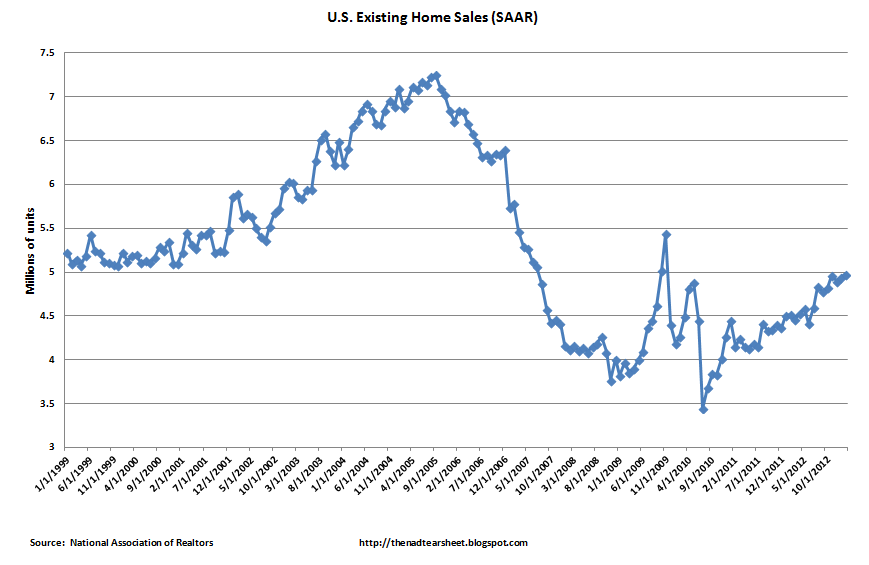
Existing Home sales rose.8% to a seasonally adjusted annual rate of 4.98MM, a 10% annual increase, according to the National Association of Realtors. Some stats from the release:
- The median house price rose 11.6% to $173,600
- Distressed sales accounted for 25% of all sales
- Professional investors purchased 22% of all homes
- The first time homebuyer accounted for 30%
- Short sale haircuts were 15%, while foreclosure haircuts were 18%
- Time on market fell 24% to 74 days
- Cash-only transactions were 1/3 of all transactions.
One feature of the financials lately has been the resurrection of many stocks given up for dead. The first one was Impac, which is up 5-fold since August of last year. Then came Radian. Well, guess who is back? Fannie Mae (FNMA), who is up 3-fold since last week when it delayed filing its 10-K and said it expects to post a profit. Also, the “Jumpstart GSE Reform Act” was introduced at the same time, which would require Congressional approval for the government to unload its Fannie Stock. I am hearing that there is action in the Fannie prefs as well. Yes, it is up on volume, too – 94MM shares traded yesterday.
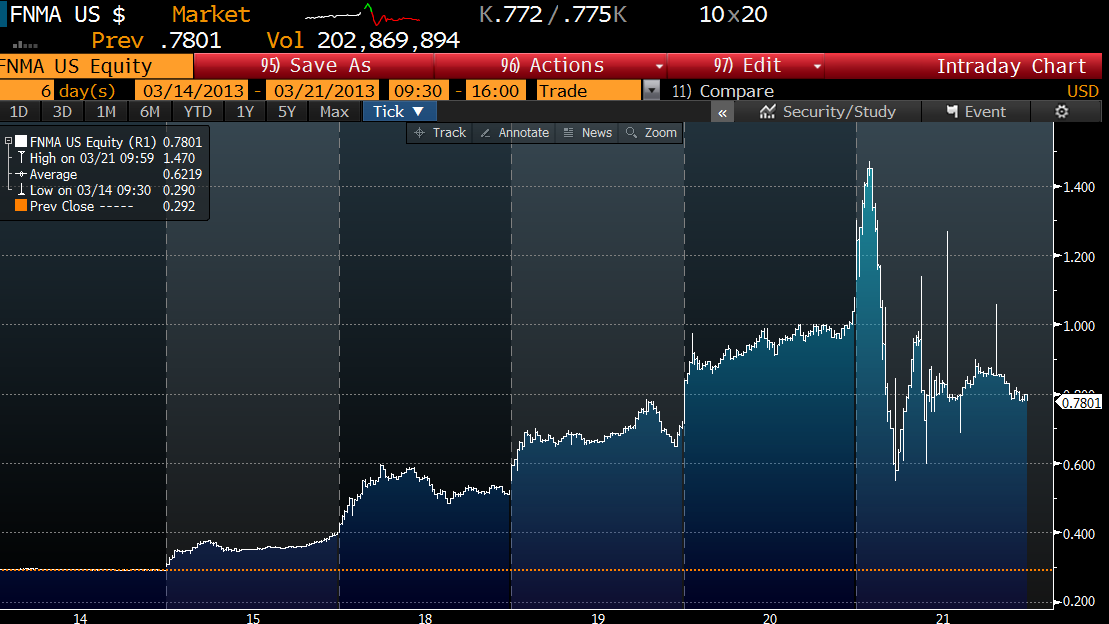
You are seeing the same action in Freddie Mac stock as well – FMCC.
Filed under: Morning Report |
 All Things in Moderation
Impressive. Obama’s DOJ brief on drone strike legality cites Nixon State Department lawyer on arguing for the legality of the secret bombing of Cambodia during the Vietnam war as a precedent.
LikeLike
HAPPY BIRTHDAY TO KEVIN WILLIS!
LikeLike
Happy Birthday Kevin!
LikeLike
the legality of the secret bombing of Cambodia during the Vietnam war as a precedent.
Are they being deliberately ironic or is the ghost of John Yoo walking the halls at night?
LikeLike
test
LikeLike
It means that the Democratic Party governs differently than they demagogue and their constituents are ok with it. Apparently only R’s are racist when killing brown people.
LikeLike
Courtesy of Shrink2 on PL.
“Unfit for Work
The startling rise of disability in America”
http://apps.npr.org/unfit-for-work/
LikeLike
http://reason.com/blog/2013/03/22/the-great-penis-robbery
LikeLike
jnc,
Money quote from that article:
That’s the equivalent of a fulltime job at $6.50/hr plus benefits. And they don’t pay FICA on it. Make work pay.
LikeLike
yello:
Make work pay.
Or better yet, don’t make not working pay.
I find it extremely odd indeed that one might see a government policy which makes pretending to be unable to work more profitable than taking a job, and then blaming it on the people offering the job.
LikeLike
Or disability less appealing.
LikeLike
disability shouldn’t be an option, but something that you have to take after all other options are exhausted.
LikeLike
“yellojkt, on March 22, 2013 at 11:04 am said:
jnc,
Money quote from that article:
I’d substitute this one:
“In the past few decades, an entire disability-industrial complex has emerged. It has just one goal: Push more people onto disability. “
LikeLike
I have some second hand experience with this as my sister’s boyfriend is on SSDI despite being in his early 40s. He was in a car accident and has severe deafness which can only be partially compensated with a hearing aid. He walks with a bad limp and has pain which keeps him from standing or sitting in on position too long. He collects SSDI, lives with my sister and does the after school care for her daughters. I can’t imagine him gainfully employed. It took him over two years to get his checks going. And as the article states, once people go on SSDI they rarely leave.
LikeLike
Yello,
I am so sorry to hear about your sister’s boyfriend and Imsinca’s sister. Being disabled isn’t fun at all.
Right now my hubby is doing everything; all the house cleaning, cooking, shopping, etc. I’d give anything to be able to get in my own car and take a drive. But as things are now, it causes too much pain just to be a passenger. Just picture how the bobble heads bobble on a dashboard… that’s what it does to our necks too.
But I am very optimistic about getting approved and that my husband and I will have enough “income” to make all ends meet. That of course may change once either of us are eligible for medicare (at least we hope it’s still avail when we are eligible), just how much that is going to cost us. We also want to purchase a supplemental health care plan as well. Hopefully we can do that and still make all ends meet. We’ll just have to wait and see.
Oh, and that reminds me…. a peeve I have about SSDI and Medicare.
Just when a person is told they are too disabled to work and get on SSDI, you still have to wait until the end of the 24 month “waiting” period to be eligible for medical care via Medicare.
I am only hoping that once I am approved for SSDI, perhaps I can get approval for Medicaid so I can at least get some more dang shots in my neck. But they will probably still say I made too much last year. So the waiting for me is going to be very painful, especially as time goes by. This congenital spinal stenosis does not get better without treatment, it only gets worse and more painful as more nerves are compressed. AND, I run the risk of any one or more of them being damaged to a point that I lose the use of whatever the nerve is for, i.e. fingers hand, arm, leg, foot,.. even my diaphragm which can cause pulminory failure.. paralysis of any part or all (quadraplegic)… or an artery gets cut or severed… now that’s my worst fear. I’ve already learned I cannot tilt my head back. Learned that trying to rinse my hair in the shower. An artery gets pinched and I drop to the floor with a splitting headache, feeling feint and extremely sick to my stomach. Like I said, I try not to move my neck/head… and it’s already gotten old. I JUST WANNA MOVE !
LikeLike
I agree Nova, disability shouldn’t be an option.. and the only instance I have heard of anyone getting disability, when I thought it was totally wrong, is when I have heard of drug addicts and severe alcoholics get it “cause they were unfit to work”. Which makes no sense to me at all… isn’t that what rehab centers are for? get them off the drugs/alcohol so they CAN work.
Other than that, I don’t know of anyone who chooses to be on disability. After 32 years as a commercial insulation installer for 32 years (and that is extremely hard work and any construction worker will verify that) and then beating stage 4 cancer, my husband tried to go back to work and did so for 22 months. He didn’t recover, physically, at all ,after 33 rounds of radiation, 6 weekly chemos and two 96 hour slow drip chemos. It all left him physically just as if he had been a holocaust victim. Since he also has scoliosis and degenerative arthritis and discs, it only took SS less than 90 days to approve him. He got his first check in Oct, and he is 60.
I am soon to be 58, and am waiting for my disability approval. I have 32 years in IT. I always had health insurance and have kept myself as physically fit as I can. But I was a premie, born at home just Mom and me (she did a great job on my belly button). I was born with my knees out of alignment but didn’t realize until I was 30 when I took up running. I’ve had 4 knee surgeries and they say I will eventually need more, but I do what I can to postpone any major surgeries… after all, I could still get around in a wheelchair vs having major knee replacements done.
I also have degenerative arthritis and degenerative disks. I was also born with spinal stenosis… born with my spinal column too small to house my spinal cord… well, it does house it, but barely. Means there’s no room for the swelling of the inner soft tissues as old age sets in. And today is a good day for me, so I am able to post this… I do have days where I just can’t even use my arms or hands… and am always in pain with nerves (and an occasional artery) being pinched in my neck and lower back.
I was having surgery scheduled for my neck in July 2010. The surgery is expensive, a minimum of $250,000. It will make my column bigger for vertebrae C3-7 and allow the needed room for swelling, by taking bone chips from one of my legs to insert into an opening in each vertebrae (by cutting them so they can be opened up – called an open door laminectomy). But before we could get the surgery scheduled, my job was outsourced to India and all I could get done in time before I had no insurance was another round of shots. I’ve had the deep vertebrae shots every 18 months since 2006 for this disability. The shots have kept me going.
But now, since I’ve needed more shots for over a year now, but can’t afford, yet make too much (barely) to get Medicaid, my spine is now in such bad shape, my doc says no more shots, must have surgery. Since I can’t afford it, he simply said, well you can’t work either. And he’s right about that. Trust me, most days are very painful for me and I simply can’t risk moving my neck much (for looking both ways when driving, etc.) I am having to stay as immobile as possible.
So, here I am applying for SS disability, at age 57, with a good 10 more working years…. if I only could. Simplest would be to get another round of shots, that would last about a year now… but I can’t.
So, simply by default, I am now going to be on disability. Doesn’t mean I want to be. Doesn’t mean my husband wanted to be either.
We had plans, we were working those plans… and we won’t get to see them finalized… but we got close. All because, in my case at least (not hubby, nothing can fix what cancer did to him)…. I simply can’t find a job that will pay a decent wage AND provide health insurance options. I can either get the pay to take care of our household, or, I can get a low paying job with health insurance.
But it doesn’t matter now I guess, doc kicked me to the curb on working.
Point is, people don’t get on disability because they WANT to.
LikeLike
Good luck to you and your husband Geanie. My sister has been on disability for 25 years and it’s no picnic but the alternative is worse.
I have heard that a number of people who were trying to work rather than claim the disability they may have been entitled to gave up in this recession as there were no jobs for them anyway. And as far as I know it’s still quite difficult to qualify and make it through the appeals process.
LikeLike
Imsinca,
Thank You. I certainly understand about some giving up with this recession, particularly since I’ve had my job outsourced 3 times since 2002… lost 4 full years total of employment in my field during the past 10 years… and the job I was doing when doc told me I was not to work anymore, hired me full time (no benefits) and last June changed me to part-time @ 16 hours a week. But even at that, I earned more than I will get on SSDI. But (lol), since I did earn more than most women in my career, my SSDI award will be enough to sustain us. We also have hubbies, but if something were to happen and it would be only me, I can make it… no frills, but can make it.
As far as how long I should expect for my approval, it should be rather quick… my congenital spinal stenosis and other disabilities I have are on the SS ‘fast track” list. I’m actually thinking I should be approved in time to actually receive my first monthly check on my birthday in July. 🙂
LikeLike
My sister’s husband drove them off a cliff (he was drunk) and she was thrown from the car, which actually saved her life but took his as he went down the mountain with the car. She was found three hours later in the snow and in really bad shape. She was in a coma for about two weeks and woke with brain damage. That’s how my husband and I ended up raising our niece and nephew who were 12 and 15 at the time.
My sister lives in NM with a care giver in a cabin they bought 30 years ago. She refuses to leave as her husband and daughter’s ashes are on the property, but I think this year we’ll have to move her in with us as she’s been getting progressively worse over the last year or two. She won a settlement against an insurance agency for my niece’s death about two years ago which has helped the finances, mostly ours as we were paying for the care giver until then but hers also. SSDI isn’t really much money but it does help having medical included.
LikeLike
Ditto to Kevin!
LikeLike
Happy B-Day, Kev.
LikeLike
Happy Birthday, KW!
How was the cruise?
LikeLike
Mich:
I’m still curious about what you found objectionable in my link about science and truth.
LikeLike
Genie, perhaps the exchanges and subsidies via the ACA will help you transition to Medicare. My sister’s been on so long I’ve forgotten whether she had to wait or not. Most of her initial medical bills were covered by their auto insurance and or medical insurance they had at the time of the accident. We sold their house in CO and paid off the cabin so she could live rent free and she loved it there even though her kids were here in CA. She was never the same mentally or physically after the accident and was partially paralyzed as well.
I was sick last year and it’s no fun so I really sympathize with you. I have a nasty back and it keeps me from doing a lot of the things I used to love doing but I managed to find some enjoyable replacements………………………..I hope you’ve been able to do that. I’m having trouble imagining what your life must be like.
One of our friends here, Emily Meier, fought through a lot of disabilities from her cancer treatment once it metastasized to her bones and I always had so much respect for her resilience so I offer you the same. She lived with a broken hip for a couple of years and spent them in a wheel chair because of it.
LikeLike
Insurance. . . .
Here is the latest in my world. After being denied ability to collect on Brian’s life insurance (since he hadn’t written a will specifying that I was his beneficiary, and despite his calls to the insurance company to state that)(and my paying his last two premiums), now his auto insurance is trying to collect >$50K in liability from me for an accident he had three months after we were divorced. Call me crazy, but this is just immoral. First I have to deal with divorce, then death, now the insurance company is after me.
LikeLike
Michi,
I agree with Imsinca, they can’t make you pay for something that isn’t yours, especially since you were already divorced when the accident happened. All you really have to do is let them know had already been divorced for 3 years before the accident happened and that you are not paying and if they want to continue to pursue, they will have to take you to court and have a Judge say you are responsible, which no judge will. Make sure you tell them all this in a certified letter with delivery receipt on it.
We had to do the same for my hubby on something his deceased wife had that he had no knowledge of. We never heard from them again.
And on his life insurance… the policy itself should have had a beneficiary on it, it’s required…. what does it state? If it states you, then it shouldn’t matter about a will. But if there’s no beneficiary stated on the policy (which would be very surprising to me) and nothing in the will for the beneficiary, AND he did not remarry, have any other heirs such as children, you should win it in probate… but those are a lot of if’s. But in answering all those if’s, you will know if you even have a chance to consider probate for the benefit.
LikeLike
I don’t see how they can legally do that Michi. You might need a lawyer to fight them though………………….more money out the window.
We had a good lawyer on my niece’s case against the insurance company but I’m still not sure it was worth the cost or the heartache. But I wasn’t getting stuck with a bill like they’re trying to do to you.
LikeLike
Evidently I’m next-of-kin on collecting money from me, but not giving money to me.
Yeah, I’m very bitter right now.
LikeLike
Private e-mails suggest an interestingly cozy relationship between the lawyers who argued against California’s Prop 8 and the judge who ruled in their favor.
LikeLike
Having ruled in Olson’s favor and then retired, there is nothing suspicious here. Had he ruled the other way and retired he would have surely asked opposing counsel for their advice.
No judge wants to be reversed, and here, having retired, it is comprehensible that this judge might want to see his landmark decision argued at the Supremes, but be concerned that his presence might be a distraction.
It is my guess that the appellate lawyers in CA on both sides were well known and well liked by the judge, as high profile appellate lawyers are repeat performers in the high courts.
Judge Roberts was every Supreme Court Justice’s absolute fave appellate lawyer. Ted Olson is probably at or near the top of judicial favorites in every court in which he has appeared. In both cases, this is because they are/were outstanding appellate lawyers, and gentlemen, not because they are conservatives.
There is a strong likelihood that at least one of the losing attorneys in the 9th C. case was also one of the judicial favorites.
“Favorite” here means one whose advocacy is always a work of art, not one whose campaign contributions are always in five figures. There is no hint of impropriety here.
LikeLike
Imsinca,
I’m sure hoping ACA will be of some help, especially since our Governor (OK) just rejected the Medicaid expansion which would have included me and I would have been able to get the shots and continued working. I just don’t understand it at all. If I were included, I could be kept functional and thus, be able to continue to work. But NOOO, I’m being forced to go on disability instead. But I have always been the optimist and I have always believed in not sweating the little things. Being in a wheelchair, to me, is a little thing (while in reality I am sure it isn’t)… but I do want a horn and a radio on my wheelchair when I finally have to take that route. 🙂
On Sat, Mar 23, 2013 at 5:26 AM, All Things in Moderation wrote:
> ** > markinaustin commented: “Having ruled in Olsen’s favor and then > retired, there is nothing suspicious here. Had he ruled the other way and > retired he would have surely asked opposing counsel for their advice. No > judge wants to be reversed, and here, having retired, it is compr” >
LikeLike
Mark:
Had he ruled the other way and retired he would have surely asked opposing counsel for their advice.
Is this standard practice? Do judges often attend SCOTUS hearings for cases that they themselves have ruled on, and if so do they usually ask permission from the arguing lawyers before they do so?
And I wonder why he wouldn’t have asked opposing counsel anyway. Why would he only be concerned about being a “distraction” for one side but not the other?
There is no hint of impropriety here.
The full context of the e-mails definitely hint that there is more than just a professional relationship between the lawyers and Walker. At one point Olson’s partner even refers to him as “my friend”. Are judges allowed to rule on cases being argued by personal friends?
It is of course possible that they have become friends post-ruling and post-retirement, maybe even because of the ruling itself. There is no established impropriety, sure, but to say there is not even the hint of any seems to go a bit to far. As a layperson, it appears that at least some questions might be reasonably asked.
LikeLike
Is this standard practice? No.
Do judges often attend SCOTUS hearings for cases that they themselves have ruled on, and if so do they usually ask permission from the arguing lawyers before they do so?
Still active judges, no, and no. For a retired judge this would be a treat.
And I wonder why he wouldn’t have asked opposing counsel anyway. Why would he only be concerned about being a “distraction” for one side but not the other? Because he is now a partisan for the ruling that he made, wanting it to be affirmed.
The full context of the e-mails definitely hint that there is more than just a professional relationship between the lawyers and Walker. At one point Olson’s partner even refers to him as “my friend”. Are judges allowed to rule on cases being argued by personal friends?
Absolutely yes. All judges are lawyers and had careers in the law before being judges and are generally on friendly, and socially friendly, terms with the lawyers who regularly practice before them. These lawyers include former partners, former employers, former employees, former law clerks, mentors, Tuesday night card buddies, and even lovers, but current business partners are excluded. In the rarified world of major appellate work, the community is probably as close as it is in a county of 100,000 with 3 trial judges and 50 lawyers who make regular appearances. Remember that when the judges were practicing they were often friends with, or law school classmates of, the lawyers they opposed. It is a professional community. In a specialty, lawyers become friendly with other lawyers in the same specialty from their county, their state, and even across the nation.
It is unimaginable that only out of town lawyers could practice in your county, or that the best appellate lawyers would not be allowed to appear in the Circuits and before the Supremes.
And no one pretends they are not friends. Collegiality is not a “problem”.
LikeLike
Mark:
These lawyers include former partners, former employers, former employees, former law clerks, mentors, Tuesday night card buddies, and even lovers, but current business partners are excluded.
Seems somewhat odd to me that the only thing considered to be a potential conflict of interest is a financial relationship.
LikeLike
Worth a read.
“Sears and J.C. Penney: A pair of cautionary tales”
http://www.washingtonpost.com/business/2013/03/22/2c6d625c-919b-11e2-bdea-e32ad90da239_story.html
LikeLike
I’m trying to stay away from controversial subjects, politics or otherwise, during the infrequent times I show up here, and I understand that Matt Taibbi is a lightening rod for some of you. I can’t resist putting this here though as I think it’s important and it might even be a subject that different political persuasions can agree on, but of course I’m not sure. Anyway, here it is if any of you are interested in the whole state secrets, whistle blower dilemma.
But in all of these cases, the government pursued maximum punishments and generally took zero-tolerance approaches to plea negotiations. These prosecutions reflected an obvious institutional terror of letting the public see the sausage-factory locked behind the closed doors not only of the state, but of banks and universities and other such institutional pillars of society. As Gibney pointed out in his movie, this is a Wizard of Oz moment, where we are being warned not to look behind the curtain.
What will we find out? We already know that our armies mass-murder women and children in places like Iraq and Afghanistan, that our soldiers joke about smoldering bodies from the safety of gunships, that some of our closest diplomatic allies starve and repress their own citizens, and we may even have gotten a glimpse or two of a banking system that uses computerized insider trading programs to steal from everyone who has an IRA or a mutual fund or any stock at all by manipulating markets like the NYSE.
These fervent, desperate prosecutions suggest that there’s more awfulness under there, things that are worse, and there is a determination to not let us see what those things are. Most recently, we’ve seen that determination in the furor over Barack Obama’s drone assassination program and the so-called “kill list” that is associated with it.
Weeks ago, Kentucky Senator Rand Paul – whom I’ve previously railed against as one of the biggest self-aggrandizing jackasses in politics – pulled a widely-derided but, I think, absolutely righteous Frank Capra act on the Senate floor, executing a one-man filibuster of Obama’s CIA nominee, John Brennan.
Paul had been mortified when he received a letter from Eric Holder refusing to rule out drone strikes on American soil in “extraordinary” circumstances like a 9/11 or a Pearl Harbor. Paul refused to yield until he extracted a guarantee that no American could be assassinated by a drone on American soil without first being charged with a crime.
Read more: http://www.rollingstone.com/politics/blogs/taibblog/wikileaks-was-just-a-preview-were-headed-for-an-even-bigger-showdown-over-secrets-20130322#ixzz2OPZhtvQu
And also too, I sure as hell can’t bring up Rand Paul’s filibuster at the PL…..hahahha
LikeLike
lms (from the article):
We already know that our armies mass-murder women and children in places like Iraq and Afghanistan, that our soldiers joke about smoldering bodies from the safety of gunships, that some of our closest diplomatic allies starve and repress their own citizens, and we may even have gotten a glimpse or two of a banking system that uses computerized insider trading programs to steal from everyone who has an IRA or a mutual fund or any stock at all by manipulating markets like the NYSE.
This passage is a good example of why Taibbi is such a dishonest hack. To characterize the deaths in Iraq that he is talking about as “mass murder” is to intentionally ignore the context in which they occurred. And the article to which he linked with regard to the high speed trading program gives no indication at all that the program engages in insider trading nor that anyone, much less “everyone”, who owns stocks has been been stolen from by it.
LikeLike
“computerized insider trading programs”
I don’t think Taibbi knows what insider trading is…
LikeLike
He knows that his readers will react to it, want to be fed with reinforcement of their belief. That they have no control, dark forces always manipulating events. It’s like reading a SDS or Weatherman statement. Cartoonish.
LikeLike
You guys have an interesting way of inviting discussion, what do you call it? Must be some sort of lecture series.
LikeLike
Isn’t disagreeing with what someone wrote, engaging in discussion? If not, why not? How is one supposed to disagree that would not sound like a “lecture series?” I ask this periodically and I always am sincere when I ask it, how can I engage in disagreement that will not be seen as illegitimate or alienating?
For example, in any military there will be individuals who will engage in horrific behavior. I guarantee that there were American service personnel, during the Haiti earthquake relief effort, that engaged in some pretty heinous things. Does that mean the intent of the relief effort was mass rape? To read Taibbi is to believe that genocide and war crimes are prime missions of the US military. Do you believe that? I think it’s an outrageous implication and discredits him completely, as does Sullivan’s Trig Trutherism and worthy of pointing out. What if I continually referenced that freaky California lawyer woman who’s a big birther, she ran (and lost) a CA Attorney General race, wouldn’t, shouldn’t I expect derision from those that post here?
It’s not like any of us wrote, “if you disagree you will be banned.” You posted a Taibbi article, was your hoped for outcome agreement? If so, how is that any different than a lecture?
LikeLike
It doesn’t matter mcwing. I thought it was an interesting topic of conversation which no one addressed, instead y’all skipped the topic, no worries. You’re discussing it now but I’m on my way out the door……………………….no big deal. I didn’t post it to discuss Taibbi’s shortcomings with you guys, I posted it because I thought the subject was interesting. I sure don’t expect agreement but I do think the whole whistle blower subject and state secrets is an interesting one that could, although I’m probably wrong, cross political lines. I don’t find it particularly cartoonish and if you do then there’s probably no point in discussing the finer points is there?
Birthday Party time………………………………..
LikeLike
“Insider trading” is when an individual trades on material, non-public information about a particular stock. Martha Stewart was busted for insider trading because she sold her Imclone stock before the market learned that their drug had failed an FDA trial. Insider trading is illegal.
What Taibbi is writing about is code for high-frequency trading, which is not illegal. So, as someone who holds himself out as the journalist “cop” on Wall Street, who dares to write the stories that are too provocative for the mainstream press, it would be helpful on his part if he at least understood basic terminology and securities law. Either he is being deliberately disingenuous (because he can get away with it) or he doesn’t really understand the business he hates so much and has made a career of bashing..
LikeLike
Regardless of Taibbi’s lack of understanding of insider trading or his bank bashing, I still thought the point of his piece was a topic worth discussing. John Q Public is in the dark on a lot of this state secret stuff and generally the people who try to shine a little light on it are the ones being put behind bars. If that doesn’t bother you then I guess I struck out on a topic of discussion.
His mention of high-frequency trading was a minor mention but leave it to you and Scott to pick up on that and ignore the rest. And whether he understands the banking industry or the stock market is not that important to me, most of us don’t and don’t even want to. Really, I’m mildly interested as I have a few investments and run a business but generally my eyes glaze over during most economic discussions. We do have that sneaking suspicion though that a few people, or maybe even more than a few, evaded prosecution thanks to the government that subsidized them and or hid their criminal mis-adventures. It’s really convenient for the industry that so few of us understand it.
Next time I try to find an interesting subject I’ll make sure there’s no mention of banks or the stock market in case someone has something negative to say and we lose our focus on the important stuff.
Now I really do have to go.
LikeLike
lms:
Next time I try to find an interesting subject I’ll make sure there’s no mention of banks or the stock market in case someone has something negative to say and we lose our focus on the important stuff.
For what it is worth, I would recommend that if you have a subject that you really want to have a discussion about, don’t use Taibbi to introduce it. His articles are not designed to provoke thought or to provide insight. They are designed to incite the passions of those true believers who already agree with him. And they are so routinely dishonest and/or ignorant, it is impossible not to focus on that aspect of them.
And BTW, I find it particularly inconvenient that so few understand the finance industry. It makes them easy targets for hucksters like Taibbi and other populist demagogues.
LikeLike
With regard to the issue of government secrecy, I’d say that while it is certainly true that there is a need for the government to keep certain things out of the public domain, it is a dead certainty that the government keeps way more secrets than it needs to, and that it’s ability to keep secrets prevents accountability at some level. I don’t think there is an ideal solution to the problem of secrecy being both necessary and dangerous.
However, I much prefer that government secrecy be policed by domestic media organizations, which themselves have some degree of accountability within the nation, and which, it is not altogether unreasonable to assume, have at least some degree of concern for national interests. Using non-US individuals, like Julian Assange, who at best have no presumed interest in US national security and at worst are actually anti-American and wish to harm our national security, is the height of irresponsibility and ought to concern us all. The fact that Brady used someone like Assange makes me question just what his motives really were.
I also think government secrecy is of an entirely different order than secrecy in business. When Rolling Stone Magazine starts publishing its own internal e-mails (including Taibbi’s) and posting its internal meetings on YouTube for all to see, perhaps I’ll take its fretting over the secrecy of Wall Street firms a little more seriously. Until then, I’ll see them for the hypocrites that they are.
LikeLike
One more quick one and then we’re off. “The American Conservative” isn’t exactly a Tea Party or neo-conservative publication but I believe they’re to the right of Taibbi still. Here’s their take from last year on the same subject, much less objectionable I suppose to conservatives here as he doesn’t actually discuss the banks or high frequency trading………………………grist for the base I suppose or just those of us who don’t inherently trust the Jamie Dimons of the world.
http://www.theamericanconservative.com/articles/in-defense-of-bradley-manning/
LikeLike
“Brent Nyitray, on March 24, 2013 at 10:01 am said:
“Insider trading” is when an individual trades on material, non-public information about a particular stock. Martha Stewart was busted for insider trading because she sold her Imclone stock before the market learned that their drug had failed an FDA trial. Insider trading is illegal.
What Taibbi is writing about is code for high-frequency trading, which is not illegal. “
Brent, I believe you yourself have characterized high-frequency trading as illegal front running on this forum in the past.
LikeLike
I believe HFT is front-running, but that isn’t insider trading. HFT, while I believe it pushes the envelope of what should be permitted, isn’t illegal.
LikeLike
Having Taibbi discuss Wall Street is like listening to Rush Limbaugh talk about abortion.
LikeLike
Whistle blowing seems to me to be a case of whose ox is being gored. Von Spasky’s revelations about the DOJ’s Civil Rights divisions overt racism didn’t seem to go over to well on the left, and Mark Felt’smotives revenge driven revelations certainly wasn’t received well on the right.
Can you name a whistleblower who you think was dead wrong in doing what they did?
LikeLike
“However, I much prefer that government secrecy be policed by domestic media organizations, which themselves have some degree of accountability within the nation, and which, it is not altogether unreasonable to assume, have at least some degree of concern for national interests.”
I’m the opposite. I’d rather review the unredacted source material myself than trust the filtering process of the media organizations.
LikeLike
jnc:
I’d rather review the unredacted source material myself than trust the filtering process of the media organizations.
So would I. But there are plenty of people that i would not necessarily want to have access to source material. My premise is that there is both a need and a justification for the government to keep some things out of the public domain. So the question is not whether I (or you) personally would like to see everything, but rather how to police what is kept secret so that the need is not abused.
If you disagree with the premise and think that the government has neither the need nor the justification to keep anything from the public, then that is a different argument. But if you grant the premise, then my question to you would be why you would trust Bradley, or Julian Assange, more than, say, the WSJ or the NYT, to be a better judge of just what should be secret and what shouldn’t.
LikeLike
According to the New York Times the secrecy at the Manning trial is itself Kafkaesque.
Original sources and reported context are not mutually exclusive. Without context the Pentagon Papers would have been incomprehensible.
LikeLike
I find the phrase ‘mass-murder’ very disrespectful to the professionalism of our troops but the two incidents linked to in the article detail the trigger-happy paranoia that our extended occupation promulgated. In an insurgency with the weapons of the modern terrorist such as suicide bombers and weaponized vehicles such excessive caution is justified on a force-protection basis but it comes at a huge toll on both our moral authority and Iraqi civilians. Over 100,000 Iraqis have died and not all of them were attacking Americans but they all had relative who mourned their death.
I was against the invasion if Iraq and thought our occupation was bungled from the start, but when the instant the abu Ghraib photos came I out I knew with unwavering certainty that we had lost. Those incidents were also made public by people whose sensibilities were shocked.
Taibbi’s hyperbole aside, the way we were conducting the occupation deserves scrutiny and examination rather than how these documents reached the public’s attention.
LikeLike
We all agree that Taibbi’s shorthand is technically inaccurate but the bigger point that the middle class retail investor gets played for suckers by the investment industry is equally indisputable.
LikeLike
Troll,
I couldn’t google ‘Von Spasky’ so I have no clue what scandal you are referencing. Are you thinking of Hans von Spakovsky who was so controversial with the GOP judges that he got kicked off the Fairfax Election Board?
LikeLike
That’s the guy, the left has demonized him.
LikeLike
Demonized how? I only know what I read about him in the lamestream media.
LikeLike
Actually, I fucked up, I meant Chris Coates, not Von Sparkosky. VS has written about Coates here:
http://www.nationalreview.com/articles/228943/politicizing-law/hans-von-spakovsky
Thought google “Von Sparkosky demonized” and you’ll see what I mean.
LikeLike
I think the WSJ hits the nail on the head with today’s editorial about the Supremes and the SSM case it hears today.
If the Supreme Court now reads a right to gay marriage into the Constitution and imposes that definition on all states, it won’t settle the debates Americans are conducting. It will inflame them and ensure they never end, prematurely aborting the give-and-take on contentious moral and social issues the Constitution is designed to encourage. Five Justices—or fewer, if they split into pluralities—could further polarize the body politic and make compromise more difficult…
(snip)
The Supreme Court does not have a good record legislating cultural change. A ruling on behalf of same-sex marriage could enshrine Hollingsworth and Windsor with Roe v. Wade, the 1973 abortion decision that imposed a judicial diktat even as laws in many states were liberalizing. Instead of finding a rough consensus inside the political mainstream, abortion became an all-or-nothing combat that still rages.
The same-sex marriage cases are an opportunity for the Court to show it has learned from that mistake. Justice Kennedy and his colleagues can incite another Forty Years War or they can return their social jurisprudence to the measured, incremental approaches the Constitution intends.
LikeLike
Incrementalism is justified in the law for many excellent reasons, the best of which, from the lawyer’s view, is that the lawyer can then predict for his client the effect of the outcome the client’s proposed conduct better than if courts blow with the wind.
I think these two cases can be decided consistently and with a nod to federal-state relations if DOMA is set aside as an impermissible imposition of federal failure to recognize as lawful something a state can obviously permit. There is, after all, no such thing as a federal marriage license. The 9th C. case could be decided either way so long as the state’s prerogative is recognized, or if the Prop 8 proponents have no standing.
A ruling that all states must now recognize SSM because of a newly expanded view of the 14th A. should be avoided because that issue is not necessary to the resolution of either case and would suffer the same vice as CU did, in that respect. Further it would inject that unpredictability into the law that I dread.
OTOH, a ruling that DOMA is indeed constitutional would permit a further Congressional trampling of hitherto recognized state prerogatives. Remember, the Congress did not outlaw SSM, it just said that no matter if a state law allows SSM, the feds won’t recognize it [although I am curious how various federal data bases like the census treat lawful SSMs]. Something similar happens when states do not criminalize MJ but the feds do, so it is not unheard of for the feds to trample hitherto recognized state prerogatives. I think it is bad form there, as well, of course.
I think the Court will be closer to a consensus on DOMA than on the Prop 8 case, unless they duck the Prop 8 case on the standing issue.
This should be irrelevant to a Court Decision, but:
DOMA probably causes a net loss of tax revenue to the feds and a net increase of expenditures, although I do not have stats. I would be interested in an analysis, if any of you have a link.
I base my inferences on two different notions. On the income side, it seems to me that two individual earners would pay less in taxes than the same two as married couples in most instances [ although a one income SSM family would pay more, I am guessing there are a predominance of two income SSM families ]. On the expenditure side, more single persons are eligible for Medicaid by reason of the rules that require spousal support to count as disqualifying income for benefit purposes.
I’ll bet NoVA has stats for the projections on Medicaid.
LikeLike
but the bigger point that the middle class retail investor gets played for suckers by the investment industry is equally indisputable.
I vehemently dispute that. The investment industry has slashed the price of brokerage commissions to where they are almost nothing, has provided products for instant diversification (ETFs) which have much lower management fees than mutual funds, provides research to everyone, not just the big institutions that pay commissions, and has a gauntlet of regulators at the state and federal level to deal with, Not only that, but every single new issue comes with a veritable phone book of ever real and imagined risk factor with the investment and basically gives you every reason in the world why you shouldn’t buy it.
The instances of criminality and fraud in the investment community are usually centered around institutions and high net worth investors (the Madoffs, etc). They are not directed towards the guy with a $75,000 in his IRA. The middle-class retail investor has more protection than you can imagine.
Losing money is part and parcel of the stock market. Even the pros are typically 300 – 350 hitters. They make money by position management (ie building their winning positions, and getting rid of losers before they become big).
I know there is this unfortunate American mentality, primarily on the left, that if something bad happens to you, it is someone else’s fault. But that doesn’t make it true.
LikeLike
Here is a completely false assertion from the WSJ editorial:
Civil rights for homosexuals still lag behind discrimination based on race and religion. In many states sexual orientation is still not a protected class in employment. It is legal in many places to fire people for being gay.
The proof that progress is being made seems to be an odd argument that it can now be halted.
LikeLike
yello:
Here is a completely false assertion from the WSJ editorial:
It isn’t even partially false, much less completely false. Gays have the same right to vote as anyone else.
LikeLike
Andy Borowitz puts his tongue only slight in cheek when he channels Scalia:
Read more: http://www.newyorker.com/online/blogs/borowitzreport/2013/03/scalia-says-marriage-views-not-affected-by-lifelong-fear-of-gays.html#ixzz2OYpi3GfO
LikeLike
“Brent Nyitray, on March 25, 2013 at 6:30 am said:
but the bigger point that the middle class retail investor gets played for suckers by the investment industry is equally indisputable.
I vehemently dispute that.”
I submit this as a more sophisticated critique than Taibbi’s as to how HFT and front running does in fact advantage large investors (either hedge funds or banks trading on their own accounts) at the expense of individual middle class retail investors.
“Interview With A High-Frequency Trader
Submitted by Tyler Durden on 08/03/2012 13:49 -0400
http://www.zerohedge.com/news/interview-high-frequency-trader
LikeLike
“ScottC, on March 24, 2013 at 6:02 pm said:
…
But if you grant the premise, then my question to you would be why you would trust Bradley, or Julian Assange, more than, say, the WSJ or the NYT, to be a better judge of just what should be secret and what shouldn’t.”
I don’t, but neither do I trust the NYT or the WSJ over Assange just because they are large institutions. The more I’ve seen Assange directly interviewed, the less of a boogie man he comes across as. He actually doesn’t do pure document dumps either. See his interview with Bill Maher.
http://www.hbo.com/real-time-with-bill-maher/episodes/0/271-episode/video/february-8-2013-julian-assange.html
http://vimeo.com/59296661
The other observation is that as has been noted before, the Pentagon Papers and everything else that Daniel Ellsberg leaked was classified at a much higher level than anything that Manning & Wikileaks published. The classification system is so misused as a way to avoid embarrassing disclosures that don’t directly affect national security that it’s almost useless as a benchmark as to what’s appropriate and what’s not.
Ron Paul, among others has brought me around on this:
http://www.theamericanconservative.com/ron-paul-stands-for-manning-and-assange/
And Assange himself self identifies as a libertarian, and appears to have thought through the premise of a free market:
http://reason.com/blog/2010/11/30/assange-im-influenced-by-ameri
http://www.forbes.com/sites/andygreenberg/2010/11/29/an-interview-with-wikileaks-julian-assange/
LikeLike
jnc:
I don’t, but neither do I trust the NYT or the WSJ over Assange just because they are large institutions.
I don’t trust the NYT or WSJ more because they are large institutions. I trust them more because, no matter what my disagreements with them over what might actually need to be kept secret, I assume they have an actual stake in, and hence a genuine interest in, preserving the national security of the US. Assange has no such stake, and I think he is at best indifferent to US security, and quite possibly actually hostile to it.
Again, my assumption is that there is a legitimate need for the government to keep some things out of the public domain, and so the question I ask myself is which would I prefer to act as a check on that need, a domestic institution with some degree of accountability within the nation itself, or some foreign individual with no ties or accountability within the nation at all. From my perspective it really isn’t much of a contest.
LikeLike
@jnc4p, I am not going to defend HFT, but I do find the idea that the investment industry’s MO is to defraud individual investors completely false.
LikeLike
Did you have an opinion on the technical accuracy of the interview?
LikeLike
“From my perspective it really isn’t much of a contest.”
I’d argue that you are being sentimental, and this isn’t supported by the facts.
What WikiLeaks released from Manning was no where near as damaging as the NYT’s revelations about the NSA warrant-less wiretapping and Stuxnet or the Washington Post’s report on the secret CIA prisons in terms of actual impact on U.S. counter-terrorism activities.
LikeLike
jnc:
What WikiLeaks released from Manning was no where near as damaging as the NYT’s revelations about the NSA warrant-less wiretapping and Stuxnet or the Washington Post’s report on the secret CIA prisons in terms of actual impact on U.S. counter-terrorism activities.
What reason do we have to believe that Assange would not also have revealed the same things had he been in a position to do so?
The relevant question to me is what motivates someone to reveal what they reveal. Both the Times and the Post would undoubtedly argue that from their perspective revealing what they did was of greater value to the American public than whatever cost the revelations might have imposed on our security. I may disagree with that assessment in a particular case, but I do believe their judgement is a sincere one. Which is to say that I think at some level an assessment of US national interests factored into their decision, and I would expect it to factor in for future decisions. I am not at all convinced that such is true of someone like Assange, and I have a hard time understanding why anyone might think he cares one iota about US interests or security. Particularly in light of wikileaks’ self-declared hope to accelerate “the total annihilation of the current US regime.”
LikeLike
“I do believe their judgement is a sincere one.”
I don’t believe their sincerity is any more valid than what Assange himself proports to believe in based on his interviews and actions to date. The Times and the Post also have commercial considerations as well.
I believe that Jon Stewart is correct about the MSM:
“The bias of the mainstream media is towards sensationalism, conflict and laziness”.
http://www.politico.com/blogs/politicolive/0611/Jon_Stewart_Press_biased_towards_.html
Again, based on the patterns of behavior to date based on what has actually been released from both WikiLeaks and the MSM, you can’t support your analysis. it’s pure conjecture and bias in favor of the status quo.
I oppose the idea that there’s a special protection in the First Amendment for media corporations over and above what individuals have, which seems to be where you are going with this.
I find Assange more persuasive:
“..[W]hen an executive can kill its own citizens arbitrarily at will, in secret, without any of the decision making becoming public, without even the rules of procedure, without even the laws behind it being public — that’s why we need organizations like WikiLeaks.”
http://www.huffingtonpost.com/2013/02/09/assange-bill-maher_n_2650810.html
LikeLike
jnc:
I don’t believe their sincerity is any more valid than what Assange himself proports to believe in based on his interviews and actions to date.
I’m not sure what you mean by “valid”. I’m not questioning Assange’s sincerity in whatever he purports to believe. I am simply questioning whether he has any concern for US interests or security. I doubt he does, and I have never seen any indication that he does. I do assume that the people who make editorial decisions at the NYT and the WaPo do have a concern for US interests and security. I could be wrong about the latter, I suppose, but I doubt very much I am wrong about the former.
Again, based on the patterns of behavior to date based on what has actually been released from both WikiLeaks and the MSM, you can’t support your analysis.
What indication is there that Assange has withheld information from the public in an effort to protect US interests and security?
I oppose the idea that there’s a special protection in the First Amendment for media corporations over and above what individuals have, which seems to be where you are going with this.
I haven’t proposed special protection for media corporations. I said that I think there is no ideal solution to the problem, and that I also think giving a document dump to someone like Assange and leaving it to him to decide what he will and will not make public is the height of irresponsibility, and makes me question Brady’s motives. A responsible “whistleblower” would either vet the documents himself, or use someone with a real concern for what should, in the national interest, be kept secret to do so.
BTW, I don’t see how the ability of the executive to kill someone without the decision being made public makes an organization like wikileaks “necessary” at all. The only reason to think wikileaks would provide a more valuable service in this regard than some domestic watchdog groups (like the NYT or WaPo) is if one believes that wikileaks has a better moral compass in what it reports than those domestic watchdogs. I see no reason to believe that at all. And I am hardly a knee-jerk defender of the moral compass of either the NYT or the WaPo, as you know.
LikeLike
More directly to your point:
I find this at least as persuasive as any self serving justification by the NYT.
LikeLike
Thanks for the great discussion you guys, sorry I missed most of it.
LikeLike
“Particularly in light of wikileaks’ self-declared hope to accelerate “the total annihilation of the current US regime.””
Also I tracked this quote down. Assange’s response speaks for itself.
Doesn’t strike me as any different than the justification that Andrew Rosenthal would give for reporting on something that the government doesn’t want released.
The main difference is WikiLeaks is less likely to be a conduit for “senior administration officials who requested anonymity” so that an entire article has to be taken for fact based solely on the reputation of the NYT with no supporting evidence actually presented.
See also
http://wikileaks.org/WikiSecrets-Julian-Assange-Full.html
There’s also WikiLeaks role in releasing the ClimateGate E-mails. If they were truly a political actor with an ideological agenda, they should have held those back.
LikeLike
jnc:
Assange’s response speaks for itself.
Yes it does. He says he knows it generated controversy and thinks the word used was “administration” not regime. But he doesn’t know if he wrote it. Pull the other one, Julian.
More on this later…I have to jump out for a bit.
LikeLike
jnc:
Assange’s response speaks for itself.
As I suggested earlier, I don’t find Assanges claim not to know whether he wrote those words or not believable. And, just like any politician who has been caught saying something in private that doesn’t play so well in public, he denies that he really meant what what was plainly said. “We’re not interested in annihilating any government.” That’s hard to believe, and not just because of the disclosed e-mail. There are certainly some governments that I think ought to be annihilated. I just don’t think the US government is among them. It’s not at all clear to me that Assange agrees.
Again, my concern is for the protection of US interests and security with regard to information about which there is a legitimate need for secrecy, while at the same time allowing information about which there is no need for secrecy to be made public. There is no ideal solution, but I think traditional, domestic media organizations at least share these dual concerns, while I don’t think Julian Assange gives a crap about US interests or security, and so I think releasing information through wikileaks, particularly by simply dumping an enormous amount of documents with it and letting Assange decide what he will and won’t make public is highly irresponsible of anyone who has an interest in protecting US interests and/or security.
There’s also WikiLeaks role in releasing the ClimateGate E-mails. If they were truly a political actor with an ideological agenda, they should have held those back.
Only if their ideology was aligned with AGW alarmism. It is possible to have an ideology that doesn’t care at all about AGW alarmism. Besides which, my concern is not over what their ideology is, but what it isn’t. Specifically, it does not care about US interests or security. And therefore I have no expectation that they will refrain from making public even those things that, being made public, will injure US interests or security.
LikeLike
Did you have an opinion on the technical accuracy of the interview?
I think for the most part it is accurate. I do believe that HFTs have a faster pipe to the floor and they take advantage of it. (Renaissance Capital, run by James Simons is the grand-daddy). I do believe they are arbitraging the different exchanges. I think that for every trade, you probably want to use an algo (trading algorithm) when you are working an order. Think of it as virus vs virus protection program scenario. If you trade through any of the major trading platforms, they all have algorithms to defeat the games that HFTs use. I do not know if your individual Charles Schwab account has these trading algorithms (if they don’t, they will shortly), but I can guarantee you that your financial advisor, mutual fund, or hedge fund has trading algos to defeat this sort of behavior. If the old days, floor traders, scalpers, etc did the same sort of thing HFTs do. This is a fact of markets, there are always people looking for an edge.
Now, where do I disagree with him? Where he claims that HFTs use quick, large sell orders to make the stock fall enough so that it cleans out the stops and then he buys it back on the way up. First of all, just about everyone who has traded professionally knows that you never get back your position. You will probably get back half, if you’re lucky and end up right back where you started, except that you’re short now. Every position trader has tried this tactic at least once, and it never, ever works. And its not just speed. HFTs hate volatility. They are only playing for a penny or so to begin with. So if you decide to throw 5k AAPL at market, you might drive the stock down a quarter. But you aren’t getting 5k shares on the way back. Why? Because every market maker and HFT will immediately cancel their orders until they have figured out what is going on. Then other participants will figure out that there is someone with an axe out there (meaning they know someone really, really needs to buy some stock), and will jump in front of you, hoping to buy a little stock and kick it back to you a nickel higher. You’ll be lucky to get 3,000. And now you’re short 2,000 APPL and probably underwater. Not a way to make money.
I would also note that (a) the guy got blown out of the water trading on fundamentals. He is understandably angry and wants to blame something. But, you don’t lose 40% because a bunch of HFTs were taking a penny a share out of your order. You probably aren’t even paying a penny in commission. When I started in the business, commissions were a nickel. So the toll is smaller now. Even with these guys.
Second, I would note that he has a hedge fund that supposedly has strategy to not only beat the HFTs, but to exploit their mistakes. So he has a sale to make. Also I do think there is a bit irony is that his strategy is probably nothing more than a different HFT strategy)
Finally, before we discuss regulatory answers, HFTs were more or less enabled (you could go as far as to say “created”) by the government. HFTs are the offspring of the SOES bandits of the 90s. The SOES bandits grew out of Crash of 87. Before the Crash, you pretty much had to use the phone to take an order, and during the crash, market makers stopped picking up their phones. The regulators demanded that small investors be able to trade 1,000 shares electronically and without delay. So was born the Small Order Execution System. The early guys, (Datek and Knight) turned the Small Order Execution System into a profit center. They typically picked off a market maker who was asleep at the wheel (i.e. taking a leak) and not moving with the market. Instinet (which was owned by Reuters) was the first dark pool, and it was created in the late 90s. This was the beginning of multiple exchanges for NASDAQ stocks, but US stocks have always been balkanized, with the NYSE, the AMEX, Nasdaq, and the pink sheets already. As more and more volume was being taken to alternate exchanges, the first generation of HFTs basically arbitraged the difference between the various platforms, which probably did help improve liquidity and may not have been all bad.
What has been the net result for the individual investor? Trading is almost completely automated, and that automation has driven commissions down to almost nothing. So HFT probably costs you a penny a trade, but all of the competition in the exchanges has reduced your commission from a nickel to a penny. And before commissions were deregulated in the 1970s, an individual investor could pay over $100 a ticket.
I think HFTs are a pain in the ass, and I won’t cry crocodile tears if they go away, but I think their footprint on your actual investment returns are quite small.
Full disclosure: I was a NASDAQ market maker in the 90s, and a block trader / prop trader in London in the early 00s. I also traded for big guys on the buy-side.
LikeLike
I don’t think that Wikileaks had much, if anything to do with Climategate.
LikeLike
Brent, thanks for the detailed response. It was a good read.
LikeLike