

 Brent Nyitray
 Fairlington Blade
 Let the mutherfuker burn!
 jnc4p
jnc4p Kevin S. Willis
 Michigoose
 lmsinca
 markinaustin
 Arcanaut
 novahockey
 quarterback
 ScottC
 yellojkt
Vital Statistics:
| Last | Change | Percent | |
| S&P Futures | 1423.2 | 3.0 | 0.21% |
| Eurostoxx Index | 2615.1 | 19.1 | 0.73% |
| Oil (WTI) | 85.78 | 0.2 | 0.26% |
| LIBOR | 0.31 | -0.001 | -0.32% |
| US Dollar Index (DXY) | 80.09 | -0.236 | -0.29% |
| 10 Year Govt Bond Yield | 1.65% | 0.03% | |
| RPX Composite Real Estate Index | 190.8 | 0.3 |
Markets are higher this morning on optimism for a deal on the fiscal cliff and a better-than-expected report on German investor confidence. The US government exited its AIG position. UBS will begin charging clients for deposits in swiss francs. Bonds and MBS are down.
The NFIB Small Business Survey fell off a cliff in November to 87.5. The survey blames the election, not Sandy. If people though uncertainty over the election was the cause of the nascent slowdown, this survey shows that it wasn’t. Of course there is a correlation and causation effect happening here: Does uncertainty cause a lousy economy, or does a lousy economy increase the risk that politicians will do something stupid?
Chart: NFIB Small Business Optimism:
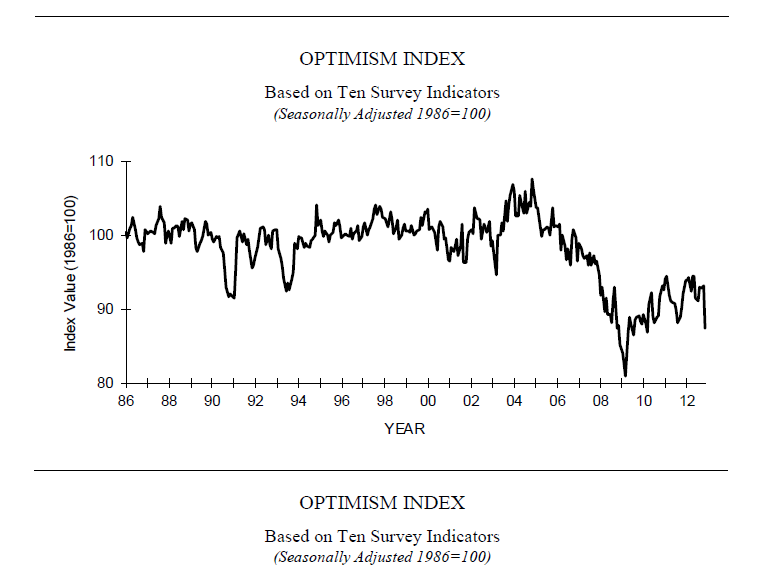
Part of the reason for falling optimism is falling profits. One claim constantly thrown out is “Profits are at record levels, why aren’t people hiring?” Maybe it is because they are not, at least not in the small business arena. This is even more profound when you consider that taxes are going up. Small business should be pushing as many expenses as possible to next year in order to minimize their 2013 tax bite, which means that profits should be increasing now as their expenses are deferred. Which means that underlying business profitability may in fact be lower.
Chart: NFIB Small Business Earnings:

Note that Bill Dunkelberg is a free-market sort of guy, so the language of his survey will reflect his political leanings. That said, the numbers are what the numbers are.
Ezra Klein of WaPo sums up where things really stand in the fiscal cliff negotiations. The White House needs (a) an increase in tax rates for the rich, (b) a long-term solution to the debt ceiling, and (c) an extension of unemployment insurance. Republicans need something on the entitlement front – either an increase in the medicare eligibility age or a change in inflation calculations for Social Security.
The change in inflation calculation involves a going to a “chained CPI.” One of the historical criticisms of the Consumer Price Index is that it fails to take into account the substitution effect, which means that as relative prices increase, consumers substitute cheaper goods for higher priced goods. In other words, if the price of beef rises, consumers substitute chicken for beef. Since the CPI is based on a static basket of goods, it fails to take into account the fact that the basket of goods changes as relative prices change, which means that it overstates inflation. The chained CPI is an attempt to correct for this.
Today begins the two-day meeting of the FOMC. The Street is expecting that the Fed will announce an open-ended Treasury Purchase program, which could push its balance sheet to almost $4 trillion. The estimate is that the latest round of QE will add $500B in Treasuries to $620B in mortgage backed securities. It will be interesting to see if the Fed notes its frustration that consumer borrowing rates are not falling in lockstep with mortgage backed securities. It would be even more interesting if there was some acknowledgement of G-fee increases, which explain the reason why.
Filed under: Morning Report | 22 Comments »
 All Things in Moderation