

 Brent Nyitray
 Fairlington Blade
 Let the mutherfuker burn!
 jnc4p
jnc4p Kevin S. Willis
 Michigoose
 lmsinca
 markinaustin
 Arcanaut
 novahockey
 quarterback
 ScottC
 yellojkt
Will be away for the rest of the week, so no MRs
Be back next week.
Filed under: Morning Report | 16 Comments »
Will be away for the rest of the week, so no MRs
Be back next week.
Filed under: Morning Report | 16 Comments »
I’ve mostly been on the road this week. My sons finished kindergarten (yay!) on Wednesday, which happens to be the day that my wife was starting a week long job for the US Forest Service. I’m transferring to a new job in July, so a family break seemed warranted.
I found a surprise along the way. There’s a pretty decent Italian place in Lewisburg, WV, of all places (Giovanni’s). I ordered lasagna for Secondo, pasta with greens and sausage for Primo (he’s on a health kick), and a roasted veggie salad for myself. I figured I could hoover up what they left behind. Well, the salad was terrific. A good balance of veggies and the roasted squash really added heart. The pasta and greens didn’t look like much, but looks can be deceiving. They used broccoli rabe for the greens and a mild sausage that balanced the dish. The pasta was penne and cooked al dente. The lasagna was simple–a couple layers of noodles with ricotta in the middle and marinara on top. I took a bite of it and got a surprise. The noodles were tender and the ricotta is as good as anything I picked up at the Italian Store in Arlington. Turns out they make everything in house. This is the kind of restaurant everyone wishes they had in their neighborhood. The total was $37, including two sodas.
But that’s not important right now. I’m writing about chicken. The day after I arrived at the lake, my brother made a beer can chicken. I’d never tried it before. It was quite good, but he misjudged the timing (we didn’t have a thermometer) and so the inner portions were undercooked. That’s the eternal problem with roasting a chicken. Undercooked meat or dried out breast meat (or in the worst of all cases, both). How to solve it?
One of my sons was wanting chicken and I know my parents enjoy it. So, what to do? On a whim, I decided to try a butterflied chicken. Cut out the backbone, flatten the thing, and roast it. As a bonus, you can use the wings and the back to make a nice mini batch of stock. I did a bit of hunting about and came upon Kenji Alt’s blog. He used to appear on America’s Test Kitchen. The method seemed straightforward and dispensed with turning the chicken. The ideal is 150 degrees for breast meat and 170 for dark meat. I was shocked when the meat thermometer registered the perfect temperature both times. And the chicken was perfect!
1. Preheat the oven to 400 degrees.
2. Take a 3 1/2 – 4 lb. chicken. Brine it if you like (I do) and air dry. Cut out the backbone with some kitchen shears. Flatten the beastie. Spread a tablespoon of vegetable oil (sesame oil is tasty) over the top and season with salt and pepper. I shoved a couple tablespoons of butter between the skin of the breasts and the meat. It may be gilding the lily, but what the hey.
3. Slide up a half dozen small (1″) potatoes. Toss with oil and put in the bottom of a roasting pan. Put a flat rack on top and place the chicken on it. [Note: don’t use a V-rack for a butterflied bird. If you don’t have a flat rack, just put it right on the potatoes.]
4. Roast the bird for about 45 minutes, until the breast meat registers 150 degrees and the thigh registers 170 degrees. As I noted above, it worked perfectly for me.
5. Let the bird rest for 5 minutes and then enjoy!
BB
Filed under: Bites and Pieces, cooking, food, fun stuff | 4 Comments »

Prediction time — by 9:00 Thursday morning enter your prediction. To keep this somewhat simple, include (at a minimum) the outcome on the mandate and the related insurance reforms (guarantee issue and community rating), the vote, and who writes the opinion for the majority and the dissenters and a brief rationale. If you want to weigh in on the Medicaid expansion feel free.
Example:
6-3 mandated overturned, but guarantee issue and community rating upheld. Roberts for the majority, Kennedy concurring, and Thomas with the dissent. Congress can dictate how insurance is sold and priced, is within its rights to require companies to sell to all comers, but it can’t make an individual purchase it.
Just edit the post to insert your comments next to your handle. Applogies if I’ve missed a name.
UPDATE: How to read the ruling from SCOTUSblog
NoVA: Mandate is unconstitutional based on a vote of 5-4. Based on this, the entire law goes down 6-3, as one of the liberals — Sotomayor — joins with the rest majority on the severability issue and finds that Congress did not want the rest of the law without the mandate. Roberts with the majority, Thomas with a concurrence that eviscerates the reasoning behind Wickard, and Kagan with the dissent.
ScottIn a total shock, one liberal justice (not sure which one) decides to actually read the constitution and betray the cause, sending the mandate down in flames, 6-3. Then, in October, Yankees over the Nationals in 6. A-Rod goes 0 for the series, Strausberg get the win in both National victories, including only the second perfect game in World Series history, but Robinson Cano win Series MVP honors after hitting .515.
LMS Mandate goes down 5-4 with Scalia writing a scathing critique of Obama as the majority. I read about his dissent in the immigration case, took it all the way back to the civil war and free blacks from what I heard. Ginsburg writes the dissent. I’m not sure about the rest (or even the above frankly) but I don’t really expect the rest of the law to stand as is. I’m just not enough of a lawyer (none at all actually) to know how they could frame it.
Yanks vs Angels in American League Playoffs…………..Trout saves game five for the Angels with an over the wall catch and two home runs but Weaver pitches the no hitter that clinches the AL title in six.
NoVA, what do we win if we get it right? What’s the prize?
Mark
1] Severance. Addressed only by Thomas and Scalia in their dissents.
2] Medicaid. Roberts writes majority opinion on all points. 6-3 uphold expansion, but more important to the state AGs, effectively 8 vote that the Congress cannot penalize a state for refusing the “voluntary” expansion. Breyer dissents that the states can be penalized for refusing the “voluntary” expansion. The state AGs get what they hired Clement to do.
3] Individual Mandate. Congress can dictate how insurance is sold and priced, is within its rights to require companies to sell to all comers, can’t make an individual purchase it, but can tax the uninsured, which is what Roberts says is being done. Upheld, 6-3, Scalia, Thomas, and Alito dissenting. Breyer concurs but writes an opinion that Congress can make an individual purchase insurance if it is part of an overarching scheme to provide health care for all. Kagan and Sotomajor join the concurrence but RBG does not, preferring to join Roberts and Kennedy in the Opinion.
4] Anti-Injunction statute. Roberts shuts that door on a second attack in 2015. Scalia writes an attack dissent to this, suggesting that the first time someone pays the tax he should sue for a refund, because this whole scheme is an imposition on liberty.
I might change my mind, because like QB I really go back and forth on this.
Banned
Yello The insurance mandate is struck down 5-4 with Roberts writing the main opinion. Scalia’s concurring opinion mentions broccoli explicitly. Kennedy writes a separate concurring opinion undercutting Scalia and giving guidance on how a rewrite could pass muster.
Brent
Kevin
Michi
Entire law stands 6-3, Alito, Scalia and Thomas dissenting. Georgia just opened the door to interstate commerce with its new health insurance law, and the Court has to address it; Roberts sees the long picture and decides to go with history. Of course, I’m writing this without the benefit of having read any of the learned comments posted below, so. . .
Roberts writes the majority opinion, with Sotomayor and Ginsberg writing their own concurrences (if that’s the right term), and Scalia jumps the shark again in his dissent.
Scott–I never knew that you were such a romantic! Cano batting 0.515?!?!! 🙂
Ashot
Mike Well, FWIW …
1) Anti-Injunction Act. 7-2, SCOTUS is not precluded from deciding. Roberts writes that the penalty is really a penalty and not a tax because the word “penalty” is written into the legislation. So, AIA doesn’t apply. Scalia/Thomas dissent.
2) Mandate. 6-3, mandate upheld. Roberts buys the argument that Congress can regulate the purchase of health care and that buying health insurance is the way that most health care is purchased. Since Congress has already mandated that emergency rooms must provide health care regardless of ability to pay (through EMTALA), they can assess a penalty for “costs.” The activity/inactivity argument is tackled using Judge Sutton’s formulation of self-insurance. Scalia/Thomas/Alito dissent, each writing a dissent and reading from the bench.
3) Severance. Mooted by the majority opinion upholding the mandate.
4) Medicaid expansion. 7-2, upheld. Roberts is unwilling to go back through all the Spending Clause cases and agrees with the lower courts that the expansion is consistent with Congress’ spending power. He is also unwilling to set a precedent for the application of coercion theory in this case. Scalia/Thomas dissent.
Dave!
TrollMcWing
Quarterback: Upheld 5-4. Kennedy will not have the courage to do the right thing. As the Casey plurality opinion showed, he is more committed to protecting what he sees as Court legitimacy than to following the Constitution. [I have changed my mind several times recently, and may do so again! In fact, even now I am trying to imagine how he will rationalize upholding it. I would like to read all the Arizona opinions first but probably won’t have time.]
jnc4p
Fairlington Blade: Mandate goes down 5-4, but I’ll go with severability. Most of the law stands.
okie
allbutcertain
bsimon
Filed under: aca, Affordable Care Act, Supreme Court | 91 Comments »
Vital Statistics:
| Last | Change | Percent | |
| S&P Futures | 1310.5 | -16.3 | -1.23% |
| Eurostoxx Index | 2135.2 | -51.6 | -2.36% |
| Oil (WTI) | 78.44 | -1.3 | -1.65% |
| LIBOR | 0.461 | -0.001 | -0.22% |
| US Dollar Index (DXY) | 82.51 | 0.250 | 0.30% |
| 10 Year Govt Bond Yield | 1.62% | -0.06% | |
| RPX Composite Real Estate Index | 181.4 | 0.2 |
A soggy tape to match a soggy morning here on Wall Street. There is no real news driving futures down, just a sense of malaise coming out of watching the European slow-motion train wreck. Euro sovereigns are slightly wider, while the US 10-year is up about a point. MBS are higher as well.
New Home Sales came in at 369k, well ahead of expectations of 347k. That said, we are still running at levels below the bottoms of recessions going back to the 1960s and well below the average 700k pace from 1963 to the bubble burst.
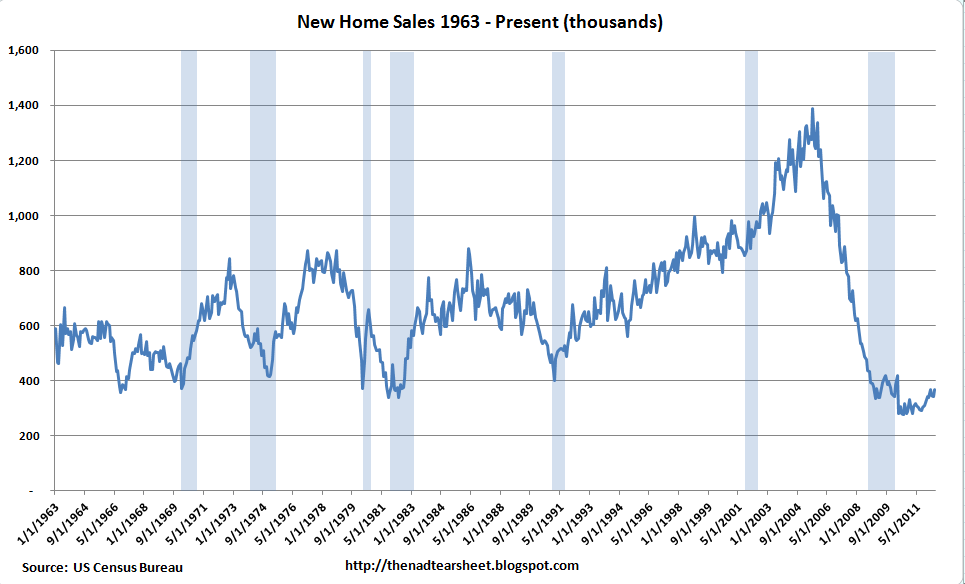
We have a lot of economic data this week, with April Case-Schiller and Consumer Confidence coming out tomorrow, Durable Goods and pending home sales Wed, Initial jobless claims and final Q1 GDP numbers on Thurs, and Personal Income / Spending numbers on Fri. We also have a European summit (something like #18) and will potentially hear the fate of Obamacare as well.
We are in earnings pre-announcement season, where companies who are going to miss their quarters disclose it to the market. Earnings season will officially begin in two weeks with Alcoa’s numbers.
Treasury yields will hit 1% by year end, says CNBC. Certainly that is a possibility if nothing is done about Taxmageddon or if Europe implodes. Simon Johnson is worried about how US banks will handle a European implosion, and even introduces a new risk we can wring our hands over: Dissolution Risk.
The Chicago Fed National Activity Index declined to -.45 in May from +.08 in April, which indicates slowing economic growth. Positive numbers indicate the economy is growing above trend, while negative numbers indicate the economy is growing below trend. The 3 month moving average, decreased to -.34 from -.13 in May. If the 3 month moving average falls below -.7, it typically means a recession has already begun.

$9.3 billion. That is the amount of money people lose per year responding to those ubiquitous Nigerian email scams. To put that number in perspective, that is roughly what GM made last year and accounts for 11% of Nigeria’s GDP.
Filed under: Morning Report | 16 Comments »
As the Supreme Court’s ruling on the constitutionality of Obamacare approaches, the NYT today has an article about how many supporters of ACA were slow to realize the dangers of a constitutional challenge.
It was to be expected that Obama would express public confidence in the constitutionality of the law, and of course we all remember Nancy Pelosi’s now potentially embarrassing dismissal – “Are you serious?” – of a reporter who dared to question her on the constitutional legitimacy of the law she had just passed. At the time I simply assumed that this was natural political bluster. But it seems that a great many Dems did indeed view the idea that forcing people to purchase a private, commercial product simply because they happen to exist might be beyond the legitimate power of the government to be beyond the pale.
“It led to some people taking it too lightly,” said a Congressional lawyer who like others involved in drafting the law declined to be identified before the ruling. “It shouldn’t strike anybody as a close call,” the lawyer added, but “given where we are now, do I wish we had focused even more on this? I guess I would say yes.”
How could they have been so wrong about this? It is one thing to be able to craft, out of Supreme Court precedent and a manipulation of language, a legitimate-sounding argument supporting the constitutionality of a power that had never been exercised before in the history of the US. But it is quite another to imagine that no reasonable counter argument could possibly exist or be forwarded. I don’t know which way the Supremes will ultimately vote on this, but it is clear now that it has been a reasonably close call, whichever way it goes.
How could experienced lawyers and constitutional scholars have thought – actually still think – that the constitutionality of a heretofore unexercised power which relies on the counterintuitive (some might even say perverse) definition of the absence of activity as the presence of activity, was an obvious and certain constitutional lock? Is it an example of widespread wishful thinking? The results of an academic liberal echo chamber? A mass delusion? I really don’t get it.
Filed under: aca, Supreme Court | 93 Comments »
Moonrise Kingdom. Only slightly surreal comic instant mini-classic. Two 12 year old first time actors are delightful as the central players. Surrounded by Bill Murray and Frances McDormand, the girl’s parents, lawyers who call each other “counselor”; Ed Norton as the boy’s scoutmaster, Bruce Willis as the town cop, the Englishwoman Tilda Swinton as “social services”, and Harvey Keitel as the scouting commander, the two kids have a misadventure-and-romance-on-the-hike on a New England island in the mid 60s, while the adults search for them. It is identifiably Wes Anderson, if you know his stuff, especially Rushmore. A
Bernie. Not to be confused with Weekend with Bernie. Linklater presents the true story of a murder in Carthage, TX. It is the funniest murder pseudo-documentary you will ever see, with Shirley McLaine as the town’s hated banker and eventual victim and Jack Black, in what could be an award winning role, as the town’s beloved assistant funeral director and murderer. Matthew McConnaghey plays the D.A. and a retired lawyer I have known since law school, Brady Coleman, plays the defense attorney. But not to be missed are the actual citizens of Carthage, TX, who provide continuing commentary as the story unfolds. As one of them explains, Carthage is behind the “Pine Curtain” in east TX – the part of TX that is in the South. A-
MIB3 I loved it. It cannot be critically reviewed. Tommy Lee Jones. B Must see for fans like me.
Filed under: movies | 1 Comment »
Just a couple of quick links from the NEJM about electronic medical records and the difficulty doctors are having with implementation. Perhaps NoVA can help out and give a his perspective as well.
Even as consumer IT — word-processing programs, search engines, social networks, e-mail systems, mobile phones and apps, music players, gaming platforms — has become deeply integrated into the fabric of modern life, physicians find themselves locked into pre–Internet-era electronic health records (EHRs) that aspire to provide complete and specialized environments for diverse tasks. The federal push for health IT, spearheaded by the Office of the National Coordinator for Health Information Technology (ONC), establishes an information backbone for accountable care, patient safety, and health care reform. But we now need to take the next step: fitting EHRs into a dynamic, state-of-the-art, rapidly evolving information infrastructure — rather than jamming all health care processes and workflows into constrained EHR operating environments.
Escaping the EHR Trap — The Future of Health IT
Debates about the productivity yield of IT are new to health care but not to other sectors of the economy. During the 1970s and 1980s, the computing capacity of the U.S. economy increased more than a hundredfold while the rate of productivity growth fell dramatically to less than half the rate of the preceding 25 years.1 The relationship between the rapid increase in IT use and the simultaneous slowdown in productivity became widely known as the “IT productivity paradox,” and economists debated whether investing billions of dollars in IT was worthwhile. The Nobel laureate economist Robert Solow observed in 1987 that “you can see the computer age everywhere but in the productivity statistics.”
That earlier IT debate and its resolution carry important messages for today’s health IT debate. Solow’s famous observation launched more than two decades of research on IT’s effect on productivity, and that research revealed numerous explanations for the paradox — as well as evidence that earlier conclusions about the relationship between IT and productivity were incorrect and that under the right conditions, IT could indeed yield significant productivity gains.
Unraveling the IT Productivity Paradox — Lessons for Health Care
Filed under: healthcare | 38 Comments »
Yesterday jnc4p mentioned a slight difference between men and women that I found provocative.
It appears that when there is a financial crisis there is a gender divide on what the appropriate resolution is.
The male outlook as represented by Robert Rubin, Hank Paulson, Larry Summers, Alan Greenspan, Tim Geithner and Ben Bernanke seems to favor the make a deal approach as the way to resolve it with the government assisting/backstopping private entities. If a deal goes bad, make a bigger one until confidence is restored. I believe this is part and parcel of having the regulators captured by the mindset of the Wall Street banks they are supervising.
This is contrasted with the female outlook as represented by Sheila Blair and Brooksley Born which is more in line with follow the rules and let the chips fall where they may.
He went on to say how much respect he has for women like Sheila Bair and Brooksley Born. His comment made me think of another woman who’s doing her part right now, not in the financial world, but in the political arena nonetheless, as a response to the spending cuts in the Ryan Budget, the increase in poverty since the beginning of this recession and in defiance of the Catholic Bishops’ rebuke. Have you heard of Sister Simone?
(CBS News) JANESVILLE, Wis. – Fourteen Roman Catholic nuns on a nine-state bus tour are in Chicago Wednesday, after several stops in Wisconsin. Officially, they’re protesting cuts in federal programs for the poor. But the “Nuns on the Bus” tour is also an act of defiance against criticism from the Vatican.
Sister Simone Campbell is a Roman Catholic nun and the executive director of Network — a liberal social justice lobby in Washington.
She’s been under siege, but she’s not fazed.
“Into every life a little rain must come,” she said.
Sister Simone is also a bit of a provocateur.
“Catholic sisters have always been out on the edge,” she said. “And quite frankly we have a long history of kind of annoying the central authority.”
The central authority they’ve recently annoyed is the Vatican itself. In April, sister Simone’s group and the Leadership Conference of Women Religious — representing 80 percent of the nation’s nuns — were attacked by the church hierarchy for focusing too much of their work on poverty and economic justice, while being silent on abortion and same-sex marriage.
Vatican reprimands U.S. nuns over “radical feminist themes”
U.S. Catholic nuns go about work after rebuke
Simone says she pleads guilty to part of that charge: “That I spend too much time working for people in poverty. I wear that as a badge of honor.”
The Vatican has appointed a bishop to correct what the church calls “serious doctrinal problems” in the way the nuns work.
They’ve been called radical feminists.
Simone’s response: “Oh my heavens. I actually have to laugh. We are strong women. We’re educated women. We ask questions. We engage in dialogue. That’s all we do. We stay faithful to the gospel and trying to live it.
From the AP via the Washington Post:
While the nuns say they aren’t opposing any specific Republican candidate, they plan stops at the offices of several closely tied to the budget process, including House Speaker John Boehner of Ohio, and Wisconsin Rep. Paul Ryan, the architect of the House-passed budget. Their first stop Monday was Rep. Steve King’s office in Ames. The tour will end in Washington on July 2.
Social activism at its finest.
Filed under: 2012, Poverty | Tagged: Catholic Bishops, Catholic Nuns, Ryan Budget, Sister Simone | 5 Comments »
see:
http://www.statesman.com/news/local/new-study-tort-reform-has-not-reduced-health-2402096.html
Disappointing, because TX took such a hard line in 2003 that if there were good results to show we would have them by now.
Filed under: tort reform | 9 Comments »


 All Things in Moderation