Bank bailouts and “risky bets”

The conventional story line behind the passage of the new Dodd-Frank regulations, and in particular the Volcker rule, is that prior to 2008 banks were using federally guaranteed deposits to engage in highly risky “bets” using complex and esoteric derivative products which eventually blew up, necessitating a government bailout of the banks. In order to prevent taxpayers from yet again having to bear the cost of these risky bets going bad in the future banking activity needs to be much more heavily regulated and indeed much activity, such as these “bets” using derivatives, needs to be prevented entirely.

When it is pointed out, as I did yesterday, that in fact the “bailout” of the banks didn’t cost the taxpayers anything, and that the taxpayer has actually netted a profit on the assistance provided to banks during the 2008/09 crisis, the usual retort (although admittedly not in evidence yesterday) is that the bailout of AIG, while not officially a bank bailout, was in reality a backdoor bailout of the banks, and that particular bailout has not only not netted any profit for taxpayers, it is almost certainly going to result in a loss. While this is certainly a reasonable point to make, it also demonstrates the folly behind the conventional belief that it was “risky bets” on derivatives that resulted in bank losses.

The reason that the AIG bailout can be seen as an implicit bank bailout is that AIG owed the banks (or it owed some banks/institutions which in turn owed others) a lot of money on its derivative trades, and if AIG defaulted on its obligations, the banks would be out a lot of money. But if these were simple, outright bets of the sort routinely condemned by those in favor of Volcker or Glass-Steagall on the part of the banks, the bailout would have been totally unnecessary because the bank “losses” would have simply been paper losses of profit, not an actual drain on bank capital. The reason that AIG’s failure to pay would have been so devastating to the banks is because the gains from the “bets” with AIG were needed to offset losses that were being incurred elsewhere on other positions, for example corporate and real estate lending activities. In other words, the “risky bets” with AIG must in fact have been hedges, not outright bets. To draw an analogy, if you make a $1 million dollar bet with your neighbor on the outcome of the Super Bowl, but he fails to pay you when you win, you have, strictly speaking, “lost” $1 million dollars, but you aren’t going to have to sell your house and bankrupt yourself because of it. You haven’t actually “lost” any of your previously held capital at all.

The real problem, of course, was not that the banks lost on their “bets”, but that without the payouts from these “bets” that they had actually “won”, the banks stood to lose actual capital on the positions that the AIG “bets” were meant to hedge. Looked at another way, the losses the banks faced due to an AIG collapse were not due to “risky bets” on derivatives, but were instead due to a bad credit decision, ie the judgement that AIG would make good on its covering obligations. And as far as I know, no one is proposing that banks be disallowed from making credit decisions in order to protect taxpayers from such risk.

Now, the AIG situation does point to an area of the various derivatives markets that does deserve some attention. Would the banks’ judgement of AIG as a worthy credit have been the same had they known the extent of the risks that AIG was insuring against? Or, would AIG themselves have insured so much risk if they were required to post hard capital as margin/collateral against potential losses (over and above simple mark-to-market collateral) on the risks they were insuring? These are worthy questions, and areas where sensible regulation might prove beneficial. But the conventional portrayal of “risky bets” on derivatives as the cause of bank losses necessitating a bank bailout is both wrong and is spawning monstrous regulations that will do little more than make banks less profitable than they otherwise would be, and hence more likely to fail.

Morning Report 5/17/12

Vital Statistics:


Last

Change

Percent

S&P Futures 

1319.6

-2.8

-0.21%

Eurostoxx Index

2140.4

-35.0

-1.61%

Oil (WTI)

93.04

0.2

0.25%

LIBOR

0.467

0.000

0.00%

US Dollar Index (DXY)

81.59

0.218

0.27%

10 Year Govt Bond Yield

1.76%

0.00%


RPX Composite Real Estate Index

175.6

0.1


Markets are lower this morning on a report in the Spanish press that Moody’s will downgrade the Spanish banks today and the continuing stand-off between the ECB and the Greek banks. The Spanish IBEX stock exchange is down 24% for the year and is at 9 year lows. Despite the headlines, Euro sovereign yields are flat / lower.

Initial Jobless claims came it at 370k, in line with expectations and we have good earnings from Wal-Mart and Sears. Later today, we will get Philly Fed. Bonds and MBS are up slightly.

Facebook prices tonight and should start trading tomorrow. Barry Ritholtz weighs in. David Einhorn took aim at AMZN at the Ira Sohn conference. His comments could have come from a Alan Abelson column in 1999. I expect to hear a lot of the same “you don’t get it” arguments on FB that we heard on AMZN back then.

The minutes of the April FOMC meeting were released yesterday afternoon. They note the possibility of “taxmageddon” – the expiration of the Bush tax cuts – as a sizeable risk to the economy. While they note the size of the shadow inventory and tight lending standards, they believe real estate prices have stabilized. Overall, there seem to be no major changes in this statement – the Fed remains open to QEIII should economic conditions warrant. 

Ellie Mae released their latest Origination Insight Report. Ellie Mae provides loan processing software and handles about 20% of US mortgage loan origination. Typical profile of a denied loan?  702 FICO / 87 LTV / DTI 28/43.  Talk about a tight mortgage market. 

The problem with having a London Whale is that you have thousands of Ahabs shooting harpoons at you once you disclose you are in trouble with an oversized position. Dealbook is estimating that JP Morgan’s trading losses have increased from $2 billion to $3 billion in the last 4 days as every wise-guy hedge fund manager that missed the initial trade puts it on.

Morning Report 5/16/12

Vital Statistics:


  Last Change Percent
S&P Futures  1334.7 6.5 0.49%
Eurostoxx Index 2186.7 8.0 0.37%
Oil (WTI) 92.98 -1.0 -1.06%
LIBOR 0.467 0.001 0.21%
US Dollar Index (DXY) 81.31 0.086 0.11%
10 Year Govt Bond Yield 1.80% 0.03%  
RPX Composite Real Estate Index 175.5 0.4  

S&P futures are firming this morning after hitting lows of 1321 overnight. Good earnings reports from Target and Deere seem to be overshadowing the bank run going on in Greece. Greek, Irish and Portuguese yields are higher this morning. US Treasuries are down half a point while MBS are flat. Everyone is waiting for the minutes of the last FOMC meeting which will be released this afternoon. 

Industrial Production increased 1.1% in April, a reasonably strong reading. Capacity Utilization ticked up to 79.2%, but the Fed revised down everything for the past year.

The recent drop in rates is triggering refi activity, as evidenced by a 9.2% jump in mortgage applications last week.

April Housing Starts came in at a 717k annualized rate, better than expectations, but still horribly depressed. To put that number in perspective, the in the 74-75 recession, starts bottomed at 904k.  In the 81-82 recession, they bottomed at 837k. In the 91-92 recession, they bottomed at 798k.  These bottoms were V-shaped and typically lasted 6 months or so before returning to normalcy of around 1500.  When was the last time we saw a 800k print?  September of 2008 – almost 4 years ago. Housing historically leads the economy out of a recession, and its absence has been a big part of why this recovery has been so anemic.

Is the summer of 2012 going to be a replay of the summer of 2011?  Certainly the pieces are being put in place – Europe’s sovereign debt crisis is again in the forefront, the economy is decelerating after a good Q4 / Q1, and the old saw “Sell in May and go away” was good advice again. We even have the prospect of major tax increases Jan 1 as the Bush tax cuts expire. The only thing we are missing is a debt ceiling fight. Oh, wait…

The Florida Supreme Court is hearing an foreclosure case that asks an interesting question – can the banks who filed foreclosures based on robo-signed documents voluntarily dismiss these cases and re-file them with better documents?

The good market reception to the Facebook IPO means that sellers are increasing the amount for sale. Existing holders like Goldman, Tiger, and Accel are blowing out of 241MM shares, much more than they originally planned.  Surprisingly, and perhaps no coincidentally,  GM has dropped paid advertising with Facebook because they “weren’t effective enough”. Apparently “likes” doesn’t necessarily translate into sales or dealer inquiries.

Toobin on Citizens United

Jeffery Toobin has an article in the New Yorker about the behind-the-scenes action in Citizens United. It’s long, so I haven’t had the chance to read it in its entirety, but here’s a “review” from Jonathan Adler at VC. The first graf:

The latest New Yorker has an extensive excerpt of Jeffrey Toobin’s forthcoming book, The Oath: The Obama White House vs. the Supreme Court, focusing on the Supreme Court’s Citizens United decision. The story, “Money Unlimited: How Chief Justice John Roberts orchestrated the Citizens United decision,” is everything you’d expect from a Toobin piece. It’s engaging and informative, with exclusive behind-the-scenes reporting of how the decision came to be. This stuff is catnip for court watchers. Yet the article also contains plenty of subtle (and not-so-subtle) spin in service of Toobin’s broader narrative of an out-of-control conservative court. As a consequence, Toobin paints a somewhat misleading picture of the case and the Court.

Morning Report 5/15/12

Vital Statistics


Last

Change

Percent

S&P Futures 

1336.0

1.9

0.14%

Eurostoxx Index

2179.7

-22.2

-1.01%

Oil (WTI)

94.71

-0.1

-0.07%

LIBOR

0.466

0.000

0.00%

US Dollar Index (DXY)

80.89

0.280

0.35%

10 Year Govt Bond Yield

1.78%

0.02%


RPX Composite Real Estate Index

175.5

0.4


Markets are up this morning on a lack of news out of Europe and some mixed economic data. The Consumer Price Index showed inflation remains benign, while retail sales data showed spending up slightly and below expectations. Bonds and MBS are down slightly. Greek bond yields are up 160 basis points. Portugal and Ireland are up as well 

The New York Fed released its Empire State Manufacturing Survey this morning, which came in better then expected on higher shipments. Six month optimism fell.

The National Association of Home Builders released its builder confidence survey this morning, which showed improving sentiment.

The Washington Post is starting to focus on the tax hikes that will take place in the beginning of 2013. They note the uncertainty that it is causing. So far, there seems to be no discussions in Washington about what to do about it. IMO this has been driving some of the recent deceleration in the economy.

Lots of institutional investors are clicking “Like” – Facebook raised the range of its IPO price from 28-35 to 34-38. At the top end of the range, FB would be valued at 26x sales – or about twice the valuation of the Google IPO.

Ally doesn’t plan on re-organizing the mortgage business and getting back in to the housing market. They are going to stick with car loans. Money Quote from Ally CEO Michael Carpenter: “You can live in your car if you don’t pay your mortgage.  I don’t mean to be cute, but the fact is people make their car payment before they pay their mortgage.”

Chart:  NAHB Index:

Morning Report 5/14/12

Vital Statistics:

Last Change Percent
S&P Futures 1340.2 -9.8 -0.73%
Eurostoxx Index 2199.2 -55.4 -2.46%
Oil (WTI) 94.47 -1.7 -1.73%
LIBOR 0.466 -0.001 -0.21%
US Dollar Index (DXY) 80.51 0.248 0.31%
10 Year Govt Bond Yield 1.78% -0.05%
RPX Composite Real Estate Index 175.3 0.0

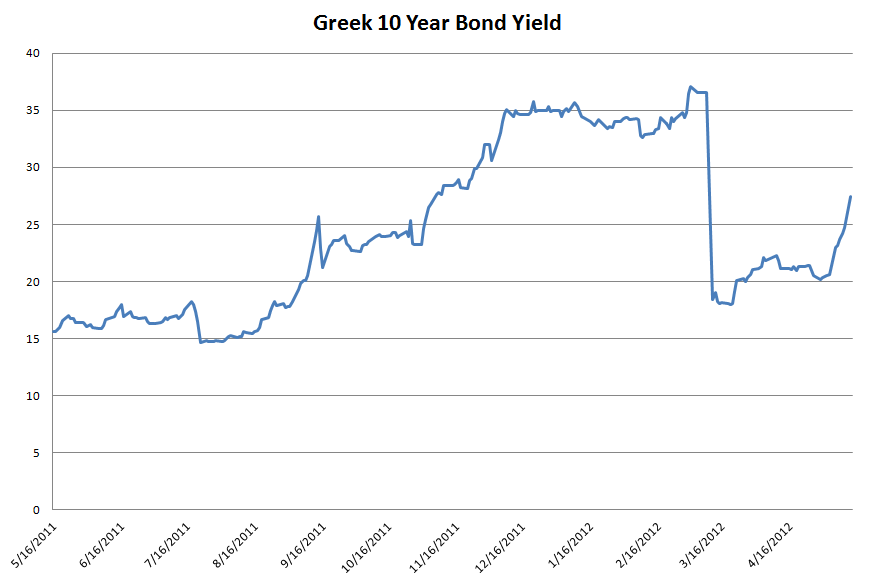
A sloppy start to the week as sovereign spreads widen in Europe. Greek sovereign debt is now trading at a 27.4% yield, which is the same level as last Nov. Don’t forget, this is the post-reorg debt – for those keeping score at home, Greek sovereigns were at 15% last year at this time, rose to over 40%, did a restructuring two months ago which pushed yields down to 17%, and now they are 27%. Spanish yields are rising, and it is time to start paying attention to the credit default swaps on the big European banks – Dexia is considered one of the worst cases, and is trading at the 17.75% level.

All of the stress in Europe is pushing down Treasury yields which sit about 10 basis points above September’s lows. MBS are higher as well, with the Fannie and Ginnie 3.5s up 6 ticks. This is putting pressure on oil and the Euro. The S&P futures are suggesting that the 200 day moving average is going to get broken on the open.

It is official – Ally’s Residential Capital has filed for bankruptcy protection. This move separates the auto loan and banking business, and should pave the way for the government to divest its 74% stake. Ally is providing the $150MM DIP and is kicking in $750MM.

It looks like 3 executives from JP Morgan will walk the plank over the $2 billion “hedging” loss in their Chief Investment Office unit. Jamie Dimon is not resigning, at least not yet. It is surprising that JP Morgan disclosed the loss before it fully exited the position – if disclosure rules forced his hand, that is a big unintended consequence. This episode will undoubtedly elicit calls for more regulation, and strengthens the view in Washington that there is no alpha in banking, just beta.

Chart: Greek 10 year bond yield:

Bites and Pieces: Build a Better Burger

Gourmet burgers have become all the rage in the DC area. The Five Guys burger chain has its origins at the intersection of Glebe Road and Columbia Pike in Arlington, not too far from where I live. Rays Hell Burger was locally famous before it became a favorite place for President Obama to take visiting dignitaries. Their burgers really are THAT good. BGR is another favorite of mine. The worst burger I ever ate was at a greasy spoon off campus of the University of Missouri. I was interviewing for a faculty position in the Physics Department. I ordered a burger for lunch, took one bite, and realized that the center was raw. My guess is that it hadn’t completely defrosted when they put it on the grill. My choices were to send it back, potentially causing an awkward moment, or to choke it down. I choked it down and probably was fortunate to not get sick. I didn’t get the job; they gave it to a former grad student of the chair of the search committee. On the plus side, we went to a wine dinner that night at a local shop that was worth the trip.

A good burger is a thing of beauty and a great base for whatever you want to do. In Santa Fe, New Mexico, it’s going to be topped by green chili. Treat it like a steak and top with bernaise sauce. When you come down to it, basic is best. Few things are finer than a simple cheese burger on a good bun. Perhaps some fried onions or ketchup. Keep the mustard and relish away from my burger, please. Waiter, if me and the boys wanted to eat a hot dog, we would have ordered a hot dog. [Credit to Humphrey Bogart]

So, why on earth am I going to waste a valued slot of Bits and Bites on burgers. We all know how to make a burger. Take some ground beef, make some patties and grill them. Simple, no? Well, it’s time for me to go all Alton Brown on you. I want to focus on the critical ingredient: ground beef. If you’re buying it from a supermarket, you are either paying too much or don’t know what you’re using. I’m not talk about pink slime, simply that the stuff sold as “ground beef” in supermarkets might as well be mystery meat. It’s all the trimmings ground together, adjusted for fat content, and thrown out there for $4/pound. Good for the bottom line, but not the making of a great burger.

I ground my own beef for the first time a few years ago. We were one of a half-dozen families who were getting together for a picnic and I was assigned burgers. One of our copies of Cooks Illustrated had an easy way of making ground beef using a food processor, so I decided to give it a go. The burgers were great, even if the picnic wasn’t. One of my sons had an extended crying jag and I had to leave around the time that enough people finally arrived for the grilling to commence.

Thereafter, there has been a repeated refrain when it comes to E Coli contamination: ground beef. Does anyone remember when E Coli hit Jack in the Box. I remember a suggested slogan for them after the scare. “Jack in the Box: We cook the shit out of our burgers.” The best way to have a burger is medium rare and the only way you can be sure of it is to know where the beef comes from or trust the source. As long as you’re going to make your own burger, why not take a bit of extra time on the most important ingredient?

What meat to use? I have two ways to make ground beef. Chuck roast is perfect for making ground beef, which is why you often see it listed as ground chuck. One gets about 20% fat, perfect for burgers. We have a Costco membership, so I pick up some chuck roast every so often. I can get it for about the same price as ground meat in the grocery store. Oh, but the quality is so much better. I sometimes use flank steak, which is flavorful, but quite lean. I pair the flank steak with boneless short ribs to get the right fat level. Other folks like sirloin. Hey, do what you want to do! I’ve read about using a cheap cut of relatively lean beef and adding in lard to kick up the fat level. You could go full gourmet and add duck fat.

How to make the ground beef? We bought a stand mixer a few years ago via Craigslist and the owner threw in a pasta making attachment (useless) and a grinding attachment (wonderful). So, I use that for making ground beef. A food processor works just fine. Cut the meat into 1” – 2” chunks, put it in the freezer for about 15 minutes to firm it up, and pulse it until you get the right consistency. It’s easy! Process it in batches and freeze the excess. I wrap the ground beef in plastic wrap, followed by a barrier layer of aluminum foil. It’ll keep and there’s no freezer burn.

How do you make a better burger? A great burger needs three things: ground beef, salt, and pepper. If you’re adding bread or onions or whatever else, you’re making meat loaf, not a burger. Don’t get me wrong, I love a good meat loaf. This, however, is about burgers. I do think that the salt and pepper should be mixed it. The entire burger should be seasoned. Otherwise, there’s a hit of seasoning on the crust, and nothing inside. So, mix in the salt and pepper. I like ½ teaspoon of salt and ¼ teaspoon of black pepper for a pound of ground beef. Once it’s mixed, divide the beef into about 5 oz. for each patty. Cook how you like. It’s hard, ok, impossible, to beat the grill. On the stove, I use a cast iron skillet. Avoid non-stick at all cost.

Now, sauce time. I can hardly fault the combination of grilled onions and cheese. I mentioned the New Mexico penchant for green chile sauce on burgers, so I thought I’d share my favorite salsa verde. It comes from Rick Bayless, the chef with a number of Mexican restaurants in the Chicago area, including Topolobampo and Frontera Grill.

1 pound of tomatillos
1 head of garlic, separated into cloves with skin on
8 Serrano peppers
1 lg. white onion
1 bunch cilantro
2 – 4 limes (depending upon how juice they are)
salt and pepper to taste

Remove outer wrap from tomatillos and wash. Rub with vegetable oil and put into oven (a toaster oven is great for this) on broil until skins blacken. Set aside to cool and remove skins. Don’t worry about getting it all. When skins are removed, toss into the bowl of a food processor.
Meanwhile, thoroughly coat Serrano peppers and garlic cloves with vegetable oil and put in medium sized pan. Cook over med-high heat, shaking occasionally, until skins of peppers blister and the garlic slightly blackens. Remove from heat, cover and let cool. Remove the skins from the garlic cloves and Serrano peppers. The steaming action while cooling makes removing the skins easy. Depending upon how spicy you like your salsa, you can remove some, all, or none of the seeds from the peppers. Toss the peppers into the bowl of the food processor.

Chop white onion and briefly blanch in hot water (I boil a bit, but very hot tap water works too). Drain and put in food processor. Rinse cilantro and coarsely chop. Keep the stems in as they’ve plenty of flavor. Blend everything and pour into a bowl. Add salt, pepper, and lime juice to taste.

I’m also moving Okie Girl’s tomato salsa as it’s a great ketchup alternative. [Hope you don’t mind me moving it up into the main post, Okie!]

ORIGINAL TOMATO SALSA

This recipe came via one of the old regulars at a neighborhood dive bar I used to frequent to play shuffleboard. His nickname is “Lumpy” as a result of a serious car accident in which his neck was broken. He published the recipe in a cookbook the bar patrons all contributed to many years ago. Another regular patron who owned a local restaurant then began serving it in his restaurant and reported it was a huge success. I made some modifications that I’ll describe after the original recipe and began giving it as holiday gifts. It has been so popular I am now up to giving away 4-6 pint cases every Christmas.

Ingredients

6 lbs plus 3 oz canned chopped tomatoes
¾ C dried onion
½ C sugar
1 ¼ C white vinegar
3-4 jalapeno peppers (to taste)
1/8 C pickling salt
¾ Tbs chili powder
1 tsp pepper
1 tsp cumin
½ tsp alum
1 small can green chilies

Preparation

Mix all ingredients together in large pan. Bring to a boil, then remove from heat. After it cools, pour into jars and keep refrigerated. Makes about 8 pints.

Modifications

I use fresh chopped onion instead of dried, reduce the sugar a bit, and use a mix of canned and fresh tomatoes. This tends to make a rather thin salsa, so I use half fresh tomatoes and half canned crushed tomatoes to add some body. I also add a couple of cloves of minced garlic, a large chopped bell pepper, and about a half bunch of chopped cilantro. If I’m going to be using the salsa immediately, I reduce the vinegar a bit (to about 1C) but leave vinegar as is if I’m canning it.

Since this makes a more liquid salsa than I typically prefer, I frequently strain off some of the liquid and use it as seasoning in other dishes (such as using it for part of the cooking liquid for rice).

So, what’s your better burger?

BB (for beef burger of course)

Fallout from PLIVA v. Mensing

Something I’ve been keeping an eye on is the effects of the SCOTUS ruling in PLIVA v. Mensing, limiting liability of generic drug makers for side effects of the drug that are not included on the warning label from the brand-name drugs.

A couple of links.

First:

In the wake of Mensing, state courts in Pennsylvania, California, and New Jersey have been considering what to do with thousands of suits by metoclopramide users who claim they weren’t warned about the long-term risks of developing a neurological disorder. (The cases were mostly filed in state courts after the Judicial Panel on Multidistrict Litigation denied a bid to consolidate the metoclopramide litigation at a federal level.) What’s notable is that judges in those states have taken markedly different approaches to their metoclopramide dockets: In Philadelphia and San Francisco, judges have allowed thousands of personal-injury suits against the generics to move forward despite Mensing. But on Friday Superior Court Judge Carol Higbee in Atlantic City, New Jersey, ruled that generics are largely off the hook in her court.

Alison Frankel at Thomson Reuters. In addition to the Higbee decision, there was another case in NJ (in re Fosamax)

A likely case for eventual SCOTUS review, to reconcile the decisions in PLIVA v. Mensing and Wyeth v. Levine, which provided for damages to plaintiffs who suffered side effects from brand-name drugs.

On Wednesday, the Court of Appeals for the First Circuit upheld a $21 million verdict awarded to a woman who suffered grievous injuries as a result of taking a generic pain medication prescribed by her doctor. In its appeal to the First Circuit, the generic drug manufacturer, Mutual Pharmaceutical Company, argued that the design defect claims were preempted by the Hatch-Waxman Amendments to the Federal, Drug, and Cosmestic Act (“FDCA”) under the Supreme Court’s 2011 decision PLIVA v. Mensing.

Bartlett v. Mutual

A NYT article about people suffering from side effects of the generics. Included in the article is a mention of a Public Citizen petition of the FDA to allow generics to use the Changes Being Effected process to change their warning labels. The FDA has apparently postponed their decision on this petition.

And Sen. Leahy has introduced a bill to address the PLIVA/Levine discrepancy. The bill is here with its House counterpart, introduced by Rep. Van Hollen here.

Friday Fodder…

I read the following story and I figured that it was a good way to cap off a week.  It’s one of those things that I find funny even though there are financial implications to it…  The title of it: 

This Is Not a Joke: Government Issues Study of a Study About Studies

The Pentagon was inundated with so many studies in 2010 that it commissioned a study to determined how much it cost to produce all those studies.

Now the Government’s Accounting Office has reviewed the Pentagon’s study and concluded in a report this week that it’s a flop.

The study of a study of studies began in 2010 when Defense Secretary Robert Gates complained that his department was “awash in taskings for reports and studies.” He wanted to know how much they cost.

Two years later, the Pentagon review is still continuing, which prompted Congress to ask the GAO to look over the Pentagon’s shoulder. What they found lacked military precision.

The GAO found only nine studies that had been scrutinized by the Pentagon review, but the military was unable to “readily retrieve documentation” for six of  the reports.

The Department of Defense’s “approach is not fully consistent with relevant cost estimating best practices and cost accounting standards,” the GAO concluded. In fact, they often did not include items like manpower, the report found.

The Pentagon “partially concurs” with the GAO’s report.

The cost of the study of the study of the studies was not immediately available from the GAO.

Morning Report 5.11.12

Vital Statistics:


  Last Change Percent
S&P Futures  1349.3 -8.3 -0.61%
Eurostoxx Index 2231.1 -16.3 -0.72%
Oil (WTI) 96.03 -1.0 -1.08%
LIBOR 0.467 0.000 0.00%
US Dollar Index (DXY) 80.19 0.078 0.10%
10 Year Govt Bond Yield 1.85% -0.02%  
RPX Composite Real Estate Index 175.3 -0.1  

Markets are lower this morning after J.P. Morgan announced a $2 billion trading loss in its Chief Investment Office unit. April PPI showed inflation is behaving at the wholesale level. Bonds and MBS are higher.

The JP Morgan story is interesting. The position was supposed to be a hedge the bank’s credit exposure. However, if you read the Blooomberg story, it suggests the bank had sold protection on the Markit Series 9 CDX North American investment grade index. Which means it wasn’t hedging anything at all – selling protection and extending credit (which is what the bank does) are similar risks. The story goes on to speculate that it may have been some sort of spread bet, where the bank was short long-dated protection and long short-dated protection. Regardless, this position in no way hedges the bank’s overall business, at least as far as I can tell. Good luck getting out, guys. J.P. Morgan is going to get their eyes ripped out on the exit.

This incident will not cause a systemic risk in any way – if anything it will simply give ammo to the proponents of the Volcker Rule. A $2 billion loss for a bank that made $19 billion the year before and has $176 billion in equity is not fatal in any way. It also shows (again) the fundamental weakness in Value at Risk (VaR), which basically tells you the best case scenario when the fit hits the shan. JP Morgan stock is down 9.2% this morning. 

The CFPB has proposed rules for mortgage origination costs, which bans origination charges that vary by the size of the loan. Rob Christman summed it up perfectly:  “I’m sure that consumer groups are happy about it – just wait until they can’t find anyone who’s going to do a $100,000 loan.” The CFPB has also re-affirmed the anti-steering rules by the Fed.

The Facebook IPO is supposedly garnering lukewarm interest, at least at the price being discussed. It must be bad – I heard Mark Zuckerberg was seen this morning in a suit and tie, eschewing his traditional hoodie. The underwriters still have time to whip up excitement for the deal which should list on May 17 under they symbol FB.