Morning Report 5/24/12

Vital Statistics:

  Last Change Percent
S&P Futures  1317.8 2.1 0.16%
Eurostoxx Index 2154.3 20.3 0.95%
Oil (WTI) 90.56 0.7 0.73%
LIBOR 0.467 0.000 0.00%
US Dollar Index (DXY) 82.14 0.046 0.06%
10 Year Govt Bond Yield 1.75% 0.02%  
RPX Composite Real Estate Index 176.7 0.5  

Markets are giving up earlier gains on the back of some disappointing economic reports. Euro sovereigns are higher with the exception of Greece which now yields 30% and Portugal. Bonds are down a point and MBS are down a few ticks as well.

The Durable Goods headline number came in at +.2%, more or less in line with expectations, but DG ex transportation fell .6%. Cap Goods orders and shipments both fell. This metric tracks business investment and is an ominous sign for the economy.  This might explain why HP is laying off 27,000 workers.  

Initial Jobless claims came in at 370k, in line with expectations.

Freddie Mac released their Economic and Housing Outlook yesterday. It mainly re-hashes data we have already seen. They are of the view that housing is at or near bottom and that rental vacancies are at 9-year lows.

The housing market had another positive data point with the Toll Brother’s earnings announcement. Toll is in the McMansion business, so this report focuses more on the high end. Q2 revenues rose 14% YOY, but signed contracts increased 51%.  Backlog was up 49%. Granted, we are coming off of a low base, but you are starting to see some life in homebuilding. Doug Yearley, CEO said “It appears that the housing market has moved into a new and stronger phase of recovery as we have experienced broad-based improvement across most of our regions over the past six months. The spring selling season has been the most robust and sustained since the downturn began.”  Granted, he is talking his book, but still…

Morning Report 5/23/12

Vital Statistics

  Last Change Percent
S&P Futures  1305.2 -9.6 -0.73%
Eurostoxx Index 2148.5 -44.3 -2.02%
Oil (WTI) 91.15 -0.7 -0.76%
LIBOR 0.467 0.000 0.00%
US Dollar Index (DXY) 81.71 0.218 0.27%
10 Year Govt Bond Yield 1.74% -0.03%  
RPX Composite Real Estate Index 176.2 0.6  

Markets are lower this morning on GREXIT (Greek exit) fears and a lousy earnings report from Dell. Euro sovereign yields are generally lower, with the exception of Greece which is 22 basis points higher and approaching 30%. Remember, this is the post-reorg debt that is trading here. Their debt was trading around 35% before Greece did their restructuring about 10 weeks ago. The stress in Europe is pushing down bond yields here and MBS are up as well.

While the migration to tablets is hurting Dell, they also noted corporations are delaying spending.  Is it because IT spending is slowing in general, or is it that corporations have learned not to beta-test Microsoft operating systems (in this case Windows 8)? 

The Congressional Budget Office weighs in on Taxmageddon. Punch line: The budget deficit will drop by $560 billion, and real GDP growth will be .5%, with a contraction of 1.3% in 1H and an expansion of 2.3% in 2H. Remember the government operates on a Sep fiscal, so they are predicting recession in the Sep 12 – Mar 13 time period. If we cancel the tax increases and spending cuts, CBO estimates that real GDP growth would be about 4.4% in real (not nominal) terms in CY13. That is an aggressive (with a capital “A”) forecast. 

DealBook has an interesting article on the possible unintended consequences of breaking up the big banks.

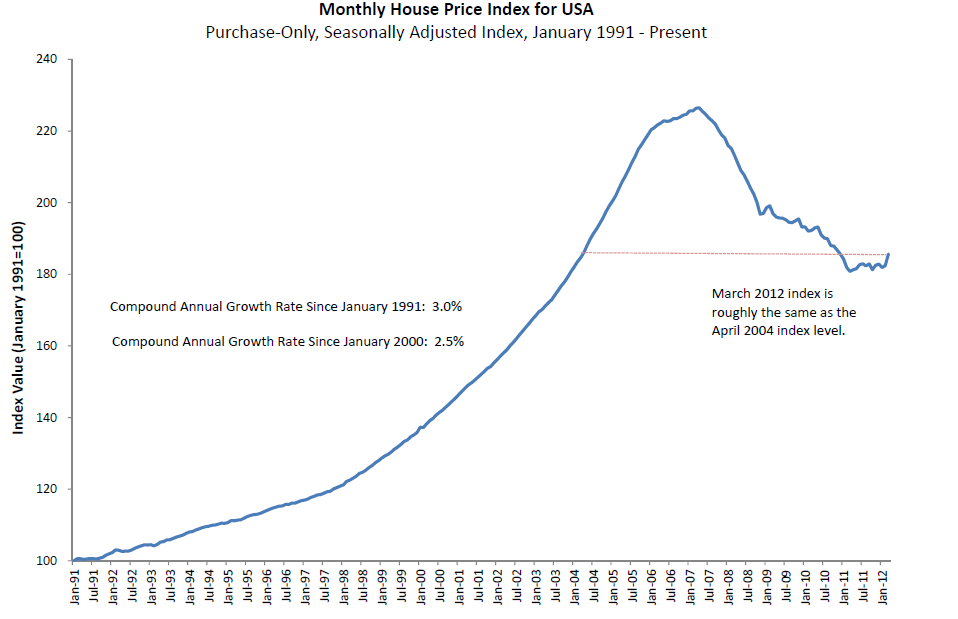
In other news, the NAR has declared the housing recovery to be underway. The MBA reported that mortgage applications increased 3.8% last week. New home sales in April were 343k, an increase of 3.3% MOM. The FHFA House Price index showed an increase of .55% QOQ and .5% YOY.  This is the first increase since early 2007.  Remember the FHFA index only looks at conforming loans, which is more of the “core” housing market.  It has proven to be a much less volatile index than Case-Schiller or RPX. 

Chart:  FHFA House Price Index:


Tracking Police Misconduct

Cato is out with a new website that reports on police misconduct.

Example:

7 Clarkstown NY cops subject of suit by man claiming they beat him on video during a false arrest at a bar [3] http://lohud.us/HwzzpY

Here’s the FAQs on what the project is about and why they’re doing it. Simply put, they’re doing it because nobody else is.

Of course, it is from Cato.   And apparently that’s created a bit of a blogosphere dust-up, as we all know that inside a libertarian is a Republican dying to get out.    For those interested in that see Radley Balko.

Morning Report 5/22/12

Vital Statistics:

  Last Change Percent
S&P Futures  1319.1 3.4 0.26%
Eurostoxx Index 2181.4 31.3 1.45%
Oil (WTI) 92.34 -0.2 -0.25%
LIBOR 0.467 0.000 0.00%
US Dollar Index (DXY) 81.2 0.119 0.15%
10 Year Govt Bond Yield 1.78% 0.04%  
RPX Composite Real Estate Index 175.7 0.1  

Markets are generally firmer this morning on hopes of further stimulus out of China and Europe. Euro sovereign yields are lower. US bond futures are down a point and MBS are down slightly.  MBS underperformed bonds in the rally, so they should outperform as bonds retrace.

Richmond Fed came in below expectations. This survey looks at the service sector for Richmond, Baltimore and Charlotte. Revenues actually contracted in May. They note that service providers expect stronger customer demand over the next six months, while retailers do not. 

Existing Home Sales came in at 4.62MM annualized.  5.5 million is about “average.”  The number is up 10% YOY. The lack of distressed sales and the seasonal move towards bigger houses increased the median price 10% from 161,100 to 177,400. Overall, it notes that the headwinds in the real estate sector are abating.

Yesterday we had a number of sizeable mergers, with Eaton buying Cooper Industries for 12.8 billion, DaVita buying Healthcare Partners for 4.5B and Wanda Group buying AMC. Generally speaking, mergers are a good sign for the markets and the economy in general.

Andrew Ross Sorkin has a good column on why Glass Steagall wouldn’t have prevented the crisis. The Glass-Steagall issue has become a facile explanation of what went wrong. Elizabeth Warren even acknowledges this – one of the reasons she has been pushing reinstating GS – even if it wouldn’t have prevented the financial crisis – is that it is an easy issue for the public to understand and “you can build public attention behind.”  And there you have it. Never mind that nobody else in the world (the UK, Europe, Japan, Canada) separates commercial and investment banking, or even draws a distinction between the two. 

What was the rationale behind Glass-Steagall in the first place?  Poorly underwritten deals (for example, Facebook).  Facebook was the quintessential poorly underwritten deal.  An underwritten deal means that the investment banks (primarily Morgan Stanley) actually write a check to the company and buy 421MM shares at 38. It then places those shares with institutional investors.  If the deal is handled well, Morgan Stanley sells all the stock, collects its fee and moves on. This deal did not go well, obviously. Institutional investors sold into the market and FB was in danger of breaking price. Morgan Stanley stood in the market and bought everything that the market was willing to sell at the offer price. (If an IPO breaks price on the first day, that is a MAJOR embarrassment to the investment bank). So Morgan Stanley is now lugging millions of Facebook shares that it bought in the market at 38. The stock is trading at 32.65. Huge loss. Pre-Glass Steagall, what would they do?  Sell the stock to their captive commercial bank at 38. (Hey, we bumped up your allocation to 5 million shares)  Institutional investors will pull their money out quickly if they sense an investment bank is in trouble.  Depositors at a sleepy commercial bank?  Not so much.  Note:  This was done more with bond issues than stock issues, but the rationale remains the same. In the Great Depression, commercial banks were failing and it turned out their assets were not home mortgages or commercial loans – they were all the lousy deals their sister investment bank couldn’t unload. That is why we had Glass-Steagall – to prevent commercial banks from being repositories for losing positions. 

Fast forward to the financial crisis – commercial banks weren’t failing because they bought CDO-squared issues from their investment banking divisions. Or because Citi was stuffing its retail bank with LBO paper it couldn’t unload. The reason we had a financial crisis is because we had a residential real estate bubble.  Every bank in the US is exposed to residential real estate in some way, shape, or form. And it didn’t matter whether you were exposed to residential real estate through a mortgage backed security or through holding whole loans on your balance sheet.  The small community banks who wouldn’t know a CDO from a codfish blew up just the same as the big integrated banks 

Probably the single best thing regulators could do to prevent a re-occurrence would be to deal with the cascading counterparty risk from OTC derivatives. They should demand that OTC derivatives become standardized and exchange-traded with a central clearing party, position limits, and open interest disclosure. That would have prevented AIG from taking the positions it did and exposing all of its counterparties when it failed.

Baby Boomers: Get Tested for Hep C

So says the CDC.

Apparently 75% of all hepatitis C cases are baby boomers.

More than 2 million U.S. baby boomers are infected with hepatitis C, accounting for more than 75 percent of all American adults living with the virus. Baby boomers are five times more likely to be infected than other adults. Yet most infected baby boomers do not know they have the virus because hepatitis C can damage the liver for many years with few noticeable symptoms. More than 15,000 Americans, most of them baby boomers, die each year from hepatitis C-related illness, such as cirrhosis and liver cancer, and deaths have been increasing steadily for over a decade and are projected to grow significantly in coming years.

This just hit my inbox and figured I’d pass it along. Hep C is passed primarily by blood-to-blood contact associated with intravenous drug use, poorly sterilized medical equipment and transfusions.   So use clean needles people.   Or not at all.

Morning Report 5/21/12

Vital Statistics:


Last

Change

Percent

S&P Futures 

1296.5

5.7

0.44%

Eurostoxx Index

2146.8

2.1

0.10%

Oil (WTI)

91.62

0.1

0.15%

LIBOR

0.467

0.000

0.00%

US Dollar Index (DXY)

81.26

-0.036

-0.04%

10 Year Govt Bond Yield

1.73%

0.01%


RPX Composite Real Estate Index

175.6

0.0


Markets are generally firmer this morning on comments from Chinese Premier Wen Jiabao supporting further measures to boost the economy. Euro sovereign sovereign spreads are a touch wider. Bonds and MBS are down.

The Chicago Fed National Activity Index rose .11 in April after falling .44 in March. This basically means that the economy is growing at its historical trend. Anything between -.7 and +.7 is considered on trend. Production was a positive factor, while consumption was negative. Employment was neutral.

Is the Fed more optimistic about future growth than Wall Street?  It appears to be the case. The average Wall Street growth forecast for 2012 is 2.3%, while the Fed is forecasting 2.4% – 2.9% growth. One explanation is that the Fed underestimates how much the credit-multiplier breaks down in the aftermath of asset bubbles. Meanwhile, the TIPS market is trimming its inflation forecast and giving Ben Bernake the room to maneuver.

Facebook has broken the IPO price in the pre-open and is trading at 36.51.  5.6 million shares have traded. Bob Griefeld, CEO of NASDAQ, blamed software glitches for the problems with trading FB on Friday where customer sell orders were delayed on the open.

Bites and Pieces, A Quiet Saturday Edition

Most of you who have heard of Steven Raichlen will have heard of him in his roll as BBQ guru, but I first came upon him as the author of a series of “High Flavor Low Fat” cookbooks, in which he espouses the use of spices–and lots of them–to make food satisfying and comforting. Some of his substitutions are more successful than others, but these three recipes from his “High Flavor Low Fat Vegetarian Cooking” book are some of my favorites, especially as the weather starts getting hotter and gardens start ripening (I think Lulu’s going to love the third recipe–I bet she’s got everything except the saffron and noodles growing in her garden!)

Peking Tacos

  • 10 flour tortillas
  • 2 cups mung bean sprouts
  • 10 scallions, thinly sliced into rounds
  • 1 cucumber, peeled, seeded and cut into 2-inch matchsticks
  • 2 1/2 cups red-cooked beans
    • 1 cup Chinese rice wine or sherry
    • 1 cup water
    • 4 T soy sauce
    • 1/4 cup light brown sugar
    • 2 star anises
    • 1 cinnamon stick
    • 3 pieces dried tangerine peel or 2 strips fresh tangerine or orange peel
    • 2 cloves garlic, peeled
    • 2 1/4-inch-thick slices fresh ginger
    • 3 scallions, trimmed and finely chopped
  • 1/2 cup hoisin sauce

To make the red-cooked beans, combine all of the glaze ingredients in a large heavy saucepan and bring to a boil.  Boil the mixture until thick, glazy, and reduced to about 1/2 cup.  Stir occasionally to keep it from boiling over.  Strain the mixture into a large nonstick frying pan and add 2 1/2 cups cooked beans, then cook over medium heat until the beans are thickly coated with glaze, 3 – 5 minutes.  Correct the seasoning, adding soy sauce or sugar as needed so that the beans are sweet, salty and aromatic.

Place the bean sprouts in a strainer and pour boiling water over them; drain well.  Soften the tortillas by heating, then assemble the tacos by brushing some hoisin sauce onto a tortilla, sprinkle scallion rounds and some bean sprouts on, then top with red-cooked beans and some cucumber matchsticks.  Fold (or roll) and enjoy!

Crusty Millet Cakes with Feta Cheese

  • 1 1/2 cups millet
  • salt
  • 1 T EVOO
  • 2 cloves garlic, minced
  • 4 scallions, finely chopped
  • 1/2 red bell pepper, diced as finely as possible
  • 1/2 yellow bell pepper, diced as finely as possible
  • 3 T finely chopped flat-leaf parsley
  • 1/4 cup feta cheese, crumbled
  • Freshly ground black pepper

Cook the millet in 3 cups rapidly boiling, lightly salted water for 20 – 30 minutes, or until tender.  Drain in a strainer and let cool; do not rinse.

Heat 2 teaspoons EVOO in a nonstick skillet; add teh garlic, scallions, bell peppers and parsley and cook over medium heat until soft but not brown, about 3 minutes.  Combine these vegetables and the millet, cheese, salt and pepper in a large bowl and mix well; correct seasoning if needed.

Note: This is where I depart from Steven’s recipe: he has you fry them in oil over medium low heat, but I could never turn them without them falling apart. . . so I bake them.

Preheat an oven to 425 degrees; form the millet mixture into 12 3-inch patties and place them on a baking sheet.  Bake 10 – 15 minutes, until heated through, then brown by placing under the broiler for a minute or two 1″ from the heat.

Grilled Zucchini Lasagna with Roasted Red Pepper Sauce

For the Red Pepper Sauce:

  • 4 large red bell peppers
  • 1 T olive oil
  • 1 onion, chopped
  • 3 cloves garlic, chopped
  • 3/4 cup bread crumbs
  • 1 T balsamic vinegar
  • 1/4 t saffron, soaked in 1 T hot water
  • 2/3 cup vegetable (or other) stock
  • salt, freshly ground black pepper and a pinch of cayenne pepper

To finish the lasagna:

    • 6 medium zucchinis cut lengthwise into 1/3-inch slices
    • 1 to 2 t EVOO
    • 9 lasagna noodles
    • 21 basil leaves

Make the red pepper sauce by roasting, peeling, and coring/seeding the red peppers.  Heat the oil in a large nonstick skillet and cook the onion and garlic over medium heat until soft but not brown.

Combine the peppers, onion mixture, and bread crumbs in a food processor and puree to a smooth paste.  Add the vinegar, saffron and enough vegetable stock to obtain a thick sauce (the mixture should be the consistency of soft ice cream.)  Correct the seasoning, adding salt, pepper, cayenne and vinegar to taste: the sauce should be very highly seasoned.  Preheat your grill to high (this is where Brent and Brian can get excited about this recipe!)

Lightly brush each zucchini strip with olive oil and grill until limp(2 – 4 minutes/side) or, if you must, broil or oven-roast the strips.  Cook the lasagna noodles in 4 quarts rapidly boiling salted water for 8 minutes or until al dente; drain the noodles and rinse with cold water.

Preheat the oven to 350 degrees.  Lightly oil an 8 x 11-inch baking dish; spread 3 lasagna noodles over the bottom, then arrange 1/3 of the zucchini strips over the noodles, 1/3 of the basil leaves, and 1/3 of the sauce.  Repeat for layers two and three.  The lasagna can be prepared up to 24 hours ahead to this stage.

Bake the lasagna for 30 – 40 minutes or until thoroughly heated.  Enjoy!

Note: I usually make about twice as much sauce when I’m doing this, since it also is a great dip/spread for veggies and good bread.  Bon appetit!

Morning Report 5/18/12

Vital Statistics:


Last

Change

Percent

S&P Futures 

1307.5

6.2

0.48%

Eurostoxx Index

2155.6

8.7

0.40%

Oil (WTI)

92.68

0.1

0.13%

LIBOR

0.467

0.000

0.00%

US Dollar Index (DXY)

81.38

-0.004

0.00%

10 Year Govt Bond Yield

1.72%

0.02%


RPX Composite Real Estate Index

175.6

0.1


Markets are firmer this morning after enduring a bloody week which sent the S&P down 3.6% and the 10 year government bond yield down to 1.69%. Today is also the expiration of May options, so there is always the potential for funny closing prints. There is no economic data being released this morning.  Bonds and MBS are down slightly.

It’s Facebook Day! Facebook priced at the top end of the revised range last night and should begin trading around 11:00. There are a stocks that capture the attention of the populace and Facebook is one of them. Growth fund managers who have been starving for a good growth story besides Chipotle Mexican Grill and Lululemon just got a new one. With an IPO price at 28x revenue, the stock will have to almost collapse to get value and GARP guys interested. I’m sure if you are a good technical trader, you should be able to have a field day with this one. Treat it as a slip of paper with an alphanumeric code, not an investment, cause it isn’t.

Bloomberg has a column on why principal reductions won’t solve the housing crisis. The big problem is that something like 80% of all underwater homeowners with Fan and Fred mortgages are current on their mortgages. Any principal reduction program will encourage people to stop paying their mortgage. Second, of those seriously delinquent, most of them won’t be able to afford the lower payment anyway.

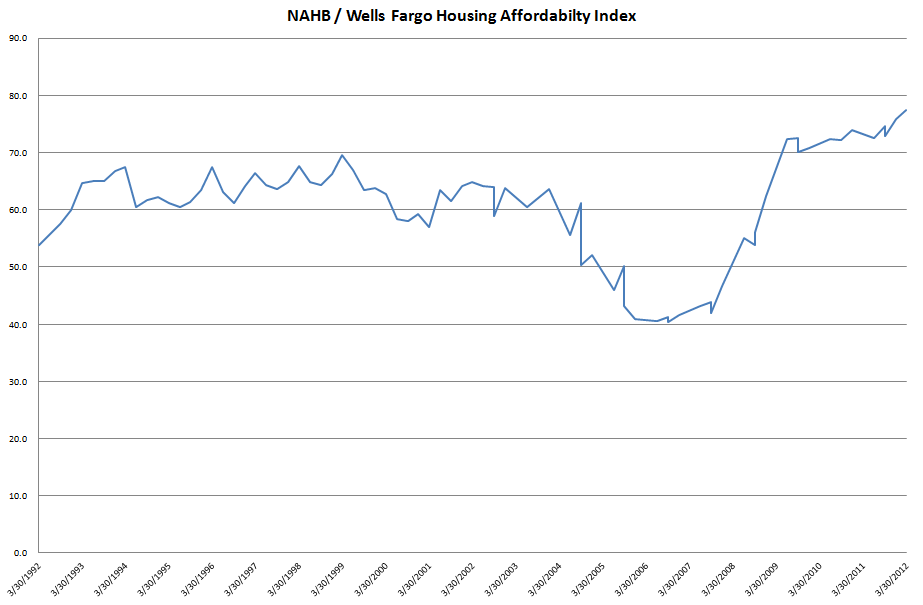
The National Association of Home Builders and Wells Fargo have constructed a housing affordability index, which is a measure of the percent of homes affordable by someone at the median income. The latest index is 77.5, which means 77.5 percent of all new and existing homes sold in Q1 were affordable for families earning the national median income. In a lot of ways, this chart is the inverse of my median house price to median income chart.

Chart: NAHB / Wells Fargo Housing Affordability Index:


The Wrong Focus?

According to US Postal Service financials, in 2007 the USPS posted a net loss of $5.1 billion. In 2008 it posted a loss of $2.8 billion. In 2009 the loss was $3.8 billion. In 2010 it posted a loss of $8.5 billion. In 2011 it posted a loss of $5 billion. In the most recent quarter this year, it reported a loss of $3.2 billion, bringing this year’s total loss to $6.2 billion.

So let’s add that all up. Since 2007 the USPS has lost a total of $31.4 billion.

Now, a question for the folks of ATiM: Who should the US taxpayer be more concerned about having to support with a taxpayer funded bailout, the US Postal Service or JPM Chase?

Next up…how much have taxpayers piled into Amtrak over the last 5 years?

Tribute to MCA

http://vimeo.com/42106181

This may or may not be your thing, but I found this to be hilarious. The only flaw that I can see is the use of guns, which were not in the original.

And here’s the original