Legal news

An interesting case was argued at SCOTUS yesterday:

[I]n Christopher v. SmithKline Beecham Corp[, t]he Justices will decide, once and for all, whether pharmaceutical sales representatives (PSRs) are “outside salesmen” and thus exempted from overtime-pay requirements of the Fair Labor Standards Act of 1938 (FLSA) The decision will also settle a circuit split between the Second and Ninth Circuits: the former held that PSRs are not outside salesmen and thus are not exempted from the FLSA’s requirement that they be paid overtime wages, while the Ninth Circuit (in this case) unanimously reached the contrary conclusion. This will be an interesting case with wide-ranging ramifications for the pharmaceutical industry and the ninety thousand people nationwide employed as PSRs.

Christopher v. SmithKline Beecham Corp

Also, the en banc Ninth Circuit decided the AZ voter ID case:

We uphold Proposition 200’s requirement that voters show identification at the polling place, but conclude that the NVRA supersedes Proposition 200’s registration provision as that provision is applied to applicants using the National Mail Voter Registration Form (the “Federal Form”) to register to vote in federal elections. [NVRA = National Voter Registration Act — ed.]

Gonzalez v. AZ

Morning Report

Vital Statistics:

Last Change Percent
S&P Futures 1370.2 6.3 0.46%
Eurostoxx Index 2334.3 33.1 1.44%
Oil (WTI) 103.8 0.9 0.85%
LIBOR 0.466 0.000 0.00%
US Dollar Index (DXY) 79.54 -0.018 -0.02%
10 Year Govt Bond Yield 1.99% 0.01%
RPX Composite Real Estate Index 172.3 0.3
Markets are higher this morning on a better than expected German investor confidence data and a decline in Spanish bond yields. Bonds and MBS are lower. After falling out its narrow 140 -144 trading range, June 10 year bond futures are back in it again, driving mortgage rates back to February levels.
Johnny John reported better than expected numbers, as did Goldman, who also bumped up their dividend. Ex-highflyer First Solar is cutting 30% of its workforce.
Housing starts missed estimates by a wide margin, falling sharply from 694k in February to 654k in March. Remember, 1.5 million is more or less “normalcy,” and having starts heading downwards for two months in a row this late in an expansion is not a good sign. Optimists will point to the unexpected increase in permits. Nevertheless, forward-looking economic indicators are starting to turn down, indicating the economy is slowing. Remember, the Bush tax cuts expire Jan 1, and that will provide a large fiscal drag. Business (and the markets) are going to start handicapping the possibility of an early 2013 recession, which should mean a slowing economy this summer and into the fall.
Industrial Production was flat in March, vs a .3% increase.  Capacity utilization ticked up .1% to 78.6%, still below the historic 80% average. This shows there is still a lot of slack in the economy, which bodes well for the inflation numbers.
The rental market continues to outshine the purchase market, according to Zillow. The rent index increased 2% YOY in February, while the Zillow home value index dropped 4.5%. The huge backlog of foreclosures remains a wet blanket on the home value index, while ex-homeowners are driving rental prices higher. Localities like Chicago and Philadelphia showed huge divergences.
As if Spain didn’t have enough headaches, Argentina is expropriating Repsol’s 51% stake in YPF. Latin America has been one of the bright spots for Spanish banks, so if money starts fleeing the area, it will put further pressure on the Spanish economy. Granted, Brazil and commodity prices are going to be the main factor, but forced nationalization tends to make emerging markets investors nervous.
Are you trading gasoline futures?  If so, the Obama administration is taking aim at you. Worried that high prices at the pump may endanger his re-election campaign, the administration has announced a series of measures aimed at reducing speculation in the gasoline futures market. The most significant measure would allow the CFTC to increase margin requirements (never mind that the exchanges can do this already..)

Morning Report

Vital Statistics:

Last Change Percent
S&P Futures 1369.5 4.5 0.33%
Eurostoxx Index 2298.9 7.3 0.32%
Oil (WTI) 102.7 -0.1 -0.12%
LIBOR 0.466 -0.001 -0.11%
US Dollar Index (DXY) 80.09 0.206 0.26%
10 Year Govt Bond Yield 1.98% -0.01%
RPX Composite Real Estate Index 172 0.8
Equity futures are rising this morning on better than expected retail sales data. Citi missed earnings estimates and traded down a couple of bucks early, but has recovered as people digest the internals of the earnings report.
Empire Manufacturing came in lower than expected on weakness in China and Europe. While still positive, the pace of expansion has slowed. The forward-looking indicators continue to weaken, which is something to keep an eye on.
Spanish credit default swaps continue to increase in price, and have passed their high from last November during the Greek crisis. 10 year CDS for Spain are trading at 476 basis points. Spain’s GDP is the 12th largest in the world, so any default there will not be as tame as Greece. Their banks are much more household names – Banco Santander has the same market cap as Goldman. Paul Krugman is nonplussed.
11 state AGs sent a letter to Acting FHFA Ed DeMarco urging him to allow principal reductions on Fannie and Fred loans.
Earnings season gets in full swing this week.

Weekend Report

Fix income inequality with $10 million loans for everyone!

By Sheila Bair, Published: April 13

Are you concerned about growing income inequality in America? Are you resentful of all that wealth concentrated in the 1 percent? I’ve got the perfect solution, a modest proposal that involves just a small adjustment in the Federal Reserve’s easy monetary policy. Best of all, it will mean that none of us have to work for a living anymore.

For several years now, the Fed has been making money available to the financial sector at near-zero interest rates. Big banks and hedge funds, among others, have taken this cheap money and invested it in securities with high yields. This type of profit-making, called the “carry trade,” has been enormously profitable for them.

So why not let everyone participate?

Under my plan, each American household could borrow $10 million from the Fed at zero interest. The more conservative among us can take that money and buy 10-year Treasury bonds. At the current 2 percent annual interest rate, we can pocket a nice $200,000 a year to live on. The more adventuresome can buy 10-year Greek debt at 21 percent, for an annual income of $2.1 million. Or if Greece is a little too risky for you, go with Portugal, at about 12 percent, or $1.2 million dollars a year. (No sense in getting greedy.)

Think of what we can do with all that money. We can pay off our underwater mortgages and replenish our retirement accounts without spending one day schlepping into the office. With a few quick keystrokes, we’ll be golden for the next 10 years.

Of course, we will have to persuade Congress to pass a law authorizing all this Fed lending, but that shouldn’t be hard. Congress is really good at spending money, so long as lawmakers don’t have to come up with a way to pay for it. Just look at the way the Democrats agreed to extend the Bush tax cuts if the Republicans agreed to cut Social Security taxes and extend unemployment benefits. Who says bipartisanship is dead?

And while that deal blew bigger holes in the deficit, my proposal won’t cost taxpayers anything because the Fed is just going to print the money. All we need is about $1,200 trillion, or $10 million for 120 million households. We will all cross our hearts and promise to pay the money back in full after 10 years so the Fed won’t lose any dough. It can hold our Portuguese debt as collateral just to make sure.

Because we will be making money in basically the same way as hedge fund managers, we should have to pay only 15 percent in taxes, just like they do. And since we will be earning money through investments, not work, we won’t have to pay Social Security taxes or Medicare premiums. That means no more money will go into these programs, but so what? No one will need them anymore, with all the cash we’ll be raking in thanks to our cheap loans from the Fed.

Come to think of it, by getting rid of work, we can eliminate a lot of government programs. For instance, who needs unemployment benefits and job retraining when everyone has joined the investor class? And forget the trade deficit. Heck, we want those foreign workers to keep providing us with goods and services.

We can stop worrying about education, too. Who needs to understand the value of pi or the history of civilization when all you have to do to make a living is order up a few trades? Let the kids stay home with us. They can play video games while we pop bonbons and watch the soaps and talk shows. The liberals will love this plan because it reduces income inequality; the conservatives will love it because it promotes family time.

I’m really excited! This is the best American financial innovation since liar loans and pick-a-payment mortgages. I can’t wait to get my super PAC started to help candidates who support this important cause. I think I will call my proposal the “Get Rid of Employment and Education Directive.”

Some may worry about inflation and long-term stability under my proposal. I say they lack faith in our country. So what if it cost 50 billion marks to mail a letter when the German central bank tried printing money to pay idle workers in 1923?

That couldn’t happen here. This is America. Why should hedge funds and big financial institutions get all the goodies?

Look out 1 percent, here we come.

outlook@washpost.com

Sheila Bair is a former chairman of the Federal Deposit Insurance Corp. and a regular contributor to Fortune Magazine.

Morning report

Vital Statistics:

Last Change Percent
S&P Futures 1377.7 -8.2 -0.59%
Eurostoxx Index 2316.8 -35.4 -1.51%
Oil (WTI) 103.1 -0.5 -0.49%
LIBOR 0.466 -0.001 -0.11%
US Dollar Index (DXY) 79.53 0.249 0.31%
10 Year Govt Bond Yield 2.01% -0.04%
RPX Composite Real Estate Index 171.3 0.3
Markets are weaker this morning after a disappointing GDP report out of China. The Consumer Price Index showed prices increasing 2.7%, which was more or less in line with expectations. Stocks and bonds didn’t react much to the data. Google, JP Morgan, and Wells Fargo all reported better than expected earnings and are flat to slightly down pre-market.
JP Morgan reported better than expected earnings this morning. The highlight has been the mortgage origination which contributed $1.6 billion in revenue, an increase of 80% from Q111. Servicing revenue dropped 5% and the entire activity broke even. A Bloomberg story on Morgan’s earnings cites a Friedman Billings analyst who thinks Q2 will be the best quarter for the mortgage business in a long time.
Christine Lagarde (head of the IMF) urged the US government to pursue a policy of principal reduction in mortgage debt. As I have discussed in prior posts, that probably isn’t going to happen, at least with respect to conforming loans. Still, I don’t rule out some sort of mortgage relief given that this is an election year.
Google is trying a new wrinkle in corporate governance. As part of their earnings release last night, they announced a stock split. Sort of. Google has two classes of shares – the supervoting shares held by the founders, and the reduced vote shares that currently trade. They are introducing a third share which will be nonvoting. Google shareholders will get as a dividend 1 share of nonvoting stock. The new stock will be used for employee equity-based compensation and other corporate uses, which means Google can issue stock without diluting Sergey and Larry’s control over the company.

Morning Report

Vital Statistics:

Last Change Percent
S&P Futures 1365.9 1.9 0.14%
Eurostoxx Index 2318.7 -22.7 -0.97%
Oil (WTI) 102.8 0.1 0.06%
LIBOR 0.467 -0.002 -0.43%
US Dollar Index (DXY) 79.57 -0.230 -0.29%
10 Year Govt Bond Yield 2.02% -0.02%
RPX Composite Real Estate Index 171 0.2
Equity markets are generally flat after early strength was given back on disappointing economic data. Bonds have reversed earlier declines and MBS are up as well.
The PPI showed that wholesale price inflation remains broadly in check, although the core numbers (ex-food and energy) were slightly higher than expected, running at 2.9%. Initial Jobless Claims were much higher than expected, 380k vs 355k. The trade deficit was lower than expected due to a drop in imports. Futures sold off on the numbers. Some of the other indicators (NAPM, ISM) have been coming in weak as well, signalling the economy might be headed for a slowdown.
The market may be picking up on the sheer amount of fiscal tightening that is scheduled to begin on Jan 1, as the Bush tax cuts expire and the budget cuts from the debt ceiling debates kick in. Of course, no one really wants this to happen, but it is an election year, and they will take effect if nothing happens to stop it. So the market is probably going to start handicapping this a little.
Bill Gross continues to cut Treasuries and buy MBS. This is basically a bet that the Fed will continue Operation Twist in a different way after it expires in June – by trying to influence mortgage rates directly by buying current coupon MBS and repoing short.
RealtyTrac released its US Foreclosure Market Report for Q1, noting that foreclosure activity was the lowest since Q407. Activity dropped in the non-judicial states and increased in the judicial ones. Foreclosure starts have been ticking up, and everyone expects a wave of foreclosures to hit the market as the shadow inventory gets liquidated.
Janet Yellen said that the Fed may have to maintain ultra-low interest rates even beyond 2014. Yellen is one of the more dovish members of the FOMC, and her statements stand in contrast to other members who are noting pricing pressures.
In earnings, Google and Nationstar report after the close. JP Morgan and Wells Fargo report Friday before the open.

NHL Picks

I will have nothing to say on health policy for awhile. My schedule is packed from here until early June.

Pens in 6
Bruins in 5
Devils in 5
Rangers in 6

Kings in 7
Blues in 6
Blackhawks in 7
Predators in 7

Pens over Preds in 6
Fluery is your Conn Smythe winner — only because Malkin won’t be able to abuse Ruk’s team, as seen below:

Morning Report

Vital Statistics:

Last Change Percent
S&P Futures 1367.0 9.9 0.73%
Eurostoxx Index 2353.9 32.4 1.39%
Oil (WTI) 101.25 0.2 0.23%
LIBOR 0.4687 -0.001 -0.11%
US Dollar Index (DXY) 79.641 -0.219 -0.27%
10 Year Govt Bond Yield 2.03% 0.04%
RPX Composite Real Estate Index 170.77 0.2
Equity markets are firmer as the sell-off takes a breather and investors digest Alcoa’s numbers. Spanish yields are lower as well. Italy sold 11 billion euros of T-bills at 2.84% vs 1.405% a month ago. Bonds are a touch weaker and MBS are flat. Mortgage applications were down 2.4% last week.
As Spain becomes the latest worry, the natural question becomes “Who holds the old maid?” Not the Japanese, who cut their exposures to all but the highest Euro credit last year.
The CFPB has put out proposed rules for servicers aimed at improving transparency and accountability. Certainly the tone of the piece (putting “service” back into servicing and “preventing runarounds”) suggests the government is going to regulate servicers more closely, and partially explains why you can’t give away MSRs these days.
Everyone is trying to read the tea leaves on Acting FHFA Director Ed DeMarco’s commentsregarding principal forgiveness for conforming loans. Some saw a change in tone. Others did not. The problem with principal forgiveness is that someone has to eat the losses. There certainly does not appear to be the political appetite to pass losses on underwater homes to taxpayers, and members of Congress realize their state pension funds (not to mention their own!) would get slammed if the losses were passed to them. Neither option is particularly appetizing to politicians on either side of the aisle. So, Ed DeMarco remains a very convenient guy in Washington, allowing the Left to fulminate over his obstinate refusal to budge on principal reductions, safe in the knowledge that they won’t have to face the consequences of what they advocate.
Are lenders moving back out on the risk curve? Seems like it, at least as far as credit cards and auto loans are concerned. Aside from a few hard money lenders, we aren’t seeing this in the mortgage business yet, as it remains impossible to securitize this sort of paper.

Florence and the 4th Amendment

I promised Mark I’d post some thoughts on Florence v. Board of Freeholders, the recent 4th Amendment case from SCOTUS. Since this post isn’t a scholarly document, I’m not going to provide extensive references or links.  My sources are the opinions from the various cases, which can be found at various sites on the web.

First, a brief summary of the case from Lyle Denniston at SCOTUSblog:

Insisting that it has no expertise in how to run a jail or prison, the Supreme Court divided 5-4 Monday in ruling that every person arrested and held temporarily can be subjected to a routine strip search, so long as it involves only a visual inspection without touching or abusive gestures.  The prisoner, however, may be told to manipulate some part of the body.  Some difference of emphasis among the five Justices in the majority made it appear that the decision might be more limited than at first glance.

The ruling, it appeared, did not authorize jail officials to conduct a strip search unless the prisoner was to be placed among other prisoners at the facility.  Two Justices wrote separately in an effort to stress that aspect of the ruling, and their votes were essential to the 5-4 result.

The decision was a clear defeat for challengers to strip searches as a general policy.  The Court explicitly refused to limit the authority to use strip searches only to situations in which a specific individual gave officers a reason to consider that prisoner to be dangerous or likely to be carrying a concealed weapon or drugs.   The same kind of visual inspection of an arrestee’s naked body, the Court declared, can be applied to anyone placed in the general population of a jail or prison, even if only temporarily.

If you’re still interested, then there is more below.

Continue reading

Morning Report

Vital Statistics:

Last Change Percent
S&P Futures 1377.0 2.1 0.15%
Eurostoxx Index 2359.4 -33.1 -1.38%
Oil (WTI) 102.05 -0.4 -0.40%
LIBOR 0.4692 0.000
0.00%
US Dollar Index (DXY) 79.863 0.130 0.16%
10 Year Govt Bond Yield 2.05% 0.00%
RPX Composite Real Estate Index 170.57 0.0
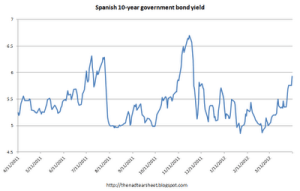
Markets are generally weaker as Europe plays catch-up with the US markets. US bonds and MBS are flat. Spanish yields are 17 basis points higher on no major economic news. An unexpected drop in imports pushed the Chinese trade balance into a surplus and is flashing warning signs about Chinese domestic demand.
With Greece temporarily off the front pages, all eyes turn to Spain. The new Spanish government is determined to implement austerity measures and reduce the budget deficit by almost 2/3 in 2013. Spain had a massive property bubble, which has weakened their banking system considerably. The banks are thought to be marking their real estate portfolios and mortgage bonds at unrealistic levels.
One powerful method of clearing the excess housing inventory is the short sale, and often times it is a lengthy, painful process as banks and other creditors drag their feet, hoping for better prices. Senator Sherrod Brown (D-OH) has introduced legislation to force banks to make a decision within 75 days of a request from a homeowner.
Bloomberg has been tracking a story about J.P. Morgan’s massive credit default swap positions in their Treasury department, which is raising questions about Dodd-Frank and proprietary trading versus hedging. The trader, Bruno Iksil, has been selling protection on an index of investment-grade bonds (Markit CDX North America Investment Grade Series 9) and is thought to have sold $100 billion worth of protection on the index. This is the trade that blew up AIG and I cannot imagine what it possibly could be hedging. As a bank, JP Morgan generally makes loans so it makes money if US corporations generally do well, and poorly when US corporations don’t do well. Selling protection is the exact same bet. The article goes on to speculate that this may be part of a spread trade, but even then a spread trade is a speculative position, not a hedge. Anyway, regulators and politicians seem to be lining up against this trade, and if JP Morgan is forced out, they will undoubtedly pay dearly to exit.
Chart: Spanish 10-year government bond yields