

 Brent Nyitray
 Fairlington Blade
 Let the mutherfuker burn!
 jnc4p
jnc4p Kevin S. Willis
 Michigoose
 lmsinca
 markinaustin
 Arcanaut
 novahockey
 quarterback
 ScottC
 yellojkt
Apparently recorded the same year he graduated from law school, and 5 years before he ran for the Illinois Senate.
He had a different speaking style then, I think.
Filed under: Obama | Tagged: barack obama, black history minute | 7 Comments »
Vital Statistics
| Last | Change | Percent | |
| S&P Futures | 1352.7 | 5.0 | 0.37% |
| Eurostoxx Index | 2504.6 | 16.3 | 0.65% |
| Oil (WTI) | 101.52 | 0.8 | 0.77% |
| LIBOR | 0.4951 | -0.003 | -0.50% |
| US Dollar Index (DXY) | 79.543 | 0.159 | 0.20% |
| 10 Year Govt Bond Yield | 1.93% | -0.01% |
Markets are higher this morning on statements from the Bank of China regarding support for the European bailout and its willingness to help. Concerns about an eventual Greek deal are offsetting some of these gains. Bonds and mortgage backed securities are flat.
Mortgage Loan Delinquencies are increasing again, according to TransUnion. 64% of MSAs reported increases, which was flat compared to Q3, but much higher than Q2. There are seasonal factors at work here, and the continuing decline in real estate prices are certainly playing a part, but that is not an encouraging data point economically. As if the foreclosure pipeline wasn’t big enough already.
Not that the markets really care, but it looks like we have a payroll tax deal.
The Empire State Manufacturing Index came in at stronger than expected. This is a touchy-feely indicator of general business conditions put out by the New York Fed. This index is notoriously volatile, so big moves should be taken with a grain of salt, but it shows that the expansion is gaining momentum in New York State. Separately, industrial production was flat and capacity utilization unexpectedly fell.
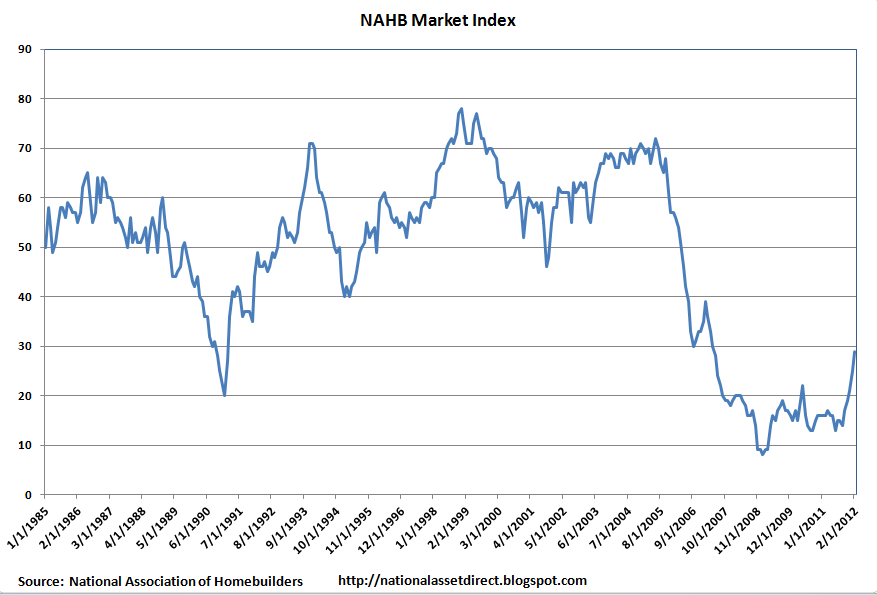
The National Association of Home Builders will release their market index at 10:00 am. Residential construction has been the missing piece of the recovery, but has been showing signs of life lately. Earnings reports from the homebuilders have been constructive.
The FOMC minutes will be released this afternoon. I am very curious to see why the Fed is behaving as if the economy is rolling over, while the data suggest otherwise.
Last, Ezra Klein at the Washington Post has a story on how the World Cup affects trading. I can attest to this personally, having been a block trader at Bear Stearns in London for a number of years. When England was playing a match, the phones would stop ringing and everyone had their backs to their screens, watching the match. You could actually see major stocks like British Petroleum and Vodafone stop trading. As an American, it was strange to watch.
****EDIT
The National Association of Homebuilders released their market index at 10:00 am. The index came in better than expected and it looks like conditions are improving at an accelerating rate.
Chart: NAHB Market Index:
Filed under: Economic data, Federal Reserve, Homebuilding, stock market | 55 Comments »
Vital Statistics:
| Last | Change | Percent | |
| S&P Futures | 1344.3 | -4.8 | -0.36% |
| Eurostoxx Index | 2486.5 | -5.1 | -0.20% |
| Oil (WTI) | 101.08 | 0.2 | 0.17% |
| LIBOR | 0.4976 | -0.005 | -0.99% |
| US Dollar Index (DXY) | 79.279 | 0.144 | 0.18% |
| 10 Year Govt Bond Yield | 1.94% | -0.03% |
Markets are a touch weaker after a disappointing retail sales number. Advance retail sales for January were up .4% vs. expectations of .8%. S&P futures sold off slightly on the number while bonds and mortgage backed securities rallied. For those who follow charts, the S&P is right up against resistance at the 1350 level. If we break through, the next stop is 1600 or so.
European markets are flat in spite of Moody’s downgrades of Spain, Portugal, and Italy yesterday. The ratings agencies have been behind the curve for the whole crisis. European finance ministers are set to meet in Brussels tomorrow to approve a second Greek bailout.
Andrew Ross Sorkin has a good article on the Volcker Rule and the Costs of Good Intentions. At issue is where one draws the line between bona fide market making and proprietary trading. Bona Fide market making serves a purpose in that it keeps trading costs down and adds liquidity to the market. (FWIW, Paul Volcker doesn’t necessarily think this is a good thing). The crux of the issue is whether investment banks will be allowed to maintain an inventory of product. If they aren’t permitted to maintain any inventory of any size, then all trades will be agency trades. In other words, if the bank can’t find the other side of your trade, you’re out of luck.
The CFPB has laid out a broad outline of some of the changes it expects to make for mortgage servicers. The initial steps will involve changes to billing statements – new rules to make it clearer when resets will occur, better contact information, and a statement from HUD. An example of the new template is here. The rules will also address forced-place insurance, where servicers can put a homeowner in a new, more expensive insurance plan if they fall behind in their payments.
Does anyone find it ironic that the rule which sets new tax rates on dividends is named after a guy who’s company doesn’t pay them?
Filed under: Big Banks, Economic data, Morning Report, TBTF | Tagged: Buffett Tax | 29 Comments »
I’ve never been a fan of Al Sharpton, but who knew the man had such a sense of humor? This had me laughing out loud:
And too bad Scott’s busy this week. A Libertarian economist’s POV on why FOX’s Megan McArdle is wrong on why brick-and-mortar universities will go away:
Assortative mating works best when the cognitive elites are able to combine signaling behaviors for their superior genes, particularly for doing economics, with the physical proximity that supplies bonding behaviors and oxytocin and also the opportunity to sniff the pheromes.
Since we got onto a first dance wedding song kick (a bit) on Mark’s Funny Valentine post last night, I’ve been listening to Al Jarreau , so here’s another one of my favorites:
And, while I don’t count myself amongst the bitter folks, I thought that this story on NPR about three anti-Valentine’s Day books was amusing.
Happy Valentine’s Day, all ATiM-ers!!
Filed under: Uncategorized | 7 Comments »
IIRC, this song first became popular when the great, then young, west coast jazz trumpeter, Chet Baker, sang it.
A couple of years later, it was made popular again when Ella sang it on the Rodgers and Hart Songbook.
Still later in the 50s, Frank Sinatra sang it. But for reasons that are part of a funny story I will tell here someday, I do not play Sinatra.
Sting butchered it in a live concert.
Chet Baker and Gerry Mulligan, along with Brubeck and Desmond, defined west coast “cool” jazz. When we were in high school, we really loved that stuff. Baker did not often sing, but until he died in the 80s, whenever he played he would be asked to sing this. Like any jazz guy, he never sang it the same way twice. This first rendition was my favorite, and the one that put the song on the map as a “standard”.
And Ella was Ella. I met her once. I was 14. She was gracious, as if it mattered to her that I knew who she was. She was with the blind singer, Al Hibbler, at the time, and although I did not recognize him, when she introduced us, I knew who he was – he had made a hit of “Unchained Melody”. I fumbled in embarrassment, but Ella made it AOK.
Happy Valentine’s Day, all.
Filed under: music | 49 Comments »
Vital Statistics:
| Last | Change | Percent | |
| S&P Futures | 1349.1 | 8.5 | 0.63% |
| Eurostoxx Index | 2495.7 | 14.9 | 0.60% |
| Oil (WTI) | 100.32 | 1.6 | 1.67% |
| LIBOR | 0.5026 | -0.003 | -0.67% |
| US Dollar Index (DXY) | 78.775 | -0.229 | -0.29% |
| 10 Year Govt Bond Yield | 1.99% | 0.01% |
World markets are rallying on the positive Greek austerity vote over the weekend. European finance ministers will meet on Wednesday to approve the second bailout plan. Does this mean the crisis in Greece is over? Not really. Bondholders have to accept the proposed haircuts and if there are holdouts (and the holdout trade is a staple of distressed hedge funds), there will still be risk of default.
Heard on the Street has a good piece on corporate profit margins and what that means for the economy. Productivity has been falling, and that perversely can portend good things. After the financial collapse, companies dramatically cut their workforces and held off on capital spending unless it was absolutely necessary. As demand returned, companies squeezed as much output as they could from existing resources. They held off hiring and making investment in productivity-increasing capital. Stocks have reacted positively to growth in profit margins as revenues increased while costs stayed stagnant. This was reflected in the productivity numbers (which measure amount of output per input). Lately, productivity increases have been smaller and smaller, meaning that effect has largely been played out. This means if companies want to meet increased demand, they have to hire – their existing workforces are maxed out. Which bodes well for unemployment and wages. What does that mean for corporate profits and stocks? It means that the top line (revenues) will have to drive profit growth. Tepid economic growth will mean stagnant profits.
The SEC has launched an “informal inquiry” into the private equity industry. What a shock. It must be nice to have government agencies with subpoena power to conduct oppo research. (Couldn’t the NYT find a more menacing picture of Henry Kravis?)
No economic data today. I am very interested to see the minutes of the FOMC meeting on Wednesday.
Filed under: Economic data, Economy | Tagged: private equity, productivity | 59 Comments »
We here have been educated to understand the supply problem in American health care, thanks to NoVAH, Mike, and Michigoose, although many, if not all, of us understood the general outlines of this basic issue before we got here. This morning we read this:
What I did not know, until I read this article, is that Medicare covers the lion’s share of the cost of training medical residents. Further, in order to make ACA’s package politically marketable, in the negotiations, there was no increase in the funding for residents. Thus ACA built into itself the seeds of its own failure, and this is what NoVAH has been saying to us, although I don’t recall his having pointed to the failure to increase funding for residents.
When I read ACA in detail for my clients, I looked at it from the POV of the effect on small biz, which I decided was actually nil, for my clients. A myopic view, I admit, but it fit my assignment. A shortfall of 30000 new doctors in a near time frame will greatly increase health care costs above what they would have been if 30000 new docs had been trained.
Filed under: Affordable Care Act, healthcare | 12 Comments »
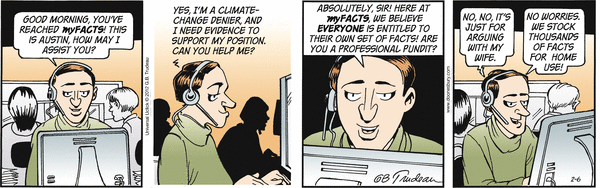
I don’t want to step on any toes, but here are some politically tinged comic strips which made me chuckle this week. Doonesbury ran with this concept all week, which kept getting funnier and funnier:
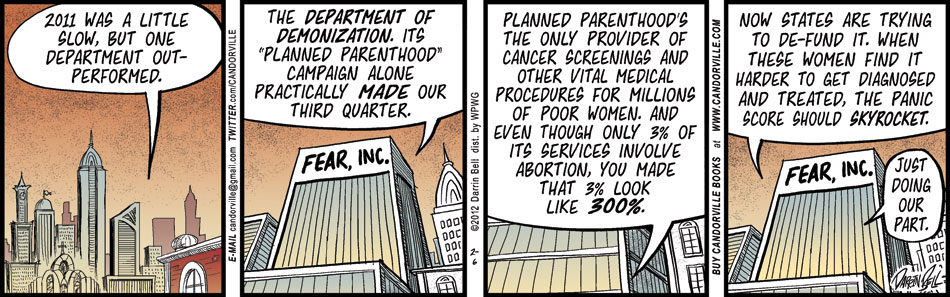
Given the lead time of newspaper comic strips, this one was rather presciently timed to coincide with the Komen Kerfuffle:
Candorville 2-10-2012
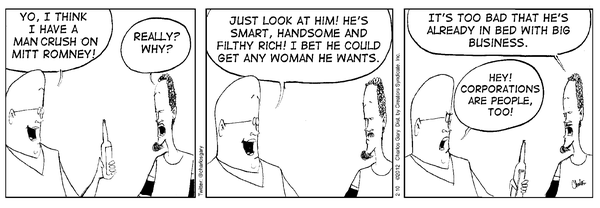
And that Mitt Romney is one handsome devil:
Cafe Con Leche 2/10/2012
Finally, this one in particular seems to sum up what is wrong with the internet:
On The Fastrack 2/6/2012
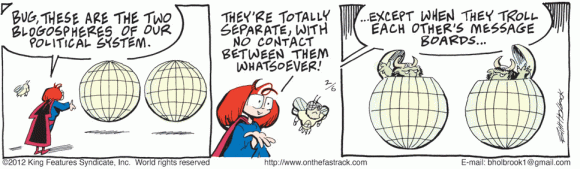
See you in the funny papers.
(edited to increase image size and add hyperlinks)
Filed under: Uncategorized | Tagged: comics | 7 Comments »
I have no idea how to embed these, so I’ll leave that to someone else:
Junior Birdmen song:
Flying Purple People Eater:
Monster Mash:
The Ipana Toothpaste jingle:
Wow! I think I’m starting to master WP’s ins and outs to an extent. There you go, MsJS–enjoy!
—Michigoose
Filed under: Uncategorized | 8 Comments »
Welcome to the launch of our first ATiM Book Review. This is something I’ve been thinking about since we first envisioned ATiM and honestly, I don’t know why it’s taken me so long to get around to it. I’m going to pull a popular Presidential move and choose our first book by “Executive Order” and have therefore chosen Suite Harmonic by Emily Meier. Next time we’ll take suggestions and vote or something. I’m reading I,Judas next, by Mark’s son-in-law, but don’t let that influence your vote.
Emily Meier (AllButCertain here at ATiM) has not only published six books, but has also launched her own publishing company, Sky Spinner Press, in the past year. Suite Harmonic is her longest novel so we’ll get back together the weekend of April 13th for a discussion, that should be enough time for everyone to read it. In the meantime, be thinking of suggestions for our next reading assignment……and try not to think of it as homework.
From a recent interview:
Her honors include Minnesota State Arts Board and National Endowment for the Arts fellowships and Loft Mentor and Loft McKnight awards. Her stories have been published in national literary journals, and she’s won national fiction contests at Florida Review and Passages North. One of her stories is in “The Second Penguin Book of Modern Women’s Short Stories.”
From her website:
During this 150th anniversary year of the beginning of the Civil War, Suite Harmonic: A Civil War Novel of Rediscovery is the indispensable novel for readers interested in discovering the intense experience of both battlefield and homefront in the teeming world of the Civil War.
Excerpt from Chapter One:
It was eleven charged days since the 25th Indiana, Volunteer Infantry, had left St. Louis on the Continental and traveled with the fleet down the Mississippi. The men had watched warily as flatboats edged between ice floes. They’d rushed to fill buckets to keep the deck wet beneath the boat’s fiery chimneys. Steaming past canebrakes and turkeys perched on tree branches, they’d kept a lookout for guerrillas and spotted herons and red-tailed hawks flying at water’s edge, eyed pignut hickories and saw Judas trees not yet in bud. A steamer suddenly crossed their bow, and the captain reversed engines just in time to avoid a collision.
At Cairo, its broad levee swarming with soldiers, they escorted angry mutineers to quarters. One of them, hearing the west of Ireland in John’s voice, cursed him in Gaelic. At Paducah they saw an otherworldly boat, brightly lit: plumed officers and beautifully gowned women strolling its upper deck. Then, the Iatan had turned from the Ohio into the Tennessee. It had pushed down the western knob of Kentucky. It had steamed into Tennessee. It had entered the Confederacy itself where the citizens weren’t just wavering but gone. When at last the boat came into view of the Stars and Stripes newly flying on Fort Henry after the navy’s victory, a thunderous, foot-stomping yell erupted around John. The wood of the boat shuddered clear through him. He was cheering so loud his throat hurt. A big fight was coming. He knew it. They all did.
Now, after a night bivouacking at Fort Henry and the march to Fort Donelson and the long, sleepless hours in front of the Confederate rifle pits, the fight had arrived.
You can purchase Emily’s book, Suite Harmonic, from Amazon here, or from her website here. I hope many of you will read it and enjoy it, and then we can have a lively discussion afterward, beginning the weekend of April 13th. I’ve added a sidebar under the log in feature as a friendly reminder of our (my) choice of book and the date we’ll have our discussion as well as links for purchasing the book.
Filed under: 2012, Book Review, Emily Meier, Suite Harmonic | Tagged: Book Review, Emily Meier, Suite Harmonic | 20 Comments »
 All Things in Moderation