Morning Report

Vital Statistics:

Last Change Percent
S&P Futures 1239.4 -33.8 -2.65%
Eurostoxx Index 2247.4 -55.810 -2.42%
Oil (WTI) 94.65 -2.150 -2.22%
US Dollar Index (DXY) 77.587 0.922 1.20%
US 10 Year Yield 1.97% -0.10%
Italy 10 Year Yield 7.33% 0.56%

Added a new vital statistic – the Italian 10 year government bond yield.

S&P futures are getting crushed as investors focus on Italy and the rise in Italian government bond yields. Overnight, LCH Clearinghouse increased the margin requirements on Italian government debt by 75%, triggering a sell-off in Italian bonds. Spanish and Irish yields are wider as well. Both EURIBOR / OIS and LIBOR / OIS are signaling stress in the financial system. One problem for the banking system is that government bonds form the basis of Tier 1 (risk-free) capital. So if the “safe stuff” is suspect, all of the banks are suspect.

Luckily the US credit markets (with the exception of the mortgage space) have been largely insulated from the problems emanating out of Europe. US banks raised a lot of capital during the crisis and have been de-levering for years. Two big corporate issues priced yesterday and hedge funds are raising money for distressed debt vehicles. The US government bond is back under a 2% yield.

The European experience is instructive for the US. Slow-moving train wrecks can lull investors into a false sense of security. Simply because investors are not focusing on a well-advertised problem at the moment doesn’t mean things are fine. These sorts of things typically coalesce in a short period of time. In other words, it doesn’t matter until it matters, and then it is the only thing that matters.

Bits & Pieces (Tuesday Night Open Mic)

Will Ferrell answers questions from the Internet. Unsafe for work. Profanity. Strong sexual content. Etc.

•••

Been a busy day. Busy beating Microsoft Sequel Server into submission. Simple enough, but I’m from an era of sequential scripts and Microsoft BASIC. Nesting select statements get just select the records for a school, year, and period with the most recent timestamp took me 3 hours to get working. Anyone who does this stuff knows how simple this is:

select * from (  

select S.schName as School, L.schYear,L.prd as period,jl.date_run as DateRun, ‘Approved’=case when status = 1 then ‘Y’ else ‘N’ end,  L.prvUser as AprBy,  convert(char(10),L.prvDate,101) as AprDate,L.schID as school_id
from adaLock as L
 

left join t_SchAtt as S on L.schId = S.schNum       

join Job_Log jl on (L.schId = jl.schoolid and L.prd = jl.period and L.schYear = jl.school_year) 

where  schYear = @schYear and prd = @prd 

union all select schName,@schYear,@prd,null,’Not Run yet’,null,null,null from t_schAtt where schNum not in  ( 

select schId  from adaLock where schYear = @schYear  and prd = @prd rty

)

group by schName  ) subSetx

WHERE subSetx.DateRun = (select max(date_run) from Job_Log jlo where jlo.period = subSetx.period and jlo.school_year = subSetx.schYear and jlo.schoolid = subSetx.school_Id) 

group by school,schYear,period,DateRun,Approved,AprBy,AprDate,school_id

But it took me 3 hours to make it work. I knew at the outset I wanted to select records where date_run = max(date_run), but finally finding the right combination to make it actually work . . . and they call SQL a natural language query language. Oh, brother!

After the Debacle, The Questions

One hesitates, or one should hesitate, to allow the race for the Republican nomination for president to become an opportunity to ask serious questions. Most of the candidates aren’t serious and one of the serious candidates isn’t being considered seriously; there’s a great deal of silliness; and, most importantly, no one has yet cast a vote.

I suspect, however, that even the most jaded of us, even those inclined to shrug slightly, smile pleasantly, note that this is the silly season, and calmly reassure others that rational (never mind calmer) voices will prevail, even those among us most inclined to take all of this with a grain of salt, must be given cause by the phenomenon of Herman Cain.

Even that most jaded observer must wonder what one should make of the Republican party, the conservative movement in general, the Tea Party in particular, and conservative media, given that they played a part in giving us Cain, a candidate who was not aware that China possesses nuclear weapons, has offered a tax plan that has no chance of passing, and who seems to believe that one can refuse actually to address questions and remain a viable candidate for the Republican nomination.

Cain will not win the nomination and he will not, in all likelihood, create serious problems for the winning candidate. Cain is not a serious candidate and his campaign, such as it is, has the appearance of a book tour that has gotten well and truly out of hand. That said, the individuals and organizations that assisted in giving rise to the debacle that is Cain should be asked some hard questions, and, importantly, they should be asking those questions of themselves.


“All you can do is give that woodchuck a tuna melt, a romantic shoe, or a metal skull crusher.”

Not to mention that extra-fatal lady shimmer.

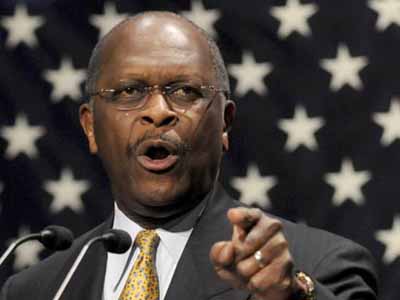
Herman Cain makes his own case. — KW

The Conservative 9th Circuit

The Supremes are about to hear a wonderful (read: law school exam problem, argue both sides) new search and seizure case.  Can police attach a GPS unit to your car for a month at a time without a warrant?  The liberal 9th Circuit said “yes”, the leaning conservative DC Circuit said “no.”  The case was so well covered by Nina Totenberg this morning that I am laying out the whole NPR report.  You non-lawyers may think this one is fun.  For an aficionado of the Supremes, like Mike Teng, this case points up how original intent often just does not get us very far with new technology.  I tend to think the government position on unreasonable search is stronger here, but I am bothered by the secondary argument about “seizure“, as are many prosecutors, according to NT’s story.  If you found a police GPS bug on your car and you removed it, I think you would be within your rights, and not obstructing justice.  But does that mean police need a warrant to place it?  Is it an unreasonable seizure of your car?  Read on.

DoPolice Need Warrants For GPS Tracking Devices?

The Supreme Court considers whether GPS monitoring devices like this one may be affixed to suspects' cars without a warrant from a judge.
Yasir Afifi/AP

The Supreme Court considers whether GPS monitoring devices like this one may be affixed to suspects’ cars without a warrant from a judge.
November 8, 2011
The U.S. Supreme Court, an institution steeped in tradition, steps into the turbulent world of new technology Tuesday. At issue before the court is whether police must get a warrant from a judge before they can attach a GPS tracking device to a car so they can monitor a suspect’s every movement for an indefinite period of time.
The case could have enormous implications for privacy rights in the information age.
Police, quite naturally, want to use new technology to get the goods on the bad guys, and citizens, quite naturally, think that when they leave their homes, they still have some zone of personal privacy in their cars. This case presents that clash in vivid terms.
In 2004, a joint FBI-Washington, D.C., Metropolitan Police task force began investigating suspected drug kingpin Antoine Jones. First they got a warrant and wiretapped him, but Jones was careful about how he spoke on the phone. So then they put a GPS tracking device on his car, and for 28 days, every time that car moved, its location was tracked by satellite, with the information sent every 10 seconds to the FBI. The tracking led to Jones’ arrest, plus the seizure of 97 kilos of cocaine and $850,000 at a stash house. Jones was convicted of conspiracy to distribute drugs, but a panel of conservative and liberal judges on the U.S. Court of Appeals in Washington unanimously threw out the conviction because the tracking device had been attached without a warrant. The court said that tracking a car for such a long period without court authorization violates the Fourth Amendment’s ban on unreasonable searches.
The government appealed to the U.S. Supreme Court, contending that no warrant is required when a car is on public roads. And the Supreme Court hears arguments Tuesday in the case.
“It’s critical to understand that this case is not about whether law enforcement can use GPS devices. It’s about whether they should get a warrant,” says lawyer Walter Dellinger, who represents Antoine Jones.

“If the Supreme Court gave a green light” to warrantless GPS tracking, he adds, then “any officer can install any GPS device for any reason on anybody’s car, even if the officer thinks it would be interesting to know where Supreme Court justices go at night when they leave the courthouse. No one would be immune from having a GPS device installed on their vehicles.”


The government, however, contends that the Fourth Amendment only bans warrantless searches of private spaces, like the home, or the interior of a car, or a locked office desk. And the Supreme Court has previously held that searches on public streets — of trash put out for pickup, for instance — do not require a warrant. In addition, the government asserts that the GPS device is just an electronic extension of old-fashioned human surveillance.
Pat Rowan, a former federal prosecutor and assistant attorney general in the Bush administration, supports that view. “There’s no Fourth Amendment implication for what a person is doing out in the public space, whether they’re walking down the street and being observed or whether they’re driving down the street and being observed,” he says.
Rowan concedes that everyone has what he calls “an instinctive reaction” that warrantless GPS tracking goes too far. But, he adds, “you are talking about a very clear line that the Supreme Court has laid down over a very long time, that what the police can observe in public, the individual doesn’t have a reasonable expectation of privacy in. And this is the functional equivalent of having the police do a very effective covert surveillance of an individual over a long period of time.”
Rowan does say as a practical matter that it would be next to impossible to conduct surveillance for a month without being detected. That’s why the GPS is a game changer and, as Rowan puts it, a “terrific boon” for police. So why not get a warrant first? Because to get a warrant, police have to show they have probable cause to believe a crime is occurring or has occurred. And the government says GPS tracking is particularly useful at the early stages of an investigation — before probable cause can be established. “You have a lead against a person, but it’s not corroborated,” says Rowan. “You don’t know what they’re up to. This is a low-cost device that would allow the FBI or any law enforcement agency to gather a great deal of information about their movements without having to go to a judge and justify their investigation.”
That’s exactly the point, counters Dellinger, the defendant’s lawyer. “The government’s position is that any law enforcement officer, in his completely unfettered discretion, can choose to put this device on anyone’s car and track what medical appointments you go to, what religious groups you meet with, what political activities you drive to. This is really an extraordinary undertaking and one where the critical protection would be that a neutral magistrate would approve in advance whether there is actually some probable cause to believe someone has committed a crime before you install a GPS device,” he says.
Dellinger has a second argument, not addressed by the appeals court, but that is before the Supreme Court. The Fourth Amendment to the Constitution bans not only unreasonable searches, but also seizures of a property. He argues that placing the GPS device on the exterior of Jones’ car interfered with Jones’ right to exclude others from using his car, and that planting the device constituted a trespass on Jones’ property. That argument does appeal to former Assistant Attorney General Rowan, who opines that “it just doesn’t sound right” that there is no expectation of privacy when a device is covertly affixed to a car.
Indeed, an unscientific sampling of prosecutors shows a real hesitation about how far to push the envelope with GPS devices.
David Kelley, the former U.S. attorney in New York, who spent nearly 20 years as a federal prosecutor, says he always assumed that a warrant was needed for a long-term tracking device. “The four corners of the car is yours,” he contends. “And you have a reasonable expectation of privacy in that.”
Kelley concedes that requiring a warrant will mean some bad guys get away. “Tough luck,” he says. “Go find another way to get the guy. And if you can’t get probable cause, you know what? Maybe you have no business getting into that car to put in that device.”
While today’s case involves GPS devices, it could have enormous repercussions for other devices in the information age. What about cameras that photograph people on public streets? What about cellphones that can be tracked whenever they are on?
Defense attorney Dellinger maintains those are different: The cameras are stationary, and the cellphones can be turned off.
The Supreme Court is usually reluctant to rule boldly on matters of new technology. It has learned, the hard way, that the reach of new technology is hard to predict. In the 1920s, when law enforcement began wiretapping suspects, the court ruled that no warrant was required.
Nearly four decades later, in 1967, the court overruled that decision and said a warrant is required.
The court’s only ruling on any sort of a car tracking device was in 1983. In that case, the court approved the placement, without a warrant, of a beeper in a large container that suspects put in their car. Police then followed the sound of the beeper for a single day. The court, however, specifically left open the question of whether any longer-term tracking device would require a warrant.
In recent years, the lower courts have split on the question.
In Washington, D.C., Judge Douglas Ginsburg, writing for a unanimous appeals court panel, said a warrant was required in the Jones case because of its intrusiveness. “A person who knows all of another’s travels can deduce whether he is a weekly churchgoer, a heavy drinker, a regular at the gym, an unfaithful husband, an outpatient receiving medical treatment, an associate of particular individuals or political groups.”
The likelihood that police could conduct such a monthlong, 24/7 surveillance by just watching and following the suspect, he said, is “nil.”
When the full nine-member appeals court declined to review the panel’s decision, Chief Judge David Sentelle dissented. “A person’s reasonable expectation of privacy while traveling on public highways is zero,” he said, and “the sum of an infinite number of zero-value parts is zero.”
That dissenting view prevailed on the opposite coast when the Ninth Circuit Court of Appeals, based in San Francisco, ruled that no warrant is required in GPS cases. When the court declined to reconsider its ruling, Chief Judge Alex Kozinski, a native of communist Romania who immigrated to the United States with his parents in 1962 when he was 12, dissented. “There is something creepy and un-American about such clandestine and underhanded behavior,” he wrote of the warrantless placing of GPS tracking devices. “To those of us who have lived under a totalitarian regime, there is an eerie feeling of deja vu.”


DC Circuit Upholds Affordable Care Act

DC Circuit upholds Affordable Care Act. Was there any doubt? I thought it would be upheld, myself.

Link above goes to a PDF of the opinion.
************************************
Mark added:  I could not open that link, so I am adding this one to Volokh, which in turn also links to the opinion.

http://volokh.com/2011/11/08/silbermans-opinion-as-template/

Recall that Judge Silberman wrote the reversal of the NLRB case two weeks ago that said NLRB could no longer treat union discipline of a member who reported a safety violation  even ‘though he was under a duty to do so as a per se unfair labor practice.
He is a very conservative senior judge, and a mentor to Thomas.  Benjamin writes that his opinion is a template for the conservatives on the Court to uphold the ACA.

Morning Report

Vital Statistics:

Last Change Percent
S&P Futures 1265.7 8.2 0.65%
Eurostoxx Index 2335.1 59.160 2.60%
Oil (WTI) 96.16 0.640 0.67%
US Dollar Index (DXY) 76.846 -0.133 -0.17%
10 Year Govt Bond Yield 2.04% 0.01%

Today is a “risk on” day, as Euro markets rally on Vodafone’s positive earnings announcement and Germany’s unexpected increase in exports. Later today, Italian lawmakers will vote on Prime Minister Silvio Berlusconi’s budget. EURIBOR / OIS (a measure of stress in the banking system) is declining again after spiking last week, but is still elevated.

There is an interesting article in this morning’s WSJ discussing the decline in Chinese real estate prices. Prices fell .23% MOM (about 23 basis points) in October after falling .03% (or about 3 basis points) in September. The Chinese authorities have been trying to cool the real estate market for two years, and it appears that they are finally getting some traction. Of course, letting the air slowly out of a financial bubble has proven to be a nearly impossible task. The article discusses how the financing of projects has dried up, which presages a hard landing about 110% of the time.

“Real-estate developers are having greater problems finding financing to complete projects or start new ones. Trust-investment vehicles—a key part of China’s shadow lending system—have become a major source of funding for developers, after bank lending all but dried up this year.”

This sounds a lot like the US in July, 2007. That was when the credit markets started seizing up. Of course the financial press referred to it as a “buyer’s strike” – meaning a temporary phenomenon. Main Street and Washington didn’t even notice there was a problem until Fall of 2008. My point is that these things have long lead times, and this time next year, the Chinese economic implosion may dominate the headlines.

In the “bursting Asian bubbles” category, a couple of Japanese blue chips have been getting roughed up lately. Olympus Optical (the maker of cameras and diagnostic equipment) was limit down last night as news of accounting issues dating back to the 1990s come out. Olympus hid losses from securities in the mid 90s, by holding them off balance sheet. They then tried to use inflated M&A acquisition costs to launder these losses. The problem came to light when Olympus tried write off a 27% M&A fee for the Gyrus acquisition. Nomura (Olympus’s banker) was also in the doghouse and hit a 37 year low.

Part of the reason why the Japanese implosion was such a slow-motion event stems from this. Because of the Japanese keiretsu system, most Japanese companies had holdings in other companies, typically suppliers, customers, etc. These holdings dated back to the WWII era. Japanese accounting has these investments carried at cost, not market, which means that companies always had a “slush fund” they could draw upon to manage earnings. If earnings are going to be in the red, sell a part of your equity holdings and buy it back at market. The gains on that sale (the difference between the stock price today and the cost basis, which for all intents and purposes was close to zero) drop to the bottom line. Presto! Profitability. This allowed the Japanese corporate sector to avoid facing reality for a decade. As a matter of fact, the Ministry of Finance used to conduct “price keeping operations” where they would instruct the banks to support the equity markets. The Japanese believed equity prices and real estate prices were too important to be determined by a mere market.

Unfortunately the Obama administration believes house prices to be too important to be determined by a mere market and is focusing on trying to support house prices at an unsustainable level. And that remains an anvil on the economy.

Musing on the Free Use of the Word "Hypocrisy"

Hypocrisy is the state of pretending to have virtues, moral or religious beliefs, principles, etc., that one does not actually have, according to wiki.

Greg Sargent, at PL, could not understand why conservatives would call Ms. Warren “hypocritical”. He wrote:

“Ta-Nehisi Coates skewers the latest conservative attack on Elizabeth Warren: That her own personal wealth somehow makes it hypocritical to seek higher taxes on the wealthy , i.e., on herself.
Not clear how it’s ‘hypocritical,’ if Warren is also agreeing to pay the higher tax rates.


In this instance, Mr. Sargent understands that a prospective legislator who can support legislation against her monetary interest is serving, in her mind, a greater good, her perception of the public good, as opposed to her own.

However, he could not understand the same principle when Ms. Bachmann supported repeal of agricultural subsidies, against her monetary interest. When I criticized his reasoning then, a crowd of commenters chimed in that I did not understand “hypocrisy”, whose name was “Bachmann”.

Yes, I tried dictionary definitions and many examples. I did not read PL closely enough to recall if anyone commented in agreement, but I never saw it.

So when QB explained at PL why Ms. Warren could be called a hypocrite [she should voluntarily pay more taxes if she thinks taxes should be higher], I thought it would be a good time to discuss “hypocrisy” and what it means, among adults, here.

In my view, there is no perfect or absolutely correct formulation of either revenue expenditure or of taxation. There could be evil formulations, but assume with me that they are outside the bounds of this discussion. Thus I can support higher taxation as a goal or lower expenditure as a goal, or vice versa, especially when it will be to my monetary detriment to do so, without hypocrisy. By contrast, in my view, marital fidelity is an oath I took seriously, in front of God and everyone, and were I to visit prostitutes I would be a hypocrite. Warren Buffett is not a hypocrite for supporting higher taxes, and John McCain is not a hypocrite for attacking wasteful defense contracts, and Ms. Bachmann is not a hypocrite for opposing ag subsidies she receives, but Sen. Vitter and the former NY AG are hypocrites. Period.

If we extend the definition of hypocrisy beyond the moral and religious bounds to include anyone who votes against her personal monetary interest we will have defined selfless legislating as out of bounds, and we would be begging for all legislators to vote only their personal monetary interests. Is that not obvious?

Bits & Pieces (Monday’s Unexpected Party Edition)

My Hobbit name is Berilac Bramble of Willowbottom. My Elvish name is Amras Lossëhelin. Follow the links to find yours.

There’s a new production video from The Hobbit on Facebook now. In it, Peter Jackson others discuss shooting in 3D and 48 fps, but there’s lots of nifty studio footage. Given that they wrapped studio shooting several months back, it must take awhile to get one of the video diaries together.

Eric Vespe from Ain’t It Cool News has a new set report (this one involving his cameo in The Hobbit), making me wish I wrote for an entertainment website and was in New Zealand.

Looking forward to The Hobbit. December 2012. I can’t wait that long. Arrrghh!

• • • 

It’s illegal in China to use an ultrasound to determine the sex of your baby. I didn’t know that. I learned that from the Freakonomics podcast on China’s one child policy. Also touches on legalized abortion leading to a drop in crime (the most controversial assertion from their first Freakonomics book).

That’s it (from me) for today. Namaste. — KW

Morning Report

Vital Statistics:

Last Change Percent
S&P Futures 1243.5 -7.6 -0.61%
Eurostoxx Index 2276.2 -15.240 -0.67%
Oil (WTI) 94.14 -0.120 -0.13%
US Dollar Index (DXY) 77.16 0.249 0.32%
10 Year Govt Bond Yield 2.03% 0.00%

Greek Prime Minister George Papandreou stepped aside to allow the formation of a new Unity government which will implement the required measures to receive 130 billion euros in financing. Holders of Greek debt will receive 50 cents on the dollar. Surprisingly ISDA (who oversees derivative contracts) will not consider this to be a “credit event,” so if you had hedged your Greek sovereign debt holdings with credit default swaps, you are out of luck. This adds a brand new risk element to debt / CDS investing – interpretation risk – or the risk you can get crammed down and have it not be considered a credit event. It will be interesting to watch the dynamic here – CDS levels might start giving misleading indications. Since credit default swaps are basically puts, their put value will decline as investors factor in the possibility that they won’t get paid if, say, Italy or Portugal does a similar cramdown plan. Watch the bonds, not the swaps.

Earnings season is more or less over. While companies generally reported strong results, analysts are taking down 2012 estimates. FWIW, there has been a “V” shaped recovery in corporate profits, but that has not extended to employment. From my perch overlooking the mortgage market, I am seeing companies miss out on business because they don’t have the staff to handle it. They are pulled in different directions from increased activity, and paralysis from having no clue how the regulatory environment is going to look. Strange times indeed.

We have a few minor economic data releases this week, but nothing really market moving, except for Initial Jobless claims on Thurs morning. Europe will continue to dominate the market until the January fiscal retailers report Q3 numbers in a few weeks.


-ashotinthedark

I thought Triumph the Insult Comic Dog’s visit to OWS was too funny not to share.

The New Monopolies

Just a quick post on something I’ve been thinking about in the last few weeks. With my publishing project, I’ve had a more first person experience with some of the big monoliths in today’s world—Google (AdWords specifically), Amazon, and Facebook, though a friend took on the Facebook role as it was an odd fit for me and not something I had time for in any case.

I have to admit to being in awe of the reach of these big companies that have become so important in our lives so quickly. I won’t go into all the very real benefits they’ve brought because we know what they are. But the smaller comment I want to make is that in a service age, these are not outfits that are particularly good at helping the people who use them. They count on users to know what they’re doing or to figure it out. For instance it’s easy enough to sign up for AdWords in hopes of a marketing boost. For a person who doesn’t have a starting knowledge of all the kinds of data it generates and how to use it effectively, it’s tough and time-consuming to figure out all the ins and outs of how it works and if it works, even if you check on it daily.

With Amazon KDP, you can upload things quickly but if you hit submit before you should, you won’t be able to fix a mistake with the same speed. If you send an email for help, you’ll hear back, but not quickly. As often as not, it’s assumed you’ll have your questions answered in forums by other people who’re also trying to navigate the system. I know very little about Facebook, but I have learned that there’s not a lot of software flexibility. You can have five pictures at the top of your page, or you can have five pictures at the top of your page. If you mistakenly link your page to another page, it’s apparently stuck that way.

My personal concern is with what’s essentially customer service, although it feels bigger than that. When an outfit is as huge and dominant as any of these are and still seeking to expand its reach, even if it’s relatively new in the marketplace, it’s still a monopoly with all the dangers that implies. We love the services and sometimes breathtaking opportunities we get from companies like this, but in some fundamental ways, I think we should be wary. I’m just not sure how.