Giblets and necks

Hi all,

My annual Thanksgiving preparations are ongoing. I’ve learned that starting on Monday means I can actually enjoy Thursday. We generally invite a few friends over to our place for Thanksgiving meal. Most folks bring a side or an appetizer (and wine!) Complicating the annual preparations is that two of our friends are vegetarians. Stuffing is a high light of the meal for me, so it’s gotta be made. I like to have all my guests able to enjoy it, so that means two batches. One turkey flavored and the other not.

Likewise, gravy. I made a mushroom gravy one year. Good, but a little complicated. This year I had an interesting idea. Mashed potatoes made with roasted garlic are tasty, so why not make a roasted garlic gravy? I have an Indian recipe for a garlic curry (cook garlic, onion and chiles in clarified butter until brown, add spices and coconut milk). I toned down the heat a bit and pureed the mixture.

I’ll have to think about the turkey alternative. It seems a shame to just eat sides and I’m sure fish has graced more than one holiday table. I roasted a rock fish one year, which turned out well. It’s fairly easy to do (salt and paper inside out out, toss herbs in the cavity and roast in a hot oven). It is, however, something that requires attention right when everything else is coming together. I actually made a lobster risotto another year. I’m tempted by the lobsters as they were $5/pound at the market and looked pretty frisky. Problem being that risotto is relatively time intensive. I might just try a makhni sauce (used for Indian butter chicken). Cook the lobsters, take the meat off the shell and toss into the sauce. I can make the sauce ahead of time and it’ll be tasty.

So, Monday night was stock night. I made a turkey stock from roasted neck bones. Well, it was a hybrid stock as turkey necks are $2.20 per pound and chicken necks are $0.69/pound. While that was going on, I also made the absurdly complicated vegetarian stock from Cooks Illustrated. The first time I made it, I swore I’d never do it again. In addition to the usual suspects, there’s a pound of collard greens and a cauliflower. All that work to produce a quart of stock. I’ve found that the recipe doubles just fine and makes a quite tasty stock. Still, I’d rather just use chicken stock.

Not much to do yesterday. I made the roasted garlic gravy and roasted some beats. I dice them up for a salad with yogurt, some spices, and some cilantro. Thanksgiving with a side of Mumbai. I took the bird out of the fridge this morning and put it in the brine. I’ll take it out of the brine this afternoon and leave it in the fridge to air dry. Life is also easier for myself if I do a lot of chopping tonight. Carrots, onions, and celery are pretty hard and it’ll save me time tomorrow.

Well, I’d best get to work, go home, and get to work.

BB

Thanksgiving with the WSJ

The WSJ editorail page has some excellent pre-Thanksgiving Day reads today. First up is a chronicle of the Pilgrims arrival at Plymouth, as recounted by William Bradford, “sometime governor thereof”:

Being now passed the vast ocean, and a sea of troubles before them in expectations, they had now no friends to welcome them, no inns to entertain or refresh them, no houses, or much less towns, to repair unto to seek for succour; and for the season it was winter, and they that know the winters of the country know them to be sharp and violent, subject to cruel and fierce storms, dangerous to travel to known places, much more to search unknown coasts.

Besides, what could they see but a hideous and desolate wilderness, full of wilde beasts and wilde men? and what multitudes of them there were, they then knew not: for which way soever they turned their eyes (save upward to Heaven) they could have but little solace or content in respect of any outward object; for summer being ended, all things stand in appearance with a weatherbeaten face, and the whole country, full of woods and thickets, represented a wild and savage hew.

If they looked behind them, there was a mighty ocean which they had passed, and was now as a main bar or gulph to separate them from all the civil parts of the world.

Next, while not explicitly a T-day piece, an interesting take on the state of the nation, and why we should be thankful for it:

Of course the stranger cannot quiet their spirits. For it is true that everywhere men turn their eyes today much of the world has a truly wild and savage hue. No man, if he be truthful, can say that the specter of war is banished. Nor can he say that when men or communities are put upon their own resources they are sure of solace; nor be sure that men of diverse kinds and diverse views can live peaceably together in a time of troubles.

But we can all remind ourselves that the richness of this country was not born in the resources of the earth, though they be plentiful, but in the men that took its measure. For that reminder is everywhere—in the cities, towns, farms, roads, factories, homes, hospitals, schools that spread everywhere over that wilderness.

We can remind ourselves that for all our social discord we yet remain the longest enduring society of free men governing themselves without benefit of kings or dictators. Being so, we are the marvel and the mystery of the world, for that enduring liberty is no less a blessing than the abundance of the earth.

And we might remind ourselves also, that if those men setting out from Delftshaven had been daunted by the troubles they saw around them, then we could not this autumn be thankful for a fair land.

Finally, Thomas Fleming recounts an English Thanksgiving from 1942:

The most dramatic ceremony was in London’s Westminster Abbey, where English kings and queens have been crowned for centuries. No British government had ever permitted any ritual on its altar except the prescribed devotions of the Church of England. But on Nov. 26, 1942, they made an exception for their American cousins.

No orders were issued to guarantee a large audience. There was only a brief announcement in the newspapers. But when the Abbey’s doors opened, 3,000 uniformed men and women poured down the aisles. In 10 minutes there was not a single empty seat and crowds were standing in the side aisles. One reporter said there was a veritable “hedge of khaki” around the tomb of Britain’s unknown soldier of World War I.

Cpl. Heinz Arnold of Patchogue, N.Y., played “Onward Christian Soldiers” on the mighty coronation organ. With stately strides, Sgt. Francis Bohannan of Philadelphia advanced up the center aisle carrying a huge American flag. Behind him came three chaplains, the dean of the Abbey, and a Who’s Who of top American admirals, generals and diplomats. On the high altar, other soldiers draped an even larger American flag.

Their faces “plainly reflected what lay in their heart,” one reporter noted, as the visitors sang “America the Beautiful” and “Lead On O King Eternal.” The U.S. ambassador to Britain, John G. Winant, read a brief message from President Franklin D. Roosevelt: “It is a good thing to give thanks unto the Lord. Across the uncertain ways of space and time our hearts echo those words.” The Dean of Westminster and one of the Abbey’s chaplains also spoke. “God has dealt mercifully and bountifully with us,” the chaplain said. “True, we have had our difficulties . . . but all of these trials have made us stronger to do the great tasks which have fallen to us.”

This last one reminds me a bit of London following 9/11. I was living there at the time, and a few days after 9/11 they held a ceremony in St. Paul’s Cathedral in honor of the victims. My office was close by to St. Paul’s, so I went over. I couldn’t get within 200 feet of the front doors, it was so packed both inside and outside, but they had set up speakers outside so everyone could hear. During the ceremony, the Queen spoke briefly, and then the Star Spangled Banner was played while the US flag hung outside the cathedral, the first and only time that a foreign national anthem had ever been heard inside the walls of St. Paul’s. I’m not a religious guy in the slightest, but I have to admit it was pretty moving.

GOP Security and Foreign Policy Debate

So apparently there was another Republican debate last night and the candidates discusseed Security and Foreign Policy…again.

For those, like myself, who were too busy gauging their eyes out or refuse to watch another debate until jets fly across the screen again, here are a handful of articles discussing the debate:

The NY Times has a good summary of the goings on. And I enjoyed this live blogging of the debate from the WSJ. My personal favorite was Gingrich (who apparently is the new front runner) defending the Patriot Act by noting “All of us will be in danger for the rest of our lives.” Good times. I’ll be sure to pass that heart warming nugget on to my son if he ever decides to leave the womb.

Not surprisingly and hardly unique to Republican politicians, there were some factual inaccuracies made by the candidates.
Not to be outdone, the WaPo fact checker points out 15 statements that weren’t entirely consistent with reality.

What’s a debate if we can’t instantly declare winners and losers (anyone who watched the debate falls, I suspect, into the later category)CBS News takes a Little League approach and names virtually everyone a winner. Apparently Cain called Wolf Blitzer, Blitz, which is cute. And in breaking news Jon Huntsman and Ron Paul are apparently running for the Republican nomination.Cillizza sees Ron Paul as a loser in the debate mostly because the rest of the Republicans were hawkish and Ron Paul is decidedly not.

Last, but not least, no news on the baby front. We’ve tried every remedy known to man and if the baby is not here by Tuesday we’re headed to the hospital for induction. Thanks for all the well wishes and an early Happy Thanksgiving to everyone.

Bits & Pieces (Tues. Open Thread)

(Posted by ScottC, but discovered and written by lmsinca)
I was going to attempt a You Tube video here of the World’s scariest roller coaster, but I suffered a tech fail.  (tech fail resolved – SC). A few of us had a discussion a week or so ago comparing the economy to a roller coaster ride so here ‘ya go.  I thought of Ashot also, waiting for baby ashot to show up, as riding an emotional roller coaster.  I hope we hear from him soon.

How Many Americans Don’t Pay Taxes?

From an unexpected source, National Review Online, there is a take-down of the talking point about how “47 percent of Americans don’t pay [income] tax”.

Ramesh Ponnuru in his article “The Freeloader Myth” dismisses many of the misconceptions about the number of people who don’t pay income tax, in particular that the statistic ignores payroll taxes which for many Americans are a bigger burden than income taxes.

Federal taxes are still “progressive” — higher earners pay a disproportionate share of federal taxes — but the Tax Policy Center estimates that only about 18 percent of filers pay neither income nor payroll tax.

Ponnuru explains that the separation of income and payroll taxes is a false one often propagated for political purposes by both sides.

Many conservatives argue that since payroll taxes are dedicated to Medicare and Social Security, people who pay only payroll taxes are contributing to their retirements but not to the general operations of the government. The irony here is that FDR deliberately and explicitly introduced the payroll tax to accompany Social Security because it would encourage people to draw this false connection.

This hits on one of my favorite hot buttons. Money is fungible. A dollar sent to the government is a dollar sent to government no matter what its intended purpose. Even when it is earmarked or lock-boxed or whatever, those are just accounting fictions and it all goes into and out of the same big pool.

And here is the crux:

Count both the payroll and income tax and there is no trend toward lighter federal taxes on the lower-middle class.

He also addresses the implicit free-rider fear that somehow getting something for nothing drives poor voters into the hands of tax-and-spend liberals.

In one respect, the fixation on the number of people paying income tax is absurdly optimistic. Conservatives who worry about the political implications of this number are assuming that people who pay no income tax will conclude that expansions of government serve their material interests and vote accordingly. {snip} Under those circumstances merely requiring everyone to pay some amount in income taxes would change nothing. Any welfare state will have a large number of net beneficiaries. In a welfare state that runs routine, large deficits, almost everyone may be among them.

So is the answer to get more people with skin in the game? Not according to Ponnuru:

To seek to raise taxes on poor and middle-class people would be a terrible mistake. The idea is bound to be unpopular. And it would alter the character of conservatism for the worse. 

The phrase ‘compassionate conservativism’ has been permanantly sullied by its inventor, but balancing the finances of our country on the backs of the poor is not something to be wished for.

Where We Are Today-The Middle Class

I read this piece this morning and thought it had quite a few interesting points to make.  Since I began blogging about three years ago (I know, I was a little slow) one of the things I’ve been harping on is the reversal of fortune or stagnation of the middle class.  I think a lot of it has to do with the high cost of health care, which this piece doesn’t explore, but I’ve also blamed our free trade policies which have created a large trade deficit, out sourcing jobs with no consequences for the out sourcers, lack of quality investment in education and being stuck in a couple of wars and fossil fuel reliance.  I don’t believe either party has done a very good job in the last several decades of addressing issues that would encourage or train our people for the 21st. Century.  We’ll give them a little in the way of a safety net, which is always at risk, when what people really want are jobs and a decent life to pass on to their children.  I understand that our first commitment at the Federal level is National Security and we could probably get rid of some Federal agencies and combine others but in the meantime our leaders have shirked their duty, a strong word I know, in providing opportunity to our citizens.  That’s my opinion anyway.  Think how much money we’d save if people didn’t need to rely on the safety net so thoroughly or how much more tax revenue we’d have at current levels of taxation if more people had decent paying jobs.  Most of the innovation of the last couple of decades has come from the financial industry, which just seems weird to me, not that we don’t need financial services but the balance has skewed too far away from industry and innovation, again, in my opinion.  Here are several excerpts from this rather long piece.

In recent months, Federal Reserve Board Chairman Ben Bernanke and President Obama have sounded increasingly urgent alarms about the staggering number of long-term unemployed. And they are right to do so: 42.4 percent of the nation’s 13.9 million unemployed workers have been out of a job for more than six months. That’s by far the highest share of long-term unemployed since the government started keeping records a half-century ago.

What Bernanke and others rarely mention, though, is that this trend has been building for at least three decades. The share of left-behinds has generally ratcheted up with every economic downturn since the early 1980s. And today, even two years after the Great Recession technically ended in June 2009, the number of long-term jobless has continued to climb to record levels. It shot up from 29.3 percent of total unemployed workers in June 2009 and peaked at 44.6 percent as recently as September.

Washington, dominated by a free-market consensus ever since President Reagan’s era, has ignored that 30-year pattern. Partly as a result, reams of data show that America’s middle class has been shrinking. Among the few who has long second-guessed the Washington mind-set is Frank Levy, an economist at the Massachusetts Institute of Technology who coauthored a much-cited 2007 paper concluding that labor began losing the fight to capital in the late 1970s.

“I’m not sure how much better we could have done in preserving the middle class,” he says. “But I know that, with a few exceptions like the earned income tax credit, we didn’t really try.”

There can be little question that the middle class, or what’s left of it, is less and less able to cope. Adjusted for inflation, average hourly wages declined by 1 percent from 1970 to 2009. Meanwhile, home prices increased 97 percent, gas prices went up 18 percent, health costs rose 50 percent, and the price tag for public college spiked a whopping 80 percent after adjusting both wages and costs for inflation, according to figures compiled by the Senate Health, Education, Labor, and Pensions Committee. The average family of four needs an annual income of $68,000 just to cover basic costs, but in 2010, half of all jobs paid less than $33,840. The number of Americans living below the poverty line—46.2 million—is the highest in the 52 years that the Census Bureau has been tallying figures.


The bleak numbers raise obvious questions about the dominant economic paradigm of our time. For more than a generation, we have thought of the spread of free markets and globalization were pretty much inevitable. Economists, trade experts, and policymakers, including both Republican and Democratic presidents, have told us, in effect, that we could do little about the brutal displacement of old industries and jobs, and that we might as well just get used to it. Indeed, we were told, the U.S. must lead this charge: Free trade in the West helped to win the Cold War, after all, and the United States emerged as the sole superpower. It created to a strange blend of false fatalism and American hubris. Somehow, the champions of hands-off economic policy insisted, we would come out on top in the end.

It may not be an accident that the growth of long-term unemployment, starting in the 1980s, coincided with what MIT’s Levy calls the end of the “Treaty of Detroit”—a consensus that supported high minimum wages, progressive taxes, and other New Deal policies. Scott agrees. “Looking at wage trends, they all shift dramatically for the worse since then. The peak was really 1979. That’s the point at which three trends came together: the process of globalization, de-unionization, and deregulation. The fundamental guiding philosophy was, ‘markets know best.’ ”
Today, as a result, a deeper sense of alienation haunts American society than anyone can remember. “The sense that were all in this together as one nation, a common society and a common policy, has been disrupted by globalization,” Rodrik says. “Now, there is a greater realization that the benefits of globalization accrued disproportionately to the professional classes, the higher skilled, the ones who had the mobility and access to capital.” “And what strikes me is how unperturbed and unaffected and apparently insulated the winners have been in this whole process…. The costs are heavily concentrated among the youth, the high school dropouts, those with little education, the blacks in the urban areas. The rest of us effectively have been insulated.”

The solution for the United States may be a smarter combination of more-intensive training and education programs that turn industry and academia into partners, and a savvier policy of subsidizing crucial industries. Whatever the budget constraints, American workers need a lot more money for education and training. Total federal spending for job training adds up to a mere $15 billion annually, or one-tenth of 1 percent of gross domestic product, far less than any other major country. It may be too late for today’s displaced workers. But the children and grandchildren of displaced workers mired in these lost communities need to know that jobs exist for those willing to leave home and get trained and that education does not require on ruinous debts.

Nor should industrial policy be about the government “picking winners,” as the debacle over Solyndra, the bankrupt solar-panel company, made clear. Instead, the government can more subtly prod strategic industries along by, say, taxing fossil fuels to encourage investment in green technologies. For anything like such a comprehensive change to happen, of course, politicians in Washington will have to agree on the nature of the malady they helped to create over the past 30 years. And there is little sign of that happening yet.

Morning Report

Vital Statistics:

Last Change Percent
S&P Futures 1184.8 -5.9 -0.50%
Eurostoxx Index 2158.5 -1.820 -0.08%
Oil (WTI) 97.29 0.370 0.38%
US Dollar Index (DXY) 78.229 -0.136 -0.17%
10 Year Govt Bond Yield 1.94% -0.01%

US and Euro stock indices are lower on widening Euro sovereign yields and a disappointing GDP report. EUROBOR / OIS is out at 94 basis points, close to a post-crisis high. US 3Q GDP (QOQ) came in at 2.0% vs 2.5% expected. This is the first pass at 3Q GDP and it will probably be revised higher if past experience is any guide. 3Q Consumption came in at 2.3% vs 2.4% expected.

The European banking crisis is causing a credit crunch in emerging economies, the WSJ reports. Latin America is particularly affected by Spanish banking activity, and it appears the French banks have pulled out completely. The most exposed are the Eastern European economies.

So now that the Super-committee failed to reach an agreement, should you be shorting defense stocks? Not so fast, according to the WSJ. There is a loophole (go figure) – wartime costs are exempt from the automatic defense spending cuts. So expect a little budgetary jiggery-pokery as non-wartime costs are shoved into the wartime cost category. The Joint Strike Fighter will probably take a hit, though cutting on weapons procurement rarely produces the anticipated savings, largely due to increased average costs for the remaining items purchased and termination penalties.

There is a slew of economic data tomorrow, but volumes should be light ahead of the Thanksgiving holiday.

Bits & Pieces (Monday Night Open Mic)

BTW: I’m out for the rest of the week. I may comment here or there, but posting is going to be out of the question, probably until next Monday. So, any Bits & Pieces are going to have to come from Michigoose, lmscina, Okie, Scott, QB, Mark, or somebody. Not trying to suggest that some of you 99% are mooching off as top 1%, but . . . you know what’s going on.

“That armors to thick for our blasters!” Empire Strikes Back fail:

Name a Man’s name that begins with “K”:

Have you ever seen Dr. Horrible’s Sing-a-Long Blog with Neil Patrick Harris, and Nathan Fillion as Captain Hammer? It’s awesome. There are several parts, here’s one:

It features Geek Goddess Felicia Day. See more Felicia Day on The Guild, and in her video, Do You Want to Date My Avatar:
***
This Bits and Pieces Brought to you by Mr Sparkle™. He’s disrespectful to dirt! Can you do any less? For lucky best wash, use Mr. Sparkle!
There;s your answer, Fish-bulb!

— KW

My Saturday morning

I forgot to write a post this weekend about our Saturday morning. There’s a charity that builds houses for wounded veterans and they had one built by a developer in our community for Army Sgt. Joel Tavera. His “homecoming” was this weekend, complete with a flag-lined parade route, police/fire escort, and several members of Rolling Thunder. A big to-do, with some top brass present as well (no doubt due to the proximity of MacDill and JSOC, since Gen. McRaven was there). I didn’t know about it until Sat. morning when I saw the flags lining the street and asked my neighbor what was going on. Sgt. Tavera now lives about 1.5 miles from me.

Pix and the story are here:

Home for Sgt. Tavera

Statement from the UC President

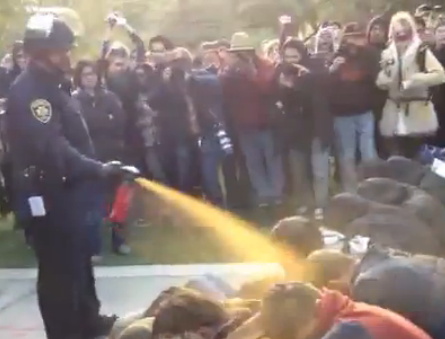
Students across the UC campus system are protesting in solidarity with the UC Davis students, all of whom are protesting yet another 9% hike in tuition/fees after a 32% hike in 2009 across the 10 campus university.  The image of a police officer emptying a canister of pepper spray directly into the faces of sitting students has caused quite a stir out here.

University of California President Mark G. Yudof today (Nov. 20) announced the actions he is taking in response to recent campus protest issues:

I am appalled by images of University of California students being doused with pepper spray and jabbed with police batons on our campuses.


I intend to do everything in my power as president of this university to protect the rights of our students, faculty and staff to engage in non-violent protest.


Chancellors at the UC Davis and UC Berkeley campuses already have initiated reviews of incidents that occurred on their campuses. I applaud this rapid response and eagerly await the results.


The University of California, however, is a single university with 10 campuses, and the incidents in recent days cry out for a systemwide response.


Therefore I will be taking immediate steps to set that response in motion.


I intend to convene all 10 chancellors, either in person or by telephone, to engage in a full and unfettered discussion about how to ensure proportional law enforcement response to non-violent protest.


To that end, I will be asking the chancellors to forward to me at once all relevant protocols and policies already in place on their individual campuses, as well as those that apply to the engagement of non-campus police agencies through mutual aid agreements.


Further, I already have taken steps to assemble experts and stakeholders to conduct a thorough, far-reaching and urgent assessment of campus police procedures involving use of force, including post-incident review processes.


My intention is not to micromanage our campus police forces. The sworn officers who serve on our campuses are professionals dedicated to the protection of the UC community.


Nor do I wish to micromanage the chancellors. They are the leaders of our campuses and they have my full trust and confidence.


Nonetheless, the recent incidents make clear the time has come to take strong action to recommit to the ideal of peaceful protest.
As I have said before, free speech is part of the DNA of this university, and non-violent protest has long been central to our history. It is a value we must protect with vigilance. I implore students who wish to demonstrate to do so in a peaceful and lawful fashion. I expect campus authorities to honor that right.