

 Brent Nyitray
 Fairlington Blade
 Let the mutherfuker burn!
 jnc4p
jnc4p Kevin S. Willis
 Michigoose
 lmsinca
 markinaustin
 Arcanaut
 novahockey
 quarterback
 ScottC
 yellojkt
This topic came up in a bit of back and forth recently, so I thought I’d hold forth and dodge a few soft tomatoes. Sauce!
There seem to be two sharp divisions between conservatives and liberals on taxation. The first of these is what kind of taxes people should pay. I have heard the refrain from conservative economists that taxes such as capital gains and estate taxes are the worst and consumption taxes are the best. I’m sure it’s pure coincidence that the wealthy pay the former taxes whereas lower wage earners are hit more heavily by the latter. I see this division as a philosophical one. I support taxing capital gains as ordinary income with indexing for inflation. Or perhaps a rate lowered by the inflation rate.
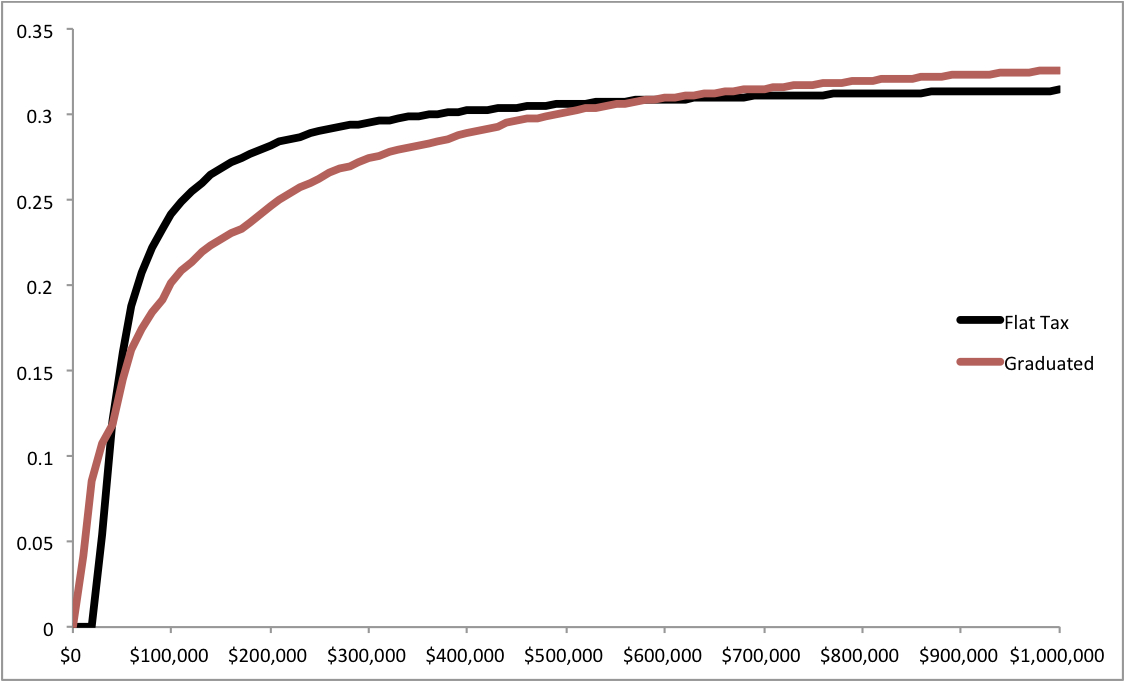
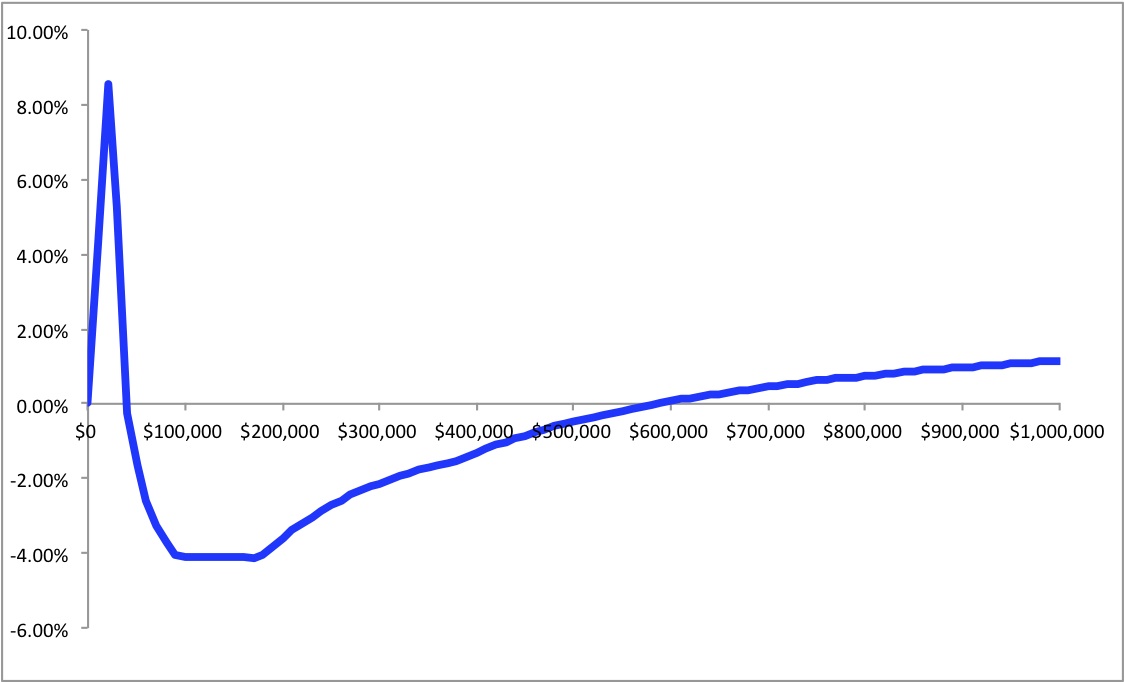
The flat tax vs. graduated rates is more interesting to me. As it has been proposed, the flat income tax is reasonably progressive due to the large personal exemption that is attached to it. But how do they compare? I took as a proposition to compare the current tax rates with a hypothetical flat tax. I put in a significant exemption for the flat tax and required it to raise roughly the same revenue as the current system. I even went to the census to get the income distribution. It’s a little tricky as 26% of households earn $100k or more and that wasn’t broken out. I assumed a gradually falling fraction from $100K upwards (using a Lorentzian distribution). It misses those earning $1M+, but I’ve heard enough times that this is a small fraction of the total. Anyway, this is a thought experiment, so my theoretical America has an income cap of $1M.
The requirements on my flat tax are that it has a $25K personal exemption and must raise the same amount as the current system. Turns out that you need a 32% rate. Here’s the plot of the two rates compared and the difference.

Filed under: Uncategorized |
 All Things in Moderation
Fairlington:One quick comment, and then more later (I have a meeting I have to go to).I have heard the refrain from conservative economists that taxes such as capital gains and estate taxes are the worst and consumption taxes are the best. I'm sure it's pure coincidence that the wealthy pay the former taxes whereas lower wage earners are hit more heavily by the latter.Even under a consumption tax, the wealthy (er…I think you mean high income earners) will pay vastly more taxes than lower income earners. They consume much more, and hence will pay more. It is just that, as a percentage of income, lower wage earners will pay a higher percentage of their income, because they necessarily consume more of their income than high income individuals.More on the flat tax later.
LikeLike
Scott – It's a good point, which admittedly "hit more heavier" fuzzily. In this particular case, I did mean wealthy though it is also true of higher earners. A wealthy individual is more than likely to earn money from investments and thus will be paying capital gains. Likewise, estate taxes clearly impact the wealthy. High earners might become wealthy (or crash and burn). With current exemptions of $1M+, we can both agree on whose ox is gored there.I favor a progressive tax system and so am not opposed to a flat tax with a significant exemption. For such a flat tax, the overall net tax rate is fairly flat from $100K on up. So, the main effect is to insure that everyone in the top quarter of income pays about the same rates. If one brought in indexed capital gains, I'd happily sign onto it.BB
LikeLike
"I see this division as a philosophical one. I support taxing capital gains as ordinary income with indexing for inflation. Or perhaps a rate lowered by the inflation rate."You'd have to have an exclusion for the sale of primary residences. If my income tax is 35% and then I sell my house and am taxed that rate on the profits, even though I'm turning around and buying another house . . . I'd have to make up that 35% difference (on the "profit") just to stay even. I don't think that would go over well.There is a certain inherent philosophical fairness in consumption taxes, and also controllability. If I have disposable income and don't want to buy something that is taxed at 10%, I don't have to. If I like to buy certain things and the consumption taxes go up, I can modulate my behavior. This is more difficult if, say, the property taxes on my house go up (especially if the increased property taxes make my house more difficult to sell). Of course, I support a progressive tax system, similar to the one we have now, though perhaps one that eases the burden on folks making less than $250k (and most likely to spend that extra cash in the local domestic economy) and increasing it in teeny-tiny increments up to incomes of $10m. With the increases being in the top marginal rate. Of course, I'd also want to see the growth of government spending reigned in. If you never have to tighten your belt, you never learn how to budget. True of people, companies, and government agencies….As I understand, the last time the capital gains rate was cut, the actual revenue from capital gains went up. If true, I'd be happy to see the capital gains tax cut a few more percentage points for a while, to see what happens.
LikeLike
Here is a flow chart from Cato via NRO and Veronique de Rugy attempting to illustrate multiple taxation of income. In general, it is right, but I think it is slightly inaccurate in several respects. The corporate income tax should precede capital gains tax, which also is not paid until the investor sells the stock.But it illustrates problems with the current system that conservatives and libertarians have criticized for many years, and that make Warren Buffett's claims of undertaxation, which we were discussing, dubious at best.
LikeLike
Kev, in the first years after CG rates were cut there have been sell-offs. In the second years after the cuts, activity went back to the previous equilibrium, more or less. Thus a CG cut predictably will generate a flurry of selling immediately thereafter, increasing revenue for one year.BB, I posted something similar in a week when I had some time. I agree with Kevin that primary residences would continue to require exclusion or special treatment. You probably do too.I do believe that we should move toward consumption and transaction taxes. It bears repeating that the sum of transactions is about two orders of magnitude higher than "incomes" and thus can be taxed at a rate about two orders of magnitude lower than "incomes" to be effective. When you consider transactions as well as ordinary consumption, you remove the "regressive" argument against sales taxes. NYSE on a busy day tops $100B in transactions.
LikeLike
Any opinions on Herman Cain's 9-9-9 proposal? Maybe I should ask if anyone has even heard anything about it first. The idea (without my having read any details) is a 9% rate for income, corporate, and sales taxes. It got some play here because of that straw poll thing Cain won recently.
LikeLike
9-9-9 sounds kind of arbitrary. Also, it would make states with high sales taxes very expensive to buy anything in. I'm sure a 9% income tax would eliminate deductions, meaning that there wouldn't be a significant reduction for 4-person households with a household income of $60k or less. It's a tax that would benefit the rich and very rich much more than the middle class and the working poor. But, given Perry's recent debate performance, Herman Cain is still looking pretty good.
LikeLike
Business income taxes are predicated on a different standard than personal income taxes. Businesses pay a % of net income; individuals pay a % of gross income [less politically popular deductions, not ordinary and necessary ones]. This is a hugely different tax base. 9-9-9 is an arbitrary talking point, like "buy a large and get a medium for free" [nod to Kevin].
LikeLike
Given the wide disparities, I'd be happy with the US going to a low rate of corporate taxation with a simple scheme. We get little enough money from the corporate tax anyway.BB
LikeLike
I don't see how 9-9-9 is any more arbitrary than 35% or any other proposals to make the corporate rate higher.
LikeLike