He’s Baaaackkk

I remember saying to someone, can’t remember who, that once the 2012 election drew closer that Obama would begin his renewed appeal to the base. After the trouncing over the debt limit deal and faltering polling numbers, he would return home again. Well, it’s begun. I’m hoping it’s because he believes his own populist rhetoric and it’s not just a slick campaign maneuver, but according to the headlines over the past week or so, he’s got his groove back. If this is too controversial, I’ll put up a food post tomorrow, unless FarilingtonBlade beats me to it. I’m testing the waters.

Obama throws class warfare charge back in Gops face

Greg Sargent:

This has to be the clearest sign yet that Obama has taken a very sharp populist turn as he seeks to frame the contrast between the parties heading into 2012. During his remarks this morning, Obama directly responded to Republicans accusing him of “class warfare,” but rather than simply deny the charge, he made the critical point that the act of protecting tax cuts for the rich is itself class warfare, in effect positioning himself as the defender of the middle class against GOP class warriors on behalf of the wealthy.

Obama’s veto threat

Matthew Yglesias:

The biggest news out of today’s deficit plan from President Obama probably isn’t the plan itself but an ancillary veto threat. We’ve long known that the White House favors higher taxes on the rich, and also that it’s willing to consider agreeing to some very right-wing notions about Medicare spending as part of a grand bargain to get it. Today, though, the president is clearly stating for the first time that he will veto any plan from the super committee or elsewhere that cuts Medicare benefits without raising taxes on the wealthy.

He’s not afraid

Steve Benen:

As for the substance, and the president’s call for tax fairness, it’s hard not to notice the president is playing a strong hand. Republicans believe the mere mention of “class warfare” is supposed to stop any and all conversation, but Obama is delivering a popular, sensible message that will very likely resonate with the American mainstream. What’s more, he’s sending a signal that he’s not afraid of GOP talking points on this.

Speaking of Political Animals, I still am one.

Rant Rant Rant: 2 Ways to Trim Medicare a Bit

Number 1:

I never understood why, in this day and age, a doctor writes a new prescription for 30 days. For example, about a third of the new meds MrJS is prescribed he takes for 7-10 days, finds they aren’t to his liking and stops taking them. Yes, in some cases takes longer for the meds to kick in, but frequently one can make an assessment in two weeks or less. The upshot is that Medicare Part D pays for 20-23 days of meds that won’t ever be used. For many of us it’s no biggie to get a 14-day trial scrip (when appropriate) and then have the doc call in a 30-day if the results are promising.

So I wonder how many Medicare Part D patients experience this and what it costs the taxpayer.

Number 2:

True story—A woman on Medicare eats bad take-out food and gets violently ill. At 3am she gives up being stoic and, on her doctor’s advice, heads to a local ER (not where her doctor works). She’s put on an IV drip, gets a jolt of anti-nausea meds and some morphine, and starts to feel better (who wouldn’t?). The nurses draw the requisite blood and urine samples and announce that the woman may have a UTI. Before the test results are even back, the hospital attempts to admit the woman for a UTI ‘with complications.’

Note that UTI’s are routinely treated with antibiotics and rarely require any hospital stay. Yes, if the patient doesn’t improve in 3-5 days the doc may want a follow-up visit, but hospitalizations at the outset are outlier events. Note also that the ‘complications’ have nothing to do with the UTI and appear to be responding well to treatment.

So how many women in this or a similar situation would go ahead and allow themselves to be unnecessarily admitted?

BTW, the above describes my life since I signed off last evening. And I’m at home.

Don’t get me wrong. I am glad Medicare exists. But wasteful stuff like this can’t be happening just to me.

Also, I promise to catch up on the other threads. I just needed to vent. Thanks everyone for carrying on so brilliantly.

Tax Rates Part Quatre (?)

Any serious discussion of top tax rates should start with understanding top rates around the world.

http://en.wikipedia.org/wiki/Tax_rates_of_Europe
http://en.wikipedia.org/wiki/Tax_rates_around_the_world

I began this conversation on our first day with the suggestion that corporate tax rates peaked too high [39%] and too early, dropping off above $350K taxable income.  It has continued at times that I could not comment because life, as it were, interfered.  My corporate tax argument was based on both the irrationality of taxing small biz at a higher marginal rate than big biz, and at taxing it at a higher rate than our trade partners would.

The same argument applies to the personal tax.  There is some point where personal wealth would flee to invest in another nation where taxation was not as burdensome.
However, no matter how low taxes are in Albania, it will not go there.  We have experienced capital flight, so we know it does happen and we know what we are up against.  On the tax front, we probably need to worry only about western Europe, Japan, Canada, and Australia right now, but the field will expand, as other nations are viewed as safe, with protective judicial processes and as friendly to investment. Russia and China are out, for now.

So we can set our top personal tax rate at the low middle of our most similar competitors without fear of capital flight.

TMW, that would be the extent of my conservative argument here.  I suggest the following to you:

If the rate is not prohibitive, if it does not force capital flight to another country, then the highest such rate will not affect employment or decision making in a negative way.

Why?

1]  The tax is on net income only and does not affect pricing.  Net income is maximized for a competitive business at the same competitive price with or without the tax, although after tax profit is reduced across the board.

2]  The reduction of profit across the board could lead to less investment in a future year.  Again, as long as the worldwide comparison is favorable to us, we get more than our share of the future investment.  I would revisit this aspect if investment in America was stronger than in our trading partners, but we were all suffering from a shortage of private capital, that is, if an inordinate % of net income was replowed into expansion and R&D rather than sitting relatively idle.

3]  Think of high marginal tax rates [say, 40%] as high contributions from government for deductible expenses.  In other words, each new employee I hire when I am in the forty percent bracket is only 60% paid by me; each new Sec. 179 asset I buy is only paid 60% by me, etc.

TMW, I ask you to think about these points absent the bathtub theory that we can starve big government by removing its revenue stream.  About the Norquist theory: obviously, if the idea is to shrink the federal government across the board, that is one way to do it, in theory.  It has not worked in practice for reasons you and I have agreed upon before.  Both of our political parties are Free Lunchers.  They each want to be known to the voters as having supplied something for nothing.

A better plan for reigning in costs is a renewed Gramm-Rudman-Hollings statute.  At least it is better than arguing for tax cuts and wars at the same time.  It is also better than a constitutional amendment because were we to become fiscally responsible we would be balancing over a business cycle, not in both great years and bad years.  As it stands we only reached balance and surplus recently at the culmination of a boom in the late 90s.  Rather than either tax cuts or spending increases, we could have simply reduced the ND, knowing we might have to increase it in a bust.

Look at the world info and think of tax rates in that competitive light.  I suspect that will be an interesting exercise for each of you, whether you share your conclusions or not.

See y’all again rather late tonight, I fear.

Monday Morning Tab Dump

Esquire profiles Jon Stewart: Jon Stewart and the Burden of History.

Jon Stewart isn’t always nice, and may have a personal agenda. Shocking.

Email Trail on Solyndra looks like the the faceless bureaucrats were doing their job, but their cautious concern was apparently ignored at the end of the day. I’m past the point where I can experience schadenfreude on “liberal” failures. This is bad, and it would have been better to put the money into boutique companies making expensive electric sports cars (wait, we have? Ruh roh.) than to pick a solar plant that many folks saw as doomed to fail from the outset.

Solar energy is something we should be pursuing and expanding. This sort of stuff is not helpful. But, according to VC Vinod Khosla, it’s to be expected, and progress will continue.

Finally, as we have discussed on more than one occasion the value of being civil, and trying to understand in our disagreements, rather than just argue, I point you to Kathryn Schulz TED Talk on Being Wrong:

She makes a point that seems simple, but is one we tend to lose sight of in the heat of debate. She asks, “What does it feel like to be wrong?” The answer being, of course, it feels exactly like being right. Anyway, I think it’s worth listening to.

Update: Something that combines John Stewart and Solyndra. Just sort of brings it all home. You go, Joe Biden!

UBS Story Doesn’t Make Sense

I don’t know if anyone is really paying attention to this UBS rogue trader story, but I think there is more to it than is currently being reported. The WSJ (no link, as it requires a subscription) is reporting that UBS says that the trader was operating on his own, and had created fictitious positions ostensibly covering his real positions, making him appear to be within position limits when in fact he was not. There are some things about this that don’t seem right to me.

Regarding the fictitious positions, UBS is apparently claiming that the trader booked false exchange-traded transactions to make it appear that he was within his liimits. This doesn’t makes sense at all, as such fake trades would be very difficult to hide. Exchange traded transactions generally require daily margin calls. This means that, each day, as the positions started to lose money, the exchange would have been calling for UBS to post daily cash/collateral as margin to cover the losses. But, from UBS’ side, if it thought that the positions were hedged by what it now knows to have been fictitious covering trades, it would have expected not to have to post much or even any margin at all. So how is it that UBS did not think something was amiss when the exchanges started calling for margin that UBS thought it didn’t owe?

I can think of only 3 reasons.

First, the front office trader was somehow in control of back office functions, allowing him to post margin that he knew he owed, while manipulating reports to make it appear that it wasn’t being posted. This is essentially what happened 15 years ago when Nick Leeson took down Barings Bank with unauthorized trading in Singapore. Allowing a single person to be engaged in both front office and back office functions is a major breach of control rules, a fact that ought to be obvious but was reinforced in the wake of the Leeson debacle with the introduction of many more regulations, as control issues were all the rage for several years following that event. Hence, I find it pretty much impossible to believe that any such thing is still going on at a place like UBS.

Another possibility is that the back office controllers at UBS were wholly incompetent. This is possible, but still highly unlikely. Each day the back office would have had to confirm with the exchange not only the amount of margin to be posted, but also the existing positions held there. This is one of the most basic functions performed by the back office. If false trades had been entered into UBS’s system, the daily checks would never have matched with the exchange. The level of incompetence needed to overlook this, and post margin on it despite the discrepancy, is too big to be plausible.

Lastly, the trader could have had assistance from someone in the back office helping him to cover up the fraud. This, to me, is the most plausible explanation. Control systems can never make fraud or unauthorized trading impossible. Some degree of trust in employees is necessary and inevitable. What they do is to make it difficult to engage in a prolonged fraud by spreading essential responsibilities across different people, making it impossible for a single person to maintain it. Hence, for this to have gone on for at least the 3 months they claim it was going on, I think he needed help.

UBS says that this trader was acting alone. I will be very surprised if this turns out to be true.

Monday Administrative Thread

I thought I would take the liberty of putting up at least a draft administrative thread because I want to mention a couple of things … administrative.

I am going to work on several posts and leave them in draft for a day or two (or longer) until they are ready to go. If you look at the drafts, you’ll see that I started one this morning, but it will take a little research to plug in some references and the like. It occurred to me over the weekend that starting and holding drafts that aren’t time sensitive might be a good practice for some of us to use so that we can percolate them and post them when there’s a need for some new content. I know some others have already been doing this a bit, so perhaps I’m just slow on the uptake, but there has been some discussion before of spacing out posts, and using draft status is a good way for us not only to work on items that we can’t knock out in a few minutes in one sitting but to have a little inventory of working items to drop in at the right time to keep things moving. Just a thought.

I don’t know whether others have been using labels, but I suggest we do start using them, creating new ones as needed and using labels others have already created when they fit. With a laissez-faire, collaborative blog, I suppose we might end up with label proliferation, but labels are good.

Also, I wonder whether anyone else has the same problem I have with the text editing window positioning itself so that about 3/4 of the editing buttons (font, ital, etc.) at the top is blocked by gray. Is this another IE7 thing? It’s very annoying, and I can’t even see what the two gray, rectangular buttons on the far left are. If I knew how to take a screen shot to show what my screen looks like, I would, but I am too inept. — QB

The Monday Morning Opening

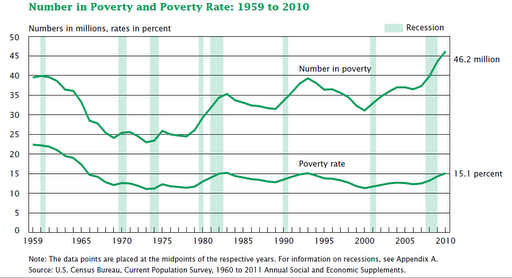
There were some interesting discussions of poverty in the US over the weekend and for some reason I thought it might be helpful to see the trajectory of poverty rates over the last 50 years. The chart also overlays the statistics over past recessions which I think is helpful. Content below is from EconMatters. (lmsinca)

By EconMatters

In yet another sign that the Great Recession cuts deep and long–the number of Americans living below the official poverty line reached 46.2 million, the highest in 52 years since the Census Bureau started tracking the figures in 1959.

The overall poverty rate also climbed to a 17-year high at 15.1%, which means 1 in 6 Americans are living below poverty line largely due to the high unemployment and underemployment rate. The official poverty line for 2010 is defined as an annual income of $22,314 for a family of four, and $11,139 for an individual.


Chart Source: The Census Bureau

The Census Bureau’s annual report released on Tuesday, Sept. 13 gives a very grim snapshot of American households in 2010. As the U.S. economy expanded 3% in 2010, and corporations reported good profits, the gains are not trickling down to workers. The median household income in 2010 dropped to $49,445, which is virtually unchanged from the level in 1997. Overall, household income has fallen by 6.4% since the recession began in December 2007. (Ok, who was the one declared that the recession “officially” ended in June 2009?)


Note from lmsinca

So we’re one week in and it has been interesting to say the least. The site is both stable and usable as a forum for discussions. We’ve attracted a great group of commenters and authors so far but I would suggest we need to at least double our list over the next couple of weeks to keep things interesting. There were some great posts with both controversial and non-controversial comments and even a few heated arguments……………welcome to blogging. We’ve already seen a few people leave or decide not to participate for various reasons, which I don’t find unusual in the least. We keep working, discussing and improving, building on success and learning from our mistakes. The more people take ownership of this space the more successful it will be. Are we having fun yet?

Welcome to week two.

(Posted Sunday night from the West Coast for East Coast early birds)